









stuffing في 30 ثانية
- Stuffing is the soft material used to fill pillows, cushions, and toys to give them shape.
- In cooking, it is a seasoned bread and herb mixture placed inside poultry or vegetables.
- The word is typically an uncountable noun and is central to holiday meal traditions.
- It can be used figuratively in idioms like 'knock the stuffing out of someone' to mean exhaustion.
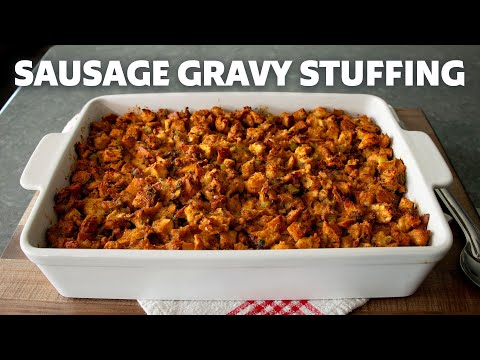
The word stuffing is a versatile noun that primarily occupies two distinct worlds: the culinary arts and the manufacturing of soft goods. In a kitchen context, stuffing refers to a flavorful mixture used to fill the cavity of an animal—most famously a turkey during Thanksgiving or Christmas—or to fill vegetables like bell peppers and mushrooms. This mixture usually consists of a base of breadcrumbs or cubed bread, combined with aromatics like onions and celery, herbs like sage and thyme, and often a liquid binder like broth or melted butter. The purpose is twofold: it absorbs the juices of the main ingredient while cooking, and it provides a satisfying, textured side dish that complements the protein. Beyond the kitchen, stuffing refers to the resilient materials—such as polyester fiberfill, foam, feathers, or even recycled cotton—that are packed into cushions, pillows, mattresses, and plush toys to give them shape, volume, and comfort. Without stuffing, your favorite teddy bear would be a limp piece of fabric, and your sofa would offer no support. People use this word most frequently during holiday seasons when discussing meal preparations or when describing the repair or quality of household furniture and children's playthings.
- Culinary Application
- The act of placing a seasoned bread mixture inside a bird or vegetable to enhance flavor and moisture during the roasting process.
The chef prepared a traditional sage and onion stuffing for the holiday bird.
- Industrial/Domestic Use
- Soft materials like cotton, wool, or synthetic fibers used to provide structure and softness to upholstered items and toys.
After years of use, the stuffing in the sofa cushions had become lumpy and needed replacement.
Understanding the context is vital because while the word is the same, the physical properties are vastly different. You would never want polyester in your turkey, nor would you want sage and onion breadcrumbs in your pillow. The word implies a sense of 'filling up' an empty space to create a more complete or functional whole. It is also used metaphorically in expressions to describe someone's physical or emotional state, such as when someone has had the 'stuffing knocked out of them,' meaning they have lost their energy or confidence. This breadth of usage makes it a staple of the English language, appearing in cookbooks, DIY manuals, and idiomatic speech alike.
The toy factory uses high-quality hypoallergenic stuffing for all its teddy bears.
I prefer my stuffing with plenty of chestnuts and a hint of orange zest.
The taxidermist carefully replaced the stuffing to make the exhibit look lifelike.
- Metaphorical Use
- Refers to a person's inner strength, resilience, or vitality.
Using 'stuffing' correctly requires an understanding of its role as a noun that describes a substance. Because it is often an uncountable noun, it typically does not take a plural form when referring to the general material. For instance, you would say 'There is too much stuffing in this pillow,' rather than 'too many stuffings.' However, in culinary contexts where you are comparing different recipes or types, the plural 'stuffings' is acceptable. When constructing sentences, it often follows verbs like 'add,' 'remove,' 'replace,' or 'prepare.' In the kitchen, you 'prepare the stuffing,' while in a repair shop, you might 'replace the stuffing.' It is also frequently modified by adjectives that describe its composition, such as 'bread-based stuffing,' 'polyester stuffing,' or 'firm stuffing.' Paying attention to these modifiers helps the listener or reader immediately identify which of the two primary meanings you are employing.
- As a Direct Object
- The noun receives the action of the verb, often related to preparation or physical manipulation.
Could you help me push the stuffing back into this ripped teddy bear?
- In Prepositional Phrases
- Used to describe the contents or characteristics of an object.
The turkey with the chestnut stuffing was the highlight of the meal.
In more formal or technical writing, such as a furniture manufacturing report, you might see 'stuffing' replaced by more specific terms like 'padding' or 'upholstery filler.' However, in everyday conversation, 'stuffing' remains the most natural choice. When describing food, it is often the subject of the sentence when discussing its flavor profile or texture. For example, 'The stuffing was a bit too dry this year' focuses on the quality of the dish. In creative writing, the word can be used to evoke a sense of domesticity or even a slightly grotesque image if referring to taxidermy. The key to mastery is ensuring the surrounding adjectives and verbs provide enough context to distinguish between a delicious side dish and the innards of a cushion.
We need to buy more stuffing if we want to finish making these decorative pillows.
Her grandmother's secret stuffing recipe includes diced apples and spicy sausage.
The old armchair was leaking stuffing from a hole in the armrest.
- As a Compound Noun
- Often paired with other nouns to create specific terms like 'stuffing mix' or 'stuffing material.'
You will encounter the word 'stuffing' in several specific real-world environments. The most common is undoubtedly the domestic kitchen or during televised cooking segments. During the months of November and December in North America and the United Kingdom, the word is ubiquitous in grocery store aisles, where 'stuffing mix' is sold in boxes, and in food magazines featuring the 'ultimate stuffing recipe.' It is a central topic of conversation during holiday meal planning, where families debate the merits of adding oysters, cranberries, or walnuts to the mix. In these contexts, the word carries a warm, nostalgic connotation associated with family gatherings and tradition. You will also hear it in the context of hobbies and crafts, specifically among those who enjoy sewing, quilting, or making 'amigurumi' (crocheted stuffed animals). Craft stores like Michaels or Hobby Lobby have entire sections dedicated to bags of 'poly-fill stuffing.'
- Culinary Media
- Cooking shows, recipe blogs, and holiday advertisements frequently highlight various stuffing techniques.
On the cooking channel, the host explained how to achieve the perfect crispy top on your stuffing.
- Retail and Manufacturing
- Furniture stores and toy manufacturers use the term to describe the internal components of their products.
The product description noted that the pillow featured eco-friendly bamboo stuffing.
Another interesting place you might hear this word is in a museum or a taxidermy shop. While perhaps less common for the average person, the 'stuffing' of animal skins is the foundational process of taxidermy, though modern professionals often use the term 'mounting' or 'forms.' Nevertheless, the public still widely refers to these as 'stuffed animals,' and the material inside is the stuffing. In sports and competitive environments, the idiom 'to knock the stuffing out of someone' is frequently used by commentators to describe a powerful hit in boxing or a decisive victory in a team sport. This usage highlights the word's ability to represent the 'core' or 'substance' of a person. Whether you are at a dinner table, a craft store, or watching a football game, 'stuffing' is a word that bridges the gap between the literal and the figurative.
The local craft fair had a booth where children could choose the stuffing for their own handmade dolls.
The sports announcer shouted that the heavy tackle had really knocked the stuffing out of the quarterback.
I need to find a way to clean the stuffing inside this vintage cushion without ruining it.
- Idiomatic Speech
- Commonly used in phrases to describe exhaustion or defeat.
One of the most frequent mistakes learners make with 'stuffing' is confusing it with the verb form 'stuffing.' While they share the same spelling, their grammatical roles are different. For example, in the sentence 'I am stuffing the turkey,' 'stuffing' is a verb indicating an action. In 'The stuffing is delicious,' it is a noun referring to the food itself. Another common error involves countability. As mentioned previously, stuffing is usually uncountable. Saying 'I bought three stuffings' is grammatically incorrect unless you specifically mean three different *types* or *packages* of stuffing. Usually, you should say 'three bags of stuffing' or 'three types of stuffing.' This is a subtle distinction that often trips up non-native speakers who are used to nouns being either strictly countable or uncountable.
- Noun vs. Verb Confusion
- Mistaking the substance for the action of putting something into a container.
Incorrect: He is making a stuffing the toy. Correct: He is stuffing the toy with stuffing.
- Improper Pluralization
- Using 'stuffings' to refer to a large quantity of the same material.
Incorrect: The floor was covered in stuffings from the pillow. Correct: The floor was covered in stuffing.
Additionally, learners sometimes confuse 'stuffing' with 'filling.' While they are synonyms in many contexts, 'filling' is more general. You have 'pie filling' or 'tooth filling,' but you would never call these 'stuffing.' 'Stuffing' implies a more packed, textured material, often used to give shape or volume, whereas 'filling' can be liquid, gel, or solid. Another mistake is using 'stuffing' when 'ingredients' would be more appropriate. For example, 'The stuffing of this cake is chocolate' is incorrect; you should say 'The filling of this cake' or 'The ingredients in this cake.' Finally, avoid using 'stuffing' as a synonym for 'things' or 'stuff' in a formal context. While 'stuff' is a very common informal word for 'items,' 'stuffing' is a specific noun and cannot be used to mean 'a collection of miscellaneous objects.'
Incorrect: I need to put all my stuffing in the suitcase. Correct: I need to put all my stuff in the suitcase.
Incorrect: The stuffing of the donut was jam. Correct: The filling of the donut was jam.
Incorrect: I love the stuffing you used in this sandwich. Correct: I love the filling you used in this sandwich.
- Contextual Misuse
- Using 'stuffing' for items that are better described as 'filling' or 'contents.'
To expand your vocabulary, it is helpful to look at words that are similar to 'stuffing' but have different nuances. 'Filling' is the most common alternative. While 'stuffing' often implies a material that provides structure or is cooked inside something else, 'filling' is a broader term used for anything that occupies an empty space, from the cream in a pastry to the gold in a tooth. In the culinary world, 'dressing' is the most significant synonym. In many parts of the United States, 'dressing' is used interchangeably with 'stuffing,' though purists argue that 'stuffing' is cooked inside the bird and 'dressing' is cooked in a separate dish. Another culinary term is 'forcemeat,' which is a more technical, French-derived word for a mixture of ground meat, fat, and seasonings used to fill various dishes. This is common in high-end gastronomy and charcuterie.
- Stuffing vs. Filling
- Stuffing is usually textured and structural; filling can be any substance, including liquids or pastes.
While the stuffing in the pillow was firm, the filling in the pie was quite runny.
- Stuffing vs. Padding
- Padding is specifically designed to provide a soft surface or protection, whereas stuffing fills a three-dimensional volume.
The box needed extra padding to protect the glass, but the teddy bear just needed more stuffing.
In the context of furniture and crafts, 'padding' and 'wadding' are excellent alternatives. 'Padding' suggests a layer of material added to make something softer or to protect it, like the padding on a chair arm. 'Wadding' (or 'batting' in American English) refers to sheets of cotton or wool used in quilts or to line garments. For a more formal or scientific tone, you might use 'filler.' This is a neutral term for any material used to increase the bulk of something or to fill a gap, such as 'wood filler' used to repair a hole in a table. In a metaphorical sense, if you want to avoid the idiom 'knock the stuffing out of,' you could use 'demoralize,' 'exhaust,' or 'defeat.' Choosing the right word depends entirely on whether you are in a kitchen, a factory, or a casual conversation.
The artisan used a high-density foam filler to ensure the chair remained comfortable for years.
Some people prefer cornbread dressing over traditional white bread stuffing.
The forcemeat used in the pâté was seasoned with truffles and cognac.
- Stuffing vs. Wadding
- Wadding is usually in sheet form, while stuffing is loose and bulkier.
How Formal Is It?
حقيقة ممتعة
The culinary use of 'stuffing' was first recorded in the 1530s. Before that, the mixture was often called 'farce,' a term still used in French today.
دليل النطق
- Pronouncing the 'g' at the end too harshly.
- Confusing the 'u' sound with an 'oo' sound.
- Stressing the second syllable.
- Failing to blend the 'st' at the beginning.
- Making the 'i' sound too long like an 'ee'.
مستوى الصعوبة
Easy to recognize in context, though technical uses can be harder.
Learners must remember it is usually uncountable.
Common word, easy to pronounce once the 'ng' is mastered.
Clearly audible, though can be confused with the verb form.
ماذا تتعلّم بعد ذلك
المتطلبات الأساسية
تعلّم لاحقاً
متقدم
قواعد يجب معرفتها
Uncountable Nouns
We use 'some stuffing' or 'much stuffing' rather than 'a stuffing' or 'many stuffings'.
Gerunds as Nouns
In the phrase 'The stuffing of the toy,' 'stuffing' acts as a noun derived from a verb.
Compound Nouns
Stuffing often combines with other nouns (e.g., 'stuffing mix') to create a new specific meaning.
Adjective Placement
Adjectives like 'savory' or 'fluffy' usually come before 'stuffing'.
Prepositional Phrases
We often use 'with' or 'of' (e.g., 'filled with stuffing', 'bag of stuffing').
أمثلة حسب المستوى
The teddy bear has soft stuffing inside.
Le nounours a un rembourrage doux à l'intérieur.
Stuffing is used here as an uncountable noun.
I like the stuffing in the chicken.
J'aime la farce dans le poulet.
Refers to food.
The pillow needs more stuffing.
L'oreiller a besoin de plus de rembourrage.
Used with 'more' to show quantity.
Is there stuffing in this toy?
Y a-t-il du rembourrage dans ce jouet ?
Question form using 'is there'.
The stuffing is white and fluffy.
Le rembourrage est blanc et duveteux.
Describing the noun with adjectives.
We eat stuffing at Christmas.
Nous mangeons de la farce à Noël.
General statement about a tradition.
Don't pull the stuffing out!
Ne retire pas le rembourrage !
Imperative sentence.
This stuffing tastes like herbs.
Cette farce a un goût d'herbes.
Linking verb 'tastes' used with the noun.
My grandmother makes the best bread stuffing.
Ma grand-mère fait la meilleure farce au pain.
Compound noun: bread stuffing.
The stuffing is coming out of the old chair.
Le rembourrage sort de la vieille chaise.
Present continuous verb 'is coming' with the noun subject.
You can buy stuffing at the supermarket.
On peut acheter de la farce au supermarché.
Modal verb 'can' used for possibility.
This cushion has very firm stuffing.
Ce coussin a un rembourrage très ferme.
Adjective 'firm' modifying the noun.
We need a bag of stuffing for the project.
Nous avons besoin d'un sac de rembourrage pour le projet.
Partitive phrase: 'a bag of'.
The recipe says to add onions to the stuffing.
La recette dit d'ajouter des oignons à la farce.
Infinitive 'to add' followed by the prepositional phrase.
The toy is soft because of the stuffing.
Le jouet est doux à cause du rembourrage.
Using 'because of' to show reason.
Do you prefer stuffing with or without meat?
Préfères-tu la farce avec ou sans viande ?
Choice question using 'prefer'.
The long hike really knocked the stuffing out of me.
La longue randonnée m'a vraiment épuisé.
Idiomatic use meaning 'to exhaust'.
She used recycled cotton as stuffing for the dolls.
Elle a utilisé du coton recyclé comme rembourrage pour les poupées.
Using 'as' to show function.
Sage and onion is a classic combination for stuffing.
La sauge et l'oignon sont une combinaison classique pour la farce.
Identifying a specific type of stuffing.
The stuffing in the sofa has shifted over time.
Le rembourrage du canapé s'est déplacé avec le temps.
Present perfect tense 'has shifted'.
I bought some extra stuffing to make the pillows fluffier.
J'ai acheté du rembourrage supplémentaire pour rendre les oreillers plus moelleux.
Comparative adjective 'fluffier' in the purpose clause.
Is the stuffing cooked inside or outside the bird?
La farce est-elle cuite à l'intérieur ou à l'extérieur de la volaille ?
Passive voice 'is... cooked'.
The cat managed to pull all the stuffing out of the cushion.
Le chat a réussi à retirer tout le rembourrage du coussin.
Verb 'managed to' followed by the action.
This brand of stuffing is too salty for my taste.
Cette marque de farce est trop salée à mon goût.
Using 'too' for negative excess.
The quality of the stuffing determines how long the mattress will last.
La qualité du rembourrage détermine la durée de vie du matelas.
Subject-verb agreement: 'quality... determines'.
He felt a bit deflated, as if someone had knocked the stuffing out of him.
Il se sentait un peu dégonflé, comme si quelqu'un l'avait vidé de son énergie.
Simile using 'as if' and the idiom.
The taxidermist used a specialized stuffing to maintain the animal's shape.
Le taxidermiste a utilisé un rembourrage spécialisé pour maintenir la forme de l'animal.
Past tense with an infinitive of purpose.
Many modern stuffings are made from hypoallergenic synthetic fibers.
De nombreux rembourrages modernes sont fabriqués à partir de fibres synthétiques hypoallergéniques.
Plural 'stuffings' used here to mean different types.
The chef experimented with a savory mushroom and walnut stuffing.
Le chef a expérimenté une farce savoureuse aux champignons et aux noix.
Complex adjective phrase 'savory mushroom and walnut'.
Without proper stuffing, the upholstery will quickly lose its form.
Sans un rembourrage approprié, la tapisserie perdra rapidement sa forme.
Prepositional phrase 'Without proper stuffing' showing condition.
The stuffing process for these toys is now fully automated.
Le processus de rembourrage de ces jouets est désormais entièrement automatisé.
Using 'stuffing' as a gerund/noun in a compound subject.
She prefers the texture of cornbread stuffing over the traditional variety.
Elle préfère la texture de la farce au pain de maïs à la variété traditionnelle.
Comparison using 'over'.
The critique of his debut novel really knocked the stuffing out of his confidence.
La critique de son premier roman a vraiment sapé sa confiance.
Abstract application of the idiom.
The artisan insisted on using organic wool stuffing for all her bespoke furniture.
L'artisan insistait pour utiliser du rembourrage en laine biologique pour tous ses meubles sur mesure.
Subjunctive-like structure with 'insisted on using'.
Traditional forcemeat is often more complex than the simple stuffing found in home kitchens.
La farce traditionnelle est souvent plus complexe que la simple farce que l'on trouve dans les cuisines familiales.
Comparative structure comparing two technical terms.
The stuffing of the ballot box was a clear indication of electoral fraud.
Le bourrage des urnes était une indication claire de fraude électorale.
Metaphorical/Political use of 'stuffing' as an action-noun.
Over time, the natural down stuffing in the duvet tends to clump together.
Avec le temps, le rembourrage en duvet naturel de la couette a tendance à s'agglutiner.
Present simple for a general truth.
The museum's restoration team had to carefully replace the degraded stuffing in the 18th-century settee.
L'équipe de restauration du musée a dû remplacer avec précaution le rembourrage dégradé du canapé du XVIIIe siècle.
Complex sentence with historical context.
Her recipe for oyster stuffing is a closely guarded family secret.
Sa recette de farce aux huîtres est un secret de famille jalousement gardé.
Passive construction 'closely guarded'.
The industrial stuffing machine can process thousands of units per hour.
La machine de rembourrage industrielle peut traiter des milliers d'unités par heure.
Compound noun 'industrial stuffing machine'.
The pervasive sense of defeat seemed to have knocked the stuffing out of the entire community.
Le sentiment d'échec omniprésent semblait avoir vidé toute la communauté de sa substance.
Using the idiom to describe a collective emotional state.
In the realm of high upholstery, the choice between horsehair and coconut fiber stuffing is a matter of significant debate.
Dans le domaine de la haute tapisserie, le choix entre le rembourrage en crin de cheval et en fibre de coco fait l'objet d'un débat important.
Formal register with specialized vocabulary.
The author uses the leaking stuffing of the protagonist's childhood bear as a poignant motif for his crumbling mental state.
L'auteur utilise le rembourrage qui s'échappe de l'ours d'enfance du protagoniste comme un motif poignant de son état mental qui s'effondre.
Literary analysis using 'stuffing' as a symbolic device.
The sheer density of the stuffing rendered the cushion almost as hard as a rock.
La densité même du rembourrage rendait le coussin presque aussi dur qu'une pierre.
Resultative construction 'rendered... hard'.
The historical transition from straw stuffing to spring-based systems revolutionized furniture design.
La transition historique du rembourrage en paille aux systèmes à ressorts a révolutionné la conception des meubles.
Noun phrase as a subject in a historical context.
The chef's deconstructed stuffing featured toasted brioche crumbs and a reduction of wild poultry jus.
La farce déconstruite du chef comprenait des miettes de brioche grillées et une réduction de jus de volaille sauvage.
Sophisticated culinary description.
Electoral observers noted several instances of ballot stuffing in the rural districts.
Les observateurs électoraux ont noté plusieurs cas de bourrage d'urnes dans les districts ruraux.
Technical political term 'ballot stuffing'.
The meticulous stuffing of the specimen required an expert knowledge of anatomy and aesthetics.
Le rembourrage méticuleux du spécimen nécessitait une connaissance experte de l'anatomie et de l'esthétique.
Gerund-noun 'stuffing' in a formal scientific context.
تلازمات شائعة
العبارات الشائعة
— A pre-packaged mixture of dried bread and herbs sold in stores.
I bought a box of stuffing for the dinner party.
— Stuffing prepared from scratch rather than from a pre-made mix.
Nothing beats the taste of homemade stuffing.
— A somewhat redundant but common way to describe a toy or bird that is full.
The bear was stuffed with soft white stuffing.
— Stuffing that has formed uncomfortable or unappealing clumps.
The old pillow had lumpy stuffing that made it hard to sleep.
— A specific type of stuffing that includes roasted chestnuts.
Chestnut stuffing is very popular during the winter holidays.
— A variation of stuffing made using crumbled cornbread.
Cornbread stuffing is a staple of Southern cooking.
— Man-made materials used as filler, as opposed to natural ones like down.
The jacket uses synthetic stuffing for insulation.
— Stuffing material that is not contained or has spilled out.
There was loose stuffing all over the floor after the dog bit the toy.
— Stuffing that has a salty or spicy flavor rather than a sweet one.
I love a savory stuffing with plenty of garlic.
— Stuffing that provides a lot of support and does not compress easily.
The orthopedic pillow has very firm stuffing.
يُخلط عادةً مع
Stuff is a general word for 'things,' while stuffing is a specific material used for filling.
Filling is more general; stuffing is usually textured or structural.
Padding is for protection or surface softness; stuffing fills a volume.
تعبيرات اصطلاحية
— To make someone feel very tired, weak, or to destroy their confidence.
The long climb really knocked the stuffing out of me.
informal— To eat a large amount of food very quickly (note: 'stuffing' here is a verb).
He spent the whole afternoon stuffing his face with pizza.
informal/slang— Something that is completely worthless or of very low quality.
That old car isn't worth the stuffing in its seats.
informal— The act of submitting multiple fraudulent votes in an election.
The international observers were concerned about ballot stuffing.
formal/political— To be soundly defeated in a game or competition (mainly British).
Our team got a real stuffing in the finals.
informal/slang— A technical term for a seal that prevents leakage around a moving part.
The engineer checked the stuffing-box for any signs of wear.
technical— To be extremely full after eating too much.
After that five-course meal, I feel like a stuffed pig.
informal— Adding unnecessary or fraudulent charges to an invoice.
The contractor was accused of stuffing the bill with fake expenses.
informal/business— A business practice of sending more products to retailers than they can sell.
The company was investigated for stuffing the channel to inflate sales figures.
business— To hit someone very hard or to defeat them decisively.
The champion beat the stuffing out of the challenger in the third round.
informalسهل الخلط
Both come from the same root.
Stuffed is an adjective (the state), while stuffing is the noun (the material).
The stuffed bear is full of stuffing.
They refer to the same food.
Dressing is often cooked outside the bird; stuffing is cooked inside (regional variation).
In the South, we call it dressing.
Both are culinary fillings.
Forcemeat is a technical term involving ground meat and fat; stuffing is usually bread-based.
The chef prepared a pork forcemeat.
Both are used for filling.
Wadding is usually in sheets; stuffing is loose.
Use wadding for the quilt and stuffing for the toy.
It is a type of stuffing.
Fiberfill is the specific synthetic material; stuffing is the general name for the filler.
This stuffing is made of 100% fiberfill.
أنماط الجُمل
The [object] has [adjective] stuffing.
The bear has soft stuffing.
I like [type] stuffing.
I like bread stuffing.
The [noun] is filled with [adjective] stuffing.
The cushion is filled with foam stuffing.
It really knocked the stuffing out of [person].
It really knocked the stuffing out of him.
The [process] of [noun] stuffing requires [noun].
The process of ballot stuffing requires coordination.
The [adjective] stuffing served as a [metaphor].
The leaking stuffing served as a metaphor for his failure.
We need to [verb] the stuffing.
We need to replace the stuffing.
Is there any [noun] in the stuffing?
Is there any onion in the stuffing?
عائلة الكلمة
الأسماء
الأفعال
الصفات
مرتبط
كيفية الاستخدام
Common, especially in culinary and domestic contexts.
-
I have many stuffings in my bag.
→
I have a lot of stuffing in my bag.
Stuffing is uncountable when referring to the material.
-
The stuffing of the pie was apple.
→
The filling of the pie was apple.
Stuffing is for textured/structural items; filling is for pastries.
-
He is making a stuffing the turkey.
→
He is stuffing the turkey.
Do not use 'a' before the verb form of stuffing.
-
The teddy bear's stuffing is coming out.
→
The teddy bear's stuffing is coming out.
This is actually correct, but people often confuse it with 'stuff'.
-
I like the stuffings you made.
→
I like the stuffing you made.
Even if you made a lot, it's still usually singular.
نصائح
Uncountable Rule
Treat stuffing as an uncountable noun in 95% of cases. Use 'much' or 'some' instead of 'many' or 'a'.
Dressing vs. Stuffing
If you are in the Southern US, use 'dressing' to sound more like a local, especially during Thanksgiving.
Confidence and Energy
Use 'knock the stuffing out of' when you want to describe someone who has lost their 'spark' or energy.
Safety First
When using the word in a culinary context, remember that 'stuffing' must reach a safe internal temperature to prevent food poisoning.
Poly-fill
In craft stores, look for 'poly-fill' if you are searching for the most common type of toy stuffing.
Avoid Redundancy
Instead of saying 'The stuffing inside the pillow,' you can just say 'The pillow's stuffing' or 'The stuffing in the pillow.'
The 'NG' Sound
Ensure the 'ng' is a nasal sound. Do not pronounce a hard 'G' at the end of 'stuffing'.
Check the Object
If the object is a bird or vegetable, 'stuffing' is food. If it's a toy or furniture, it's material.
Inner Core
Think of stuffing as the 'inner core' of an object. This helps you understand why the idiom about knocking it out means losing confidence.
Use 'Filling' for Pastries
Don't use 'stuffing' for donuts or pies; use 'filling' instead.
احفظها
وسيلة تذكّر
Think of 'Stuffing' as the 'Stuff' that goes 'In'. The 'ing' makes it the specific material used for that purpose.
ربط بصري
Imagine a giant turkey being filled with bread cubes, and then imagine a teddy bear being filled with the same bread cubes (to remember it's the material inside).
Word Web
تحدٍّ
Try to use the word 'stuffing' in three different ways today: once for food, once for an object, and once in an idiom.
أصل الكلمة
The word 'stuffing' comes from the verb 'stuff,' which originated in the early 14th century. It is derived from the Old French word 'estoffer,' meaning to equip, furnish, or provide. This, in turn, likely came from the Old High German 'stopfōn,' meaning to plug or stop up.
المعنى الأصلي: The original meaning was related to providing equipment or materials needed for a specific purpose.
Germanic/Romance hybrid (Old High German to Old French to Middle English).السياق الثقافي
No major sensitivities, though vegetarians will often ask if the stuffing was cooked inside a meat product.
The word is a staple of holiday vocabulary and is often associated with grandmother's cooking.
تدرّب في الحياة الواقعية
سياقات واقعية
Cooking a Holiday Meal
- prepare the stuffing
- stuffing mix
- sage and onion stuffing
- cook the stuffing separately
Crafting and Hobbies
- bag of stuffing
- polyester stuffing
- add more stuffing
- soft stuffing
Furniture Repair
- replace the stuffing
- lumpy stuffing
- foam stuffing
- upholstery stuffing
Sports and Competition
- knock the stuffing out of
- get a stuffing
- a real stuffing
- beat the stuffing out of
Politics and Law
- ballot stuffing
- stuffing the box
- allegations of stuffing
- prevent stuffing
بدايات محادثة
"Do you prefer your stuffing cooked inside the turkey or in a separate dish?"
"What is the most unusual ingredient you have ever added to a stuffing recipe?"
"Have you ever had to repair a toy and replace its stuffing?"
"Does your family have a secret stuffing recipe that has been passed down?"
"What kind of stuffing do you think makes for the most comfortable pillow?"
مواضيع للكتابة اليومية
Describe your favorite holiday meal and the role that stuffing plays in it.
Write about a time when a difficult situation 'knocked the stuffing out of you' and how you recovered.
If you were making a personalized stuffed animal, what kind of stuffing would you use and why?
Discuss the pros and cons of using natural vs. synthetic stuffing in household items.
Reflect on why certain foods, like stuffing, are so strongly tied to specific memories and traditions.
الأسئلة الشائعة
10 أسئلةStuffing is primarily an uncountable noun. You would say 'some stuffing' or 'a lot of stuffing.' However, you can use the plural 'stuffings' when referring to different varieties or types of stuffing, such as 'The restaurant offers three different stuffings for their poultry.'
In many contexts, they are the same thing. However, traditionally, 'stuffing' is the mixture cooked inside the cavity of a bird, while 'dressing' is the same mixture cooked in a separate pan. This distinction is particularly common in the United States, where 'dressing' is the preferred term in the South.
No, that is a common mistake. You should use the word 'stuff' for a collection of miscellaneous items. 'Stuffing' only refers to the material used to fill something, like the inside of a pillow or a turkey.
Ballot stuffing is a form of electoral fraud where one person or group submits multiple votes illegally to influence the outcome of an election. The term comes from the idea of 'filling' the ballot box with more papers than there are actual voters.
This is an idiom that means to make someone feel very tired, weak, or to severely damage their confidence. It likens a person to a stuffed toy; if you knock the stuffing out, the toy becomes limp and loses its shape. For example, 'The bad news really knocked the stuffing out of her.'
Most traditional stuffings start with a base of dried bread cubes or breadcrumbs. This is combined with aromatics like sautéed onions and celery, herbs such as sage, thyme, and rosemary, and a liquid like chicken or vegetable broth to bind it all together.
Yes, 'stuffing' is the present participle of the verb 'to stuff.' For example, 'I am stuffing the cushions.' However, it is also a noun. You have to look at the sentence structure to know which one is being used.
The 'best' stuffing depends on personal preference. Common materials include polyester fiberfill (cheap and hypoallergenic), down and feathers (soft and luxurious), memory foam (supportive), or even natural materials like buckwheat hulls or wool.
Yes, 'stuffing' is the term used for the mixture placed inside vegetables like bell peppers, zucchini, or mushrooms. For example, 'I made a delicious rice and cheese stuffing for the peppers.'
It is a neutral word. It is perfectly acceptable in everyday conversation and in most writing. However, in very technical or academic contexts, you might see more specific terms like 'upholstery filler' or 'gastronomic filling.'
اختبر نفسك 190 أسئلة
Describe the stuffing in your favorite pillow.
Well written! Good try! Check the sample answer below.
Write a sentence using the idiom 'knock the stuffing out of'.
Well written! Good try! Check the sample answer below.
Explain the difference between stuffing and dressing.
Well written! Good try! Check the sample answer below.
What ingredients would you put in a gourmet stuffing?
Well written! Good try! Check the sample answer below.
Write a short story about a toy that lost its stuffing.
Well written! Good try! Check the sample answer below.
How does stuffing affect the texture of a roasted chicken?
Well written! Good try! Check the sample answer below.
Discuss the ethical implications of ballot stuffing.
Well written! Good try! Check the sample answer below.
Compare synthetic and natural stuffing for furniture.
Well written! Good try! Check the sample answer below.
Describe the process of making homemade stuffing.
Well written! Good try! Check the sample answer below.
Why is stuffing considered a 'comfort food'?
Well written! Good try! Check the sample answer below.
Write a product description for a high-quality cushion.
Well written! Good try! Check the sample answer below.
What would happen if you used the wrong kind of stuffing in a toy?
Well written! Good try! Check the sample answer below.
Describe a time you felt like the stuffing was knocked out of you.
Well written! Good try! Check the sample answer below.
How has stuffing technology changed in the furniture industry?
Well written! Good try! Check the sample answer below.
Write a dialogue between two people debating stuffing recipes.
Well written! Good try! Check the sample answer below.
Explain the metaphorical use of 'stuffing' in literature.
Well written! Good try! Check the sample answer below.
What are the risks of 'stuffing the channel' in business?
Well written! Good try! Check the sample answer below.
Describe the smell of fresh stuffing cooking in the oven.
Well written! Good try! Check the sample answer below.
How do you fix a pillow with lumpy stuffing?
Well written! Good try! Check the sample answer below.
Why is 'stuffing' an uncountable noun?
Well written! Good try! Check the sample answer below.
Pronounce 'stuffing' clearly. Focus on the 'ng' sound.
Read this aloud:
قلت:
Speech recognition is not supported in your browser. Try Chrome or Edge.
Tell a partner about your favorite type of stuffing.
Read this aloud:
قلت:
Speech recognition is not supported in your browser. Try Chrome or Edge.
Explain the idiom 'knock the stuffing out of' to a friend.
Read this aloud:
قلت:
Speech recognition is not supported in your browser. Try Chrome or Edge.
Describe how to make a pillow more comfortable.
Read this aloud:
قلت:
Speech recognition is not supported in your browser. Try Chrome or Edge.
Discuss the regional differences in stuffing names.
Read this aloud:
قلت:
Speech recognition is not supported in your browser. Try Chrome or Edge.
Roleplay a customer complaining about a lumpy pillow.
Read this aloud:
قلت:
Speech recognition is not supported in your browser. Try Chrome or Edge.
Give a short presentation on holiday food traditions.
Read this aloud:
قلت:
Speech recognition is not supported in your browser. Try Chrome or Edge.
Argue for or against using synthetic stuffing in toys.
Read this aloud:
قلت:
Speech recognition is not supported in your browser. Try Chrome or Edge.
Describe the texture of a well-made stuffing.
Read this aloud:
قلت:
Speech recognition is not supported in your browser. Try Chrome or Edge.
Talk about a time you were exhausted using the word 'stuffing'.
Read this aloud:
قلت:
Speech recognition is not supported in your browser. Try Chrome or Edge.
Explain why ballot stuffing is a threat to democracy.
Read this aloud:
قلت:
Speech recognition is not supported in your browser. Try Chrome or Edge.
Describe the smell of sage and onion stuffing.
Read this aloud:
قلت:
Speech recognition is not supported in your browser. Try Chrome or Edge.
Tell a story about a dog and a stuffed toy.
Read this aloud:
قلت:
Speech recognition is not supported in your browser. Try Chrome or Edge.
Discuss the use of stuffing in professional taxidermy.
Read this aloud:
قلت:
Speech recognition is not supported in your browser. Try Chrome or Edge.
Explain the phrase 'stuffing your face' in a casual setting.
Read this aloud:
قلت:
Speech recognition is not supported in your browser. Try Chrome or Edge.
Describe the different materials used for stuffing furniture.
Read this aloud:
قلت:
Speech recognition is not supported in your browser. Try Chrome or Edge.
Talk about your favorite childhood stuffed animal.
Read this aloud:
قلت:
Speech recognition is not supported in your browser. Try Chrome or Edge.
Discuss the importance of food safety when cooking stuffing.
Read this aloud:
قلت:
Speech recognition is not supported in your browser. Try Chrome or Edge.
Explain the concept of 'stuffing the channel' in business.
Read this aloud:
قلت:
Speech recognition is not supported in your browser. Try Chrome or Edge.
Use 'stuffing' in a sentence about a repair you made.
Read this aloud:
قلت:
Speech recognition is not supported in your browser. Try Chrome or Edge.
Listen for the word: 'The stuffing is the best part.' What is the best part?
Listen for the context: 'The stuffing in this sofa is foam.' What is being discussed?
Listen for the idiom: 'He's had the stuffing knocked out of him.' How is he?
Listen for the ingredient: 'I added chestnuts to the stuffing.' What was added?
Listen for the quantity: 'We need two bags of stuffing.' How many bags?
Listen for the material: 'It's filled with polyester stuffing.' What is the material?
Listen for the location: 'The stuffing is in the bird.' Where is it?
Listen for the problem: 'The stuffing is too dry.' What is the issue?
Listen for the action: 'She is replacing the stuffing.' What is she doing?
Listen for the type: 'Do you want cornbread stuffing?' What type is offered?
Listen for the sound: 'The stuffing was aromatic.' What does aromatic mean?
Listen for the warning: 'Watch out for ballot stuffing.' What is the warning about?
Listen for the texture: 'The stuffing was lumpy.' How was the texture?
Listen for the verb: 'He is stuffing the envelopes.' Is stuffing a noun here?
Listen for the origin: 'This is a traditional stuffing.' What does traditional mean?
/ 190 correct
Perfect score!
Summary
Stuffing is a versatile noun used to describe the 'internal filler' of objects. Whether you are talking about the savory bread mixture in a Thanksgiving turkey or the polyester fluff inside a teddy bear, it always refers to the material that fills a space to provide flavor, shape, or comfort.
- Stuffing is the soft material used to fill pillows, cushions, and toys to give them shape.
- In cooking, it is a seasoned bread and herb mixture placed inside poultry or vegetables.
- The word is typically an uncountable noun and is central to holiday meal traditions.
- It can be used figuratively in idioms like 'knock the stuffing out of someone' to mean exhaustion.
Uncountable Rule
Treat stuffing as an uncountable noun in 95% of cases. Use 'much' or 'some' instead of 'many' or 'a'.
Dressing vs. Stuffing
If you are in the Southern US, use 'dressing' to sound more like a local, especially during Thanksgiving.
Confidence and Energy
Use 'knock the stuffing out of' when you want to describe someone who has lost their 'spark' or energy.
Safety First
When using the word in a culinary context, remember that 'stuffing' must reach a safe internal temperature to prevent food poisoning.
مثال
Grandma's recipe for cornbread stuffing is my favorite part of Thanksgiving.
محتوى ذو صلة
شاهدها في الفيديوهات
قواعد ذات صلة
مزيد من كلمات Food
additive
B2المادة المضافة هي مادة تضاف بكميات صغيرة لتحسين شيء ما.
additives
B2المواد المضافة هي مواد تضاف إلى الطعام لتحسين طعمه أو مظهره.
almond
B2عيناها لوزيتان وجميلتان.
annatto
B1الأناتو هو ملون طعام طبيعي برتقالي محمر مستخرج من بذور شجرة الأكيوت. يستخدم لتلوين الجبن والزبدة.
appetite
C1الشهية هي رغبة طبيعية في تناول الطعام. يمكن أن تعني أيضاً رغبة قوية في شيء آخر، مثل القوة.
appetizer
C1المقبلات هي كمية صغيرة من الطعام تقدم قبل الوجبة الرئيسية لفتح الشهية.
appetizing
B2يبدو أو تفوح منه رائحة جيدة جدًا، مما يجعلك تشعر بالجوع. / كانت رائحة الخبز الطازج شهية.
apple
C1لقد رتبت غرفتها بطريقة 'apple'، ببساطة ووضوح.
apples
A1التفاح هو فاكهة مستديرة صالحة للأكل.
apricot
C1كانت السماء بلون مشمشي رائع عند الغروب.

