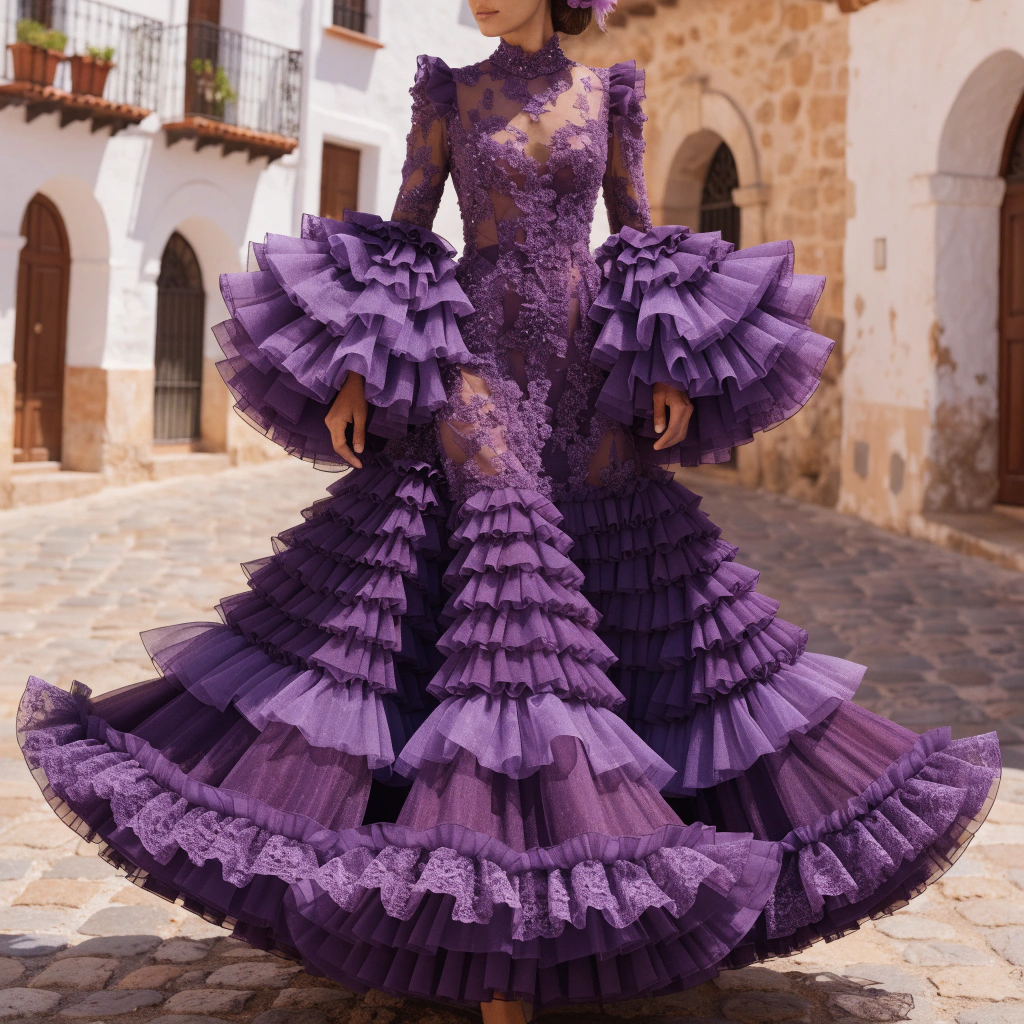
The Beautiful Flamenco Dress
Spain has a special dress. It is the flamenco dress. Women in Andalusia wear this dress. It is very beautiful and colorful.
The dress has many colors. It has red, black, and white colors. It also has many flowers and dots. Women wear the dress at big parties. These parties are in the spring.
The dress changes every year. It is like modern clothes. It follows new fashion. People love the flamenco dress. It is a famous symbol of Spain. Women also wear a flower in their hair. They look very happy.
Grammar Spotlight
Pattern: Present Simple for Facts
"Spain has a special dress."
We use the present simple to talk about things that are always true. For singular subjects like 'Spain', we use 'has' or add '-s' to the verb.
Pattern: Adjectives before Nouns
"It is a famous symbol of Spain."
In English, describing words (adjectives) usually come before the thing they describe (noun). Here, 'famous' comes before 'symbol'.
Test Your Understanding
10 questions · A1 Beginner · 1 free preview
Test what you learned from this article. Answer all questions to earn XP!
Where do women wear the flamenco dress?
Want to finish the quiz?
9 more questions are waiting for you. Sign up free to unlock the full quiz and earn XP!
Sign Up FreeAlready have an account? Sign In
Question Breakdown
Where do women wear the flamenco dress?
Your answer:
Correct answer: In Andalusia
The flamenco dress is the same every year.
Your answer:
Correct answer: False
What does 'colorful' mean?
Your answer:
Correct answer: Having many colors
The dress changes every _____.
Your answer:
Correct answer: year
The Beautiful Flamenca Dress of Spain
The Traje de Flamenca is a very famous dress from Andalusia, in the south of Spain. It is a symbol of Spanish culture. In the past, poor farm women wore these dresses to work. But today, the dress is very expensive and beautiful.
The dress is usually long and has many bright colors. Many dresses have polka dots, which are small circles. It is the only traditional dress in the world that changes every year. Designers create new styles because fashion is important in Spain.
Every spring, thousands of women wear these dresses at the Feria de Abril in Seville. They walk through the streets and dance. This dress is more popular than other traditional clothes because it is modern and traditional at the same time. People love the Flamenca dress because it represents the spirit of Andalusia.
Grammar Spotlight
Pattern: Comparatives (more + adjective + than)
"This dress is more popular than other traditional clothes because it is modern and traditional at the same time."
We use 'more' before long adjectives to compare two things. For example, 'popular' becomes 'more popular than' to show one thing has more of that quality.
Pattern: Conjunction 'because'
"Designers create new styles because fashion is important in Spain."
We use 'because' to explain the reason for something. It joins two simple sentences to show cause and effect.
Test Your Understanding
11 questions · A2 Elementary · 1 free preview
Test what you learned from this article. Answer all questions to earn XP!
Where is the Flamenca dress originally from?
Want to finish the quiz?
10 more questions are waiting for you. Sign up free to unlock the full quiz and earn XP!
Sign Up FreeAlready have an account? Sign In
Question Breakdown
Where is the Flamenca dress originally from?
Your answer:
Correct answer: Andalusia
The style of the Flamenca dress stays the same every year.
Your answer:
Correct answer: False
What are 'polka dots'?
Your answer:
Correct answer: Small circles
Designers create new _____ every year.
Your answer:
Correct answer: styles
Why is the dress different from other traditional costumes?
Your answer:
Correct answer: It changes with modern fashion
The Living Fashion of Andalusia: The Flamenca Dress
The 'traje de flamenca' is one of the most famous symbols of Spanish culture. While many traditional costumes in Europe are kept in museums, the flamenca dress is a 'living' garment. This means that it is still worn today and changes every year according to modern fashion trends. It is the only regional dress in the world that follows the latest styles.
The dress has evolved significantly since its humble origins. Originally, it was worn by women who worked in the countryside. However, over time, it has become a sophisticated fashion icon. Every spring, the streets of Seville are filled with color during the 'Feria de Abril.' Thousands of women wear these beautiful dresses, which are often decorated with ruffles and polka dots.
In recent years, many famous designers have created their own versions of the dress. These designs are presented at special fashion shows before the festival begins. The dresses are carefully made to highlight the dancer's movements, and they are usually accompanied by accessories like fans and flowers.
If you have ever visited Andalusia in April, you have probably seen how important this tradition is. People who love fashion and culture travel from all over the world to see these incredible outfits. Because the style is updated every season, there is always something new to see. The flamenca dress shows that tradition does not have to be old-fashioned; it can be modern and exciting too.
Grammar Spotlight
Pattern: The Passive Voice
"These designs are presented at special fashion shows before the festival begins."
The passive voice is used when the action is more important than the person doing it. It is formed with the verb 'to be' followed by the past participle.
Pattern: Relative Clauses
"Thousands of women wear these beautiful dresses, which are often decorated with ruffles and polka dots."
Relative clauses give extra information about a noun. We use 'which' for objects and 'who' for people to connect sentences.
Test Your Understanding
11 questions · B1 Intermediate · 1 free preview
Test what you learned from this article. Answer all questions to earn XP!
Why is the flamenca dress called a 'living' garment?
Want to finish the quiz?
10 more questions are waiting for you. Sign up free to unlock the full quiz and earn XP!
Sign Up FreeAlready have an account? Sign In
Question Breakdown
Why is the flamenca dress called a 'living' garment?
Your answer:
Correct answer: It changes every year with fashion trends.
The flamenca dress has remained exactly the same since it was first created.
Your answer:
Correct answer: False
What does 'garment' mean?
Your answer:
Correct answer: An item of clothing
The dress is often decorated with _____ and polka dots.
Your answer:
Correct answer: ruffles
Who originally wore the flamenca dress?
Your answer:
Correct answer: Women working in the countryside
The Living Tradition: Evolution and Impact of the Flamenca Dress
While many traditional costumes across Europe have become static museum pieces, the flamenca dress remains a remarkably living garment. Originating in Andalusia, Spain, this attire is uniquely distinguished by its ability to evolve. It is widely considered the only regional dress in the world that changes annually according to contemporary fashion trends. Consequently, what was once a humble outfit for peasant women has transformed into a symbol of high fashion and cultural prestige.
Historically, the dress emerged from the functional clothing worn by female livestock vendors during the 19th century. These women adorned their simple robes with ruffles to enhance their appearance. However, the dress gained significant social status during the 1929 Ibero-American Exposition in Seville. During this event, the aesthetic was embraced by the upper classes, who recognized its elegance. Since then, the silhouette has been refined, yet it maintains its core identity: the hourglass shape, vibrant colors, and intricate ruffles.
The dynamic nature of the flamenca dress is best observed at SIMOF, the International Flamenco Fashion Show. Designers here showcase new collections that incorporate modern fabrics, daring necklines, and innovative patterns. Unlike other folk traditions that resist change, the flamenco fashion sector thrives on it. This constant reinvention ensures that the dress remains relevant to younger generations, who eagerly anticipate the latest styles for the annual Feria de Abril.
Furthermore, the production of these dresses represents a vital socio-economic sector in Andalusia. The level of craftsmanship involved is extraordinary, with many pieces being hand-stitched by skilled artisans. If the dress had remained unchanged, it might not have achieved such global prestige or sustained such a robust industry. It serves as a testament to how tradition can coexist with innovation. In conclusion, the traje de flamenca is more than just a costume; it is a profound expression of Andalusian identity. Seville, which hosts the famous Feria de Abril, becomes a vibrant stage for these designs every spring, proving that some traditions are best kept alive through change.
Grammar Spotlight
Pattern: Passive Voice
"The aesthetic was embraced by the upper classes, who recognized its elegance."
The passive voice is used here to focus on the 'aesthetic' rather than the people who liked it. It is formed using the verb 'to be' (was) and the past participle (embraced).
Pattern: Non-defining Relative Clause
"Seville, which hosts the famous Feria de Abril, becomes a vibrant stage for these designs every spring."
This clause provides extra information about Seville that is not essential to the sentence's meaning. It is separated by commas and uses the relative pronoun 'which'.
Pattern: Third Conditional
"If the dress had remained unchanged, it might not have achieved such global prestige."
This structure is used to talk about a hypothetical situation in the past. It uses 'if + past perfect' followed by 'might/would + have + past participle'.
Test Your Understanding
11 questions · B2 Upper Intermediate · 1 free preview
Test what you learned from this article. Answer all questions to earn XP!
What makes the flamenca dress unique compared to other European traditional costumes?
Want to finish the quiz?
10 more questions are waiting for you. Sign up free to unlock the full quiz and earn XP!
Sign Up FreeAlready have an account? Sign In
Question Breakdown
What makes the flamenca dress unique compared to other European traditional costumes?
Your answer:
Correct answer: It changes every year based on modern fashion trends.
The flamenca dress was originally worn by wealthy noblewomen in the 1800s.
Your answer:
Correct answer: False
What does 'sector' mean in the context of the article?
Your answer:
Correct answer: A distinct part of the economy or society.
The production of these dresses involves a high level of _____, often being hand-stitched.
Your answer:
Correct answer: craftsmanship
Which event helped the flamenca dress gain social status among the upper classes?
Your answer:
Correct answer: The 1929 Ibero-American Exposition.
The Living Loom: The Sociopolitical Metamorphosis of the Traje de Flamenca
Rarely has a regional costume managed to transcend its historical shackles to become a dynamic protagonist in the global fashion industry. The Traje de Flamenca, synonymous with the vibrant soul of Andalusia, defies the static preservation typically associated with traditional attire. Unlike the vestigial garments of other European cultures, which are often relegated to museum vitrines or performative folklore, the flamenca dress undergoes an annual metamorphosis. It is this perpetual evolution that cements its status as a living artifact, a garment that breathes in tandem with the contemporary world.
The genesis of the dress lies in the pragmatism of the 19th-century peasantry. Originally worn by the wives of livestock traders attending the Seville Fair, the ruffles (volantes) were born not of vanity but of functionality, designed to facilitate movement while maintaining an air of dignity amidst the dust of the cattle market. However, through a fascinating process of socio-cultural commodification, the aesthetic of the marginalized became the aspiration of the elite. By the early 20th century, the dress had been adopted by the upper classes, undergoing a paradigm shift from humble workwear to an ostentatious display of regional pride. It was during the Ibero-American Exposition of 1929 that the garment was officially canonized as the quintessential symbol of Spanish womanhood.
What truly distinguishes the Traje de Flamenca is its susceptibility to the ephemeral whims of contemporary trends. Every spring, the International Flamenco Fashion Show (SIMOF) in Seville dictates the silhouette, color palette, and fabric of the season. Never is the tension between tradition and modernity more palpable than during this event. While the core DNA of the dress—the figure-hugging bodice and the cascading ruffles—remains sacrosanct, the details are subject to constant reinterpretation. One year might favor minimalism and monochromatic tones, while the next embraces baroque exuberance and avant-garde materials. It is the intersection of heritage and innovation that allows the garment to remain relevant in an increasingly globalized world.
Furthermore, the dress serves as a silent interlocutor in the discourse of Andalusian identity. For many women, the act of donning the dress is not merely a sartorial choice but a profound reclamation of cultural agency. The juxtaposition of the dress’s rural origins with its current high-fashion status mirrors the broader economic and social transformation of the region. Despite the influx of mass-produced imitations, the enduring appeal of a bespoke flamenca dress remains a testament to the value placed on craftsmanship and local heritage. The dress functions as a bridge between generations, where the grandmother’s shawl meets the granddaughter’s neon-infused ruffles.
In conclusion, the Traje de Flamenca is far more than a mere costume. It is a sophisticated semiotic system that communicates class, history, and a uniquely Spanish brand of modernity. Its ability to adapt without losing its essence ensures that it will continue to flourish, proving that tradition need not be a stagnant pool, but can instead be a flowing river of creative expression.
Grammar Spotlight
Pattern: Negative Inversion
"Rarely has a regional costume managed to transcend its historical shackles."
When a sentence begins with a negative or restrictive adverbial like 'rarely', the subject and auxiliary verb are inverted. This is used in formal writing to add emphasis and dramatic effect.
Pattern: It-Cleft Sentences
"It is this perpetual evolution that cements its status as a living artifact."
Cleft sentences are used to focus on a specific piece of information. The structure 'It is + [focused item] + that/who' highlights the reason or agent responsible for an action.
Pattern: Nominalization
"The genesis of the dress lies in the pragmatism of the 19th-century peasantry."
Nominalization involves turning verbs or adjectives into nouns (e.g., 'pragmatism' instead of 'being pragmatic'). This creates a more academic, abstract, and sophisticated tone.
Test Your Understanding
12 questions · C1 Advanced · 1 free preview
Test what you learned from this article. Answer all questions to earn XP!
What primary feature distinguishes the Traje de Flamenca from other European traditional costumes?
Want to finish the quiz?
11 more questions are waiting for you. Sign up free to unlock the full quiz and earn XP!
Sign Up FreeAlready have an account? Sign In
Question Breakdown
What primary feature distinguishes the Traje de Flamenca from other European traditional costumes?
Your answer:
Correct answer: It changes annually according to fashion trends.
The ruffles on the original peasant dresses were designed primarily for aesthetic beauty.
Your answer:
Correct answer: False
Which word describes the process of turning something into a commercial product?
Your answer:
Correct answer: Commodification
The flamenca dress undergoes an annual _____, changing its style every season.
Your answer:
Correct answer: metamorphosis
When was the flamenca dress officially canonized as a symbol of Spanish womanhood?
Your answer:
Correct answer: During the Ibero-American Exposition of 1929.
The core DNA of the dress, such as the figure-hugging bodice, is considered sacrosanct and rarely changes.
Your answer:
Correct answer: True
The Living Paradox: Ephemerality and Tradition in the Andalusian Traje de Flamenca
Rarely does a regional costume maintain such a precarious yet vibrant equilibrium between historical reverence and the relentless tide of modern fashion as the Traje de Flamenca. While most European folk garments have been relegated to the static halls of ethnography, ossified into museum pieces that serve as mere snapshots of a bygone era, the flamenca dress remains a living, breathing entity. It is arguably the only traditional attire worldwide that undergoes a comprehensive aesthetic metamorphosis annually, dictated by the capricious whims of the contemporary zeitgeist. Should the dress cease to evolve, it would likely lose its ontological status as a symbol of Andalusian vitality, becoming instead a hollow relic of the past.
The genesis of the Traje de Flamenca is rooted in the pragmatic necessity of the 19th-century agrarian markets. Originally, it was the humble attire of Gitanas and peasant women who attended livestock fairs in Seville. These women adorned their simple percale robes with ruffles—volantes—to imbue their workwear with a sense of festive dignity. However, a fascinating sociological shift occurred during the Ibero-American Exposition of 1929. The Sevillian bourgeoisie, captivated by the raw elegance and rhythmic fluidity of the garment, began to appropriate and refine it. This cross-pollination between the marginalized and the elite precipitated the dress's ascent into high fashion, transforming it from a utilitarian agrarian smock into a sophisticated sartorial masterpiece.
Today, the dress is governed by a rigorous annual cycle, central to which is the Salón Internacional de la Moda Flamenca (SIMOF). In this arena, designers showcase collections that experiment with volume, textile technology, and chromatic palettes, ensuring that the silhouette of the 'flamenca' is never static. It is imperative that the garment reflect the current year’s trends, whether that involves a penchant for minimalist lace or an exuberant return to baroque ornamentation. This constant flux creates a unique economic ecosystem in Andalusia, where the artisanal craftsmanship of seamstresses intersects with the high-stakes world of luxury fashion. One might argue that the dress’s survival is predicated on this very adaptability; by embracing change, it avoids the stagnation that has claimed other regional costumes.
From a semiotic perspective, the Traje de Flamenca serves as a complex vessel for identity. The juxtaposition of the structured bodice and the voluminous ruffles mimics the tension inherent in the flamenco dance itself—a dialogue between discipline and passion. The garment does not merely clothe the body; it reconfigures the wearer’s presence within the public sphere of the 'Feria.' The intricate interstices of lace and the strategic placement of the 'mantoncillo' (shawl) are not merely decorative; they are linguistic markers of heritage and social standing. Even the 'peineta' (comb) and 'flores' (flowers) are positioned with such precision that they convey a specific aesthetic grammar understood by the initiated.
Ultimately, the Traje de Flamenca challenges our conventional understanding of tradition. We often perceive tradition as something that must be preserved in amber, protected from the corrosive influence of time. Yet, the flamenca dress suggests that true tradition is found in continuity through transformation. It is a testament to the fact that for a culture to remain relevant, it must be willing to reinvent its visual language without severing its historical umbilical cord. As long as the spring air in Seville is filled with the rustle of new silk and the clatter of castanets, the Traje de Flamenca will continue to be a testament to the enduring power of a living heritage.
Grammar Spotlight
Pattern: Negative Inversion
"Rarely does a regional costume maintain such a precarious yet vibrant equilibrium between historical reverence and the relentless tide of modern fashion as the Traje de Flamenca."
When a sentence begins with a negative or restrictive adverb like 'rarely', the subject and auxiliary verb are inverted to create emphasis and a formal, rhetorical tone.
Pattern: Inverted Conditional
"Should the dress cease to evolve, it would likely lose its ontological status as a symbol of Andalusian vitality..."
The word 'should' replaces 'if' in a first or second conditional structure to make the hypothetical situation sound more formal and academic.
Pattern: Subjunctive Mood for Necessity
"It is imperative that the garment reflect the current year’s trends..."
The subjunctive 'reflect' (without the 's') is used after adjectives of necessity or urgency (imperative, essential, crucial) followed by a 'that' clause.
Test Your Understanding
12 questions · C2 Mastery · 1 free preview
Test what you learned from this article. Answer all questions to earn XP!
What distinguishes the Traje de Flamenca from other European regional costumes?
Want to finish the quiz?
11 more questions are waiting for you. Sign up free to unlock the full quiz and earn XP!
Sign Up FreeAlready have an account? Sign In
Question Breakdown
What distinguishes the Traje de Flamenca from other European regional costumes?
Your answer:
Correct answer: It changes annually according to fashion trends.
The dress originated from the elite classes of Seville before being adopted by peasants.
Your answer:
Correct answer: False
What does 'ossified' mean in the context of the article?
Your answer:
Correct answer: Rigid and unchanging
The dress underwent a sociological shift during the Ibero-American _____ of 1929.
Your answer:
Correct answer: Exposition
According to the semiotic analysis, what does the dress represent?
Your answer:
Correct answer: A dialogue between discipline and passion.
The article suggests that constant change is the reason for the dress's survival.
Your answer:
Correct answer: True
