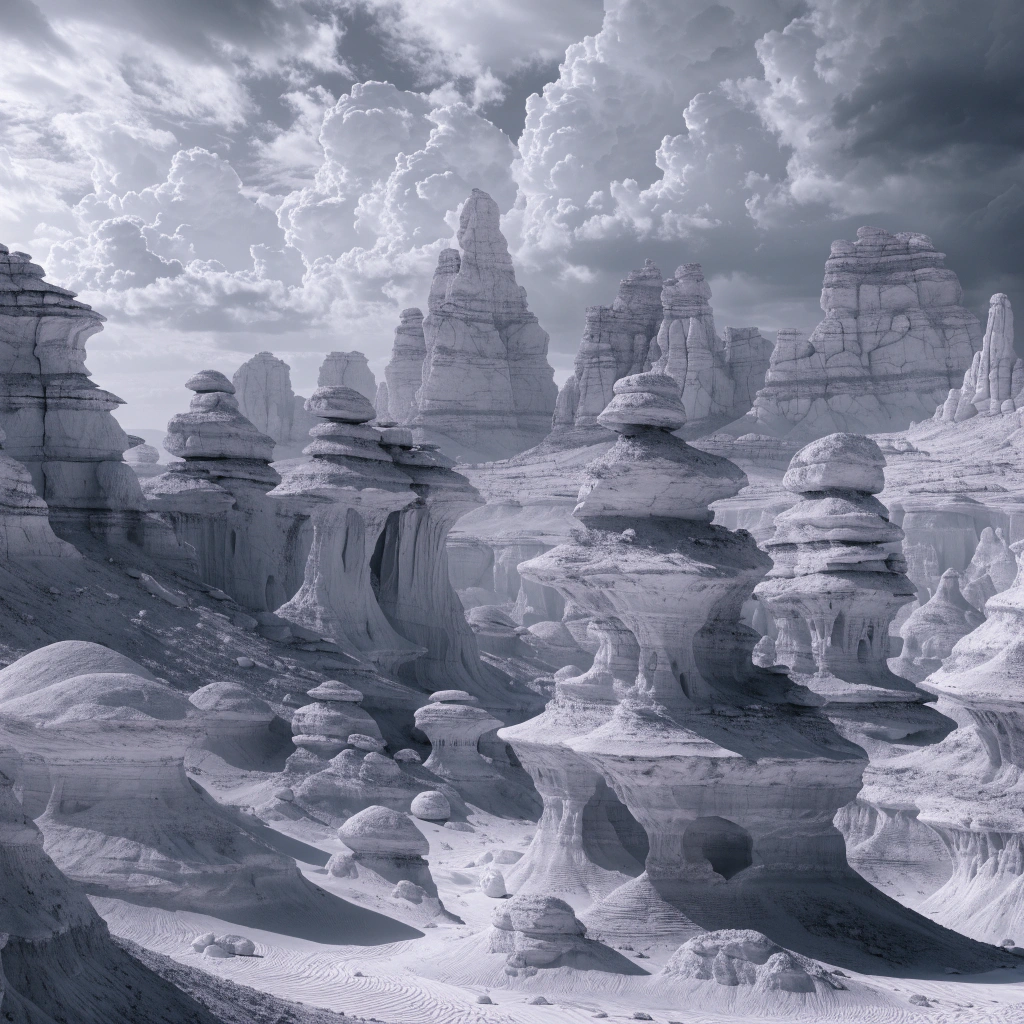
The Beautiful White Desert
The White Desert is a big national park in Egypt. It is in the west of the country. This place is very special. It looks like a different planet.
There are many white rocks. The wind makes the rocks into shapes. Some rocks look like mushrooms. Some rocks look like birds. They are very white and bright.
Many people visit the desert. They take photos of the rocks. At night, the stars are beautiful. It is a quiet and happy place.
نکته دستوری
الگو: Present Simple of 'To Be'
"The White Desert is a big national park in Egypt."
We use 'is' for singular subjects like 'it' or a single place. It helps us describe facts and permanent states.
الگو: Plural Nouns with -s
"There are many white rocks."
To talk about more than one thing, we usually add 's' to the end of a noun. For example, one rock becomes many rocks.
درک خود را بسنجید
10 سوال · A1 مبتدی · 1 پیشنمایش رایگان
آنچه از این مقاله آموختید را بسنجید. به همه سؤالات پاسخ دهید و XP کسب کنید!
Where is the White Desert?
آیا میخواهید آزمون را تمام کنید؟
9 سؤال دیگر منتظر شماست. ثبتنام رایگان کنید تا آزمون کامل را باز کنید و XP کسب کنید!
ثبتنام رایگانقبلاً ثبتنام کردی؟ ورود
جزئیات سؤالات
Where is the White Desert?
پاسخ شما:
پاسخ درست: In the west of Egypt
The rocks in the desert are black.
پاسخ شما:
پاسخ درست: نادرست
What does 'shape' mean?
پاسخ شما:
پاسخ درست: The form of something
The wind makes the rocks into _____.
پاسخ شما:
پاسخ درست: shapes
A Trip to the White Desert
The White Desert National Park is a special place in western Egypt. It is in the Farafra depression. People call it "Sahara el Beyda." When you go there, it does not look like a normal desert. It looks more like a cold place with snow or a different planet.
The park has many large, white rock formations. These rocks are made of chalk. For many years, the strong wind changed the shapes of the rocks. Now, some rocks look like mushrooms, and others look like chickens or trees. They are very beautiful and bright under the sun.
In the past, this area was under the ocean. Today, it is a protected park because it is very unique. Many tourists visit the White Desert to see the sunset. At night, the desert is quieter than the city. People often sleep in tents under the stars. It is one of the most interesting places in Egypt.
نکته دستوری
الگو: Comparatives
"At night, the desert is quieter than the city."
We use comparatives to compare two things. For short adjectives like 'quiet', we add '-er' and use the word 'than'.
الگو: Past Simple (Be)
"In the past, this area was under the ocean."
We use 'was' to talk about a single subject (this area) in the past. It describes a state or location that existed before now.
درک خود را بسنجید
11 سوال · A2 مقدماتی · 1 پیشنمایش رایگان
آنچه از این مقاله آموختید را بسنجید. به همه سؤالات پاسخ دهید و XP کسب کنید!
Where is the White Desert National Park located?
آیا میخواهید آزمون را تمام کنید؟
10 سؤال دیگر منتظر شماست. ثبتنام رایگان کنید تا آزمون کامل را باز کنید و XP کسب کنید!
ثبتنام رایگانقبلاً ثبتنام کردی؟ ورود
جزئیات سؤالات
Where is the White Desert National Park located?
پاسخ شما:
پاسخ درست: In western Egypt
The rocks in the White Desert are made of chalk.
پاسخ شما:
پاسخ درست: درست
What does 'unique' mean?
پاسخ شما:
پاسخ درست: Being the only one of its type
At night, the desert is _____ than the city.
پاسخ شما:
پاسخ درست: quieter
What helped change the shapes of the rocks over many years?
پاسخ شما:
پاسخ درست: Wind
Egypt's Alien Landscape: The White Desert National Park
Have you ever imagined walking on the moon? In the Western Desert of Egypt, there is a place that looks like it belongs on another planet. It is called the White Desert National Park, or Sahara el Beyda. This incredible park, which covers about 3,000 square kilometers, is located in the Farafra depression. It is one of the most famous natural wonders in the country.
The landscape is dominated by massive, brilliant white chalk rock formations. These formations have been sculpted by wind erosion over millions of years, creating shapes that look like giant mushrooms, birds, and towers. The white chalk was formed by tiny sea creatures during a time when this desert was actually at the bottom of a deep ocean. Since the water disappeared, the wind has been the main artist, carving the soft stone into the fantastic shapes we see today.
Because it is a protected national park, the environment has been kept in its natural state. Many travelers from all over the world have visited the area to see the rocks glow during sunset. When the sun goes down, the white stone changes color from orange to pink, and finally to a ghostly white under the stars. It is common for visitors to go on desert safaris and spend the night camping. Sleeping under the clear Egyptian sky is an experience that many people have described as magical.
The White Desert is not just a place for photos; it is a geologically unique location that shows the power of time and nature. Whether you are interested in geology or you just want to see something beautiful, this park is a destination that should not be missed. It remains a peaceful escape from the busy cities of Egypt.
نکته دستوری
الگو: Relative Clauses (with 'which')
"This incredible park, which covers about 3,000 square kilometers, is located in the Farafra depression."
We use 'which' to give more information about a thing or place. In this sentence, it adds extra detail about the size of the park.
الگو: Passive Voice (Present Perfect)
"These formations have been sculpted by wind erosion over millions of years."
The passive voice focuses on the object (the formations) rather than the subject (the wind). We form it using 'have/has been' + past participle.
درک خود را بسنجید
11 سوال · B1 متوسط · 1 پیشنمایش رایگان
آنچه از این مقاله آموختید را بسنجید. به همه سؤالات پاسخ دهید و XP کسب کنید!
Where is the White Desert National Park located?
آیا میخواهید آزمون را تمام کنید؟
10 سؤال دیگر منتظر شماست. ثبتنام رایگان کنید تا آزمون کامل را باز کنید و XP کسب کنید!
ثبتنام رایگانقبلاً ثبتنام کردی؟ ورود
جزئیات سؤالات
Where is the White Desert National Park located?
پاسخ شما:
پاسخ درست: In the Farafra depression
The white rocks were originally formed at the bottom of an ocean.
پاسخ شما:
پاسخ درست: درست
What does the word 'landscape' mean?
پاسخ شما:
پاسخ درست: The visible features of an area of land
The rock formations have been _____ by the wind over a long time.
پاسخ شما:
پاسخ درست: sculpted
What happens to the white rocks at sunset?
پاسخ شما:
پاسخ درست: They change color to orange and pink
Egypt's Surreal Masterpiece: The White Desert National Park
Located within the heart of Egypt’s Western Desert, the White Desert National Park, known locally as Sahara el Beyda, represents one of the most extraordinary geological phenomena on the planet. Covering approximately 3,000 square kilometers of the Farafra depression, the park offers a landscape so surreal that visitors often feel as though they have stepped onto another planet or a frozen arctic wasteland. Unlike the traditional golden dunes typically associated with the Sahara, this region is dominated by massive, brilliant white chalk rock formations that resemble giant mushrooms, pebbles, and abstract sculptures.
These structures have been meticulously sculpted over eons by relentless wind erosion, a process that continues to reshape the terrain today. Geologists suggest that the area was once submerged under a vast ocean during the Cretaceous period. Consequently, the white chalk is actually composed of the fossilized remains of microscopic marine organisms. Had the sea levels not receded millions of years ago, this unique ecosystem would never have emerged. The contrast between the stark white chalk and the surrounding yellow sands creates a visual dichotomy that is rarely seen elsewhere in the world.
In recent years, the park has become an essential destination for eco-tourism. Despite its remote location, it attracts thousands of travelers seeking an authentic wilderness experience. However, the delicate nature of the chalk formations means that conservation efforts are paramount. If the park were not strictly protected by Egyptian law, the influx of tourists might inadvertently damage the fragile environment. Therefore, visitors are encouraged to follow 'leave no trace' principles to ensure the site remains pristine for future generations. Furthermore, the park serves as a sanctuary for various endangered species, which adds another layer of ecological importance to the site.
One of the most captivating aspects of the White Desert is the dramatic transformation it undergoes at dusk. As the sun begins to set, the rocks absorb the orange and pink hues of the sky, creating a breathtaking visual spectacle. Many choose to camp overnight, witnessing the moonlit landscape which glows with an eerie brilliance. It is during these quiet moments that one truly appreciates the silent majesty of the desert. Ultimately, the White Desert stands as a testament to the power of natural forces and the necessity of environmental stewardship.
نکته دستوری
الگو: Inversion in Conditionals
"Had the sea levels not receded millions of years ago, this unique ecosystem would never have emerged."
This is a formal way to express a Third Conditional (hypothetical past). The word 'had' is moved to the beginning to replace 'if'.
الگو: Present Perfect Passive
"These structures have been meticulously sculpted over eons by relentless wind erosion..."
This pattern (have/has + been + past participle) focuses on the action and its current result rather than the agent of the action.
الگو: Second Conditional
"If the park were not strictly protected by Egyptian law, the influx of tourists might inadvertently damage the fragile environment."
This describes a hypothetical present situation. 'Were' is used instead of 'was' to emphasize the formal, hypothetical nature of the statement.
درک خود را بسنجید
11 سوال · B2 بالاتر از متوسط · 1 پیشنمایش رایگان
آنچه از این مقاله آموختید را بسنجید. به همه سؤالات پاسخ دهید و XP کسب کنید!
Where is the White Desert National Park located?
آیا میخواهید آزمون را تمام کنید؟
10 سؤال دیگر منتظر شماست. ثبتنام رایگان کنید تا آزمون کامل را باز کنید و XP کسب کنید!
ثبتنام رایگانقبلاً ثبتنام کردی؟ ورود
جزئیات سؤالات
Where is the White Desert National Park located?
پاسخ شما:
پاسخ درست: In the Western Desert's Farafra depression
The white chalk formations are primarily composed of fossilized marine organisms.
پاسخ شما:
پاسخ درست: درست
What does the word 'paramount' mean in the context of the article?
پاسخ شما:
پاسخ درست: Of supreme importance
The park is dominated by massive, _____ white chalk rock formations.
پاسخ شما:
پاسخ درست: brilliant
What is the primary cause of the unique shapes of the rock formations?
پاسخ شما:
پاسخ درست: Relentless wind erosion
The Ghostly Sentinels: A Critical Exploration of Egypt’s White Desert
Seldom does a landscape so thoroughly defy the conventional expectations of a desert as does Egypt’s White Desert National Park. Situated within the Farafra depression, this 3,000-square-kilometer expanse of Saharan terrain presents a visual paradox: a scorching desert that appears, to the uninitiated eye, as a frozen, arctic wasteland. It is the sheer, blinding whiteness of the chalk monoliths that strikes the visitor first, standing in stark juxtaposition to the golden dunes of the surrounding Great Sand Sea. These formations, emerging from the sand like ghostly sentinels, challenge our sensory perception of the North African environment.
The genesis of these formations dates back to the Cretaceous period, an epoch when this region lay submerged beneath the Tethys Ocean. The subsequent accumulation of microscopic marine organisms led to the formation of thick limestone and chalk strata. However, the true architect of the park’s current aesthetic is the relentless scouring of the wind. Over eons, aeolian erosion has carved the soft chalk into fantastic, ethereal shapes—mushrooms, sphinxes, and abstract towers—each a testament to the patient, abrasive power of nature. This geological metamorphosis is not a relic of the past but an ongoing process, as the wind continues to refine and reshape the landscape with every passing season.
The preservation of this delicate ecosystem requires a nuanced approach, particularly as the site’s popularity on the global stage grows. While the commodification of such natural wonders often provides essential revenue for local Bedouin communities, it simultaneously poses a significant threat to the very fragility that makes the park unique. The introduction of heavy vehicular traffic and unregulated camping could easily degrade the site, turning these ancient vestiges of a lost sea into mere casualties of modern tourism. There is a growing consensus among environmentalists that only through strict regulation and the promotion of sustainable eco-tourism can the integrity of the White Desert be maintained.
Furthermore, the White Desert invites a critical analysis of our perception of time and permanence. To witness the sunset over these formations is to observe the ephemeral nature of light playing across the apparent solidity of stone. Yet, even this stone is fleeting on a geological scale. The park is a dynamic environment where the process of disintegration is as vital as the act of creation. The constant shedding of chalk dust, which blankets the ground like fresh snow, serves as a poignant reminder of the landscape's slow-motion transformation.
What remains most compelling is the psychological impact of such profound desolation. In an era dominated by urban saturation and digital noise, the silence of the White Desert offers a necessary precursor to introspection. It serves as a reminder that the natural world possesses an inherent value that transcends human utility. Only by fostering a deep-seated respect for such geological anomalies can we ensure their survival for future generations. Ultimately, the White Desert is not merely a destination; it is a meditation on the enduring dialogue between the elements and the passage of time.
نکته دستوری
الگو: Inversion with negative/restrictive adverbs
"Seldom does a landscape so thoroughly defy the conventional expectations of a desert as does Egypt’s White Desert National Park."
When we start a sentence with a restrictive adverb like 'seldom', the auxiliary verb comes before the subject. This is used in formal writing to add emphasis or dramatic effect.
الگو: Cleft Sentences
"It is the sheer, blinding whiteness of the chalk monoliths that strikes the visitor first."
Cleft sentences use 'It + is/was + [focus] + that/who' to emphasize a specific part of the information. Here, it emphasizes 'the whiteness' as the primary striking feature.
الگو: Nominalisation
"The preservation of this delicate ecosystem requires a nuanced approach."
Nominalisation involves turning verbs (preserve) into nouns (preservation). This is a hallmark of C1/C2 writing, making the tone more objective, formal, and concise.
درک خود را بسنجید
12 سوال · C1 پیشرفته · 1 پیشنمایش رایگان
آنچه از این مقاله آموختید را بسنجید. به همه سؤالات پاسخ دهید و XP کسب کنید!
What is the primary geological cause of the unique shapes found in the White Desert?
آیا میخواهید آزمون را تمام کنید؟
11 سؤال دیگر منتظر شماست. ثبتنام رایگان کنید تا آزمون کامل را باز کنید و XP کسب کنید!
ثبتنام رایگانقبلاً ثبتنام کردی؟ ورود
جزئیات سؤالات
What is the primary geological cause of the unique shapes found in the White Desert?
پاسخ شما:
پاسخ درست: The abrasive force of wind over long periods
The article suggests that the White Desert's appearance is static and no longer changing.
پاسخ شما:
پاسخ درست: نادرست
What does 'commodification' refer to in the context of the article?
پاسخ شما:
پاسخ درست: The turning of a natural site into a commercial product
The chalk formations were originally created by the accumulation of microscopic marine _____.
پاسخ شما:
پاسخ درست: organisms
According to the text, what psychological benefit does the desert's desolation provide?
پاسخ شما:
پاسخ درست: An opportunity for deep self-reflection
The White Desert was once located at the bottom of a prehistoric ocean.
پاسخ شما:
پاسخ درست: درست
The Chimerical Topography of the Farafra Depression: A Geological and Aesthetic Analysis of the White Desert
Lying within the vast, sun-scorched expanse of Egypt’s Farafra Depression, the White Desert National Park—or Sahara el Beyda—presents a landscape so profoundly detached from terrestrial norms that it borders on the phantasmagorical. This protected sanctuary, spanning approximately 3,000 square kilometers, serves as a testament to the transformative power of geological time. Seldom does a landscape challenge the human perception of reality as forcefully as this chalky wilderness, where the relentless interplay of wind and stone has birthed a gallery of natural monoliths. To the uninitiated observer, the terrain might appear as a frozen arctic wasteland or a lunar surface, yet its origins are rooted in a primordial aquatic past.
Millions of years ago, during the Late Cretaceous period, this region was submerged beneath the Tethys Ocean. The accumulation of microscopic marine organisms led to the formation of thick layers of sedimentary chalk. As the seas receded and tectonic shifts elevated the terrain, the stage was set for the aeolian forces to begin their patient labor. Sculpted by eons of relentless wind erosion, these formations—locally known as 'mushrooms' or 'tents'—stand as silent witnesses to the Earth’s shifting climate. The juxtaposition of the brilliant white chalk against the deep ochre of the surrounding sands creates a visual dichotomy that is as striking as it is ephemeral.
Were one to traverse this chalky expanse under the celestial glow of a full moon, the distinction between reality and hallucination might well dissolve. The light reflects off the calcification of the rocks, casting long, eerie shadows that seem to pulsate with a life of their own. This liminality is a key characteristic of the park’s aesthetic appeal; it is a space that exists between the geological and the sublime. Scholars of geomorphology find in the White Desert a perfect case study of karst-like processes in an arid environment, where mechanical weathering and abrasion take precedence over chemical dissolution. The result is a highly complex sedimentary stratigraphy that reveals the environmental fluctuations of the Cenozoic era.
However, the fragility of this ecosystem cannot be overstated. Despite its rugged appearance, the chalk is remarkably soft and susceptible to anthropogenic impact. The increasing influx of tourism, while beneficial for the local economy, necessitates a sophisticated management strategy to prevent the degradation of these unique karst formations. It is imperative that conservation efforts be prioritized, lest the very features that draw visitors be eroded by the footprints of progress. The preservation of the White Desert is not merely a matter of environmental stewardship but a commitment to safeguarding a geological heritage that is, in every sense of the word, irreplaceable.
In conclusion, the White Desert National Park remains an ontological marvel, bridging the gap between deep time and the present moment. It invites us to contemplate the transience of human existence against the backdrop of monolithic stability. Whether viewed through the lens of a geologist or the eyes of a poet, the Farafra Depression offers a profound meditation on the resilience and creativity of the natural world. Only through rigorous protection and a nuanced understanding of its delicate balance can we ensure that this phantasmagorical landscape continues to inspire awe for generations to come.
نکته دستوری
الگو: Negative Inversion
"Seldom does a landscape challenge the human perception of reality as forcefully as this chalky wilderness."
Inversion is used after negative or restrictive adverbs (seldom, rarely, never) to add emphasis. The auxiliary verb 'does' precedes the subject 'landscape'.
الگو: Inverted Conditional (Subjunctive)
"Were one to traverse this chalky expanse under the celestial glow of a full moon, the distinction between reality and hallucination might well dissolve."
This is a formal alternative to 'If one were to...'. It uses the subjunctive 'were' to express a hypothetical or imaginary situation in the present or future.
الگو: Past Participle Phrase as Modifier
"Sculpted by eons of relentless wind erosion, these formations stand as silent witnesses to the Earth’s shifting climate."
The phrase 'Sculpted by...' acts as an adjectival clause modifying 'these formations'. It provides background information about the state or origin of the subject in a concise, academic manner.
درک خود را بسنجید
12 سوال · C2 تسلط · 1 پیشنمایش رایگان
آنچه از این مقاله آموختید را بسنجید. به همه سؤالات پاسخ دهید و XP کسب کنید!
What is the primary geological origin of the chalk in the White Desert?
آیا میخواهید آزمون را تمام کنید؟
11 سؤال دیگر منتظر شماست. ثبتنام رایگان کنید تا آزمون کامل را باز کنید و XP کسب کنید!
ثبتنام رایگانقبلاً ثبتنام کردی؟ ورود
جزئیات سؤالات
What is the primary geological origin of the chalk in the White Desert?
پاسخ شما:
پاسخ درست: The accumulation of microscopic marine organisms
The article suggests that chemical dissolution is the primary factor in the erosion of the White Desert formations.
پاسخ شما:
پاسخ درست: نادرست
Which word describes something that is short-lived or fleeting?
پاسخ شما:
پاسخ درست: Ephemeral
The landscape is described as having a _____ quality, meaning it feels dream-like or illusory.
پاسخ شما:
پاسخ درست: phantasmagorical
According to the text, why is the White Desert considered a 'fragile' ecosystem?
پاسخ شما:
پاسخ درست: Because the chalk is soft and easily damaged by human activity
The text claims that the White Desert's aesthetic appeal lies partly in its liminality between the geological and the sublime.
پاسخ شما:
پاسخ درست: درست

