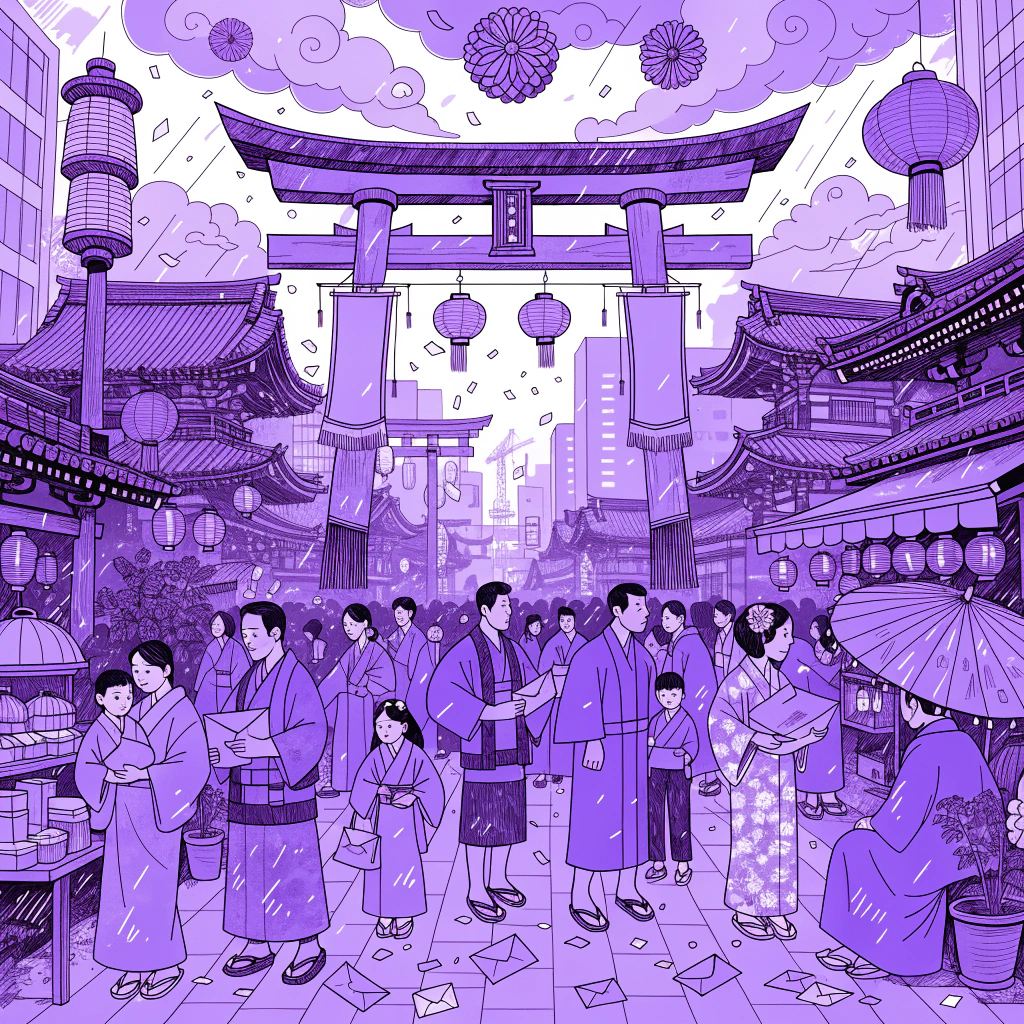
New Year in Japan
Japanese New Year is a very important time. In Japan, people call it Shogatsu. It starts on January 1st. Many people do not work. They stay at home with their families.
Families eat special food. They visit a temple or a shrine together. They pray for good luck and health. Children are very happy because they get money. The money is in small envelopes.
People clean their houses before the New Year. They want a fresh start. It is a quiet and beautiful time in Japan. Happy New Year!
نکته دستوری
الگو: Present Simple: To Be
"Japanese New Year is a very important time."
We use 'is' to describe a single thing or situation. It shows a fact that is true now.
الگو: Present Simple: Affirmative
"Families eat special food."
We use the base form of the verb (eat) for plural subjects like 'families'. It describes a habit or tradition.
درک خود را بسنجید
10 سوال · A1 مبتدی · 1 پیشنمایش رایگان
آنچه از این مقاله آموختید را بسنجید. به همه سؤالات پاسخ دهید و XP کسب کنید!
When does Shogatsu start?
آیا میخواهید آزمون را تمام کنید؟
9 سؤال دیگر منتظر شماست. ثبتنام رایگان کنید تا آزمون کامل را باز کنید و XP کسب کنید!
ثبتنام رایگانقبلاً ثبتنام کردی؟ ورود
جزئیات سؤالات
When does Shogatsu start?
پاسخ شما:
پاسخ درست: January 1st
Many people work during the Japanese New Year.
پاسخ شما:
پاسخ درست: نادرست
What is a 'temple'?
پاسخ شما:
پاسخ درست: A religious building
Children get _____ in small envelopes.
پاسخ شما:
پاسخ درست: money
Japanese New Year: A Time for Family
Shogatsu is the most important holiday in Japan. It happens from January 1st to January 3rd. For Japanese people, this is a time for family and new beginnings.
Before the New Year, families clean their houses because they want to welcome a special deity. They also put decorations at their doors. During Shogatsu, people eat special food called Osechi-ryori. These meals are beautiful and have different meanings for health and luck.
Many people visit a shrine or temple. This is called Hatsumode. They pray for a good year and buy lucky charms. Children are very happy during Shogatsu because they receive 'Otoshidama.' This was a tradition that started many years ago. It is a gift of money from their relatives.
Shogatsu is quieter than Western New Year celebrations. There are no big parties with loud music. Instead, it is a peaceful time. People stay at home and talk to their families. It is a very traditional and lovely way to start the year.
نکته دستوری
الگو: Superlative Adjectives
"Shogatsu is the most important holiday in Japan."
We use 'the most' with long adjectives to compare one thing to all others in a group. It shows that Shogatsu is number one in importance.
الگو: Past Simple Tense
"This was a tradition that started many years ago."
We use the past simple to talk about things that finished in the past. 'Was' is the past of 'is', and 'started' is the past of 'start'.
درک خود را بسنجید
11 سوال · A2 مقدماتی · 1 پیشنمایش رایگان
آنچه از این مقاله آموختید را بسنجید. به همه سؤالات پاسخ دهید و XP کسب کنید!
How long does the Shogatsu holiday usually last?
آیا میخواهید آزمون را تمام کنید؟
10 سؤال دیگر منتظر شماست. ثبتنام رایگان کنید تا آزمون کامل را باز کنید و XP کسب کنید!
ثبتنام رایگانقبلاً ثبتنام کردی؟ ورود
جزئیات سؤالات
How long does the Shogatsu holiday usually last?
پاسخ شما:
پاسخ درست: From January 1st to January 3rd
Japanese families clean their houses before the New Year to welcome a deity.
پاسخ شما:
پاسخ درست: درست
What is 'Otoshidama'?
پاسخ شما:
پاسخ درست: A gift of money for children
Many people visit a _____ or temple to pray for a good year.
پاسخ شما:
پاسخ درست: shrine
What is Osechi-ryori?
پاسخ شما:
پاسخ درست: Special food for the New Year
Shogatsu: The Traditional Japanese New Year
Shogatsu, or the Japanese New Year, is widely considered the most significant event on the Japanese calendar. While Western celebrations often focus on late-night parties and fireworks, Shogatsu is a more solemn and ritualistic period that typically lasts from January 1st to January 3rd. It is a time for renewal, reflection, and family reunions.
The origins of Shogatsu are deeply rooted in Shinto traditions. Families prepare for the arrival of Toshigami-sama, a deity who is believed to bring luck and prosperity for the coming year. Before the deity arrives, a big cleaning called osoji is performed to purify the home. Once the house is clean, traditional decorations made of pine and bamboo are placed at the entrance. These decorations, which have been used for centuries, serve as a sign to welcome the deity.
During the first three days of the year, people enjoy osechi-ryori. These are special foods that are packed into beautiful lacquer boxes. Each ingredient has a symbolic meaning; for instance, sea bream is eaten for happiness, while sweet black beans represent hard work. Another essential tradition is hatsumode, which is the first visit of the year to a shrine or temple. Millions of people wait in long lines to pray for health and success.
Children particularly enjoy Shogatsu because of otoshidama. This is a custom where money is given to children in small, decorated envelopes by their older relatives. Even though Japan is a very modern country, these ancient customs have been preserved by families across the nation. Ultimately, Shogatsu is a beautiful time when the Japanese people honor their past while looking forward to a bright future.
نکته دستوری
الگو: Passive Voice
"Shogatsu, or the Japanese New Year, is widely considered the most significant event on the Japanese calendar."
The passive voice is formed using 'to be' + past participle. It is used here to focus on Shogatsu as the subject of the sentence rather than the people who consider it important.
الگو: Relative Clauses
"Families prepare for the arrival of Toshigami-sama, a deity who is believed to bring luck and prosperity for the coming year."
A relative clause starts with a relative pronoun like 'who' or 'which'. It adds extra information about a person or thing mentioned previously in the sentence.
درک خود را بسنجید
11 سوال · B1 متوسط · 1 پیشنمایش رایگان
آنچه از این مقاله آموختید را بسنجید. به همه سؤالات پاسخ دهید و XP کسب کنید!
How long does the period of Shogatsu typically last?
آیا میخواهید آزمون را تمام کنید؟
10 سؤال دیگر منتظر شماست. ثبتنام رایگان کنید تا آزمون کامل را باز کنید و XP کسب کنید!
ثبتنام رایگانقبلاً ثبتنام کردی؟ ورود
جزئیات سؤالات
How long does the period of Shogatsu typically last?
پاسخ شما:
پاسخ درست: From January 1st to January 3rd
Osoji is a tradition of cleaning the home to prepare for the new year deity.
پاسخ شما:
پاسخ درست: درست
What does the word 'ancient' mean in the context of the article?
پاسخ شما:
پاسخ درست: Extremely old and from the past
Children receive money in small envelopes called _____.
پاسخ شما:
پاسخ درست: otoshidama
What is the purpose of placing pine and bamboo at the home entrance?
پاسخ شما:
پاسخ درست: To welcome the deity Toshigami-sama
Shogatsu: The Spiritual Resonance of the Japanese New Year
While Western New Year celebrations are frequently associated with exuberant late-night festivities and public displays of joy, Shogatsu represents a significantly more solemn and ritualistic period in the Japanese calendar. Lasting from January 1st to the 3rd, this time is dedicated to family reunions and the welcoming of Toshigami-sama, the deity of the new year who brings luck and prosperity. The essence of Shogatsu lies in the concept of renewal, where the past is reconciled and the future is embraced with a sense of spiritual purity and gratitude.
Preparations for the deity’s arrival begin long before the first of January. A tradition known as Susuharai involves a meticulous purification of the home, which is intended to sweep away the literal and spiritual dust of the previous year. It is believed that Toshigami-sama will only visit residences that have been thoroughly cleansed and prepared. Once the cleaning is finished, homes are adorned with auspicious decorations such as the Shimekazari and Kadomatsu. The Kadomatsu, a decoration made of pine and bamboo, is placed at the entrance to welcome the deity. These materials are chosen for their resilience and longevity, symbolizing a wish for a strong and healthy year ahead for the entire family.
The culinary aspect of Shogatsu is equally significant and deeply symbolic. Families gather to consume Osechi-ryori, a collection of traditional foods served in special lacquered boxes called jubako. Each ingredient is meticulously selected for its symbolic meaning and historical significance. For instance, shrimp represent a desire for a long life until one's back bends like the shrimp’s shell, while sweetened black beans signify a wish for health and hard work. These dishes have usually been prepared in advance so that no cooking is required during the first three days of the year, allowing families to focus entirely on their time together without distraction.
Furthermore, the transition into the New Year is marked by significant public rituals. As midnight approaches on New Year's Eve, the sound of Joya-no-kane, or temple bells, can be heard echoing throughout the country. The bells are rung exactly 108 times, a number that corresponds to the 108 human desires that cause suffering in Buddhist philosophy. This ritual is thought to cleanse the soul, providing a fresh start for the coming year. Following this, many people participate in Hatsumode, the first shrine or temple visit of the year, to pray for good fortune. Despite the increasing influence of modern global lifestyles, Shogatsu remains an enduring tradition that bridges the gap between the past and the present. It provides a unique opportunity for reflection, ensuring that Japan's rich cultural heritage is preserved in an ever-evolving world.
نکته دستوری
الگو: The Passive Voice
"The bells are rung exactly 108 times..."
The passive voice is used here to focus on the ritual action rather than who is performing it. It is formed using 'to be' + the past participle of the verb.
الگو: Present Perfect Passive
"residences that have been thoroughly cleansed and prepared."
This pattern describes a completed action that has a direct result on the present state of the home. It is formed with 'have/has been' + past participle.
الگو: Contrastive Conjunctions
"While Western New Year celebrations are frequently associated with exuberant late-night festivities... Shogatsu represents a significantly more solemn... period."
The word 'while' is used to introduce a subordinate clause that contrasts with the main clause. This structure is common in B2 academic writing to compare different concepts.
درک خود را بسنجید
11 سوال · B2 بالاتر از متوسط · 1 پیشنمایش رایگان
آنچه از این مقاله آموختید را بسنجید. به همه سؤالات پاسخ دهید و XP کسب کنید!
What is the primary spiritual focus of Shogatsu according to the text?
آیا میخواهید آزمون را تمام کنید؟
10 سؤال دیگر منتظر شماست. ثبتنام رایگان کنید تا آزمون کامل را باز کنید و XP کسب کنید!
ثبتنام رایگانقبلاً ثبتنام کردی؟ ورود
جزئیات سؤالات
What is the primary spiritual focus of Shogatsu according to the text?
پاسخ شما:
پاسخ درست: Spiritual renewal and welcoming a deity
Susuharai is a tradition that involves cleaning the home to prepare for the deity's arrival.
پاسخ شما:
پاسخ درست: درست
What does the word 'auspicious' mean in the context of the article?
پاسخ شما:
پاسخ درست: Suggesting future success or good luck
The temple bells are rung exactly 108 _____ to cleanse the soul.
پاسخ شما:
پاسخ درست: times
Why is Osechi-ryori typically prepared before the New Year begins?
پاسخ شما:
پاسخ درست: To allow families to focus on each other without cooking
The Sacred Silence of Shogatsu: A Study in Temporal Renewal
In the global consciousness, the transition from one year to the next is frequently characterized by exuberant revelry and the boisterous countdowns of urban metropolises. However, should one find themselves in Japan during the first three days of January, they would encounter a starkly different atmosphere—one of profound solemnity and ritualistic introspection. Known as Shogatsu, the Japanese New Year is less a celebration of temporal progression and more an esoteric process of spiritual purification. Never is the dichotomy between the secular and the sacred more apparent than during this period, where the frantic pace of modern life yields to the ancestral rhythms of Shinto tradition.
Central to the essence of Shogatsu is the welcoming of Toshigami-sama, the deity of the new year, who is believed to bestow luck and prosperity upon the household. This welcoming is not a passive event but the culmination of weeks of rigorous preparation. It is through the meticulous practice of Osoji, or 'great cleaning,' that the Japanese household attains spiritual purity, ridding the physical space of the 'kegare' (impurity) accumulated over the past twelve months. Following this purification, homes are adorned with auspicious decorations such as Kadomatsu—arrangements of pine, bamboo, and plum branches—which serve as transient dwellings for the visiting deity.
The culinary landscape of Shogatsu further exemplifies the intrinsic connection between symbolism and sustenance. Osechi-ryori, a collection of traditional foods served in tiered lacquer boxes, is a masterpiece of metaphorical consumption. Each ingredient is selected for its auspicious connotations: prawns represent longevity due to their curved backs, while herring roe signifies fertility. The intentionality behind these dishes reflects a cultural preoccupation with inviting favorable outcomes through symbolic alignment with the natural world.
Paradoxical as it may seem to the casual observer, the most significant moments of Shogatsu occur in the quietude of the early morning. Hatsumode, the first shrine visit of the year, is a pilgrimage undertaken by millions. Here, the ephemeral nature of human wishes meets the enduring presence of the divine. Visitors offer coins, ring bells to summon the gods, and purchase 'omikuji'—slips of paper that predict their fortunes. This ritual is not merely a superstitious relic; rather, it represents a collective psychological reset, an opportunity for individuals to align their personal trajectories with the cosmic order.
Ultimately, Shogatsu serves as a profound reminder that renewal is a deliberate act. While Western celebrations often emphasize the linear passage of time, the Japanese approach suggests a cyclical return to origin. The preservation of these ancient customs serves as a bulwark against the homogenizing forces of globalization, ensuring that the cultural fabric of Japan remains tethered to its spiritual roots. In an age of digital distraction, the quiet reverence of Shogatsu offers a rare sanctuary for reflection and the reaffirmation of family bonds.
نکته دستوری
الگو: Inversion with Negative Adverbs
"Never is the dichotomy between the secular and the sacred more apparent than during this period."
Inversion is used when a sentence starts with a negative or restrictive adverbial. The auxiliary verb comes before the subject to add emphasis or a more formal/literary tone to the statement.
الگو: Cleft Sentences (It-cleft)
"It is through the meticulous practice of Osoji that the Japanese household attains spiritual purity."
Cleft sentences are used to focus on a specific part of the sentence (the focus). By starting with 'It is/was', the speaker emphasizes the 'how' or 'who' of the action, making the information stand out more clearly.
الگو: Nominalisation
"The preservation of these ancient customs serves as a bulwark against the homogenizing forces of globalization."
Nominalisation involves turning verbs or adjectives into nouns (e.g., 'preservation' from 'preserve'). This allows for more abstract, formal, and concise expression of complex ideas, which is a hallmark of C1-level academic and journalistic writing.
درک خود را بسنجید
12 سوال · C1 پیشرفته · 1 پیشنمایش رایگان
آنچه از این مقاله آموختید را بسنجید. به همه سؤالات پاسخ دهید و XP کسب کنید!
According to the article, what is the primary difference between Western and Japanese New Year celebrations?
آیا میخواهید آزمون را تمام کنید؟
11 سؤال دیگر منتظر شماست. ثبتنام رایگان کنید تا آزمون کامل را باز کنید و XP کسب کنید!
ثبتنام رایگانقبلاً ثبتنام کردی؟ ورود
جزئیات سؤالات
According to the article, what is the primary difference between Western and Japanese New Year celebrations?
پاسخ شما:
پاسخ درست: The Japanese celebration prioritizes solemnity and ritual over boisterous parties.
Osoji is a ritual cleaning that aims to remove both physical dirt and spiritual impurity.
پاسخ شما:
پاسخ درست: درست
What does 'ephemeral' mean in the context of human wishes?
پاسخ شما:
پاسخ درست: Lasting for a very short time
The tiered lacquer boxes used to serve traditional New Year food are called _____.
پاسخ شما:
پاسخ درست: Osechi
What role do 'Kadomatsu' play in the Shogatsu tradition?
پاسخ شما:
پاسخ درست: They serve as temporary homes for the visiting deity.
The article suggests that Shogatsu is a superstitious relic that is losing its relevance in modern Japan.
پاسخ شما:
پاسخ درست: نادرست
The Epistemology of Renewal: Deconstructing the Ritualistic Architecture of Shogatsu
The temporal transition from one solar cycle to the next is often heralded in the Western imagination by bacchanalian revelry and cacophonous jubilation. Conversely, the Japanese Shogatsu manifests as a starkly different paradigm—one characterized by an introspective stillness and a punctilious adherence to ancestral rites. Far from being a mere hiatus in the secular calendar, Shogatsu represents a veritable ontological reset, a period where the boundaries between the ethereal realm of the deities and the terrestrial world of mortals become increasingly porous. This three-day observance, known as Sanganichi, is less a celebration of chronological progression and more a sophisticated exercise in the maintenance of cosmic and social equilibrium.
At the heart of Shogatsu lies the welcoming of Toshigami-sama, the deity of the New Year. Unlike the abstract personifications found in other cultures, Toshigami-sama is a benevolent entity whose presence is contingent upon the meticulous preparation of the household. This necessitates 'Osoji', a period of profound domestic catharsis. Were one to view Osoji as a mere exercise in physical hygiene, one would be fundamentally misconstruing its symbolic weight; it is a ritualistic purging of the previous year’s physical and spiritual detritus, ensuring that no vestige of misfortune lingers to contaminate the nascent year. The home is transformed into a sacred space, purged of the mundane to accommodate the divine.
This physical and spiritual preparation is further augmented by the placement of 'kadomatsu' and 'shimekazari'. These ornaments, fashioned from pine, bamboo, and straw, are not merely aesthetic embellishments but serve as a spiritual conduit—a beacon to guide the deity into the domicile. The juxtaposition of the ephemeral nature of the bamboo with the perennial resilience of the pine serves as a poignant reminder of the Japanese philosophical preoccupation with 'mono no aware', or the bittersweet awareness of the transitory nature of existence. Through these symbols, the household aligns itself with the natural order, seeking a harmonious integration of the human and the divine.
Culinary traditions during Shogatsu are similarly laden with metaphorical resonance. 'Osechi-ryori', the traditional New Year fare, is served in tiered 'jubako' boxes, symbolizing the stacking of happiness and fortune. Each ingredient is selected for its auspicious homophonic or visual qualities. For instance, 'kazunoko' (herring roe) symbolizes fecundity, while 'kuromame' (black soybeans) represents the desire to work hard and live healthily. The consumption of these foods is not merely a gastronomic endeavor but a symbolic ingestion of hopes for the coming months. Furthermore, the tradition of 'Otoshidama'—the gifting of money to children—highlights the intergenerational transmission of values and the importance of financial stewardship from a nascent age.
Spirituality during this period is consolidated through 'Hatsumode', the first shrine visit of the year. It is during these visits that individuals express gratitude for the past and supplicate for future prosperity. The atmosphere at the shrines is one of solemnity, yet it is punctuated by the vibrant sale of fortunes and amulets. This synthesis of the sacred and the commercial reflects a unique socio-cultural tapestry where tradition is not merely preserved in a museum-like stasis but is actively lived and renegotiated. Similarly, 'Hatsuhinode', the act of observing the first sunrise, serves as a metaphysical communion with the natural world, reinforcing the Shinto-derived belief in the divinity inherent within the environment.
In an era defined by the rapid homogenization of global culture, Shogatsu remains a formidable bastion of Japanese identity. It defies the frantic pace of modern life, demanding instead a deceleration into the domestic sphere and a reconnection with ancestral lineage. Rarely does a contemporary society manage to maintain such a high degree of ritualistic continuity without it descending into a performative facade. Shogatsu is, in essence, an exercise in temporal mindfulness—a recognition that for the future to be fruitful, the past must be honored, purged, and ultimately transcended through the power of collective ritual.
نکته دستوری
الگو: Inversion with Negative/Restrictive Adverbs
"Rarely does a contemporary society manage to maintain such a high degree of ritualistic continuity..."
When using restrictive adverbs like 'rarely', 'seldom', or 'hardly' at the beginning of a sentence, the subject and auxiliary verb are inverted. This structure provides rhetorical emphasis and is common in formal C2-level prose.
الگو: Inverted Conditionals (Subjunctive)
"Were one to view Osoji as a mere exercise in physical hygiene, one would be fundamentally misconstruing its symbolic weight..."
This is a formal alternative to 'If one were to view...'. The inversion of 'were' and the subject creates a more academic and hypothetical tone, typical of analytical writing.
الگو: Nominalization for Abstract Analysis
"The juxtaposition of the ephemeral nature of the bamboo with the perennial resilience of the pine serves as a poignant reminder..."
Nominalization involves turning verbs or adjectives into nouns (e.g., 'ephemeral' to 'ephemeral nature'). It allows for complex ideas to be packaged into concise subjects, facilitating higher-level academic discussion.
درک خود را بسنجید
12 سوال · C2 تسلط · 1 پیشنمایش رایگان
آنچه از این مقاله آموختید را بسنجید. به همه سؤالات پاسخ دهید و XP کسب کنید!
What distinguishes the Japanese Shogatsu from typical Western New Year celebrations according to the text?
آیا میخواهید آزمون را تمام کنید؟
11 سؤال دیگر منتظر شماست. ثبتنام رایگان کنید تا آزمون کامل را باز کنید و XP کسب کنید!
ثبتنام رایگانقبلاً ثبتنام کردی؟ ورود
جزئیات سؤالات
What distinguishes the Japanese Shogatsu from typical Western New Year celebrations according to the text?
پاسخ شما:
پاسخ درست: An emphasis on introspective stillness and ancestral rites
The deity Toshigami-sama is described as an abstract entity that arrives regardless of the household's condition.
پاسخ شما:
پاسخ درست: نادرست
What does the word 'fecundity' mean in the context of the article?
پاسخ شما:
پاسخ درست: Fertility and offspring
Osoji is not just cleaning; it is a ritualistic purging of the previous year’s spiritual _____.
پاسخ شما:
پاسخ درست: detritus
What is the symbolic purpose of 'jubako' boxes in Osechi-ryori?
پاسخ شما:
پاسخ درست: To symbolize the stacking of happiness and fortune
The text suggests that Shogatsu serves as a defense against the homogenization of global culture.
پاسخ شما:
پاسخ درست: درست

