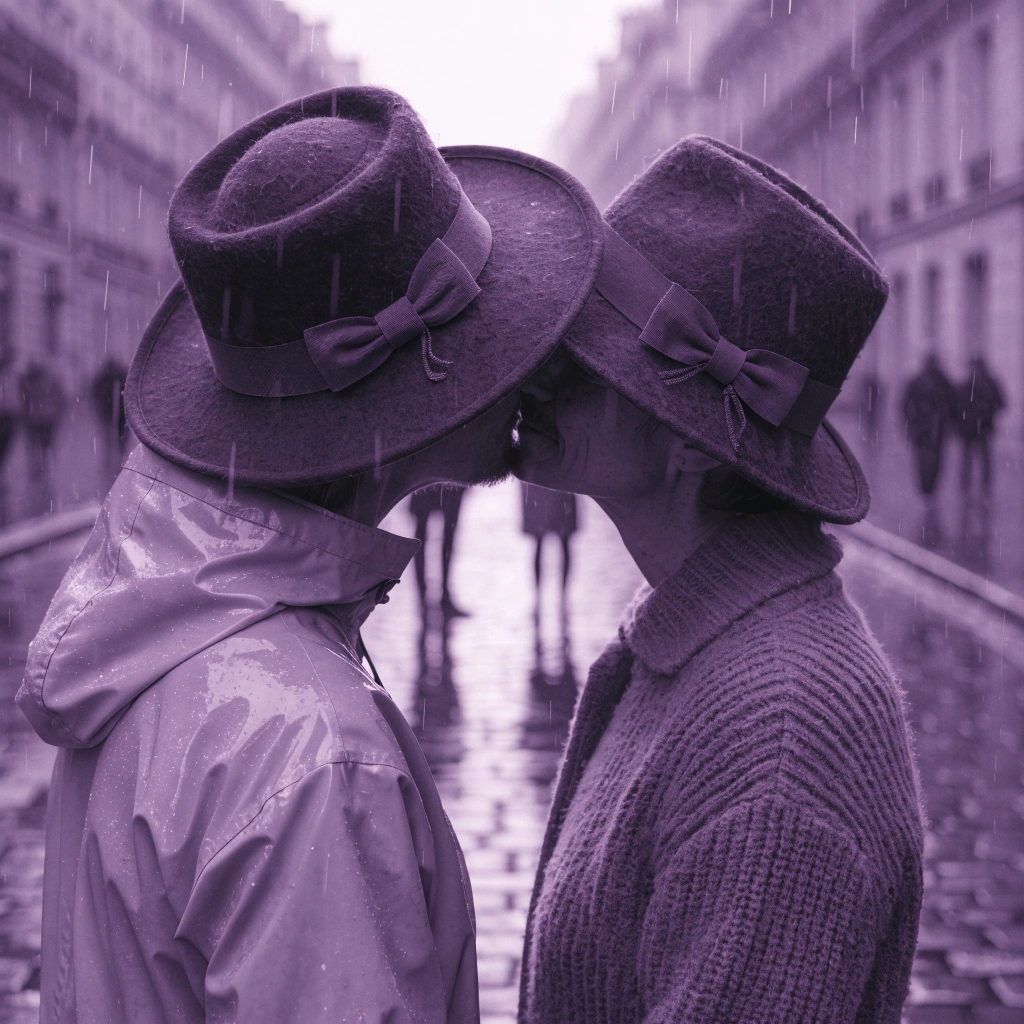
La Bise: A French Greeting
In France, people have a special greeting. It is called "la bise." Friends and family use it. They touch cheeks and make a kissing sound. It is a warm way to say hello.
The rules are different in every city. Sometimes people do two kisses. In other places, they do three or four kisses. It is a friendly tradition.
This greeting is very common. It shows that people are happy to see you. Men, women, and children do "la bise." It is a part of French life.
Point grammaire
Structure: Present Simple (to be)
"It is a warm way to say hello."
We use the verb 'to be' (am, is, are) to describe facts or states. For singular objects like 'it,' we always use 'is.'
Structure: Present Simple (Plural Subjects)
"Friends and family use it."
We use the present simple for habits. When the subject is plural, like 'friends and family,' we use the base form of the verb without adding an 's'.
Teste ta compréhension
10 questions · A1 Débutant · 1 aperçu gratuit
Teste ce que tu as appris dans cet article. Réponds à toutes les questions pour gagner des XP !
What is "la bise"?
Tu veux terminer le quiz ?
9 questions supplémentaires t'attendent. Inscris-toi gratuitement pour débloquer le quiz complet et gagner des XP !
S'inscrire gratuitementTu as dj un compte ? Connexion
Bien joué !
Continue à pratiquer !
Déjà terminé — pas de XP supplémentaire
Inscris-toi pour gagner des XPDétail des questions
What is "la bise"?
Ta réponse:
Bonne réponse: A way to say hello
People touch cheeks during "la bise."
Ta réponse:
Bonne réponse: Vrai
What does "common" mean?
Ta réponse:
Bonne réponse: Something that happens often
The _____ are different in every city.
Ta réponse:
Bonne réponse: rules
La Bise: A Special French Greeting
In France, people have a special way to say hello. They call it "la bise." It is a famous tradition, but it can be confusing for visitors. When people do la bise, they touch cheeks and make a kissing sound in the air. This greeting is older than many people think. It started a long time ago with the Romans. Today, it is a sign of friendship and warmth. People do it when they meet friends or family. In some regions, they kiss two times, but in other places, they kiss three or four times! Social rules for la bise are sometimes difficult. For example, men usually shake hands, but women often use la bise. However, in some families, men also kiss each other on the cheeks. It is often more common in the south than in the north of France. Foreigners might feel nervous at first because the rules change everywhere. But do not worry! If you visit France, just watch the local people. It is a beautiful way to feel part of the group.
Point grammaire
Structure: Comparatives
"It is often more common in the south than in the north of France."
We use 'more' with long adjectives like 'common' to compare two things. We always use 'than' after the adjective to show what we are comparing it to.
Structure: Past Simple
"It started a long time ago with the Romans."
The past simple is used for actions that finished in the past. For regular verbs like 'start', we add '-ed' to the end.
Teste ta compréhension
11 questions · A2 mentaire · 1 aperçu gratuit
Teste ce que tu as appris dans cet article. Réponds à toutes les questions pour gagner des XP !
What is 'la bise'?
Tu veux terminer le quiz ?
10 questions supplémentaires t'attendent. Inscris-toi gratuitement pour débloquer le quiz complet et gagner des XP !
S'inscrire gratuitementTu as dj un compte ? Connexion
Bien joué !
Continue à pratiquer !
Déjà terminé — pas de XP supplémentaire
Inscris-toi pour gagner des XPDétail des questions
What is 'la bise'?
Ta réponse:
Bonne réponse: A traditional way to say hello
The number of kisses is the same in every part of France.
Ta réponse:
Bonne réponse: Faux
What does 'nervous' mean?
Ta réponse:
Bonne réponse: Feeling worried or afraid
In some regions, they kiss three or _____ times.
Ta réponse:
Bonne réponse: four
Who originally started the tradition of la bise?
Ta réponse:
Bonne réponse: The Romans
A Kiss on the Cheek: Understanding La Bise in France
Have you ever visited France? If you have, you have probably seen people greeting each other with a kiss on each cheek. This famous tradition is known as "la bise." It is a social gesture that shows warmth and friendship. However, for many foreigners who visit the country, this tradition can be quite confusing because the rules are not always clear.
The practice of la bise involves touching cheeks and making a kissing sound in the air. It is important to remember that it is not a real kiss on the skin. Instead, it is a sign of social inclusion. The number of kisses that are required usually depends on the region where you are staying. In Paris, two kisses are common, but in other parts of France, people might give three or even four. This can lead to some funny moments when people from different cities meet!
This custom has been practiced for centuries. It is believed that the tradition was started by the Romans, who used different types of kisses to show social status. Today, "la bise" is mostly used between friends, family members, or colleagues who know each other well. In formal or professional situations, a handshake is still the standard greeting, although this is slowly changing in some modern workplaces.
If you are invited to a French home, you will notice that "la bise" is a way to make everyone feel welcome. It signals that you are part of the social circle. Even if it feels a bit strange at first, most travelers find that they quickly get used to it. If you are unsure about what to do, just follow the lead of the person who is greeting you. It is a wonderful way to experience the local culture.
Point grammaire
Structure: Passive Voice
"This famous tradition is known as "la bise.""
The passive voice is used when the focus is on the action rather than the person doing it. It is formed using 'to be' + the past participle.
Structure: Relative Clauses
"...for many foreigners who visit the country, this tradition can be quite confusing."
Relative clauses give more information about a noun. We use 'who' for people and 'which' or 'that' for things.
Teste ta compréhension
11 questions · B1 Intermédiaire · 1 aperçu gratuit
Teste ce que tu as appris dans cet article. Réponds à toutes les questions pour gagner des XP !
What does 'la bise' primarily involve?
Tu veux terminer le quiz ?
10 questions supplémentaires t'attendent. Inscris-toi gratuitement pour débloquer le quiz complet et gagner des XP !
S'inscrire gratuitementTu as dj un compte ? Connexion
Bien joué !
Continue à pratiquer !
Déjà terminé — pas de XP supplémentaire
Inscris-toi pour gagner des XPDétail des questions
What does 'la bise' primarily involve?
Ta réponse:
Bonne réponse: Touching cheeks and making a sound
La bise is a real kiss directly on the lips.
Ta réponse:
Bonne réponse: Faux
What does 'gesture' mean?
Ta réponse:
Bonne réponse: A movement of the body to express a feeling
The number of kisses usually depends on the _____ where you are staying.
Ta réponse:
Bonne réponse: region
Where are two kisses common according to the text?
Ta réponse:
Bonne réponse: Paris
Navigating the Nuances of the French Greeting: La Bise
The practice of 'la bise' is undoubtedly the most iconic and, for many expatriates, the most perplexing element of French social life. This ritual, which involves touching cheeks while simultaneously making a kissing sound in the air, serves as a powerful gesture that signifies warmth and social inclusion. Despite its apparent simplicity, the act is governed by a complex set of unwritten rules that vary significantly depending on regional traditions, social class, and the level of intimacy between the individuals involved. Consequently, mastering this greeting requires not only physical coordination but also a keen understanding of cultural context.
Historically, the origins of this custom can be traced back to the Roman 'osculum,' a formal kiss that established social bonds. In modern France, however, 'la bise' has evolved into a more casual yet deeply significant social glue. For an outsider, the most challenging aspect is often determining the correct number of kisses. While two is the standard in Paris, residents in the south or west of the country might expect three or even four. Furthermore, the question of which cheek to offer first is a matter of ongoing debate, often leading to awkward 'near-misses' for those unacquainted with local habits.
Social dynamics also play a crucial role in how 'la bise' is performed. It is generally customary among friends and family, but its application in professional settings remains a subject of delicate etiquette. While younger generations are increasingly inclusive and informal, a more traditional approach often prevails in formal environments. If an employee were to misjudge the social distance between themselves and a superior, the result could be a moment of significant social friction. Therefore, observation is key; it is usually safer to wait for the other person to initiate the gesture.
Moreover, the practice is not merely a physical exchange but a reflection of French values regarding community and personal connection. By engaging in 'la bise,' individuals acknowledge their membership within a social circle, breaking down the barriers of formality that might otherwise exist. Although globalization has introduced more international greetings like the handshake or the wave, 'la bise' remains a resilient symbol of French identity. Understanding these intricacies is essential for anyone wishing to truly integrate into French society, as it demonstrates a respect for the subtle variations that define the nation's rich cultural tapestry.
Point grammaire
Structure: The Passive Voice
"The practice of 'la bise' is governed by a complex set of unwritten rules."
The passive voice is used here to emphasize the action and the rules rather than the specific people performing them. It is formed using the verb 'to be' followed by the past participle of the main verb.
Structure: Non-defining Relative Clauses
"This ritual, which involves touching cheeks while simultaneously making a kissing sound in the air, serves as a powerful gesture."
These clauses provide extra, non-essential information about a noun and are separated by commas. They are common in B2 writing to add descriptive detail and sophistication to sentences.
Structure: The Second Conditional
"If an employee were to misjudge the social distance between themselves and a superior, the result could be a moment of significant social friction."
This structure is used to discuss hypothetical or unlikely situations in the present or future. It uses 'if' + past simple (or 'were to' for extra formality) and 'would' or 'could' + the base verb.
Teste ta compréhension
11 questions · B2 Intermédiaire supérieur · 1 aperçu gratuit
Teste ce que tu as appris dans cet article. Réponds à toutes les questions pour gagner des XP !
What is the primary social function of 'la bise' according to the article?
Tu veux terminer le quiz ?
10 questions supplémentaires t'attendent. Inscris-toi gratuitement pour débloquer le quiz complet et gagner des XP !
S'inscrire gratuitementTu as dj un compte ? Connexion
Bien joué !
Continue à pratiquer !
Déjà terminé — pas de XP supplémentaire
Inscris-toi pour gagner des XPDétail des questions
What is the primary social function of 'la bise' according to the article?
Ta réponse:
Bonne réponse: To signify warmth and social inclusion
The number of kisses involved in 'la bise' is standardized at two throughout all of France.
Ta réponse:
Bonne réponse: Faux
What does the word 'nuance' mean in the context of the article?
Ta réponse:
Bonne réponse: A very slight difference in meaning or tone
The practice of 'la bise' is governed by a complex set of _____ rules.
Ta réponse:
Bonne réponse: unwritten
Where can the historical origins of 'la bise' be traced back to?
Ta réponse:
Bonne réponse: Ancient Rome
Decoding the Social Choreography of La Bise
Rarely does a simple physical gesture carry such heavy cultural baggage as the French kiss on the cheek, known as 'la bise'. To the uninitiated, it appears to be a charmingly archaic greeting; however, to the French, it is a sophisticated social ritual that oscillates between warmth and rigid protocol. The perpetuation of this custom serves as a testament to the enduring power of French social cohesion, yet it remains a source of profound ambiguity for those attempting to navigate the Gallic social landscape. It is the unspoken nature of these rules that often leaves foreigners in a state of social paralysis, wondering whether to lean in or pull away.
Historically, the roots of this practice are deeply ingrained in European history, tracing back to the Roman 'osculum'. Nevertheless, its modern manifestation is far more nuanced than its ancient predecessor. The gesture involves a delicate touch of the cheeks accompanied by a faint kissing sound—actual lip contact is generally considered a breach of etiquette. What complicates the matter further is the regionality of the act. While Parisians typically settle for two kisses, residents of Montpellier or parts of the Loire Valley may insist on three or even four. This numerical variation is not merely a regional quirk; it is a fundamental component of the local identity.
Furthermore, the egalitarian facade of the bise masks a complex hierarchy. The decision of who initiates the gesture is often dictated by social standing or seniority. In professional settings, the bise has seen a gradual decline, replaced by the more globalized handshake, yet in private spheres, its dominance remains unchallenged. The paradoxical nature of the bise lies in its ability to simultaneously establish intimacy and maintain a respectful distance. It is a physical manifestation of inclusion, a signal that one has been accepted into the inner circle of a social group.
In recent years, the practice has faced unprecedented scrutiny. The global pandemic necessitated a sudden cessation of the bise, prompting a national conversation about personal space and hygiene. Some argued that the hiatus provided a welcome relief from a custom that could feel performative or even intrusive, particularly for women who often bear a disproportionate social expectation to participate. However, as social restrictions eased, the bise returned with remarkable resilience. Not only does the practice foster a sense of belonging, but it also reinforces the cultural distinctiveness of the Francophone world.
Ultimately, mastering the bise requires more than just physical coordination; it demands a keen sensitivity to social cues and an appreciation for the subtle shifts in body language. Whether it is viewed as a delightful tradition or a daunting social hurdle, the bise remains an indispensable element of the French experience. To understand the bise is to understand the delicate balance between the individual and the collective that defines French society.
Point grammaire
Structure: Negative Inversion
"Rarely does a simple physical gesture carry such heavy cultural baggage as the French kiss on the cheek."
Inversion is used after negative or restrictive adverbs like 'rarely' or 'seldom' to add emphasis. The auxiliary verb 'does' is placed before the subject 'a simple physical gesture'.
Structure: Cleft Sentence
"It is the unspoken nature of these rules that often leaves foreigners in a state of social paralysis."
Cleft sentences (It + is/was + subject + that/who) are used to focus on a specific part of the sentence. Here, it emphasizes 'the unspoken nature' as the primary cause of confusion.
Structure: Nominalization
"The perpetuation of this custom serves as a testament to the enduring power of French social cohesion."
Nominalization involves turning verbs (perpetuate) into nouns (perpetuation). This is a hallmark of C1 writing as it creates a more formal, abstract, and concise tone.
Teste ta compréhension
12 questions · C1 Avancé · 1 aperçu gratuit
Teste ce que tu as appris dans cet article. Réponds à toutes les questions pour gagner des XP !
According to the article, why is 'la bise' confusing for foreigners?
Tu veux terminer le quiz ?
11 questions supplémentaires t'attendent. Inscris-toi gratuitement pour débloquer le quiz complet et gagner des XP !
S'inscrire gratuitementTu as dj un compte ? Connexion
Bien joué !
Continue à pratiquer !
Déjà terminé — pas de XP supplémentaire
Inscris-toi pour gagner des XPDétail des questions
According to the article, why is 'la bise' confusing for foreigners?
Ta réponse:
Bonne réponse: Because it is governed by unwritten, complex, and regional rules.
Actual lip-to-cheek contact is a required part of a proper 'bise'.
Ta réponse:
Bonne réponse: Faux
What does 'ambiguity' mean in the context of the text?
Ta réponse:
Bonne réponse: The quality of being open to multiple interpretations.
The decision of who initiates the gesture is often dictated by social standing or _____.
Ta réponse:
Bonne réponse: seniority
What was the result of the pandemic on the practice of 'la bise'?
Ta réponse:
Bonne réponse: It led to a conversation about personal space and hygiene.
The number of kisses involved in the bise is the same throughout all of France.
Ta réponse:
Bonne réponse: Faux
The Ritualized Choreography of the Osculum: Deciphering the Socio-Semiotic Tapestry of 'La Bise'
To the uninitiated observer, the French practice of 'la bise' might appear as a mere perfunctory salutation, a fleeting brush of cheeks accompanied by the mimetic sound of a kiss. Yet, to dismiss it as such would be to overlook a profound socio-semiotic tapestry that defines the very essence of Gallic interpersonal relations. This idiosyncratic custom, governed by a labyrinthine set of unwritten protocols, serves as a litmus test for social integration and cultural fluency. Were one to traverse the French hexagonal landscape, one would quickly discern that the bise is far from monolithic; rather, it is a localized phenomenon, subject to the whims of regional tradition and the subtle nuances of social stratification. It is a gesture that demands both physical precision and an intuitive grasp of the prevailing social climate.
Historically, the bise finds its vestigial roots in the Roman 'osculum', a gesture of social recognition that transcended mere affection. Over centuries, it has evolved into a codified ritual that balances the delicate tension between intimacy and formality. In contemporary France, the practice is ubiquitous, yet its execution requires an almost mathematical precision. Not only does the number of kisses fluctuate—ranging from a dual exchange in Paris to a quadruple encounter in parts of the Vendée—but the very cheek upon which the ritual commences is often a source of regional contention. Should one inadvertently miscalculate the appropriate number of contact points, the resulting social dissonance can be palpable, casting a shadow of awkwardness over the nascent interaction.
Furthermore, the bise acts as a mechanism for reinforcing social hierarchies and gender dynamics. While it ostensibly promotes an egalitarian ethos of warmth, its application is frequently mediated by power structures. In professional spheres, the decision to engage in the bise is often the prerogative of the superior, a subtle assertion of dominance or, conversely, a gesture of benevolent inclusion. For the foreign interlocutor, navigating these waters requires a keen perception of the ambivalence inherent in the act—a gesture that is simultaneously inclusive and exclusionary. It is a performance of belonging that requires the participant to be acutely aware of their standing within the group.
The advent of the global pandemic, however, precipitated a seismic shift in this ancestral paradigm. The enforced hiatus of physical contact led many to reflect on the hegemony of the bise, with some advocating for its permanent retirement in favor of more hygienic, or perhaps less intrusive, alternatives. Yet, as the world recalibrates, the resilience of the bise has become evident. It remains a cornerstone of French identity, a defiant reclamation of physical propinquity in an increasingly digitized world. Ultimately, to master the bise is to acknowledge that in France, the air between two cheeks is never truly empty; it is thick with history, status, and the enduring human need for connection.
Point grammaire
Structure: Inverted Conditionals (Subjunctive)
"Were one to traverse the French hexagonal landscape, one would quickly discern that the bise is far from monolithic."
This structure replaces 'If one were to traverse'. It is used in formal, academic English to express a hypothetical situation in the present or future, adding a scholarly tone.
Structure: Negative Inversion
"Not only does the number of kisses fluctuate—ranging from a dual exchange in Paris to a quadruple encounter in parts of the Vendée—but the very cheek upon which the ritual commences is often a source of regional contention."
When a sentence begins with a negative or restrictive expression like 'Not only', the auxiliary verb comes before the subject. This is used for rhetorical emphasis.
Structure: Inverted First Conditional
"Should one inadvertently miscalculate the appropriate number of contact points, the resulting social dissonance can be palpable."
Using 'Should' instead of 'If' at the beginning of a conditional sentence makes it more formal and suggests a slightly lower degree of probability.
Teste ta compréhension
12 questions · C2 Maîtrise · 1 aperçu gratuit
Teste ce que tu as appris dans cet article. Réponds à toutes les questions pour gagner des XP !
According to the text, what does 'la bise' represent in French society beyond a simple greeting?
Tu veux terminer le quiz ?
11 questions supplémentaires t'attendent. Inscris-toi gratuitement pour débloquer le quiz complet et gagner des XP !
S'inscrire gratuitementTu as dj un compte ? Connexion
Bien joué !
Continue à pratiquer !
Déjà terminé — pas de XP supplémentaire
Inscris-toi pour gagner des XPDétail des questions
According to the text, what does 'la bise' represent in French society beyond a simple greeting?
Ta réponse:
Bonne réponse: A complex socio-semiotic indicator of social integration.
The number of kisses involved in 'la bise' is uniform across all regions of France.
Ta réponse:
Bonne réponse: Faux
Which word describes something that is arranged into a systematic set of rules?
Ta réponse:
Bonne réponse: Codified
The bise acts as a mechanism for reinforcing social _____ and gender dynamics.
Ta réponse:
Bonne réponse: hierarchies
How did the global pandemic affect the perception of 'la bise'?
Ta réponse:
Bonne réponse: It led to a reflection on its dominance and necessity.
In professional settings, the decision to perform the bise is often controlled by the person in a higher position.
Ta réponse:
Bonne réponse: Vrai

