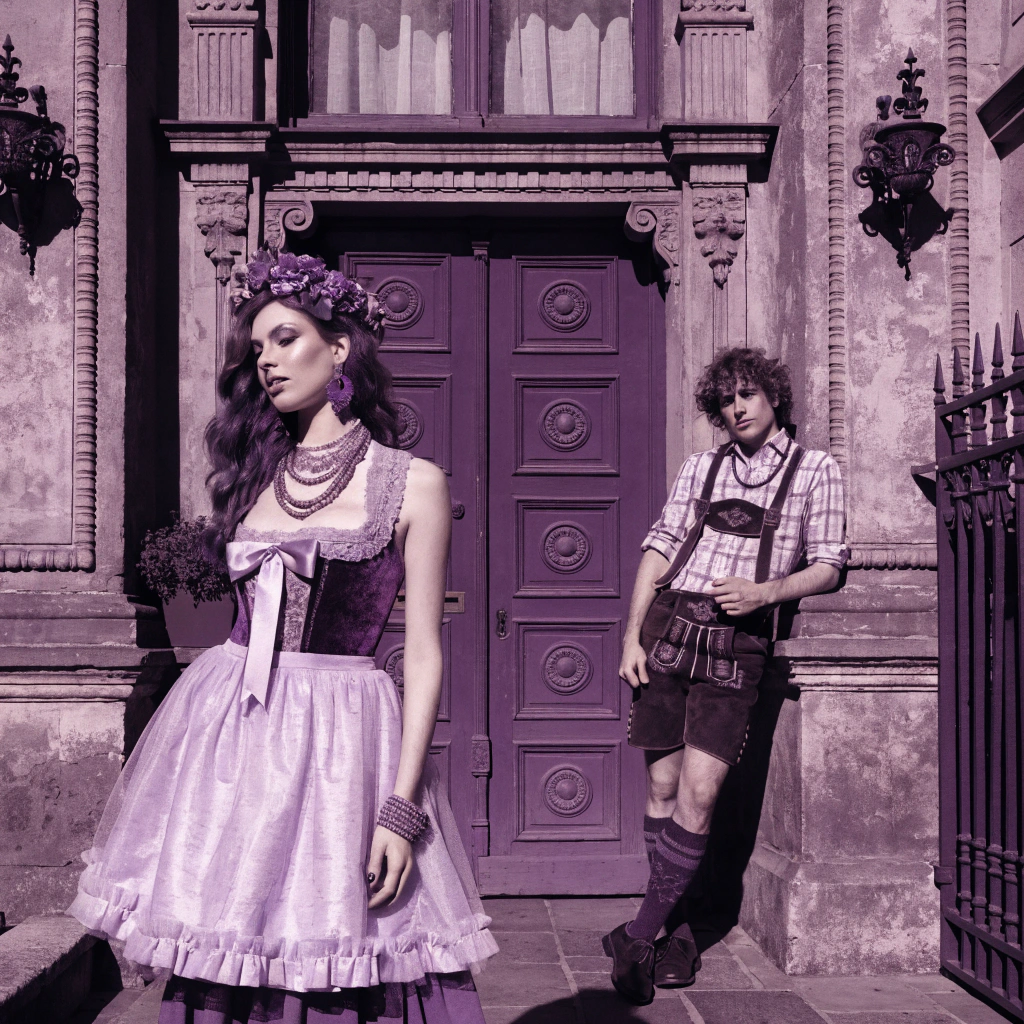
Les vêtements traditionnels en Allemagne
En Allemagne, il y a des vêtements traditionnels. On appelle ces vêtements la « Tracht ». C’est une tradition très ancienne et célèbre.
Les femmes portent le Dirndl. Le Dirndl est une robe avec une chemise blanche et un tablier coloré. C’est très joli.
Les hommes portent le Lederhosen. C’est un pantalon court. Le pantalon est en cuir. Les hommes portent aussi des chemises à carreaux.
Les gens portent ces vêtements pour les fêtes, comme l'Oktoberfest. C’est un symbole de la culture en Bavière. Aujourd’hui, beaucoup de touristes aiment ces vêtements.
Point grammaire
Structure: Le présent de l'indicatif
"Les femmes portent le Dirndl."
On utilise le présent pour parler de faits actuels ou d'habitudes. Pour les verbes en -er comme 'porter', on utilise les terminaisons : -e, -es, -e, -ons, -ez, -ent.
Structure: L'accord de l'adjectif
"une chemise blanche"
En français, l'adjectif change selon le nom. Ici, 'chemise' est féminin, donc on ajoute un 'e' à l'adjectif 'blanc' pour faire 'blanche'.
Teste ta compréhension
10 questions · A1 Débutant · 1 aperçu gratuit
Teste ce que tu as appris dans cet article. Réponds à toutes les questions pour gagner des XP !
De quel pays parle l'article ?
Tu veux terminer le quiz ?
9 questions supplémentaires t'attendent. Inscris-toi gratuitement pour débloquer le quiz complet et gagner des XP !
S'inscrire gratuitementTu as dj un compte ? Connexion
Bien joué !
Continue à pratiquer !
Déjà terminé — pas de XP supplémentaire
Inscris-toi pour gagner des XPDétail des questions
De quel pays parle l'article ?
Ta réponse:
Bonne réponse: L'Allemagne
Le Lederhosen est un pantalon pour les femmes.
Ta réponse:
Bonne réponse: Faux
Que signifie le mot 'cuir' ?
Ta réponse:
Bonne réponse: La peau d'un animal
Le Dirndl est une _____ avec un tablier.
Ta réponse:
Bonne réponse: robe
Traditional German Clothes: Dirndl and Lederhosen
Many people know traditional German clothes. Women wear a dress called a Dirndl and men wear leather trousers called Lederhosen. These clothes are from Bavaria, a beautiful region in the south of Germany.
In the past, farmers wore these clothes for hard work. Lederhosen are stronger than normal trousers because they are made of leather. This material is very tough and lasts for a long time. Women’s dresses were simple in the past, but now they are more colorful and expensive.
Today, Germans do not wear Tracht every day. They usually wear it for special festivals like Oktoberfest. It is an important symbol of their history and culture. Many young people enjoy wearing these clothes today because they feel proud of their heritage. In fact, Tracht is more popular now than it was fifty years ago. It is a great way to celebrate German traditions with friends and family.
Point grammaire
Structure: Comparatives
"Lederhosen are stronger than normal trousers because they are made of leather."
We use 'adjective + er + than' to compare two things. For long adjectives like 'popular', we use 'more' before the word.
Structure: Connectors (Because)
"Many young people enjoy wearing these clothes today because they feel proud of their heritage."
We use 'because' to give a reason for an action or feeling. It connects two parts of a sentence to show cause and effect.
Teste ta compréhension
11 questions · A2 mentaire · 1 aperçu gratuit
Teste ce que tu as appris dans cet article. Réponds à toutes les questions pour gagner des XP !
Where is Bavaria located?
Tu veux terminer le quiz ?
10 questions supplémentaires t'attendent. Inscris-toi gratuitement pour débloquer le quiz complet et gagner des XP !
S'inscrire gratuitementTu as dj un compte ? Connexion
Bien joué !
Continue à pratiquer !
Déjà terminé — pas de XP supplémentaire
Inscris-toi pour gagner des XPDétail des questions
Where is Bavaria located?
Ta réponse:
Bonne réponse: In the south of Germany
Germans wear Tracht every day to go to work.
Ta réponse:
Bonne réponse: Faux
What does 'heritage' mean?
Ta réponse:
Bonne réponse: Traditions and history from the past
Lederhosen are stronger than normal trousers because they are made of _____.
Ta réponse:
Bonne réponse: leather
Why did farmers wear Lederhosen in the past?
Ta réponse:
Bonne réponse: Because the material was tough for hard work
La mode traditionnelle allemande : le Dirndl et le Lederhosen
Quand on pense à l'Allemagne, on imagine souvent des vêtements traditionnels colorés. Cette mode, appelée « Tracht », est particulièrement célèbre en Bavière et dans les régions alpines. Bien qu'il existe de nombreux styles différents selon les régions, le Dirndl pour les femmes et le Lederhosen pour les hommes sont les plus connus à travers le monde. Ils sont devenus des symboles de l'identité culturelle allemande.
Le mot « Tracht » désigne tout costume traditionnel qui appartient à une région spécifique. Historiquement, ces vêtements ont été créés pour être pratiques et résistants. Les Lederhosen, qui sont des culottes courtes en cuir, étaient portés par les paysans parce qu'ils étaient parfaits pour le travail manuel difficile. Le Dirndl, quant à lui, était à l'origine la tenue simple des servantes avant de devenir populaire dans la haute société au XIXe siècle.
Aujourd'hui, ces costumes ne sont plus portés quotidiennement, mais ils restent très populaires lors de grandes occasions. Ils sont portés avec fierté pendant les fêtes régionales comme l'Oktoberfest à Munich, ou lors de mariages traditionnels. Le Dirndl se compose généralement d'une robe, d'un chemisier blanc et d'un tablier. Un détail intéressant est la position du nœud sur le tablier : il indique si la femme est célibataire ou mariée !
Bien que la mode évolue, le respect pour ces traditions demeure fort. De nombreux jeunes Allemands achètent aujourd'hui des versions modernes de ces vêtements pour célébrer leur héritage tout en restant élégants. C'est une belle manière de lier le passé au présent et de montrer son attachement à ses racines.
Point grammaire
Structure: La voix passive
"Ces vêtements ont été créés pour être pratiques."
On utilise la voix passive quand l'action est plus importante que la personne qui la fait. Elle se forme avec l'auxiliaire 'être' conjugué et le participe passé du verbe.
Structure: Les pronoms relatifs (qui, que)
"Le mot « Tracht » désigne tout costume traditionnel qui appartient à une région spécifique."
Le pronom relatif 'qui' remplace le sujet du verbe suivant. Il permet de relier deux phrases pour éviter la répétition du nom.
Teste ta compréhension
11 questions · B1 Intermédiaire · 1 aperçu gratuit
Teste ce que tu as appris dans cet article. Réponds à toutes les questions pour gagner des XP !
Où la mode 'Tracht' est-elle la plus célèbre ?
Tu veux terminer le quiz ?
10 questions supplémentaires t'attendent. Inscris-toi gratuitement pour débloquer le quiz complet et gagner des XP !
S'inscrire gratuitementTu as dj un compte ? Connexion
Bien joué !
Continue à pratiquer !
Déjà terminé — pas de XP supplémentaire
Inscris-toi pour gagner des XPDétail des questions
Où la mode 'Tracht' est-elle la plus célèbre ?
Ta réponse:
Bonne réponse: En Bavière et dans les Alpes
Les Lederhosen ont été créés à l'origine pour les rois.
Ta réponse:
Bonne réponse: Faux
Que signifie le mot 'cuir' ?
Ta réponse:
Bonne réponse: La peau d'un animal traitée
La position du _____ sur le tablier indique la situation amoureuse de la femme.
Ta réponse:
Bonne réponse: nœud
Pourquoi les paysans portaient-ils des Lederhosen ?
Ta réponse:
Bonne réponse: Parce qu'ils étaient résistants pour le travail
Beyond the Costume: The Cultural Evolution of German Tracht
When international observers envision German culture, the iconic image of 'Tracht'—specifically the Dirndl for women and Lederhosen for men—frequently emerges as a primary symbol. Although these garments are most strongly associated with Bavaria and the Alpine regions, they have historically functioned as significant markers of regional identity throughout Central Europe. The term 'Tracht' actually encompasses any traditional costume specific to a particular region, occupation, or social class. Historically, these garments were born out of practical necessity rather than aesthetic preference. Lederhosen, crafted from durable animal hides, were designed to withstand the rigorous physical labor of the peasantry, while the Dirndl served as a functional uniform for female domestic servants.
During the 19th century, a significant shift occurred as the urban aristocracy began to romanticize rural life. Consequently, what was once considered humble workwear was adopted by the elite, leading to more elaborate and decorative versions of the attire. Had the Bavarian royalty not embraced these styles during this period, the tradition might have faded into obscurity. Instead, this royal patronage ensured the preservation of these styles, transforming them into a sophisticated expression of national heritage. Today, the resurgence of Tracht is most visible during the world-famous Oktoberfest, where millions of attendees don these outfits to celebrate their roots.
Modern fashion designers have also begun to reinterpret these traditional elements, blending historical silhouettes with contemporary fabrics. This evolution demonstrates that Tracht is not a static relic of the past but a living tradition that continues to adapt. While the garments have become highly commercialized, for many Germans, wearing them remains a distinctive way to honor their local history and community. The intricate embroidery and specific accessories often indicate a wearer's specific village or marital status, proving that these clothes still communicate complex social messages. Ultimately, the enduring popularity of Dirndl and Lederhosen highlights a collective desire to maintain a tangible link to the past in an increasingly globalized world.
Point grammaire
Structure: Passive Voice
"Lederhosen, crafted from durable animal hides, were designed to withstand the rigorous physical labor of the peasantry."
The passive voice is used here to focus on the object (Lederhosen) rather than the unknown or less important creators. It is formed using the verb 'to be' and the past participle.
Structure: Third Conditional (Inverted)
"Had the Bavarian royalty not embraced these styles during this period, the tradition might have faded into obscurity."
This is a formal way of saying 'If the royalty had not embraced...'. It describes a hypothetical past situation and its probable result, using inversion for emphasis.
Structure: Non-defining Relative Clause
"The term 'Tracht' actually encompasses any traditional costume specific to a particular region, occupation, or social class."
This clause adds extra information about the subject. In B2 writing, these clauses help create more complex and informative sentences.
Teste ta compréhension
11 questions · B2 Intermédiaire supérieur · 1 aperçu gratuit
Teste ce que tu as appris dans cet article. Réponds à toutes les questions pour gagner des XP !
What was the primary reason Lederhosen were originally created?
Tu veux terminer le quiz ?
10 questions supplémentaires t'attendent. Inscris-toi gratuitement pour débloquer le quiz complet et gagner des XP !
S'inscrire gratuitementTu as dj un compte ? Connexion
Bien joué !
Continue à pratiquer !
Déjà terminé — pas de XP supplémentaire
Inscris-toi pour gagner des XPDétail des questions
What was the primary reason Lederhosen were originally created?
Ta réponse:
Bonne réponse: For practical use during hard physical work
The word 'Tracht' refers exclusively to clothing from the Bavarian region.
Ta réponse:
Bonne réponse: Faux
Which word describes a revival or a return to popularity?
Ta réponse:
Bonne réponse: Resurgence
The Dirndl originally served as a functional _____ for female domestic servants.
Ta réponse:
Bonne réponse: uniform
According to the text, why did Tracht become more decorative in the 19th century?
Ta réponse:
Bonne réponse: The elite began to romanticize rural life
Au-delà du folklore : La Tracht, entre héritage identitaire et réinvention contemporaine
Lorsqu'on évoque l'esthétique vestimentaire germanique, l'imaginaire collectif convoque irrémédiablement les silhouettes contrastées du Dirndl et de la Lederhosen. Pourtant, réduire la « Tracht » à un simple apparat folklorique destiné aux réjouissances de l'Oktoberfest serait faire l'économie d'une analyse socioculturelle profonde. Ce terme, dérivé du verbe « tragen » (porter), désigne originellement l'ensemble des codes vestimentaires propres à une région, une classe sociale ou une corporation. Si les variantes alpines jouissent aujourd'hui d'une hégémonie symbolique mondiale, elles n'en demeurent pas moins le fruit d'une sédimentation historique complexe où se mêlent nécessité utilitaire et revendication identitaire.
Historiquement, la Lederhosen — cette culotte de cuir robuste — fut conçue pour répondre aux exigences du labeur paysan et de la chasse en milieu montagnard. Sa pérennité s'explique par la résistance exceptionnelle du matériau, capable de braver les outrages du temps et du climat. À l'inverse, le Dirndl féminin, bien que trouvant ses racines dans le vêtement de travail des servantes, a subi une métamorphose radicale au XIXe siècle. C'est sous l'impulsion de l'aristocratie bavaroise, et notamment du roi Maximilien II, que ces habits ruraux furent élevés au rang de costume national. Ce processus de « folklorisation » par les élites visait à cimenter un sentiment d'appartenance au sein d'un empire en quête de cohésion. Peut-être ne verrait-on pas aujourd'hui une telle effervescence autour de ces tenues sans ce parrainage royal qui en a modifié la perception sociale.
À l'ère de la mondialisation galopante, on pourrait s'attendre à ce que de tels atours soient relégués au rang de vestiges désuets. Or, force est de constater un regain d'intérêt fulgurant, particulièrement chez la jeune génération. Ce phénomène, souvent qualifié de « Trachten-Boom », ne relève pas uniquement d'une nostalgie romantique. Il s'inscrit dans une volonté de s'affranchir de l'uniformisation vestimentaire contemporaine en affichant un ancrage territorial fort. Paradoxalement, cette quête d'authenticité s'accompagne d'une réinterprétation constante des codes. Les créateurs contemporains n'hésitent plus à marier les tissus traditionnels avec des coupes avant-gardistes, prouvant que la tradition n'est pas une entité figée, mais un matériau vivant.
Néanmoins, cette popularité renouvelée ne va pas sans susciter des débats passionnés. Certains puristes déplorent la commercialisation outrancière de la Tracht, transformée par endroits en déguisement de piètre qualité pour touristes en quête d'exotisme. C'est précisément là que réside le dilemme actuel : comment préserver l'intégrité d'un patrimoine séculaire tout en acceptant son inévitable évolution marchande ? Quoi qu'il en soit, la Tracht demeure un vecteur de communication non verbal puissant, capable de transcender les barrières linguistiques pour affirmer une continuité historique dans un monde en perpétuelle mutation.
Point grammaire
Structure: L'inversion sujet-verbe après certains adverbes
"Peut-être ne verrait-on pas aujourd'hui une telle effervescence..."
En français soutenu, après des adverbes comme 'peut-être', 'à peine' ou 'sans doute' placés en début de phrase, on inverse le sujet et le verbe pour un effet stylistique.
Structure: La mise en relief (C'est... que/qui)
"C'est sous l'impulsion de l'aristocratie bavaroise [...] que ces habits ruraux furent élevés au rang de costume national."
Cette structure clivée permet d'insister sur un élément précis de la phrase (ici, la cause de l'élévation sociale du costume).
Structure: Le subjonctif après une conjonction de concession
"Quoi qu'il en soit, la Tracht demeure un vecteur de communication..."
L'expression 'quoi qu'il en soit' utilise le subjonctif pour exprimer une concession ou une indifférence quant à la nature de l'événement précédent.
Teste ta compréhension
12 questions · C1 Avancé · 1 aperçu gratuit
Teste ce que tu as appris dans cet article. Réponds à toutes les questions pour gagner des XP !
Quelle est l'origine étymologique du mot « Tracht » selon l'article ?
Tu veux terminer le quiz ?
11 questions supplémentaires t'attendent. Inscris-toi gratuitement pour débloquer le quiz complet et gagner des XP !
S'inscrire gratuitementTu as dj un compte ? Connexion
Bien joué !
Continue à pratiquer !
Déjà terminé — pas de XP supplémentaire
Inscris-toi pour gagner des XPDétail des questions
Quelle est l'origine étymologique du mot « Tracht » selon l'article ?
Ta réponse:
Bonne réponse: Le verbe 'tragen', qui signifie porter
Le Dirndl a toujours été considéré comme un vêtement de haute société.
Ta réponse:
Bonne réponse: Faux
Que signifie le mot 'désuet' dans le contexte de l'article ?
Ta réponse:
Bonne réponse: Ancien et qui n'est plus utilisé
Le regain d'intérêt pour la Tracht est souvent qualifié de _____ -Boom.
Ta réponse:
Bonne réponse: Trachten
Quel rôle le roi Maximilien II a-t-il joué dans l'histoire de la Tracht ?
Ta réponse:
Bonne réponse: Il a promu les habits ruraux au rang de costume national
Les créateurs modernes refusent de modifier les coupes traditionnelles de la Tracht.
Ta réponse:
Bonne réponse: Faux
The Semiotics of Sartorial Heritage: Deconstructing the Phenomenon of Tracht
The sartorial landscape of Central Europe is perhaps nowhere more vividly encapsulated than in the enduring tradition of Tracht. While the casual observer might perceive the Dirndl and Lederhosen as mere vestiges of a bygone agrarian epoch, a more nuanced semiotic analysis reveals a complex interplay of regionalism, class dynamics, and the persistent negotiation of German identity. Were one to scrutinize the historical genesis of these garments, one would find that their ubiquity today belies a far more localized and functional origin. Historically, Tracht served as a visual nomenclature, a codified system of dress that signaled an individual’s social standing, occupation, and regional provenance. Each stitch and fabric choice was imbued with meaning, hitherto understood only by those within the immediate community.
The 19th century, however, heralded a pivotal shift in the perception of these garments. Influenced by the Romantic movement’s idealization of the 'Volk', the urban aristocracy and nascent bourgeoisie began to adopt stylized versions of peasant attire. This juxtaposition of rural pragmatism and urban artifice led to the creation of the 'Gebirgstracht' (mountain costume) as we recognize it today. Scarcely had the urban elite embraced these styles than the garments were elevated to symbols of a broader national heritage, a process that arguably involved a significant degree of commodification. This transformation was not without its controversies, as the transition from functional workwear to ceremonial attire often stripped the garments of their original socio-cultural context, rendering them ephemeral fashion statements rather than enduring cultural markers.
In the contemporary era, the resurgence of Tracht, particularly during the Oktoberfest season, presents a fascinating case study in post-modern identity. Having been relegated to the periphery of fashion for much of the mid-20th century due to problematic historical associations, Tracht has undergone a remarkable rehabilitation. Today, it is often viewed through the lens of 'Heimat'—a uniquely German concept of belonging that transcends simple nationalism. Yet, this revival is frequently critiqued for its descent into kitsch, where the ephemeral nature of fast fashion clashes with the supposedly immutable traditions of the past. The mass production of 'Wiesn-Tracht' represents a departure from the artisanal roots of the craft, signaling a shift toward a more egalitarian, albeit commercialized, expression of culture.
Furthermore, the semiotic weight of the Dirndl’s bow—indicating the wearer’s marital status—serves as a vestigial reminder of the garment’s role as a social signifier. While some purists bemoan the dilution of traditional standards, others argue that the adaptability of Tracht is precisely what ensures its continued relevance. Whether viewed as an authentic expression of heritage or a commodified spectacle, Tracht remains an indelible component of the German cultural imaginary. It invites us to consider how tradition is not a static relic to be preserved in amber, but a living, breathing entity that is constantly being renegotiated in the face of globalization and shifting societal norms. Ultimately, the enduring appeal of the Dirndl and Lederhosen lies in their ability to bridge the chasm between the historical and the contemporary, providing a sense of continuity in an increasingly fragmented world. Notwithstanding the criticisms of commercialization, the phenomenon underscores a profound human desire for tangible connections to a perceived ancestral past.
Point grammaire
Structure: Inverted Conditional (Subjunctive)
"Were one to scrutinize the historical genesis of these garments, one would find that their ubiquity today belies a far more localized and functional origin."
This formal structure replaces 'If one were to...' by inverting the verb and subject. It is used in academic prose to present a hypothetical scenario with a high degree of stylistic sophistication.
Structure: Negative Inversion
"Scarcely had the urban elite embraced these styles than the garments were elevated to symbols of a broader national heritage..."
When a negative or restrictive adverb like 'scarcely' starts a sentence, the subject and auxiliary verb are inverted. This emphasizes the immediate sequence of two events.
Structure: Perfect Participle Clause
"Having been relegated to the periphery of fashion for much of the mid-20th century due to problematic historical associations, Tracht has undergone a remarkable rehabilitation."
The perfect participle (having + past participle) indicates that the action in the clause was completed before the action in the main clause. It is a concise way to provide background context or cause.
Teste ta compréhension
12 questions · C2 Maîtrise · 1 aperçu gratuit
Teste ce que tu as appris dans cet article. Réponds à toutes les questions pour gagner des XP !
What does the author suggest about the modern ubiquity of Dirndl and Lederhosen?
Tu veux terminer le quiz ?
11 questions supplémentaires t'attendent. Inscris-toi gratuitement pour débloquer le quiz complet et gagner des XP !
S'inscrire gratuitementTu as dj un compte ? Connexion
Bien joué !
Continue à pratiquer !
Déjà terminé — pas de XP supplémentaire
Inscris-toi pour gagner des XPDétail des questions
What does the author suggest about the modern ubiquity of Dirndl and Lederhosen?
Ta réponse:
Bonne réponse: It hides the fact that they were originally very localized and functional.
The 19th-century adoption of Tracht by the urban bourgeoisie was influenced by the Romantic movement.
Ta réponse:
Bonne réponse: Vrai
What does 'commodification' mean in the context of the article?
Ta réponse:
Bonne réponse: The turning of cultural heritage into a commercial product.
Historically, Tracht served as a codified system of dress that signaled an individual’s social _____.
Ta réponse:
Bonne réponse: standing
Which term describes the uniquely German concept of 'belonging' mentioned in the text?
Ta réponse:
Bonne réponse: Heimat
The author argues that tradition is a static relic that must be preserved exactly as it was.
Ta réponse:
Bonne réponse: Faux

