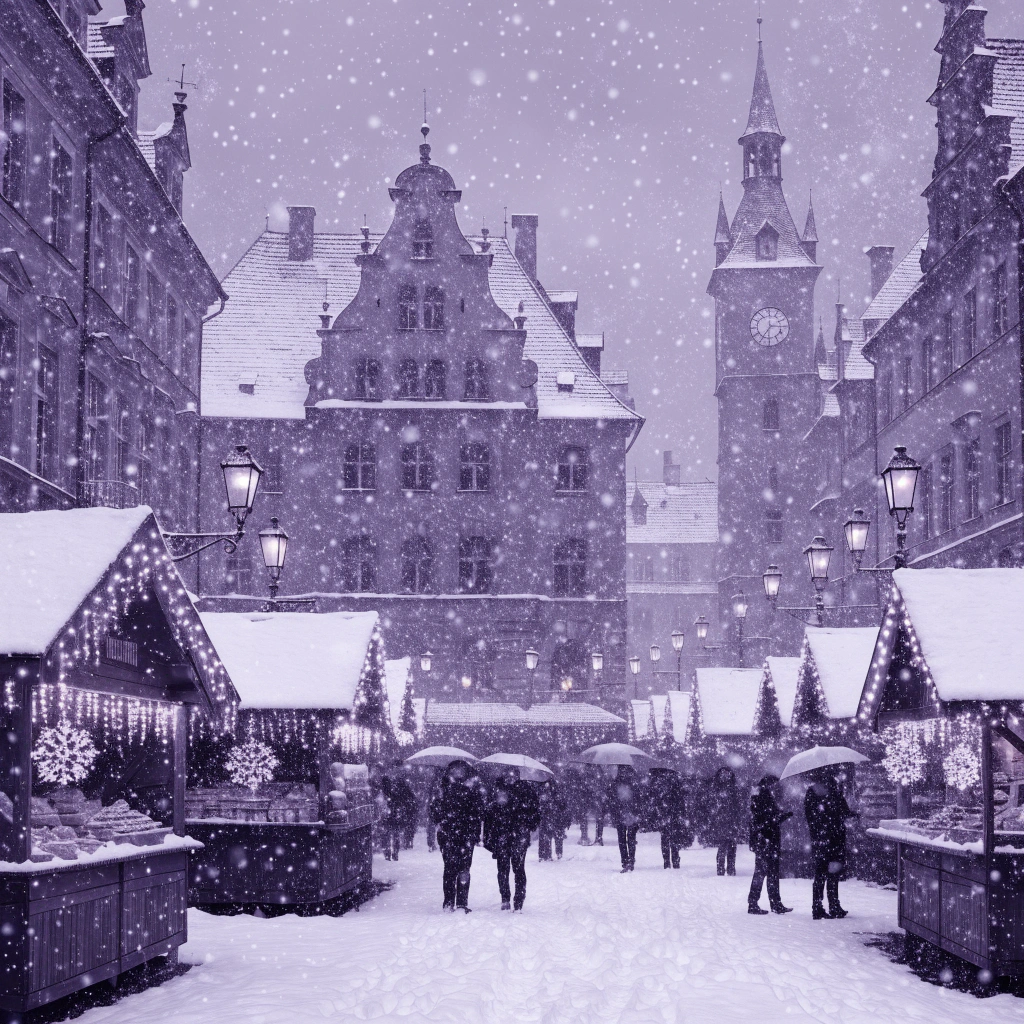
Christmas Markets in Germany
Germany is famous for Christmas markets. These markets are very old. They start in November. Every city has a big market.
People go to the market with friends. It is cold, but the lights are beautiful. You can see many small wooden houses. They sell food and gifts.
You can buy hot drinks and sweet bread. Children like the music and the toys. It is a very happy time in Germany.
文法スポットライト
パターン: Present Simple of 'To Be'
"Germany is famous for Christmas markets."
We use 'is' with singular subjects like Germany to describe facts. This is the most common way to talk about states in the present.
パターン: Modal Verb 'Can'
"You can buy hot drinks and sweet bread."
We use 'can' followed by a base verb to show possibility. It does not change its form for different subjects.
理解度をチェック
10 問 · A1 初級 · 無料プレビュー 1回
この記事で学んだことをテストしよう。全問正解してXPを獲得!
When do the markets start?
問題の内訳
When do the markets start?
あなたの回答:
正解: In November
The markets have small wooden houses.
あなたの回答:
正解: 正しい
What does 'beautiful' mean?
あなたの回答:
正解: Very pretty
You can see many small wooden _____.
あなたの回答:
正解: houses
Christmas Markets in Germany
German Christmas markets are very famous around the world. These markets started a long time ago in the Middle Ages. Today, almost every town in Germany has a market. They usually begin in the last week of November and stay open until Christmas.
People visit the markets because they want to buy beautiful gifts. You can find handmade toys, warm clothes, and decorations for your home. The food is also delicious. Many people drink hot mulled wine and eat traditional gingerbread. The air smells like cinnamon and sugar.
The atmosphere is better than a normal shopping mall. There are many bright lights and traditional music. Some markets are bigger than others, but they are all very special. People meet their friends there to talk and enjoy the winter season together. It is a wonderful tradition for everyone.
文法スポットライト
パターン: Past Simple
"These markets started a long time ago in the Middle Ages."
We use the past simple to talk about things that finished in the past. For regular verbs, we usually add '-ed' to the end of the verb.
パターン: Comparatives
"The atmosphere is better than a normal shopping mall."
We use comparatives to compare two things. For the irregular word 'good', we use 'better' followed by 'than'.
理解度をチェック
11 問 · A2 初級 · 無料プレビュー 1回
この記事で学んだことをテストしよう。全問正解してXPを獲得!
When do German Christmas markets usually begin?
問題の内訳
When do German Christmas markets usually begin?
あなたの回答:
正解: In the last week of November
Almost every town in Germany has a Christmas market.
あなたの回答:
正解: 正しい
What does 'delicious' mean?
あなたの回答:
正解: Tasting very good
The air smells like _____ and sugar.
あなたの回答:
正解: cinnamon
Why do people visit the markets?
あなたの回答:
正解: To buy gifts and see friends
The Magic of German Christmas Markets
German Christmas markets, known as 'Weihnachtsmärkte', have been a central part of winter traditions for centuries. These festive markets, which first appeared in the late Middle Ages, were originally used by local people to buy food and essential supplies for the cold season. Since then, they have evolved into wonderful community gatherings that attract millions of tourists from all over the world every year.
Today, almost every town in Germany hosts at least one market. These markets are usually opened in the last week of November and continue until Christmas Eve. Visitors can walk through rows of charming wooden stalls where handmade gifts, wooden toys, and glass ornaments are sold by local craftsmen. The air is thick with the sweet smell of roasted nuts and gingerbread, which are very popular snacks during this snowy season.
One of the most famous traditions is drinking 'Glühwein', a delicious hot spiced wine. It is often served in decorative ceramic mugs that can be kept by visitors as souvenirs of their trip. While the adults enjoy their warm drinks and conversation, children are entertained by colorful carousels and traditional holiday music. In larger metropolises like Berlin and Hamburg, dozens of different markets are organized, each offering its own unique theme and historical style.
Although many markets have become more modern and commercial, they still keep their magical traditional charm. The bright, beautiful lights and the warm social atmosphere help people to forget the long, dark winter evenings. It is a special time when friends and families meet to celebrate together, creating wonderful memories that will last a lifetime. For many people, winter in Germany would not be the same without the joy of these markets.
文法スポットライト
パターン: Passive Voice
"These markets are usually opened in the last week of November."
The passive voice is used when the action is more important than the person doing it. It is formed using 'be' + past participle.
パターン: Relative Clauses
"These festive markets, which first appeared in the late Middle Ages, were originally used by local people."
Relative clauses start with 'which', 'who', or 'that' to give more information about a noun. They help combine two sentences into one complex sentence.
理解度をチェック
11 問 · B1 中級 · 無料プレビュー 1回
この記事で学んだことをテストしよう。全問正解してXPを獲得!
What was the original purpose of the Christmas markets in the Middle Ages?
問題の内訳
What was the original purpose of the Christmas markets in the Middle Ages?
あなたの回答:
正解: To buy food and supplies for winter
Christmas markets in Germany usually start in late December.
あなたの回答:
正解: 間違い
What does the word 'ornaments' mean in the text?
あなたの回答:
正解: Decorative objects
The air is thick with the sweet _____ of roasted nuts and gingerbread.
あなたの回答:
正解: smell
What is 'Glühwein'?
あなたの回答:
正解: A hot spiced wine
The Evolution of the German Christmas Market: A Cultural Legacy
German Christmas markets, known as 'Weihnachtsmärkte', represent one of the country’s most enduring traditions, tracing their origins back to the late Middle Ages. While they initially served a practical function as venues for citizens to procure essential winter supplies, these gatherings have undergone a significant evolution over the centuries. Today, they have transformed into elaborate festive events that attract millions of tourists annually, blending historical charm with modern commercial interests.
The atmosphere of a traditional market is defined by a unique sensory experience. As one wanders through the wooden stalls, the air is frequently filled with the aroma of roasted chestnuts and spiced wine, known locally as 'Glühwein'. However, it is not merely the food that defines these spaces. Many markets pride themselves on the preservation of local craftsmanship. Artisans often demonstrate traditional woodcarving or glassblowing techniques, offering products that contrast sharply with mass-produced goods found in contemporary shopping malls. Consequently, these markets serve as a vital link to Germany's artisanal heritage.
Regional diversity is another characteristic that merits analysis. While metropolises like Berlin or Hamburg host numerous markets ranging from the classic to the avant-garde, smaller towns often provide a more intimate and authentic environment. For instance, the Striezelmarkt in Dresden is celebrated for being one of the oldest in the world, maintaining a legacy that dates back to 1434. Each region incorporates its own local folklore and culinary specialties, ensuring that no two markets are identical.
Nevertheless, the modern Christmas market is not without its challenges. The increasing commercialization of these events has led to debates regarding their cultural integrity. Some critics argue that the influx of international tourists might dilute the traditional essence of the festivities. Despite these concerns, the social value of the markets remains undeniable. They provide a communal space where people can gather during the darkest months of the year, fostering a sense of belonging and collective joy.
In conclusion, the German Christmas market is much more than a seasonal shopping destination. It is a complex cultural phenomenon that balances historical preservation with the demands of modern tourism. By providing a platform for traditional crafts and communal interaction, these markets continue to be a cornerstone of German winter identity.
文法スポットライト
パターン: Passive Voice
"The atmosphere of a traditional market is defined by a unique sensory experience."
The passive voice is used here to focus on the 'atmosphere' rather than the specific person defining it. It is formed using the verb 'to be' plus the past participle.
パターン: Present Perfect for Historical Continuity
"These gatherings have undergone a significant evolution over the centuries."
The present perfect (have + past participle) is used to describe an action that started in the past and has continuing effects or relevance in the present.
パターン: Contrastive Conjunctions
"While they initially served a practical function... these gatherings have undergone a significant evolution."
The word 'while' is used at the beginning of a clause to introduce a contrast between the historical purpose and the modern state of the markets.
理解度をチェック
11 問 · B2 中上級 · 無料プレビュー 1回
この記事で学んだことをテストしよう。全問正解してXPを獲得!
What was the primary purpose of Christmas markets during the late Middle Ages?
問題の内訳
What was the primary purpose of Christmas markets during the late Middle Ages?
あなたの回答:
正解: To provide a venue for buying essential winter supplies
Every Christmas market in Germany is identical in terms of its culinary specialties and folklore.
あなたの回答:
正解: 間違い
What does 'authentic' mean in the context of the article?
あなたの回答:
正解: Genuine and traditional
The air in the market is frequently filled with the _____ of roasted chestnuts.
あなたの回答:
正解: aroma
Why is the Striezelmarkt in Dresden specifically mentioned?
あなたの回答:
正解: It is one of the oldest Christmas markets in the world.
The Paradox of the German Christmas Market: Between Medieval Pragmatism and Modern Consumerism
As the days shorten and a crisp autumnal chill permeates the air, the German landscape undergoes a profound and systematic transformation. Seldom does the modern traveller encounter a phenomenon so steeped in historical resonance yet so vulnerable to the pressures of global tourism as the Weihnachtsmärkte. These seasonal markets, which now serve as the quintessential emblem of German winter, trace their lineage back to the late Middle Ages, specifically the 14th century. Originally conceived not as festive spectacles, but as pragmatic necessities, these gatherings allowed citizens to stockpile essential provisions and hardy textiles against the biting winter. The evolution from a utilitarian trade hub to a cultural cornerstone reflects broader shifts in European societal structures.
It is the juxtaposition of these medieval roots with the glittering facade of contemporary commerce that creates a complex cultural tapestry. What defines the modern market is an almost ephemeral atmosphere—a sensory overload where the olfactory allure of Glühwein and roasted almonds mingles with the visual splendour of timbered stalls. However, beneath the surface of this festive fervour lies a nuanced tension. The proliferation of mass-produced trinkets and standardized catering often threatens to overshadow the artisanal integrity that once defined these spaces. Critics frequently point to the commodification of tradition, arguing that the soul of the market is being sacrificed at the altar of economic gain and 'Disneyfication.'
Furthermore, the regional diversity of these markets provides a fascinating case study in local identity. While the Striezelmarkt in Dresden boasts a history of nearly six centuries, the maritime-themed markets of the northern ports offer a distinctively different aesthetic. This regionalism serves as a bulwark against the homogenizing effects of globalization. The preservation of local dialects, regional culinary specialities, and specific folk music within the market boundaries ensures that the experience remains anchored in a specific sense of place. It is this localism that prevents the markets from becoming mere carbon copies of one another.
Yet, to view the Christmas market solely through the lens of commercialism or regionalism would be a reductionist oversight. For many, the markets represent a vital vestige of community cohesion. In an increasingly digital and fragmented age, the physical act of gathering under a canopy of fairy lights provides an indelible sense of belonging. It is within this sensory sanctuary that the stresses of urban life are momentarily suspended. The preservation of cultural identity through these markets is not merely a nostalgic exercise; it is a dynamic process of adaptation.
The architectural impact of these markets on German town squares is equally significant. For four weeks, the rigid geometry of the urban environment is softened by the organic layout of wooden huts, creating a temporary 'city within a city.' This spatial reconfiguration encourages a different pace of life—one dictated by wandering rather than commuting. Whether one views them as commercial traps or cultural havens, the impact of these markets on the German psyche is undeniable. They remain a testament to the human desire for warmth and connection amidst the darkest months of the year. Ultimately, the German Christmas market survives because it successfully bridges the gap between the pragmatic survivalism of the past and the complex emotional needs of the modern era.
文法スポットライト
パターン: Inversion with negative/restrictive adverbs
"Seldom does the modern traveller encounter a phenomenon so steeped in historical resonance yet so vulnerable to the pressures of global tourism as the Weihnachtsmärkte."
When using restrictive words like 'seldom' or 'rarely' at the start of a sentence for emphasis, the auxiliary verb comes before the subject. This structure is common in formal C1 writing to add rhetorical weight.
パターン: Cleft Sentences
"It is the juxtaposition of these medieval roots with the glittering facade of contemporary commerce that creates a complex cultural tapestry."
Cleft sentences use the structure 'It is/was + [focused part] + that/who...' to emphasize a specific piece of information. Here, it highlights the exact cause of the cultural complexity.
パターン: Nominalisation
"The preservation of local dialects, regional culinary specialities, and specific folk music within the market boundaries ensures that the experience remains anchored in a specific sense of place."
Nominalisation involves turning verbs or adjectives into nouns (e.g., 'preserve' to 'preservation'). This technique makes writing more concise, formal, and abstract, which is a hallmark of C1 academic and analytical prose.
理解度をチェック
12 問 · C1 上級 · 無料プレビュー 1回
この記事で学んだことをテストしよう。全問正解してXPを獲得!
What was the primary purpose of Christmas markets in the late Middle Ages?
問題の内訳
What was the primary purpose of Christmas markets in the late Middle Ages?
あなたの回答:
正解: To allow citizens to stockpile essential winter supplies
The author suggests that regional diversity helps prevent Christmas markets from becoming identical to one another.
あなたの回答:
正解: 正しい
What does the word 'ephemeral' mean in the context of the article?
あなたの回答:
正解: Lasting for a very short period of time
The _______ of mass-produced trinkets often threatens to overshadow the artisanal integrity that once defined these spaces.
あなたの回答:
正解: proliferation
Which term is used in the text to describe the excessive commercialization of the markets?
あなたの回答:
正解: Disneyfication
The article argues that the Christmas market should be viewed strictly as a commercial trap.
あなたの回答:
正解: 間違い
ドイツのクリスマス市:伝統の粋と現代的意義の考察
ドイツの冬の風物詩として、その伝統と魅力において他の追随を許さないのが「クリスマス市」、すなわちヴァイナハツマルクトである。これは単なる商業的なイベントを超え、ドイツ文化の奥深さと共同体意識を象徴する存在として、国内外から多くの人々を魅了し続けている。その起源は中世後期にまで遡るとされ、当初は厳しい冬に備えるための食料や物資の供給の場、あるいは単発的な市に過ぎなかったものが、時を経て祝祭的な集いの場へと変貌を遂げていった経緯は、歴史的変遷の興味深い一例と言えよう。
現代において、ドイツのほぼ全ての都市、いや、ベルリンやハンブルクといった大都市から、名もなき小さな村に至るまで、少なくとも一つのクリスマス市が毎年11月最終週から開催されるのが常である。この普遍性は、その文化的重要性がいかに根深いかを物語っている。市場を訪れる人々がまず五感で享受するのは、その比類なき雰囲気であろう。焼いたアーモンドの甘い香り、スパイスの効いたグリューワインの芳香、レープクーヘンや焼きソーセージの食欲をそそる匂いが、冷たい冬の空気に溶け込み、一種独特の多幸感を醸し出す。煌びやかなイルミネーションが夜の闇を彩り、木製の屋台には精巧な手作りの装飾品や工芸品が並べられ、クリスマスソングが静かに流れる。これら全てが相まって、訪れる者を非日常的な祝祭空間へと誘うのである。
クリスマス市は、単なる物品の売買の場に留まらない。それは、家族や友人が集い、共に時間を過ごし、来るべきクリスマスを心待ちにするための、かけがえのない社交の場なのである。人々はグリューワイン片手に談笑し、子供たちはメリーゴーランドに目を輝かせ、大人たちは手工芸品の精緻な美しさに感嘆する。このような光景は、現代社会において希薄になりがちな共同体意識や連帯感を再確認させると同時に、世代を超えた交流を促進する機能も果たしていると言えよう。また、大量生産品が溢れる現代において、職人の手によって一つ一つ丁寧に作られた品々が提供されることは、消費文化に対するある種のアンチテーゼとして、その価値を再認識させる機会ともなっている。
しかしながら、その商業的成功が故に、近年ではクリスマス市の本来の精神が形骸化しつつあるとの指摘も散見される。過度な観光客誘致や商業主義の台頭は、伝統的な雰囲気を損ない、画一的な商品展開に繋がる恐れがある。また、安全保障上の懸念から、厳重な警備体制が敷かれることも珍しくなく、往時の牧歌的な情景との乖離は否めない。これらの課題を鑑みるに、伝統と革新、商業性と文化性の間でいかに均衡を保つかは、今後のクリスマス市が存続していく上で避けて通れない命題である。
結論として、ドイツのクリスマス市は、単なる季節のイベントではなく、歴史、文化、共同体意識が織りなす複雑なタペストリーである。その魅力は、単に美しい光景や美味しい飲食物に限定されるものではなく、人々が共有する時間、記憶、そして未来への希望を育む場としての機能にこそ存する。現代社会の変遷の中で様々な課題に直面しつつも、その本質的な価値は脈々と受け継がれ、これからも多くの人々に喜びと安らぎをもたらし続けるであろうと推測される。
文法スポットライト
パターン: 〜に他ならない
"これは単なる商業的なイベントを超え、ドイツ文化の奥深さと共同体意識を象徴する存在として、国内外から多くの人々を魅了し続けている。その起源は中世後期にまで遡るとされ、当初は厳しい冬に備えるための食料や物資の供給の場、あるいは単発的な市に過ぎなかったものが、時を経て祝祭的な集いの場へと変貌を遂げていった経緯は、歴史的変遷の興味深い一例と言えよう。"
「〜に他ならない」は、「〜である」という断定をより強調し、それ以外のものではないという強い肯定を示す表現です。多くの場合、結論や本質を述べる際に用いられ、書き言葉や議論で説得力を増す効果があります。名詞や動詞の終止形に接続します。
パターン: 〜ざるを得ない
"これらの課題を鑑みるに、伝統と革新、商業性と文化性の間でいかに均衡を保つかは、今後のクリスマス市が存続していく上で避けて通れない命題である。"
「〜ざるを得ない」は、「〜しないわけにはいかない」「〜するしかない」という意味で、自分の意思に反して、あるいは状況的に、ある行為をせざるをえない状況を表します。動詞の未然形に「ざる」を付け、「得ない」と続けます。C2レベルでは、客観的な状況分析や論考でよく用いられます。
パターン: 〜と言えよう
"その起源は中世後期にまで遡るとされ、当初は厳しい冬に備えるための食料や物資の供給の場、あるいは単発的な市に過ぎなかったものが、時を経て祝祭的な集いの場へと変貌を遂げていった経緯は、歴史的変遷の興味深い一例と言えよう。"
「〜と言えよう」は、「〜と言えるだろう」よりもやや硬い表現で、客観的な推測や評価、結論を述べる際に使われます。断定を避けつつも、筆者の見解や分析を提示する学術的・論理的な文章で頻繁に用いられます。名詞や動詞の終止形に接続します。
理解度をチェック
12 問 · C2 マスター · 無料プレビュー 1回
この記事で学んだことをテストしよう。全問正解してXPを獲得!
記事によると、ドイツのクリスマス市が当初どのような目的を持っていたとされていますか?
問題の内訳
記事によると、ドイツのクリスマス市が当初どのような目的を持っていたとされていますか?
あなたの回答:
正解: 冬の物資を供給すること
ドイツのクリスマス市は、大都市でのみ開催され、小さな村では見られない。
あなたの回答:
正解: 間違い
「形骸化する」という言葉の最も適切な意味はどれですか?
あなたの回答:
正解: 物事の内容や実質が失われ、外見だけが残ること
クリスマス市は、家族や友人が集い、共に時間を過ごし、来るべきクリスマスを心待ちにするための、かけがえのない_____の場である。
あなたの回答:
正解: 社交
クリスマス市の魅力の一つとして、記事ではどのような香りが挙げられていますか?
あなたの回答:
正解: 焼いたアーモンドやグリューワインの香り
現代のクリスマス市では、大量生産品よりも職人の手作りの品々が重視される傾向にある。
あなたの回答:
正解: 正しい

