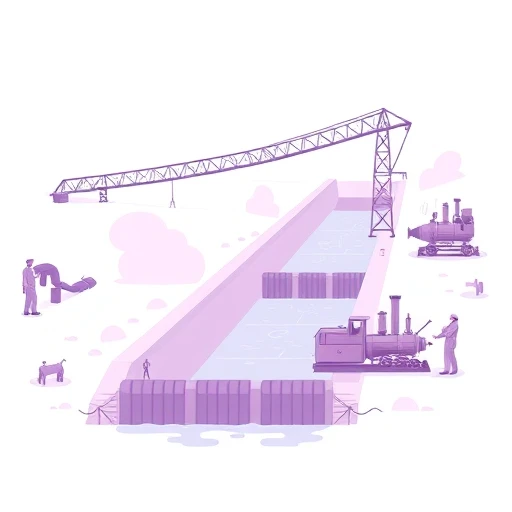
lesseps 30초 만에
- Ferdinand de Lesseps was a French diplomat who spearheaded the Suez Canal project, connecting the Mediterranean and Red Seas in 1869.
- He is equally famous for the failed French attempt to build the Panama Canal, which resulted in a massive financial and political scandal.
- Lesseps was not an engineer but a master of diplomacy and fundraising, using his political connections to drive massive international infrastructure projects.
- His name lives on in the term 'Lessepsian migration,' describing the movement of marine species through the Suez Canal into the Mediterranean Sea.
The term Lesseps refers specifically to Ferdinand de Lesseps, a towering figure in nineteenth-century history whose name has become a metonym for grand-scale engineering, international diplomacy, and the ambitious spirit of the industrial age. When people use the name Lesseps, they are almost always invoking the legacy of the man who successfully spearheaded the construction of the Suez Canal in Egypt, a project that fundamentally altered global trade routes by connecting the Mediterranean Sea to the Red Sea. This feat of human ingenuity eliminated the need for ships to navigate the treacherous waters around the southern tip of Africa, thereby shrinking the world in a way that few other projects had ever achieved. However, the name Lesseps also carries a dual legacy; it is equally associated with the catastrophic failure of the initial French attempt to build a canal across the Isthmus of Panama. In this context, the name serves as a cautionary tale about the limits of human will when confronted by the overwhelming forces of nature, disease, and financial mismanagement. In modern academic and scientific circles, the name is also used as an adjective—Lessepsian—to describe the migration of marine species from the Red Sea to the Mediterranean through the Suez Canal, a phenomenon known as Lessepsian migration. This usage highlights the unintended biological consequences of his engineering triumphs. People use the name Lesseps in historical discussions to represent the era of high imperialism, the rise of the global economy, and the transition from traditional sailing to steam-powered maritime commerce. It is a name that evokes both the brilliance of visionary planning and the tragic hubris of overreaching ambition.
- Historical Context
- Ferdinand de Lesseps was not an engineer by trade but a diplomat, which explains why his primary contribution was the negotiation of political and financial support rather than technical design.
The statue of Lesseps at the entrance of the Suez Canal was a symbol of French influence in the region for decades.
Beyond the physical canals, the name Lesseps is often discussed in the context of the 'Panama Scandal,' a massive financial corruption case that rocked the French Third Republic. Thousands of small investors lost their life savings when Lesseps's Panama Canal Company collapsed, leading to trials and a significant blow to his reputation in his later years. Therefore, depending on the audience, the name can trigger feelings of national pride in France for the Suez success or historical embarrassment for the Panama disaster. In geography and marine biology, Lesseps is a technical marker for the 1869 opening of the Suez waterway. The 'Lessepsian' effect is a major topic in environmental science, as it represents one of the most significant human-mediated invasions of marine life in history. When you hear the name in a documentary or read it in a textbook, it is often framed within the 'Great Man' theory of history, focusing on how his individual persistence and charisma drove projects that many experts at the time deemed impossible. His life story, from the triumphs in the Egyptian desert to the courtrooms of Paris, provides a narrative arc that encapsulates the highs and lows of the 19th-century European experience.
- Scientific Usage
- The term 'Lessepsian migration' is used by biologists to describe the movement of species through the canal, which has drastically changed the biodiversity of the Mediterranean.
Historians often compare the achievements of Lesseps to those of the great railroad tycoons of the American West.
In summary, Lesseps is more than just a surname; it is a symbol of an era where humanity believed it could reshape the very face of the Earth. Whether used to discuss the technical challenges of dredging millions of tons of sand or the complex diplomatic dance between the French Empire, the Ottoman Empire, and the British, the name remains central to understanding the modern world's infrastructure. It is used by historians to analyze the mechanics of 19th-century capitalism, by biologists to study invasive species, and by political scientists to examine the roots of Middle Eastern geopolitics. The name's persistence in various fields ensures that the legacy of Ferdinand de Lesseps—both his grand visions and his devastating failures—continues to be a subject of intense study and debate. To understand Lesseps is to understand the birth of the interconnected, globalized world we live in today.
- Cultural Legacy
- In France, many streets and squares bear the name Lesseps, honoring his role in projecting French prestige abroad during the 1800s.
The failure of Lesseps in Panama eventually led to the United States taking over the project in the early 20th century.
Without the tenacity of Lesseps, the Suez Canal might have remained a mere dream for another century.
The trial of Lesseps following the Panama scandal remains one of the most famous legal cases in French history.
Using the word Lesseps correctly requires an understanding of its role as a proper noun and its derived adjective form. Most commonly, it appears as the subject or object of a sentence when discussing historical events. For instance, one might say, 'Lesseps envisioned a sea-level canal that would revolutionize maritime travel.' In this case, the name acts as a shorthand for the entire organizational and diplomatic effort he led. It is also frequently used in the possessive form, 'Lesseps's vision' or 'Lesseps's failure,' to attribute specific outcomes to his leadership. When writing about him, it is important to distinguish between his personal actions and the collective efforts of the Suez Canal Company. For example, 'While Lesseps provided the diplomatic impetus, the labor was performed by thousands of Egyptian workers.' This nuance is crucial for historical accuracy and sophisticated writing. In academic contexts, the name is often paired with titles, such as 'The diplomat Ferdinand de Lesseps,' to provide clarity for readers who may not be familiar with the figure. The word can also be used to describe a specific historical period or a type of ambitious, perhaps reckless, project management style, sometimes referred to as 'Lessepsian' in more specialized literature.
- Possessive Usage
- When referring to his plans, use 'Lesseps's' (with an 's' after the apostrophe) or 'Lesseps'' depending on your preferred style guide, though 'Lesseps's' is more common in modern English.
The legacy of Lesseps is a complex mixture of engineering triumph and financial scandal.
In scientific writing, the adjective 'Lessepsian' is used to describe biological phenomena. A sentence like 'The Lessepsian migration has introduced over 300 Red Sea species into the Mediterranean' demonstrates how the name has transitioned from a person to a scientific descriptor. This is a common pattern for names of individuals who have had a profound impact on the physical world. When using the name in this way, it is usually capitalized. Another common sentence structure involves using the name to compare different historical figures. For example, 'Goethals succeeded in Panama where Lesseps had failed,' uses the name to create a direct contrast between two different approaches to the same problem. This type of comparative sentence is very common in history essays and biographies. Furthermore, the name is often found in the context of legal and financial discussions regarding the 'Panama Scandal.' A sentence such as 'The prosecution of Lesseps highlighted the corruption inherent in late 19th-century speculative ventures' uses the name to anchor a broader social critique. This shows the versatility of the name as a tool for discussing not just engineering, but also ethics, law, and economics.
- Comparative Usage
- Lesseps is often compared to other 'Great Developers' like Robert Moses or Isambard Kingdom Brunel.
Many biographers argue that Lesseps was more of a salesman than a scientist.
Finally, the name appears in geographical names and commemorative contexts. 'The Lesseps Metro station in Barcelona' or 'The Lesseps square in Paris' are examples of how the name is used as a proper noun for locations. In these instances, the name functions as a memorial. When speaking about these places, the name is used simply as a label. However, for a student of history, these labels serve as reminders of the man's global reach. In creative writing or historical fiction, the name might be used to evoke a sense of 19th-century grandeur or the specific atmosphere of colonial Egypt. A writer might describe a character as having 'the indomitable spirit of a Lesseps,' using the name as a metaphor for relentless optimism and ambition. This metaphorical use is less common but highly effective for characterization. Whether you are writing a technical report on marine biology, a history paper on the Suez Canal, or a travel guide to Paris, understanding the various ways Lesseps can be integrated into a sentence will help you communicate with greater precision and depth. The name is a key that unlocks a vast array of historical and scientific narratives.
- Metaphorical Usage
- To 'pull a Lesseps' might informally refer to attempting a project that is far more difficult than one initially admits.
The name Lesseps is etched into the history of two continents.
Even in his eighties, Lesseps remained a charismatic and persuasive public speaker.
The international community initially doubted Lesseps when he first proposed the Suez project.
You are most likely to encounter the word Lesseps in educational and intellectual environments. In a university history lecture, particularly one focusing on the 19th century, the name will appear frequently during discussions of European imperialism, the 'Scramble for Africa,' or the history of technology. Professors use the name to illustrate the intersection of private capital and state power. Similarly, in documentaries produced by channels like the BBC, National Geographic, or PBS, the name Lesseps is a staple of programs about 'Engineering Marvels' or 'The History of Trade.' These visual narratives often use his life as a framework to explain the massive physical and economic shifts caused by the Suez Canal. If you visit Egypt or Panama, you will see the name on monuments, in museum exhibits, and on street signs, as his impact on these nations' geographies and histories is indelible. In Egypt, the city of Port Said was once home to a massive statue of him, and although it was removed during the Suez Crisis of 1956, the base remains a point of historical interest where the name is still frequently mentioned by tour guides and locals discussing the canal's origins.
- Academic Settings
- The name is a keyword in courses on 'Global History,' 'Environmental History,' and 'The History of Capitalism.'
During the lecture, the professor noted that Lesseps was a master of public relations before the term even existed.
In the world of science, specifically marine biology and ecology, you will hear the name in the context of 'Lessepsian migration.' This is a common topic at environmental conferences and in research papers concerning the biodiversity of the Mediterranean Sea. Scientists use the name to categorize a specific type of biological invasion that has significant economic and ecological consequences for Mediterranean fisheries. If you are a student of biology, you might encounter this term in textbooks describing how human-made structures can alter natural ecosystems. Furthermore, in France, the name is part of the cultural landscape. It is heard in discussions about French national heritage and the 'Grands Projets' of the past. It is also a common name for schools (Lycées) and public spaces, meaning that a French student might hear the name every day simply as the name of their school. In the financial world, the name is occasionally invoked as a historical precedent for 'speculative bubbles' or the risks associated with mega-projects, making it a name that might come up in a business history seminar or a podcast about famous financial disasters.
- Scientific Discourse
- Biologists often discuss the 'Lessepsian' impact on the eastern Mediterranean's food web.
The documentary highlighted how Lesseps used his diplomatic skills to win over the Egyptian Khedive.
Another place you might hear the name is in the context of international law and maritime history. Discussions about the 'Convention of Constantinople' or the 'Suez Canal Authority' often reference the original concessions granted to Lesseps. Legal scholars and historians of international relations use the name to trace the evolution of how international waterways are managed and governed. In popular culture, the name occasionally appears in historical novels or period dramas set in the mid-to-late 1800s. Characters might discuss 'investing in Lesseps's company' or 'traveling to see the work of Lesseps.' While it is not a 'household name' in the same way as Napoleon or Einstein, it is a name that signifies a certain level of historical literacy. If you are part of a book club reading 19th-century literature or a history buff participating in an online forum, the name Lesseps will inevitably surface. It is a name that bridges the gap between the technical world of engineering and the human world of politics and drama, making it a recurring subject in many different types of conversations.
- Legal and Political Context
- The 'Lesseps Concession' is a key document studied by those interested in the history of international law and sovereignty.
The tour guide pointed out the old headquarters where Lesseps once managed the canal's operations.
Biologists are monitoring the spread of Lessepsian species as sea temperatures rise.
The financial ruin caused by the Lesseps project in Panama led to a major political crisis in France.
One of the most frequent mistakes people make when discussing Lesseps is assuming he was an engineer. In reality, Ferdinand de Lesseps was a career diplomat. While he had a profound understanding of the strategic and political importance of canals, he did not possess the technical expertise to design them. This misconception often leads to a misunderstanding of why the Panama Canal project failed under his leadership; he insisted on a sea-level canal (like the Suez) because he did not fully grasp the geological and hydrological differences between the flat sands of Egypt and the mountainous, rain-soaked terrain of Panama. Another common error is confusing his two major projects. Some people mistakenly believe he successfully completed both the Suez and Panama canals, when in fact, his failure in Panama was so complete that it led to his criminal conviction for fraud and mismanagement. It is important to remember that the Panama Canal was only finished decades later by the United States, using a completely different design involving locks and a large artificial lake.
- The 'Engineer' Myth
- Mistake: Calling Lesseps a 'great engineer.' Correction: He was a 'great promoter' or 'diplomat' who hired engineers.
It is a common error to credit Lesseps with the technical design of the Suez Canal.
Spelling and pronunciation also present challenges. The name is French, and while the 's' at the end is pronounced in English (/ləˈsɛps/), the spelling can be tricky for non-French speakers. Some people forget the double 's' or the 'p,' leading to misspellings like 'Leseps' or 'Lesseps.' Furthermore, in the context of 'Lessepsian migration,' students often forget to capitalize the word, even though it is derived from a proper noun. Another conceptual mistake is ignoring the human cost of his projects. When praising the 'genius of Lesseps,' one might overlook the thousands of forced laborers (corvée labor) who died during the construction of the Suez Canal. A balanced historical perspective requires acknowledging both his visionary leadership and the ethical failures associated with his methods. Similarly, in the Panama project, the death toll from yellow fever and malaria was staggering, a factor Lesseps largely ignored in his public communications to keep investors confident. Failing to mention these aspects can make a historical analysis seem one-sided or superficial.
- The Panama Confusion
- Mistake: Thinking Lesseps built the Panama Canal. Correction: He started it, but the project failed and was later completed by the Americans.
Many students fail to distinguish between the sea-level design favored by Lesseps and the lock system used by the Americans.
Finally, there is the mistake of viewing Lesseps in isolation. He did not work alone; his success was deeply tied to the political support of Napoleon III and the friendship of the Egyptian Khedive, Sa'id Pasha. In Panama, his failure was tied to a global economic climate and a lack of medical knowledge regarding tropical diseases. Attributing everything to his individual 'genius' or 'failure' ignores the complex systems of the time. In writing, avoid sentences that make him sound like a lone inventor. Instead, use phrases like 'The company led by Lesseps' or 'The project spearheaded by Lesseps.' This accurately reflects his role as a leader of a massive enterprise. By avoiding these common pitfalls—misidentifying his profession, confusing his projects, misspelling his name, or oversimplifying his impact—you can discuss Lesseps with the nuance and accuracy that historical and scientific topics demand. This attention to detail will significantly improve the quality of your academic or professional communication.
- Capitalization Error
- Mistake: writing 'lessepsian migration.' Correction: Always capitalize 'Lessepsian' as it comes from the proper name Lesseps.
The trial of Lesseps for fraud was a media sensation that exposed the dark side of 19th-century finance.
Critics of Lesseps often point to his stubbornness as the primary cause of the Panama disaster.
The name Lesseps should not be used as a synonym for 'engineer' but rather for 'visionary developer.'
When discussing the role and impact of Ferdinand de Lesseps, several other terms can be used to provide variety or specific nuance. Depending on the context—whether you are focusing on his diplomatic skills, his role as a project leader, or his visionary nature—different words might be more appropriate. For example, if you are focusing on his ability to organize and fund massive projects, words like entrepreneur, developer, or promoter are excellent alternatives. These words capture the essence of what he actually did: he didn't build the canal with his hands or design it with a slide rule; he 'developed' the project by securing the necessary political and financial capital. If the focus is on his forward-thinking (and sometimes unrealistic) ideas, visionary or idealist might be used. However, these words should be used carefully, as they can carry either positive or negative connotations depending on whether the project succeeded or failed. In the context of the Panama Canal, some historians might even use the word charlatan or propagandist to describe his later years, reflecting the deceptive way he managed information to keep investors from realizing the project was doomed.
- Lesseps vs. Engineer
- An engineer focuses on technical feasibility and design (e.g., Alois Negrelli), while Lesseps focused on the political and financial 'will' to make the project happen.
While Lesseps was the face of the Suez Canal, the technical brilliance came from a multinational team of engineers.
In a diplomatic context, Lesseps can be compared to other great diplomats or statesmen. His career began in the French consular service, and his success in Egypt was largely due to his personal relationship with the ruling family. Therefore, words like envoy or consul are accurate descriptors of his professional background. When comparing him to other historical figures who undertook massive infrastructure projects, names like Isambard Kingdom Brunel or Robert Moses often come up. While Brunel was a true engineer, he shared Lesseps's flair for the dramatic and his ability to inspire public confidence in massive, risky ventures. Robert Moses, the 'Master Builder' of New York City, shared Lesseps's ability to navigate complex political systems to reshape the physical landscape, often despite significant public or technical opposition. Using these comparisons can help a reader understand the 'type' of historical figure Lesseps represents—the individual who uses power and persuasion to force a grand vision into reality.
- Lesseps vs. Goethals
- George Washington Goethals was the American army officer who finished the Panama Canal. He is often contrasted with Lesseps for his disciplined, military-style management and use of locks.
The difference between Lesseps and his successors in Panama was a shift from diplomatic charm to rigorous engineering and sanitation.
In biological discussions, there are no direct synonyms for 'Lessepsian,' as it is a specific eponym. However, one might use broader terms like anthropogenic migration (human-caused movement) or invasive species introduction. These terms are more clinical and less specific than 'Lessepsian migration,' but they describe the same underlying process. In a more general sense, when describing the 'Lessepsian' quality of a person—their relentless, perhaps blind, pursuit of a goal—one might use adjectives like indomitable, audacious, or tenacious. These words capture the personality traits that allowed him to succeed in Suez against all odds, but also the same traits that led to the disaster in Panama. Choosing the right alternative depends on whether you want to emphasize his professional role, his personality, or the scientific impact of his work. By diversifying your vocabulary, you can avoid repeating the name Lesseps too frequently while still keeping the focus on his multifaceted legacy.
- Lesseps vs. Tycoon
- A tycoon (like Rockefeller) focuses on owning the industry, whereas Lesseps was more of a public-facing leader who sought national glory as much as personal wealth.
Some historians view Lesseps as a precursor to the modern 'celebrity CEO' who sells a vision to the public.
The audacity of Lesseps changed the world's maps, but it also bankrupted thousands of French families.
In the history of engineering, Lesseps stands as a reminder that political will is as important as technical skill.
How Formal Is It?
재미있는 사실
Ferdinand de Lesseps was not the first in his family to be famous; his father, Mathieu de Lesseps, was a diplomat, and his uncle, Barthélemy de Lesseps, was a survivor of the La Pérouse expedition around the world.
발음 가이드
- Pronouncing it as 'LESS-eps' (stressing the first syllable).
- Leaving the 's' silent as in many French names (it is usually pronounced in English).
- Pronouncing the 'p' too softly.
- Confusing the 'e' sound with a long 'a' (Laseps).
- Adding an extra syllable (Lessep-us).
난이도
The name itself is easy, but the historical and scientific contexts (like 'Lessepsian migration') can be complex.
Spelling 'Lesseps' correctly and using the possessive 'Lesseps's' can be tricky for learners.
Pronunciation is straightforward once you know the 's' is not silent.
Easily recognized in historical documentaries, though French pronunciation may differ slightly.
다음에 무엇을 배울까
선수 학습
다음에 배울 것
고급
알아야 할 문법
Proper Nouns as Adjectives
The name Lesseps becomes the adjective 'Lessepsian' to describe related phenomena.
Possessives of names ending in 's'
Lesseps's vision (adding 's) or Lesseps' vision (just the apostrophe).
Appositives for clarification
Ferdinand de Lesseps, the French diplomat, was a key figure in history.
Capitalization of Eponyms
Always capitalize 'Lessepsian' because it is derived from a person's name.
Articles with Proper Nouns
We say 'Lesseps was famous,' not 'The Lesseps was famous,' unless referring to a specific group.
수준별 예문
Lesseps was a famous man from France.
Lesseps était un homme célèbre de France.
Proper noun used as the subject.
He helped build the Suez Canal.
Il a aidé à construire le canal de Suez.
Past tense verb 'helped'.
Lesseps had a very big idea.
Lesseps avait une très grande idée.
Simple past of 'have'.
Many people liked Lesseps.
Beaucoup de gens aimaient Lesseps.
Subject-verb-object structure.
Lesseps was not an engineer.
Lesseps n'était pas ingénieur.
Negative form of 'to be'.
The canal made by Lesseps is in Egypt.
Le canal fait par Lesseps est en Égypte.
Passive construction with 'made by'.
Lesseps lived a long time ago.
Lesseps a vécu il y a longtemps.
Adverbial phrase of time.
We study Lesseps in school.
Nous étudions Lesseps à l'école.
Present simple tense.
Lesseps was a diplomat, not a builder.
Lesseps était un diplomate, pas un constructeur.
Contrastive structure.
He traveled to Egypt to meet the king.
Il a voyagé en Égypte pour rencontrer le roi.
Infinitive of purpose 'to meet'.
Lesseps wanted to connect two seas.
Lesseps voulait relier deux mers.
Verb 'want' followed by an infinitive.
The project of Lesseps was very expensive.
Le projet de Lesseps était très cher.
Possessive phrase 'of Lesseps'.
Lesseps became a hero in France.
Lesseps est devenu un héros en France.
Linking verb 'became'.
Later, Lesseps went to Panama.
Plus tard, Lesseps est allé au Panama.
Sequential adverb 'Later'.
The second canal was a failure for Lesseps.
Le deuxième canal a été un échec pour Lesseps.
Noun 'failure' as a complement.
You can see a statue of Lesseps.
Vous pouvez voir une statue de Lesseps.
Modal verb 'can'.
Lesseps successfully opened the Suez Canal in 1869.
Lesseps a ouvert avec succès le canal de Suez en 1869.
Adverb 'successfully' modifying the verb.
The vision of Lesseps changed international trade forever.
La vision de Lesseps a changé le commerce international pour toujours.
Abstract noun 'vision' as the subject.
Lesseps was known for his great persuasive skills.
Lesseps était connu pour ses grandes capacités de persuasion.
Passive voice 'was known for'.
Despite his success, Lesseps faced many challenges in Panama.
Malgré son succès, Lesseps a fait face à de nombreux défis au Panama.
Preposition 'Despite' showing contrast.
The name Lesseps is often associated with the 19th century.
Le nom Lesseps est souvent associé au XIXe siècle.
Present passive 'is associated with'.
Lesseps was eventually convicted of financial mismanagement.
Lesseps a finalement été reconnu coupable de mauvaise gestion financière.
Adverb 'eventually' and passive 'was convicted'.
Biologists study the Lessepsian migration in the Mediterranean.
Les biologistes étudient la migration lessepsienne en Méditerranée.
Adjective 'Lessepsian' derived from the name.
Lesseps relied on his diplomatic background to gain support.
Lesseps s'est appuyé sur son expérience diplomatique pour obtenir du soutien.
Phrasal verb 'relied on'.
Lesseps's refusal to use locks in Panama was a fatal mistake.
Le refus de Lesseps d'utiliser des écluses au Panama a été une erreur fatale.
Possessive 'Lesseps's' and complex subject.
The Panama Scandal involving Lesseps rocked the French government.
Le scandale de Panama impliquant Lesseps a secoué le gouvernement français.
Participle phrase 'involving Lesseps'.
Lesseps was a cousin of Empress Eugénie, which helped his career.
Lesseps était un cousin de l'impératrice Eugénie, ce qui a aidé sa carrière.
Relative clause 'which helped...'.
The engineering world was skeptical of Lesseps's sea-level plan.
Le monde de l'ingénierie était sceptique quant au plan au niveau de la mer de Lesseps.
Adjective 'skeptical' followed by 'of'.
Lesseps remains a controversial figure in historical debates.
Lesseps reste une figure controversée dans les débats historiques.
Linking verb 'remains' with a noun phrase.
The sheer scale of the projects led by Lesseps was unprecedented.
L'ampleur même des projets menés par Lesseps était sans précédent.
Adjective 'unprecedented' as a complement.
Lessepsian species are currently altering the Mediterranean food web.
Les espèces lessepsiennes modifient actuellement le réseau trophique méditerranéen.
Present continuous 'are altering'.
The trial of Lesseps exposed deep corruption in the financial sector.
Le procès de Lesseps a exposé une corruption profonde dans le secteur financier.
Verb 'exposed' with a direct object.
Lesseps epitomized the 19th-century belief in human mastery over nature.
Lesseps a incarné la croyance du XIXe siècle en la maîtrise de l'homme sur la nature.
Verb 'epitomized' for high-level description.
The 'Lessepsian' model of development relied heavily on private speculation.
Le modèle de développement « lessepsien » reposait largement sur la spéculation privée.
Adjective 'Lessepsian' used as a specific model.
Historians often contrast the charisma of Lesseps with his lack of technical foresight.
Les historiens opposent souvent le charisme de Lesseps à son manque de clairvoyance technique.
Verb 'contrast' with 'with'.
The downfall of Lesseps was as dramatic as his rise to fame.
La chute de Lesseps a été aussi dramatique que son ascension vers la gloire.
Comparative structure 'as... as'.
Lesseps's legacy is tainted by the high mortality rate of his laborers.
L'héritage de Lesseps est entaché par le taux de mortalité élevé de ses ouvriers.
Passive 'is tainted by'.
The Suez Canal, Lesseps's magnum opus, remains a vital artery of global commerce.
Le canal de Suez, le chef-d'œuvre de Lesseps, reste une artère vitale du commerce mondial.
Appositive phrase 'Lesseps's magnum opus'.
The biological impact of the canal is often referred to as the Lessepsian effect.
L'impact biologique du canal est souvent appelé l'effet lessepsien.
Passive 'is referred to as'.
Lesseps failed to account for the virulent diseases present in the Panamanian jungle.
Lesseps n'a pas tenu compte des maladies virulentes présentes dans la jungle panaméenne.
Infinitive phrase 'to account for'.
Lesseps's dogmatic insistence on a sea-level canal in Panama proved his undoing.
L'insistance dogmatique de Lesseps sur un canal au niveau de la mer au Panama a causé sa perte.
Complex noun phrase as subject.
The Affaire de Panama, centered around Lesseps, catalyzed a wave of anti-Semitic sentiment in France.
L'Affaire de Panama, centrée sur Lesseps, a catalysé une vague de sentiment antisémite en France.
Parenthetical phrase 'centered around Lesseps'.
The geopolitical ramifications of Lesseps's Suez project are still felt in the 21st century.
Les ramifications géopolitiques du projet Suez de Lesseps se font encore sentir au XXIe siècle.
Passive 'are still felt'.
Lesseps was a master of leveraging personal relationships for transnational industrial ends.
Lesseps était passé maître dans l'art de tirer parti des relations personnelles à des fins industrielles transnationales.
Gerund phrase 'leveraging personal relationships'.
The Lessepsian migration is perhaps the most significant biogeographic event of the modern era.
La migration lessepsienne est peut-être l'événement biogéographique le plus important de l'ère moderne.
Superlative 'the most significant'.
One cannot fully comprehend 19th-century French imperialism without scrutinizing the career of Lesseps.
On ne peut pas comprendre pleinement l'impérialisme français du XIXe siècle sans scruter la carrière de Lesseps.
Negative 'cannot' with 'without'.
Lesseps's fall from grace serves as a poignant reminder of the volatility of speculative capital.
La chute de Lesseps rappelle de manière poignante la volatilité du capital spéculatif.
Noun phrase 'fall from grace'.
The technical hubris of Lesseps in Panama was matched only by his administrative incompetence.
L'orgueil technique de Lesseps au Panama n'avait d'égal que son incompétence administrative.
Passive 'was matched only by'.
자주 쓰는 조합
자주 쓰는 구문
— The period of time when his canal projects were at the center of world attention.
The Lesseps era was a time of great optimism in French engineering.
— A critical way to refer to the failed Panama project.
Many critics at the time referred to the Panama attempt as Lesseps's folly.
— Following the path or attempting the same kind of grand project as he did.
Modern developers are often seen as walking in the footsteps of Lesseps.
— Specifically referring to the financial corruption of the Panama project.
The Lesseps scandal nearly brought down the French government.
— The idealistic goal of connecting the world's oceans.
Lesseps's dream was to make the world smaller through engineering.
— The legal right granted to him to build and operate the Suez Canal.
The Lesseps concession lasted for 99 years.
— The famous monument that once stood at the entrance to the Suez Canal.
Lesseps's statue was a symbol of European colonial power.
— The legal proceedings against him following the Panama collapse.
The Lesseps trial revealed widespread bribery of politicians.
— A common way to refer to the Suez Canal in a historical context.
Lesseps's canal changed the face of Egypt forever.
— The quality of being very ambitious and persistent.
He approached the new project with the indomitable spirit of Lesseps.
자주 혼동되는 단어
This is the adjective form. Don't use 'Lesseps' when you mean the biological effect; use 'Lessepsian migration'.
Lesseps was a diplomat. Don't call him an engineer in a formal paper.
He succeeded in Suez but failed in Panama. Don't mix up the two projects.
관용어 및 표현
— A project of immense scale and difficulty, requiring great vision and persistence.
Building the new space station is truly a Lessepsian task.
Literary/Rare— To attempt something that seems impossible or highly unlikely to succeed.
They said he was trying to build a canal in the desert, but he proved them wrong.
Metaphorical— A project that starts with great promise but ends in total disaster and scandal.
That software launch turned out to be the Panama of his career.
Informal— A simple-sounding solution that ignores complex underlying problems (referring to Lesseps's failed Panama design).
He proposed a sea-level solution to a problem that clearly required more nuance.
Specialized— To have goals that are so large they might be dangerous or unrealistic.
The CEO's Lessepsian ambition eventually led the company to bankruptcy.
Journalistic— Being overwhelmed by a project that is failing due to poor planning.
The department is currently drowning in Panama with this new initiative.
Informal— A person's greatest and most world-changing achievement.
This invention was his Suez of success.
Literary— To charm people into investing in a project that you don't fully understand technically.
He really pulled a Lesseps on those venture capitalists.
Slang/Niche— The lingering memory of a past failure that haunts a current project.
The ghost of Lesseps still hangs over the new canal proposals.
Journalistic— Going from a great success to a great failure.
His career went from Suez to Panama in just five years.
Literary혼동하기 쉬운
He led engineering projects.
An engineer designs the structure; Lesseps organized the people and money.
The engineer designed the bridge, but Lesseps would have been the one to get the permit.
He 'built' things.
An architect designs buildings; Lesseps was a diplomat who managed international projects.
The architect drew the plans, while Lesseps signed the treaties.
His projects were part of the colonial era.
A colonizer takes over land for a country; Lesseps was a private developer, though his work helped colonizers.
Lesseps wasn't a colonizer himself, but his canal helped the British Empire.
He used private money and lost a lot of it.
A speculator just bets on prices; Lesseps actually managed the physical construction.
Lesseps was more than a speculator; he was on the ground in Egypt for years.
This was his actual job.
A diplomat usually works for a government; Lesseps used his diplomatic skills for his own private company.
Lesseps was a diplomat by training, which is why he was so good at talking to kings.
문장 패턴
[Name] was a [Nationality] [Profession].
Lesseps was a French diplomat.
[Name] helped to [Verb] the [Project].
Lesseps helped to build the Suez Canal.
The [Noun] of [Name] changed the [Object].
The vision of Lesseps changed global trade.
Despite [Noun], [Name] managed to [Verb].
Despite British opposition, Lesseps managed to finish the canal.
[Name]'s career is a study in [Abstract Noun].
Lesseps's career is a study in industrial ambition.
The [Adjective] legacy of [Name] is [Adjective].
The enduring legacy of Lesseps is profoundly multifaceted.
[Name] is often associated with [Event].
Lesseps is often associated with the Panama Scandal.
The [Scientific Term] refers to [Definition].
The Lessepsian migration refers to species moving through the canal.
어휘 가족
명사
형용사
관련
사용법
The name is low-frequency in daily conversation but high-frequency in history, geography, and biology textbooks.
-
Calling Lesseps an engineer.
→
Calling him a diplomat or developer.
He had no engineering training; he was a career diplomat who managed the projects.
-
Thinking he completed the Panama Canal.
→
Acknowledging that he started it but failed.
The Americans completed the Panama Canal years after Lesseps's company went bankrupt.
-
Spelling it 'Leseps'.
→
Lesseps (with two 's's in the middle).
The name requires the double 's' for correct French and English spelling.
-
Using 'lessepsian' without a capital letter.
→
Lessepsian.
Eponyms (words named after people) should always be capitalized in English.
-
Saying he 'invented' the Suez Canal.
→
Saying he 'promoted' or 'organized' it.
The idea of a canal had existed since ancient times; Lesseps was the one who finally made it happen in the modern era.
팁
Capitalize Properly
Always capitalize 'Lesseps' and 'Lessepsian' as they are proper nouns or derived from one. This is a common mistake in student essays.
Distinguish the Canals
Remember: Suez = Success, Panama = Failure. This simple distinction will help you keep the facts of his life straight.
Use 'Spearheaded'
A great verb to use with Lesseps is 'spearheaded.' It perfectly describes his role as the leader who pushed the project forward.
The Final S
In English, the final 's' in Lesseps is pronounced. Don't treat it like a silent French 's' unless you are actually speaking French.
Lessepsian Migration
If you are a biology student, memorize this term. it is the most common way the name is used in modern scientific literature.
Describe his Role
Instead of just saying 'Lesseps built the canal,' say 'Lesseps organized the construction.' This is more historically accurate.
Think Geopolitics
When discussing Lesseps, mention how his work changed the relationship between Europe, Egypt, and Asia. It shows you understand the 'big picture'.
Diplomat, not Engineer
Always remember his background was in diplomacy. This explains why he was so good at talking but struggled with the technical parts of Panama.
The 'Less Steps' Trick
Use the 'Less Steps' mnemonic to remember that he wanted to make the world's travel routes shorter and easier.
French Pride
Understand that for many years, Lesseps was a symbol of French national pride, which is why the Panama failure was such a huge shock.
암기하기
기억법
Think of 'Less Steps.' Lesseps made the world require 'Less Steps' (or less miles) for ships to travel between Europe and Asia.
시각적 연상
Imagine a man with a giant pair of scissors cutting through a map of Egypt and Panama to connect the blue oceans.
Word Web
챌린지
Try to explain to a friend why the name Lesseps is used in both a history class and a biology class without using the word 'water'.
어원
The name Lesseps is of French origin, specifically from the Basque region (originally spelled 'Lasseps'). It became prominent in the 18th and 19th centuries through a family of diplomats and explorers.
원래 의미: The name itself is a surname, and like many surnames, its ancient meaning is related to a specific location or family lineage in southwestern France.
Indo-European > Romance > French문화적 맥락
When discussing Lesseps in Egypt, be sensitive to the history of 'corvée' (forced) labor used during the canal's construction, which is a point of national pain.
In English-speaking countries, Lesseps is primarily known through history books and documentaries about the Panama Canal, often contrasted with the later American success.
실생활에서 연습하기
실제 사용 상황
History Class
- The role of Lesseps in...
- The impact of the Suez Canal...
- The Panama Scandal of 1889...
- 19th-century French diplomacy...
Marine Biology
- Lessepsian migration patterns...
- Invasive species from the Red Sea...
- The Lessepsian effect on biodiversity...
- Monitoring Lessepsian organisms...
Business/Finance History
- The bankruptcy of the Lesseps company...
- Speculative bubbles in the 1800s...
- Funding the Suez Canal...
- Shareholder losses in Panama...
Travel in Egypt/France
- The Lesseps monument...
- Walking down Rue de Lesseps...
- The history of Port Said...
- The French influence on the canal...
Engineering Documentaries
- Lesseps's grand design...
- The challenge of the desert...
- Why Lesseps failed in the jungle...
- Connecting the world's oceans...
대화 시작하기
"Did you know that the man who built the Suez Canal, Lesseps, wasn't actually an engineer?"
"Have you ever heard of the 'Lessepsian migration' and how it's changing the Mediterranean Sea?"
"What do you think was the biggest reason for Lesseps's failure in Panama compared to his success in Suez?"
"Is it fair that Lesseps is remembered for a financial scandal after his massive success with the Suez Canal?"
"If you were an investor in the 1880s, would you have trusted Lesseps with your money for the Panama project?"
일기 주제
Imagine you are Ferdinand de Lesseps on the day the Suez Canal opened. Describe your feelings and your vision for the future.
Write about a time when you had a 'Lessepsian' ambition—a goal so big it felt impossible. Did you succeed or fail?
Research the 'Panama Scandal' and write a short reflection on how it changed the way people viewed big engineering projects.
Discuss the ethical implications of using forced labor to build the Suez Canal under Lesseps's leadership.
If Lesseps were alive today, what kind of global project do you think he would be working on?
자주 묻는 질문
10 질문No, Ferdinand de Lesseps was not an engineer. He was a French diplomat. His success in building the Suez Canal came from his ability to negotiate with governments and raise money from private investors, rather than from technical knowledge of construction.
Lesseps failed in Panama for several reasons. He insisted on a sea-level canal, which was impossible given the terrain. He also underestimated the impact of tropical diseases like yellow fever and malaria, which killed thousands of workers. Finally, his company ran out of money due to poor management and corruption.
Lessepsian migration is the movement of marine species from the Red Sea to the Mediterranean Sea through the Suez Canal. It is named after Ferdinand de Lesseps because the canal he built created the path for these species to travel.
Lesseps is not a very common surname today, but it is a very common name for streets, squares, and schools in France. It is a name that most French people recognize from their history lessons.
The Panama Scandal was a financial corruption case in France in the late 1800s. Ferdinand de Lesseps's company went bankrupt while trying to build the Panama Canal. It was discovered that the company had bribed politicians to hide its financial problems, leading to a huge public outcry.
Lesseps was a close friend of Sa'id Pasha, the Khedive (ruler) of Egypt. He used this personal relationship to get a 'concession,' which was a legal document giving him the right to build and run the canal for 99 years.
Lesseps was sentenced to five years in prison after the Panama Scandal, but he never actually went to jail. Because he was very old and had done great things for France in the past, his sentence was overturned by a higher court.
A large bronze statue of Ferdinand de Lesseps once stood at the entrance of the Suez Canal in Port Said. It was a symbol of French achievement. However, it was toppled by Egyptians in 1956 during the Suez Crisis as a protest against European colonialism.
He was not royalty himself, but he was a cousin of Empress Eugénie, the wife of the French Emperor Napoleon III. This family connection was very important because it helped him get the support of the French government for his projects.
The construction of the Suez Canal took about ten years, from 1859 to 1869. It was a very difficult project that faced many political and financial delays before it was finally completed.
셀프 테스트 200 질문
Write a short paragraph explaining the difference between Lesseps's role in the Suez Canal and his role in the Panama Canal.
Well written! Good try! Check the sample answer below.
Describe why Ferdinand de Lesseps is called a 'diplomat' rather than an 'engineer'.
Well written! Good try! Check the sample answer below.
Explain the term 'Lessepsian migration' and its impact on the Mediterranean Sea.
Well written! Good try! Check the sample answer below.
What was the Panama Scandal, and how did it affect Lesseps's later life?
Well written! Good try! Check the sample answer below.
Imagine you are an investor in 1880. Write a letter explaining why you want to invest in Lesseps's new Panama project.
Well written! Good try! Check the sample answer below.
Discuss the importance of Lesseps's family connections in his career.
Well written! Good try! Check the sample answer below.
Why did Lesseps insist on a sea-level canal for Panama, and why was this a mistake?
Well written! Good try! Check the sample answer below.
Summarize the legacy of Ferdinand de Lesseps in three sentences.
Well written! Good try! Check the sample answer below.
Write a dialogue between two historians debating whether Lesseps was a hero or a villain.
Well written! Good try! Check the sample answer below.
How did the opening of the Suez Canal affect the British Empire?
Well written! Good try! Check the sample answer below.
Describe the personality traits that allowed Lesseps to succeed in Egypt.
Well written! Good try! Check the sample answer below.
What role did disease play in the failure of Lesseps's Panama project?
Well written! Good try! Check the sample answer below.
Write a short biography of Lesseps for a children's history book.
Well written! Good try! Check the sample answer below.
Explain why the statue of Lesseps was toppled in 1956.
Well written! Good try! Check the sample answer below.
Discuss the impact of Lessepsian migration on Mediterranean fisheries.
Well written! Good try! Check the sample answer below.
How did Lesseps's age affect his leadership in the Panama project?
Well written! Good try! Check the sample answer below.
What is the 'Convention of Constantinople' and how does it relate to Lesseps?
Well written! Good try! Check the sample answer below.
Compare Lesseps to a modern-day entrepreneur like Elon Musk.
Well written! Good try! Check the sample answer below.
Describe the 'Affaire de Panama' and its consequences for French politics.
Well written! Good try! Check the sample answer below.
Why is Lesseps still a subject of study in international relations?
Well written! Good try! Check the sample answer below.
Pronounce the name 'Lesseps' correctly.
Read this aloud:
당신의 답변:
Speech recognition is not supported in your browser. Try Chrome or Edge.
Explain in your own words who Ferdinand de Lesseps was.
Read this aloud:
당신의 답변:
Speech recognition is not supported in your browser. Try Chrome or Edge.
Describe the difference between the Suez and Panama canals.
Read this aloud:
당신의 답변:
Speech recognition is not supported in your browser. Try Chrome or Edge.
What is Lessepsian migration? Explain it to a friend.
Read this aloud:
당신의 답변:
Speech recognition is not supported in your browser. Try Chrome or Edge.
Why is Lesseps called a 'visionary'?
Read this aloud:
당신의 답변:
Speech recognition is not supported in your browser. Try Chrome or Edge.
Talk about the 'Panama Scandal' for one minute.
Read this aloud:
당신의 답변:
Speech recognition is not supported in your browser. Try Chrome or Edge.
How did Lesseps's family help him in his career?
Read this aloud:
당신의 답변:
Speech recognition is not supported in your browser. Try Chrome or Edge.
Why did the British oppose the Suez Canal at first?
Read this aloud:
당신의 답변:
Speech recognition is not supported in your browser. Try Chrome or Edge.
What happened to the statue of Lesseps in Egypt?
Read this aloud:
당신의 답변:
Speech recognition is not supported in your browser. Try Chrome or Edge.
Is it fair to blame Lesseps for the failure in Panama? Why or why not?
Read this aloud:
당신의 답변:
Speech recognition is not supported in your browser. Try Chrome or Edge.
Name three things associated with the name Lesseps.
Read this aloud:
당신의 답변:
Speech recognition is not supported in your browser. Try Chrome or Edge.
How did the Suez Canal change world trade?
Read this aloud:
당신의 답변:
Speech recognition is not supported in your browser. Try Chrome or Edge.
Describe Lesseps's personality based on what you have learned.
Read this aloud:
당신의 답변:
Speech recognition is not supported in your browser. Try Chrome or Edge.
What would you say to Lesseps if you could meet him today?
Read this aloud:
당신의 답변:
Speech recognition is not supported in your browser. Try Chrome or Edge.
Why is 'Lessepsian' capitalized?
Read this aloud:
당신의 답변:
Speech recognition is not supported in your browser. Try Chrome or Edge.
What is the 'corvée' system?
Read this aloud:
당신의 답변:
Speech recognition is not supported in your browser. Try Chrome or Edge.
Who finished the Panama Canal and how was it different from Lesseps's plan?
Read this aloud:
당신의 답변:
Speech recognition is not supported in your browser. Try Chrome or Edge.
Why is Lesseps a 'controversial' figure?
Read this aloud:
당신의 답변:
Speech recognition is not supported in your browser. Try Chrome or Edge.
How did Lesseps's diplomatic background help him?
Read this aloud:
당신의 답변:
Speech recognition is not supported in your browser. Try Chrome or Edge.
What is the 'Lesseps' metro station in Barcelona named after?
Read this aloud:
당신의 답변:
Speech recognition is not supported in your browser. Try Chrome or Edge.
Listen to a description of the Suez Canal and identify the name mentioned as its promoter.
Listen for the year the Suez Canal opened.
Listen for the term used to describe species migration through the canal.
Listen for the reason why the Panama project failed.
Listen for the name of the French Empress who was Lesseps's cousin.
Listen for the city where a statue of Lesseps once stood.
Listen for the profession of Ferdinand de Lesseps.
Listen for the age of Lesseps when he started the Panama project.
Listen for the name of the Egyptian ruler who worked with Lesseps.
Listen for the result of the 1893 trial.
Listen for the two seas connected by the Suez Canal.
Listen for the country that completed the Panama Canal.
Listen for the term 'corvée'. What does it mean?
Listen for the origin of the name Lesseps.
Listen for the number of children Lesseps had.
/ 200 correct
Perfect score!
Summary
Lesseps represents the 19th-century spirit of global expansion and engineering ambition. While his success with the Suez Canal revolutionized trade, his failure in Panama serves as a warning about the dangers of overconfidence and ignoring technical realities. Example: 'The story of Lesseps shows how one man's vision can change geography, for better or worse.'
- Ferdinand de Lesseps was a French diplomat who spearheaded the Suez Canal project, connecting the Mediterranean and Red Seas in 1869.
- He is equally famous for the failed French attempt to build the Panama Canal, which resulted in a massive financial and political scandal.
- Lesseps was not an engineer but a master of diplomacy and fundraising, using his political connections to drive massive international infrastructure projects.
- His name lives on in the term 'Lessepsian migration,' describing the movement of marine species through the Suez Canal into the Mediterranean Sea.
Capitalize Properly
Always capitalize 'Lesseps' and 'Lessepsian' as they are proper nouns or derived from one. This is a common mistake in student essays.
Distinguish the Canals
Remember: Suez = Success, Panama = Failure. This simple distinction will help you keep the facts of his life straight.
Use 'Spearheaded'
A great verb to use with Lesseps is 'spearheaded.' It perfectly describes his role as the leader who pushed the project forward.
The Final S
In English, the final 's' in Lesseps is pronounced. Don't treat it like a silent French 's' unless you are actually speaking French.