









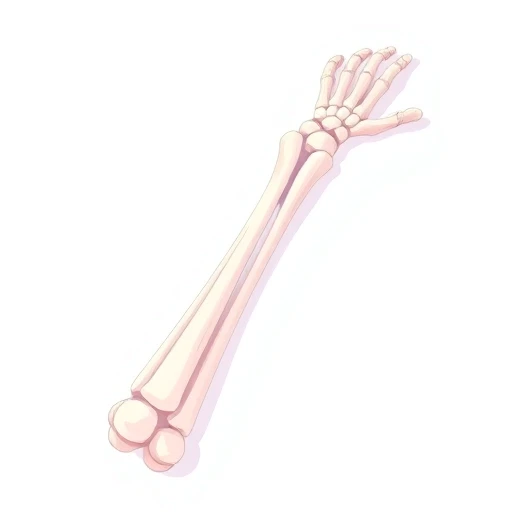
bone in 30 Seconds
- A bone is a hard, structural part of the vertebrate skeleton, primarily made of calcium and phosphorus, providing support and protection for the body.
- Metaphorically, 'bone' refers to the core, essence, or most basic version of something, as seen in the common phrase 'the bare bones.'
- The word is central to many English idioms, such as 'a bone of contention' (a disagreement) or 'to have a bone to pick' (a grievance).
- In culinary and scientific contexts, 'bone' can refer to a source of flavor in cooking or a key subject of study in anatomy and archaeology.
The word 'bone' is a fundamental term in the English language, primarily used to describe the hard, calcified tissue that makes up the skeleton of vertebrates. At its most basic level, a bone is a structural element. Just as a building requires a steel frame to remain upright and maintain its shape, the human body and the bodies of other animals rely on bones to provide support, facilitate movement, and protect vital internal organs. For instance, the skull is a collection of bones that acts as a natural helmet for the brain, while the ribcage forms a protective cage around the heart and lungs. Beyond this mechanical function, bones are dynamic, living tissues. they are not merely dry, white sticks; they are constantly being remodeled, storing essential minerals like calcium and phosphorus, and housing the marrow where blood cells are produced. This biological complexity makes the word 'bone' essential in medical, anatomical, and health-related discussions.
- Anatomical Context
- In biology, a bone refers to the rigid organs that constitute part of the endoskeleton. They are composed of a complex matrix of collagen and minerals. When doctors speak of bone density, they are referring to the amount of mineral matter per square centimeter of bone, which is a key indicator of skeletal strength and health.
The surgeon carefully realigned the fractured bone to ensure it would heal straight and strong.
In everyday conversation, 'bone' is frequently used in non-literal ways. We use it to describe the core or essence of something. When someone says they want to get to the 'bones' of a problem, they mean they want to strip away the superficial details and address the fundamental issues. This metaphorical usage extends to various idioms and expressions that permeate English culture. For example, a 'bone of contention' is a subject over which there is a continuing disagreement. This phrase evokes the image of two dogs fighting over a single bone, illustrating how a central point of conflict can dominate an interaction. Similarly, if something is 'bone dry,' it is completely devoid of moisture, emphasizing an extreme state through the comparison to the dry, weathered bones often found in arid environments.
- Culinary Context
- In cooking, bones are prized for their ability to add depth and flavor to stocks and soups. The marrow inside the bone is rich in fats and nutrients, often considered a delicacy in many cultures. Chefs might use the term 'bone-in' to describe a cut of meat that still contains the skeletal structure, which many believe improves the flavor during the cooking process.
The chef simmered the beef bones for twelve hours to create a rich, gelatinous broth.
Furthermore, 'bone' appears in archeology and paleontology as a primary source of information about the past. Fossilized bones allow scientists to reconstruct the appearance and behavior of extinct species, such as dinosaurs. In this context, a bone is a historical record, a physical link to a world that existed millions of years ago. The study of bones, known as osteology, is a specialized field that combines biology, anthropology, and forensic science. Whether we are talking about a broken leg in a hospital, a 'bone of contention' in a business meeting, or a dinosaur femur in a museum, the word 'bone' consistently refers to something foundational, structural, and enduring.
Archaeologists discovered a mammoth bone that showed signs of early human tool marks.
- Idiomatic Context
- Idioms like 'to have a bone to pick' or 'to make no bones about' something are common in informal English. These phrases use the physical properties or historical associations of bones to convey complex social interactions or attitudes, such as having a grievance or being very direct and honest.
I have a bone to pick with you regarding the way you handled the project deadline.
It takes a skilled hand to bone a whole chicken without tearing the delicate skin.
Using the word 'bone' correctly involves understanding its various grammatical roles and the contexts in which it appears. Most commonly, 'bone' functions as a countable noun. You can have one bone, two bones, or a collection of bones forming a skeleton. When discussing health or biology, it often appears in the singular to refer to a specific part of the body, such as the thigh bone (femur) or the collarbone (clavicle). In these cases, the word is usually preceded by a possessive adjective or a definite article. For example, 'She broke her bone during the soccer match' or 'The bone in his arm was fractured.' It is important to specify which bone is being discussed if the context requires precision, especially in medical or scientific writing.
- Plural Usage
- The plural form 'bones' is used when referring to the entire skeleton or multiple skeletal elements. It is also used in figurative expressions like 'I feel it in my bones,' which means to have an intuitive feeling about something. In this sense, 'bones' represents the deepest part of a person's being.
The museum displayed the fossilized bones of a Tyrannosaurus Rex in the main hall.
In addition to its role as a noun, 'bone' can act as an adjective in compound words or as a modifier. Terms like 'bone-chilling,' 'bone-tired,' and 'bone-dry' use the word to intensify the meaning of the following adjective. 'Bone-chilling' describes something so cold or frightening that it seems to penetrate through the flesh to the skeleton. 'Bone-tired' suggests a level of exhaustion that is felt deep within the body's structure. These modifiers are highly descriptive and are often used in creative writing to evoke strong physical sensations in the reader. When using these compounds, they are typically hyphenated when they precede the noun they modify.
- Verbal Usage
- As a verb, 'to bone' means to remove the bones from meat or fish. This is a technical term used in culinary arts. It can also be used in the phrasal verb 'to bone up on,' which means to study a subject intensively in a short period, often in preparation for an exam or a specific task.
I need to bone up on my ancient history before the trivia competition next week.
Furthermore, 'bone' is central to many idiomatic structures. When using idioms like 'to make no bones about it,' the word 'bones' historically referred to the dice used in gambling or the bones found in soup that might cause a person to hesitate. Today, the phrase means to be completely open and honest without any hesitation. Another common idiom is 'to have a bone to pick,' which means to have a grievance to discuss. In these cases, the word 'bone' is fixed within the phrase and cannot be easily substituted with synonyms without losing the idiomatic meaning. Mastery of these phrases is a sign of high-level English proficiency, as they require an understanding of both the literal and figurative layers of the language.
She made no bones about her dissatisfaction with the new company policy.
- Scientific Precision
- In academic writing, 'bone' is often used in conjunction with specific biological terms. You might read about 'bone resorption,' 'bone formation,' or 'bone remodeling.' In these contexts, 'bone' acts as a noun adjunct, modifying another noun to create a specific technical term.
The research paper detailed the effects of microgravity on bone density in astronauts during long-term missions.
The patient required a bone marrow transplant to treat her leukemia.
The word 'bone' is ubiquitous across many different spheres of life, from the clinical setting of a hospital to the creative environment of a kitchen. In a medical context, you will hear 'bone' used frequently by doctors, nurses, and radiologists. They might discuss 'bone fractures,' 'bone scans,' or 'bone density tests.' Patients often use the word when describing pain or injuries, such as 'I think I broke a bone' or 'My bones ache in the cold weather.' This usage is literal and focused on the physical health of the skeletal system. In sports, commentators often mention 'bone-jarring hits' or 'bone bruises' to emphasize the physical intensity and impact of certain athletic activities, particularly in contact sports like football or rugby.
- Culinary and Domestic Settings
- In the kitchen, 'bone' is a common term. You'll hear it in recipes calling for 'bone-in chicken thighs' or 'beef marrow bones.' Butchers use the word constantly as they prepare different cuts of meat, often asking customers if they want the 'bone left in' for extra flavor. At home, you might hear someone telling their dog to 'go get your bone,' referring to a chew toy or a literal animal bone given as a treat.
The butcher recommended keeping the bone in the roast to ensure the meat stays moist and flavorful.
In the world of science and education, 'bone' is a staple of biology and anatomy classes. Teachers use skeletal models to show students the different types of bones, such as long bones, short bones, and flat bones. In museums, particularly natural history museums, the word is central to the presentation of fossils. Guides might point out the 'fossilized bones' of ancient creatures, explaining how they were preserved over millions of years. This scientific usage is precise and often involves technical terms like 'ossification' or 'osteocyte,' but the root word 'bone' remains the primary point of reference for the general public.
- Metaphorical and Idiomatic Usage
- You will also hear 'bone' in many common English idioms during casual conversations or in literature. Phrases like 'the bare bones' are used in business meetings to describe the most basic version of a plan. 'A bone of contention' might be mentioned in a political debate to highlight a specific point of disagreement. These expressions are so common that native speakers often use them without thinking about the literal meaning of the word 'bone.'
The manager presented the bare bones of the new strategy, promising to provide more details in the coming weeks.
Finally, 'bone' appears in various cultural and artistic contexts. In music, 'bones' can refer to a percussion instrument made of actual bone or wood. In literature and film, bones are often used as symbols of mortality, history, or hidden secrets (as in 'skeletons in the closet'). You might hear a character in a movie say, 'I can feel it in my bones,' to express a deep, intuitive certainty about a future event. This wide range of applications—from the deeply scientific to the highly metaphorical—demonstrates how central the concept of 'bone' is to human experience and communication.
The detective knew something was wrong; he could feel the danger in his bones.
- Slang and Informal Usage
- In some informal dialects, 'bones' can refer to money (specifically dollars) or dice. While less common in formal English, you might hear these uses in certain urban environments or in older literature and films depicting specific subcultures.
He bet his last twenty bones on a single roll of the dice.
Wake up, you lazy bones! It's already ten o'clock in the morning.
One of the most frequent mistakes learners make with the word 'bone' is confusing it with the phonetically similar word 'born.' While they sound somewhat alike, their meanings and grammatical functions are entirely different. 'Bone' is a noun referring to skeletal tissue, whereas 'born' is the past participle of the verb 'bear,' used to describe the act of being brought into life. For example, saying 'I was bone in London' is a common error; the correct sentence is 'I was born in London.' Conversely, you wouldn't say 'The dog chewed on a born'; it must be 'The dog chewed on a bone.' Paying close attention to the final consonant sound—the 'n' in 'born' versus the 'ne' (which sounds like 'n' but often has a slightly different vowel length in some accents) in 'bone'—is crucial for clear communication.
- Pluralization Errors
- Another mistake involves the pluralization of 'bone' in specific idioms. For instance, the phrase is 'to make no bones about it,' always using the plural 'bones.' Using the singular 'bone' in this context would be incorrect and would sound unnatural to a native speaker. Similarly, 'the bare bones' of something always requires the plural form to indicate the multiple elements that make up a basic structure.
Incorrect: He made no bone about his dislike for the new manager. (Correct: bones)
Learners also sometimes struggle with the distinction between 'bone' and 'skeleton.' While they are related, they are not interchangeable. A 'bone' is a single unit, while a 'skeleton' is the entire framework of bones in a body. If you are talking about the whole structure, use 'skeleton.' If you are talking about a specific part, use 'bone.' For example, 'The human skeleton is made of 206 bones.' Using 'bone' to refer to the whole structure (e.g., 'The museum has a dinosaur bone' when referring to a full display) can be misleading unless you are specifically pointing out one individual piece of the display.
- Misusing 'Bone' as a Verb
- In culinary contexts, 'to bone' means to remove bones. However, some learners mistakenly use it to mean 'to add bones' or 'to strengthen.' This is incorrect. If you want to say you are adding bones to a soup, you should say 'adding bones' or 'simmering with bones.' The verb 'to bone' is strictly subtractive in a kitchen setting.
The recipe says to bone the fish, which means I need to take the ribs out before cooking.
Finally, there is the potential for confusion with the word 'bean' in some accents where the vowel sounds are similar. 'Bone' has a long 'o' sound (/boʊn/), while 'bean' has a long 'e' sound (/biːn/). Confusing these can lead to humorous or confusing situations, such as saying 'I have a bean to pick with you' instead of 'a bone to pick.' While the context usually clarifies the meaning, practicing the distinct vowel sounds will improve overall pronunciation and reduce the risk of being misunderstood. Additionally, be careful with the slang usage of 'bone,' as it can have vulgar connotations in certain contexts; it is generally safer for learners to stick to the literal and common idiomatic uses of the word.
Make sure to pronounce the 'o' in bone clearly so it doesn't sound like 'bean' or 'born'.
- Prepositional Errors
- When using the phrasal verb 'bone up on,' learners sometimes forget the 'on' or use the wrong preposition. The correct structure is always 'bone up on [subject].' For example, 'I need to bone up on my French' is correct, while 'I need to bone up my French' is not.
Before the exam, she spent the whole night boning up on organic chemistry.
The doctor pointed to a small bone in the hand that had a hairline fracture.
While 'bone' is a very specific term, there are several related words that can be used depending on the level of precision or the context required. In a general sense, 'skeleton' is the most common alternative when referring to the entire collection of bones. However, if you are looking for more technical or descriptive terms, you might consider 'ossicle,' which refers to a very small bone, particularly those in the middle ear. In a medical or scientific context, you might use the term 'osseous tissue' to describe the actual material that bones are made of. This is a more formal and precise way to discuss the biological properties of bone without using the common noun.
- Bone vs. Cartilage
- It is important to distinguish between 'bone' and 'cartilage.' Cartilage is a flexible, connective tissue found in many areas of the body, such as the nose and ears. While it is part of the skeletal system, it is not as hard or calcified as bone. Using 'bone' when you mean 'cartilage' can lead to anatomical inaccuracies, especially in medical discussions.
Unlike the rigid bones of the arm, the tip of the nose is made of flexible cartilage.
In metaphorical contexts, 'bone' has many alternatives that convey similar meanings of structure or essence. You might use 'framework,' 'foundation,' 'core,' or 'basis.' For example, instead of saying 'the bare bones of the plan,' you could say 'the basic framework of the plan.' Each of these alternatives carries a slightly different nuance. 'Framework' suggests a structured system, 'foundation' implies a supporting base, and 'core' emphasizes the central, most important part. Choosing the right word depends on which aspect of the 'bone' metaphor you want to highlight. In literature, 'frame' is often used as a synonym for the human body's skeletal structure, as in 'his weary frame,' which sounds more poetic than 'his weary bones.'
- Synonyms for Figurative Use
- When using 'bone' to mean the essence, synonyms like 'gist,' 'heart,' or 'substance' can be effective. For instance, 'the gist of the argument' is a common alternative to 'the bare bones of the argument.' These words are often more appropriate in formal writing where idioms might be seen as too casual.
The core of the issue is not the budget, but rather the lack of clear communication.
In the context of food, 'bone' is often contrasted with 'fillet' or 'boneless.' A 'fillet' is a piece of meat or fish that has had the bones removed. Using these terms correctly is essential for clarity in dining and cooking. For example, if you prefer meat without bones, you should look for 'boneless' options on a menu. In professional butchery, 'deboning' is the process of removing bones, which is a more formal synonym for the verb 'to bone.' Understanding these distinctions allows for more precise communication in a variety of everyday and specialized situations.
The restaurant offers both bone-in and boneless wings to cater to different customer preferences.
- Comparison Table
-
- Bone: A single structural unit of the skeleton.
- Skeleton: The complete framework of all bones in a body.
- Cartilage: Flexible connective tissue, not as hard as bone.
- Marrow: The soft substance inside bones where blood cells are made.
The doctor explained that the injury affected the cartilage in the knee rather than the bone itself.
The skeletal remains were found deep within the limestone cave.
How Formal Is It?
Fun Fact
The phrase 'funny bone' is actually a pun on the anatomical name for the upper arm bone, the 'humerus,' which sounds like 'humorous.'
Pronunciation Guide
- Pronouncing it like 'born' (/bɔːrn/), which has a different vowel and a final 'r' sound.
- Pronouncing it like 'bean' (/biːn/), which has a long 'e' sound.
- Over-emphasizing the final 'e', which is silent in English.
- Confusing the 'o' sound with the 'ah' sound as in 'bon' (French).
- Failing to make the 'n' sound clear at the end of the word.
Difficulty Rating
The word is easy to recognize and usually appears in clear contexts.
Spelling is simple, but using idioms correctly requires more practice.
Pronunciation is generally easy, but the 'o' sound can be tricky for some.
It is a short, distinct word that is usually easy to hear.
What to Learn Next
Prerequisites
Learn Next
Advanced
Grammar to Know
Countable Nouns
I found a bone in the woods. (Correct) / I found bone in the woods. (Incorrect, unless referring to the material)
Compound Adjectives
The bone-dry soil needed water. (Hyphenated before the noun)
Phrasal Verbs
She is boning up on her Italian. (Must include 'on')
Idiomatic Fixed Phrases
It's a bone of contention. (Cannot say 'a bone of argument')
Noun Adjuncts
Bone health is important for everyone. ('Bone' acts like an adjective)
Examples by Level
The dog has a big bone.
Le chien a un gros os.
Simple subject-verb-object structure with a countable noun.
My bones are hard.
Mes os sont durs.
Plural noun used with the verb 'to be'.
Is this a fish bone?
Est-ce une arête de poisson ?
Interrogative sentence using 'bone' as a countable noun.
He broke a bone in his leg.
Il s'est cassé un os à la jambe.
Past simple tense with a specific body part.
Bones make us strong.
Les os nous rendent forts.
General statement using the plural form.
The bone is white and dry.
L'os est blanc et sec.
Descriptive sentence with two adjectives.
I can feel the bone in my wrist.
Je peux sentir l'os de mon poignet.
Using a modal verb 'can' with a physical sensation.
Look at the dinosaur bone!
Regarde l'os de dinosaure !
Imperative sentence with an exclamation.
Drink milk to have healthy bones.
Bois du lait pour avoir des os sains.
Imperative followed by an infinitive of purpose.
The doctor showed me the X-ray of my bone.
Le médecin m'a montré la radiographie de mon os.
Past simple with indirect and direct objects.
Be careful not to swallow any fish bones.
Fais attention à ne pas avaler d'arêtes de poisson.
Negative infinitive after an adjective phrase.
The skeleton is made of many bones.
Le squelette est composé de nombreux os.
Passive voice 'is made of' followed by a plural noun.
He is such a lazy bones; he never helps.
C'est un vrai paresseux ; il n'aide jamais.
Informal compound noun used as a character description.
The dog buried its bone in the garden.
Le chien a enterré son os dans le jardin.
Past simple with a possessive adjective.
Calcium is very important for bone growth.
Le calcium est très important pour la croissance des os.
'Bone' used as a noun adjunct modifying 'growth'.
She has a small bone in her ear that helps her hear.
Elle a un petit os dans l'oreille qui l'aide à entendre.
Relative clause 'that helps her hear' modifying 'bone'.
The bare bones of the report were presented today.
L'essentiel du rapport a été présenté aujourd'hui.
Idiomatic use of 'bare bones' as a plural subject.
It was a bone-chilling night in the middle of winter.
C'était une nuit glaciale au milieu de l'hiver.
Compound adjective 'bone-chilling' modifying 'night'.
The desert was bone-dry after months without rain.
Le désert était complètement sec après des mois sans pluie.
Compound adjective 'bone-dry' used as a complement.
He needs to bone up on his history before the exam.
Il doit réviser sérieusement son histoire avant l'examen.
Phrasal verb 'bone up on' meaning to study hard.
The fracture in the bone will take six weeks to heal.
La fracture de l'os mettra six semaines à guérir.
Future simple with a time duration.
I have a bone to pick with you about the mess.
J'ai un compte à régler avec toi au sujet du désordre.
Idiom 'to have a bone to pick' followed by 'with someone'.
The soup was made by boiling beef bones for hours.
La soupe a été faite en faisant bouillir des os de bœuf pendant des heures.
Gerund 'boiling' used after the preposition 'by'.
She felt the cold deep in her bones.
Elle sentait le froid au plus profond de ses os.
Prepositional phrase 'in her bones' used for emphasis.
The ownership of the land became a bone of contention.
La propriété du terrain est devenue une pomme de discorde.
Idiom 'bone of contention' used as a subject complement.
The surgeon performed a bone marrow transplant.
Le chirurgien a effectué une greffe de moelle osseuse.
Compound noun 'bone marrow transplant' as a direct object.
He made no bones about his intention to resign.
Il n'a pas caché son intention de démissionner.
Idiom 'make no bones about' followed by a noun phrase.
The archaeologist carefully brushed the dirt off the bone.
L'archéologue a soigneusement brossé la terre de l'os.
Adverb 'carefully' modifying the verb 'brushed'.
Bone density often decreases as people get older.
La densité osseuse diminue souvent avec l'âge.
Noun adjunct 'bone' modifying 'density' in a general truth.
The athlete suffered a bone-jarring collision on the field.
L'athlète a subi une collision violente sur le terrain.
Compound adjective 'bone-jarring' to describe intensity.
You should bone the chicken before starting the recipe.
Tu devrais désosser le poulet avant de commencer la recette.
Verbal use of 'bone' meaning to remove bones.
I can feel it in my bones that something good is coming.
Je sens au plus profond de moi que quelque chose de bien arrive.
Idiom 'feel it in my bones' followed by a 'that' clause.
The bare bones of the argument were surprisingly simple.
L'essentiel de l'argument était étonnamment simple.
Metaphorical use of 'bare bones' in an academic context.
The company was operating with a skeletal staff, cut to the bone.
L'entreprise fonctionnait avec un personnel réduit au strict minimum.
Double metaphor using 'skeletal' and 'cut to the bone'.
The news sent a bone-chilling shiver down her spine.
La nouvelle lui a donné un frisson glacial dans le dos.
Vivid imagery using a compound adjective and a specific idiom.
He had a bone-deep conviction that he was doing the right thing.
Il avait la conviction profonde qu'il faisait ce qu'il fallait.
Compound adjective 'bone-deep' to describe intensity of belief.
The project was stripped to the bone to save on costs.
Le projet a été réduit au strict minimum pour économiser sur les coûts.
Passive voice with the idiomatic phrase 'stripped to the bone'.
There is not a selfish bone in her entire body.
Elle n'a pas une once d'égoïsme en elle.
Idiomatic expression to describe a person's character.
The legal dispute over the inheritance was a major bone of contention.
Le litige juridique concernant l'héritage était un point de discorde majeur.
Formal use of 'bone of contention' in a legal context.
He spent the weekend boning up on the latest market trends.
Il a passé le week-end à se documenter sur les dernières tendances du marché.
Phrasal verb 'boning up on' used in a professional context.
The author explores the very bones of human existence in her latest novel.
L'auteur explore l'essence même de l'existence humaine dans son dernier roman.
Highly metaphorical use of 'bones' to mean fundamental essence.
The budget cuts were so severe they went past the fat and straight to the bone.
Les coupes budgétaires étaient si sévères qu'elles ont touché l'essentiel.
Extended metaphor comparing a budget to a body.
Her honesty was bone-deep, making her both respected and feared.
Son honnêteté était viscérale, ce qui la rendait à la fois respectée et crainte.
Using 'bone-deep' to describe an intrinsic personality trait.
The ancient ruins provided the bare bones upon which the city was rebuilt.
Les ruines antiques ont fourni la structure de base sur laquelle la ville a été reconstruite.
Metaphorical use of 'bare bones' as a physical and historical foundation.
He made no bones about the fact that he found the proposal utterly preposterous.
Il n'a pas caché le fait qu'il trouvait la proposition tout à fait absurde.
Sophisticated use of 'make no bones about' with complex vocabulary.
The cold was not merely superficial; it was a bone-aching, relentless frost.
Le froid n'était pas seulement superficiel ; c'était un gel implacable qui faisait mal aux os.
Creating a new compound adjective 'bone-aching' for literary effect.
The skeletal remains were the only evidence left of the once-great civilization.
Les restes squelettiques étaient les seules preuves restantes de la civilisation autrefois grande.
Using 'skeletal remains' in a formal, historical context.
The disagreement over the border remains a bone of contention in international relations.
Le désaccord sur la frontière reste une pomme de discorde dans les relations internationales.
Using 'bone of contention' in a high-level political context.
Common Collocations
Common Phrases
— To reduce something to the absolute minimum, especially regarding costs or staff. It implies a very deep and severe reduction.
The department's budget was cut to the bone this year.
— An informal and often affectionate way to call someone lazy. It is frequently used with children or close friends.
Come on, lazy bones, get out of bed!
— Extremely thin or emaciated, to the point where the skeletal structure is very visible through the skin.
The stray dog was nothing but skin and bones.
— To the core or to the greatest possible extent. Often used with 'chilled' or 'frozen'.
The icy wind chilled me to the bone.
— A culinary term describing a cut of meat that still contains the bone. Many believe this adds flavor.
I prefer bone-in ribeye steak for its superior taste.
— To study or learn about something quickly and intensively. Usually followed by the preposition 'on'.
I need to bone up on my Spanish before my trip to Madrid.
— Describing a physical impact that is so hard it feels like it shakes your entire skeleton.
The car hit a pothole with a bone-jarring thud.
— An adjective phrase meaning extremely lazy. It is a more emphatic version of just 'lazy'.
He is bone idle and hasn't done a lick of work all day.
— Extremely deep or fundamental. Used to describe feelings, convictions, or physical states.
Her loyalty to the cause was bone-deep.
— The part of the elbow where the ulnar nerve is near the surface. Hitting it causes a tingling sensation.
I hit my funny bone on the edge of the table, and my arm went numb.
Often Confused With
A common phonetic error; 'born' relates to birth, 'bone' relates to the skeleton.
Vowel sound confusion; 'bean' is a vegetable, 'bone' is skeletal tissue.
A skeleton is the whole structure, while a bone is a single part of it.
Idioms & Expressions
— A subject or issue over which there is a continuing and often bitter disagreement. It is the central point of a conflict.
The location of the new park became a bone of contention in the neighborhood.
neutral/formal— To have a grievance or a complaint that you want to discuss with someone. It implies a need for a confrontation.
I have a bone to pick with you about the way you spoke to me yesterday.
informal— To be very direct, open, and honest about something, without any hesitation or attempt to hide one's feelings.
He made no bones about his desire to take over the company.
neutral— To have a strong, intuitive feeling about something, even if there is no logical evidence for it yet.
I feel it in my bones that it's going to be a great year.
informal— The most basic and essential parts of something, without any extra details or embellishments.
She gave us the bare bones of the plan, but we need more information.
neutral— To give someone a small, often insignificant concession or reward to keep them satisfied or quiet.
The manager threw the employees a bone by giving them an extra hour for lunch.
informal— Hidden, embarrassing, or scandalous secrets from one's past that they do not want others to know about.
Every family has a few skeletons in the closet.
informal— To work extremely hard for a long period of time, often to the point of exhaustion.
She worked her fingers to the bone to provide for her children.
informal— Completely dry, with no moisture at all. Often used to describe soil, weather, or a throat.
The laundry was bone dry after hanging in the sun all afternoon.
neutral— Describing a remark or joke that is so accurate or personal that it makes someone feel uncomfortable or offended.
His comments about her failed marriage were a bit too close to the bone.
informalEasily Confused
It is the adjective form of bone.
Bony describes something that has many bones or looks like a bone (e.g., a bony fish or a bony person). Bone is the noun.
The old man had very bony hands.
It is the opposite of bone-in.
Boneless means the bones have been removed, usually from meat. Bone is the object itself.
I bought some boneless chicken breasts for dinner.
It is a compound word containing 'bone'.
Backbone specifically refers to the spine or, metaphorically, to strength of character. Bone is more general.
He showed a lot of backbone by standing up to the bully.
It is found inside bones.
Marrow is the soft tissue inside the bone, not the hard bone itself.
Bone marrow is where the body makes new blood cells.
Both are part of the skeletal system.
Cartilage is flexible and soft, while bone is hard and rigid.
Sharks have a skeleton made of cartilage instead of bone.
Sentence Patterns
Subject + have/has + a/an + bone.
The dog has a bone.
Subject + broke + a bone + in + [body part].
He broke a bone in his arm.
It was + bone-[adjective].
It was bone-dry.
Subject + need to + bone up on + [subject].
I need to bone up on my math.
[Something] + is + a bone of contention.
The tax was a bone of contention.
Subject + make no bones about + [something].
She made no bones about her anger.
Subject + feel it in + [possessive] + bones.
I feel it in my bones.
[Something] + is + stripped to the bone.
The budget was stripped to the bone.
Word Family
Nouns
Verbs
Adjectives
Related
How to Use It
Very high in both literal and figurative contexts.
-
I was bone in 1990.
→
I was born in 1990.
Confusing 'bone' (skeletal part) with 'born' (brought into life). This is a very common phonetic error.
-
He made no bone about it.
→
He made no bones about it.
The idiom 'make no bones about it' always uses the plural form 'bones.'
-
I need to bone up my history.
→
I need to bone up on my history.
The phrasal verb 'bone up' must be followed by the preposition 'on.'
-
The soup has many fish's bones.
→
The soup has many fish bones.
When using 'fish' as a modifier for 'bones,' you don't need the possessive 's.
-
I feel it in my bone.
→
I feel it in my bones.
The idiom 'feel it in one's bones' always uses the plural form to mean a deep intuition.
Tips
Use 'bone' for structure
Whenever you want to describe the most basic part of a plan or idea, use the phrase 'the bare bones.' It's a very common and effective metaphor in professional English.
Clear Vowels
Make sure to pronounce the 'o' in 'bone' clearly as a long vowel. This helps distinguish it from 'born,' which is a very common mistake for English learners.
Learn the Idioms
Bones are used in many idioms. Learning 'bone of contention' and 'bone to pick' will significantly improve your ability to describe conflicts and grievances naturally.
Countable vs. Uncountable
Treat 'bone' as a countable noun in almost all situations. Always use 'a' or 'the' or make it plural when you are talking about physical bones.
Bone-in for Flavor
In a restaurant or when shopping, remember that 'bone-in' means the bone is still there, which often means more flavor, while 'boneless' means it has been removed.
Bone Density
When discussing health, 'bone density' is the standard term. Using this phrase correctly shows a good command of health-related English.
Intensifiers
Use 'bone-chilling' or 'bone-tired' to add intensity to your writing. These are much more descriptive than just saying 'very cold' or 'very tired.'
Make no bones
Use 'make no bones about it' when you want to emphasize that you are being completely honest and direct about something difficult.
Silent E
Remember the silent 'e' at the end of 'bone.' It changes the pronunciation of the 'o' from a short sound to a long one.
Skeleton vs. Bone
Don't use 'skeleton' when you mean a single part. Use 'bone' for the individual piece and 'skeleton' for the whole set.
Memorize It
Mnemonic
Think of a 'Bone' as the 'Base' of the body. Both start with 'B' and represent the foundation of a structure.
Visual Association
Visualize a classic white cartoon dog bone. This simple image can help you remember the literal meaning and the hard, white nature of bones.
Word Web
Challenge
Try to use three different 'bone' idioms in a short paragraph about a disagreement you once had with a friend.
Word Origin
The word 'bone' comes from the Old English 'bān,' which is of Germanic origin. It has cognates in many other Germanic languages, such as the Dutch 'been' and the German 'Bein.'
Original meaning: In Old English, 'bān' referred specifically to the hard parts of the skeleton, but in some related languages, it also meant 'leg.'
Indo-European > Germanic > West Germanic > Old English > Middle English > Modern English.Cultural Context
Be careful when using 'bone' in slang contexts, as it can have sexual or vulgar meanings in some dialects. In medical contexts, always use the term respectfully when discussing injuries or illness.
The word 'bone' is deeply embedded in English idioms, reflecting a historical connection to gambling (dice were made of bone) and simple, rural life.
Practice in Real Life
Real-World Contexts
Medical/Health
- broken bone
- bone density
- bone marrow
- bone scan
Culinary/Cooking
- bone-in
- boneless
- fish bone
- bone broth
Idiomatic/Casual
- bone of contention
- bone to pick
- bare bones
- feel it in my bones
Archaeology/Science
- fossilized bone
- skeletal remains
- bone structure
- bone fragment
Descriptions
- bone-dry
- bone-chilling
- bone-tired
- skin and bones
Conversation Starters
"Have you ever broken a bone? What happened and how long did it take to heal?"
"Do you prefer bone-in or boneless chicken when you are cooking at home?"
"What is a major 'bone of contention' in your workplace or community right now?"
"Is there a subject you need to 'bone up on' before a big meeting or exam?"
"Have you ever had a strong feeling 'in your bones' that something was about to happen?"
Journal Prompts
Describe a time when you had a 'bone to pick' with someone. How did you handle the situation and what was the outcome?
Write about a 'bone-chilling' experience you've had, either in real life or while watching a movie or reading a book.
What are the 'bare bones' of your daily routine? What are the most essential things you do every day?
Reflect on a goal you have. What do you need to 'bone up on' to achieve this goal successfully?
Think about a person you admire. Why do you think they don't have a 'selfish bone in their body'?
Frequently Asked Questions
10 questionsThe collarbone (clavicle) is one of the most frequently broken bones in the human body, often due to falls or sports injuries. It is a long, thin bone that is relatively easy to fracture under pressure. Other common fractures include the wrist and the ankle.
An adult human skeleton typically consists of 206 bones. Interestingly, infants are born with around 270 bones, but many of these fuse together as the child grows and develops into an adult. These bones provide the essential framework for our bodies.
This idiom refers to a specific issue or subject that causes a lot of disagreement or arguing between people. For example, 'The new office layout was a bone of contention among the staff.' It comes from the image of two dogs fighting over a single bone.
Yes, 'bone' can be a verb meaning to remove the bones from meat or fish before cooking. For example, 'You need to bone the fish carefully.' It is also used in the phrasal verb 'bone up on,' which means to study something intensively.
In most cases, 'bone' is a countable noun (e.g., 'one bone,' 'two bones'). However, when referring to the material itself in a general sense, it can occasionally be used uncountably, though this is less common in everyday English.
A bone is a single unit of the skeletal system, while the skeleton is the entire framework of all the bones in the body. You have many bones, but only one skeleton. Think of a bone as a brick and the skeleton as the whole house.
This means you have a complaint or a grievance that you want to discuss with someone. It usually implies that you are a bit annoyed and want to resolve a specific problem. For example, 'I have a bone to pick with you about the late report.'
The 'bare bones' are the most basic and essential parts of a story, plan, or idea. It means all the extra details have been removed, leaving only the core structure. For example, 'He gave us the bare bones of his proposal.'
The 'funny bone' isn't actually a bone; it's the ulnar nerve that runs near the humerus bone in your arm. The name is a pun on 'humerus' (which sounds like 'humorous') and the 'funny' tingling sensation you feel when you hit it.
The correct spelling is 'bone-dry,' with a hyphen. It is a compound adjective used to describe something that is completely dry. For example, 'The ground was bone-dry after the long summer heatwave.'
Test Yourself 180 questions
Write a sentence about a dog and a bone.
Well written! Good try! Check the sample answer below.
Describe what happens if you break a bone.
Well written! Good try! Check the sample answer below.
Use 'bone-dry' in a sentence about the weather.
Well written! Good try! Check the sample answer below.
Explain what a 'bone of contention' is in your own words.
Well written! Good try! Check the sample answer below.
Write a short paragraph using 'the bare bones' and 'bone up on'.
Well written! Good try! Check the sample answer below.
List three parts of the body where you can feel bones.
Well written! Good try! Check the sample answer below.
Why is milk important for children's bones?
Well written! Good try! Check the sample answer below.
Write a sentence using 'bone-chilling'.
Well written! Good try! Check the sample answer below.
Describe a situation where you had a 'bone to pick' with someone.
Well written! Good try! Check the sample answer below.
What does it mean to 'feel something in your bones'?
Well written! Good try! Check the sample answer below.
Discuss the metaphorical use of 'bone' in literature.
Well written! Good try! Check the sample answer below.
Use 'bone-tired' in a sentence about work.
Well written! Good try! Check the sample answer below.
Explain the difference between 'bone-in' and 'boneless' chicken.
Well written! Good try! Check the sample answer below.
Write a sentence using 'make no bones about it'.
Well written! Good try! Check the sample answer below.
What is a 'lazy bones'?
Well written! Good try! Check the sample answer below.
What happens when you hit your 'funny bone'?
Well written! Good try! Check the sample answer below.
Why is 'bone density' important for older people?
Well written! Good try! Check the sample answer below.
Use 'skin and bones' to describe a character.
Well written! Good try! Check the sample answer below.
What does 'cut to the bone' mean in a financial context?
Well written! Good try! Check the sample answer below.
Write a sentence using 'bone up on' for a hobby.
Well written! Good try! Check the sample answer below.
Say: 'The dog has a bone.'
Read this aloud:
You said:
Speech recognition is not supported in your browser. Try Chrome or Edge.
Say: 'I broke a bone in my arm.'
Read this aloud:
You said:
Speech recognition is not supported in your browser. Try Chrome or Edge.
Say: 'The desert was bone-dry.'
Read this aloud:
You said:
Speech recognition is not supported in your browser. Try Chrome or Edge.
Say: 'It's a bone of contention.'
Read this aloud:
You said:
Speech recognition is not supported in your browser. Try Chrome or Edge.
Say: 'I feel it in my bones.'
Read this aloud:
You said:
Speech recognition is not supported in your browser. Try Chrome or Edge.
Say: 'Bones are hard and white.'
Read this aloud:
You said:
Speech recognition is not supported in your browser. Try Chrome or Edge.
Say: 'Milk is good for your bones.'
Read this aloud:
You said:
Speech recognition is not supported in your browser. Try Chrome or Edge.
Say: 'I need to bone up on my English.'
Read this aloud:
You said:
Speech recognition is not supported in your browser. Try Chrome or Edge.
Say: 'He made no bones about it.'
Read this aloud:
You said:
Speech recognition is not supported in your browser. Try Chrome or Edge.
Say: 'These are the bare bones of the story.'
Read this aloud:
You said:
Speech recognition is not supported in your browser. Try Chrome or Edge.
Say: 'Wake up, lazy bones!'
Read this aloud:
You said:
Speech recognition is not supported in your browser. Try Chrome or Edge.
Say: 'The news was bone-chilling.'
Read this aloud:
You said:
Speech recognition is not supported in your browser. Try Chrome or Edge.
Say: 'I have a bone to pick with you.'
Read this aloud:
You said:
Speech recognition is not supported in your browser. Try Chrome or Edge.
Say: 'She is nothing but skin and bones.'
Read this aloud:
You said:
Speech recognition is not supported in your browser. Try Chrome or Edge.
Say: 'The budget was cut to the bone.'
Read this aloud:
You said:
Speech recognition is not supported in your browser. Try Chrome or Edge.
Say: 'A fish bone is small.'
Read this aloud:
You said:
Speech recognition is not supported in your browser. Try Chrome or Edge.
Say: 'The skeleton has many bones.'
Read this aloud:
You said:
Speech recognition is not supported in your browser. Try Chrome or Edge.
Say: 'I am bone-tired today.'
Read this aloud:
You said:
Speech recognition is not supported in your browser. Try Chrome or Edge.
Say: 'Check your bone density.'
Read this aloud:
You said:
Speech recognition is not supported in your browser. Try Chrome or Edge.
Say: 'His conviction was bone-deep.'
Read this aloud:
You said:
Speech recognition is not supported in your browser. Try Chrome or Edge.
Listen and write the word: [Audio: bone]
Listen and write the phrase: [Audio: broken bone]
Listen and write the phrase: [Audio: bone-dry]
Listen and write the phrase: [Audio: bone of contention]
Listen and write the phrase: [Audio: bare bones]
Listen and identify the word: [Audio: bones]
Listen and write: [Audio: lazy bones]
Listen and write: [Audio: bone up on]
Listen and write: [Audio: bone marrow]
Listen and write: [Audio: feel it in my bones]
Listen and write: [Audio: fish bone]
Listen and write: [Audio: bone-chilling]
Listen and write: [Audio: have a bone to pick]
Listen and write: [Audio: skin and bones]
Listen and write: [Audio: cut to the bone]
/ 180 correct
Perfect score!
Summary
The word 'bone' is essential for describing both physical structure and metaphorical essence. For example, 'The bare bones of the plan' refers to its most basic elements, while 'bone density' is a critical measure of physical health.
- A bone is a hard, structural part of the vertebrate skeleton, primarily made of calcium and phosphorus, providing support and protection for the body.
- Metaphorically, 'bone' refers to the core, essence, or most basic version of something, as seen in the common phrase 'the bare bones.'
- The word is central to many English idioms, such as 'a bone of contention' (a disagreement) or 'to have a bone to pick' (a grievance).
- In culinary and scientific contexts, 'bone' can refer to a source of flavor in cooking or a key subject of study in anatomy and archaeology.
Use 'bone' for structure
Whenever you want to describe the most basic part of a plan or idea, use the phrase 'the bare bones.' It's a very common and effective metaphor in professional English.
Clear Vowels
Make sure to pronounce the 'o' in 'bone' clearly as a long vowel. This helps distinguish it from 'born,' which is a very common mistake for English learners.
Learn the Idioms
Bones are used in many idioms. Learning 'bone of contention' and 'bone to pick' will significantly improve your ability to describe conflicts and grievances naturally.
Countable vs. Uncountable
Treat 'bone' as a countable noun in almost all situations. Always use 'a' or 'the' or make it plural when you are talking about physical bones.
Example
The doctor confirmed that the patient had a small fracture in the bone of her wrist.
Related Content
See it in Videos
 5:47
5:47
How does leg lengthening surgery work? - Jason Shih Hoellwarth
 4:12
4:12
What happens when you break a bone? - Gurpreet Baht and Natalie Pang
"The doctor confirmed that the patient had a small fracture in the bone of her wrist."
 8:01
8:01
Tuscan Style Ribs (Rosticciana) | Hot & Fast Grilled Ribs | Food Wishes
Learn it in Context
This Word in Other Languages
Related Phrases
More Body words
tongue
B1The fleshy muscular organ in the mouth of a mammal, used for tasting, licking, swallowing, and articulating speech. It can also refer to a specific language or a person's style of speaking.
eyelid
B1A thin fold of skin that covers and protects the eye. It can be closed voluntarily or involuntarily to keep the eye moist and shield it from light and foreign objects.
backs
B1The plural of 'back,' referring to the rear surface of the human body or the part of an object opposite the front. As a verb, it is the third-person singular form of 'back,' meaning to support someone or move something backwards.
bones
B1Bones are the hard, rigid organs that form the skeletal framework of humans and other vertebrates. They provide structural support for the body, protect internal organs, and allow for movement by serving as levers for muscles.
clitoris
C1A small, sensitive, erectile part of the female genitals located at the anterior end of the vulva. It is homologous to the penis in males and is a primary source of sexual pleasure.
sleeping
A1The state of being in a natural, recurring condition of rest for the body and mind, characterized by closed eyes and altered consciousness. It is a vital biological process required for physical recovery and mental health.
tendon
C1A strong, flexible band of fibrous connective tissue that connects muscle to bone. It functions to transmit the mechanical force of muscle contraction to the bones to create movement.
urine
B1Urine is a liquid waste product filtered from the blood by the kidneys and stored in the bladder before being expelled from the body. It consists primarily of water, along with urea, salts, and other dissolved substances.
arm
C1Describes someone or something equipped with weapons for combat, or metaphorically, someone thoroughly prepared with specific tools, information, or resources for a particular task.
poop
B1Solid waste discharged from the bowels; excrement. Also used as a verb to mean the act of discharging waste.

