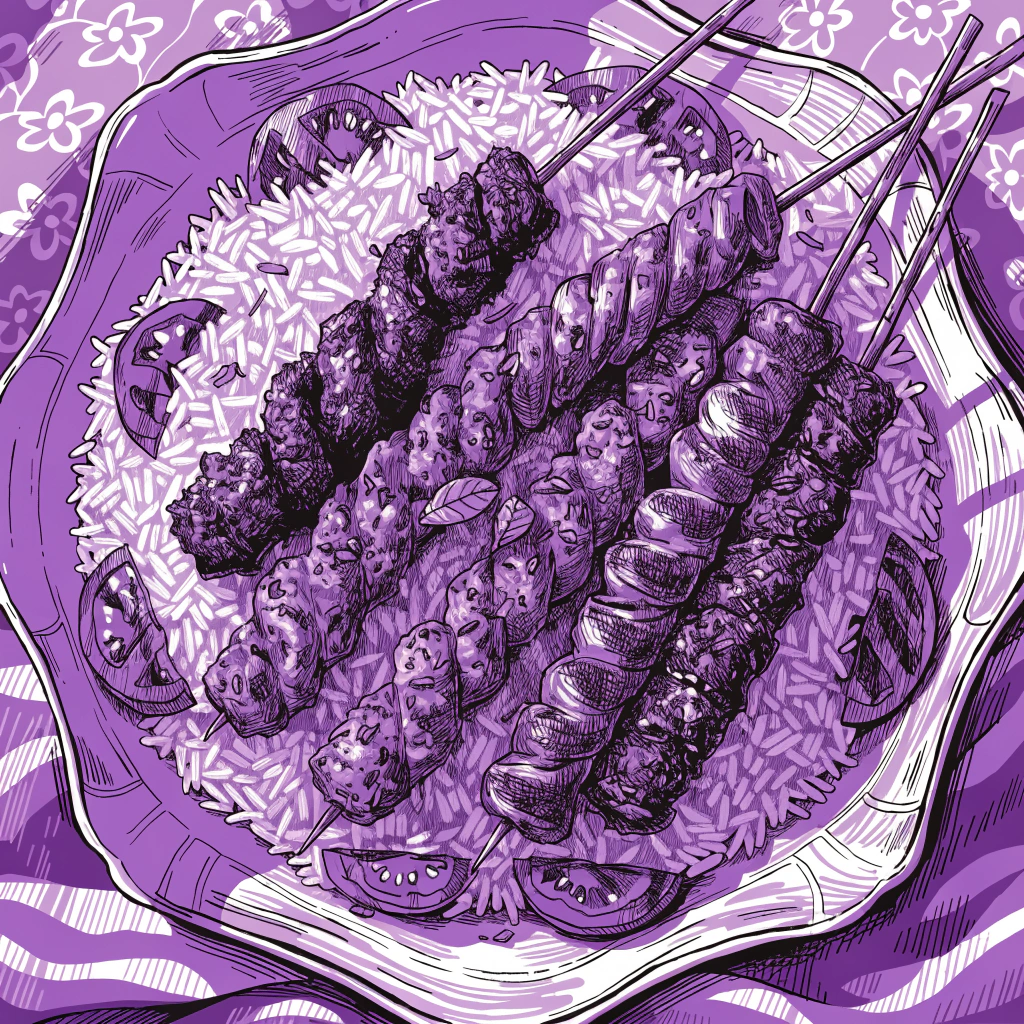
Chelow Kabab: A Famous Iranian Meal
Chelow Kabab is a very famous food in Iran. Many people in cities like Tehran and Tabriz eat it every day. It is a special meal for families and friends.
This traditional dish has two parts. 'Chelow' is white rice. It is soft and good. 'Kabab' is meat. Cooks grill the meat over a fire.
Iranians eat the rice with butter. They often drink a yogurt drink called Doogh. The food smells very good. It is delicious! Many people love this Iranian food.
Gramática em destaque
Padrão: Present Simple (be)
"Chelow Kabab is a very famous food in Iran."
We use 'is' with singular subjects to describe facts. It tells us what something is or how it looks.
Padrão: Present Simple (action verbs)
"Cooks grill the meat over a fire."
We use the base form of the verb for plural subjects like 'cooks'. This describes a regular action or habit.
Teste sua compreensão
10 perguntas · A1 Iniciante · 1 pré-visualização grátis
Teste o que aprendeu neste artigo. Responda todas as perguntas para ganhar XP!
What is 'Chelow' in this meal?
Quer finalizar o quiz?
9 perguntas a mais estão esperando por você. Cadastre-se grátis para desbloquear o quiz completo e ganhar XP!
Cadastrar grátisJá tem conta? Entrar
Detalhamento das perguntas
What is 'Chelow' in this meal?
Sua resposta:
Resposta correta: Rice
People in Tehran and Tabriz eat Chelow Kabab.
Sua resposta:
Resposta correta: Verdadeiro
What does 'delicious' mean?
Sua resposta:
Resposta correta: Tastes very good
Iranians often drink a yogurt drink called _____.
Sua resposta:
Resposta correta: Doogh
Chelow Kabab: The Famous Food of Iran
Chelow Kabab is the most famous meal in Iran. You can find it in every city from Tehran to Tabriz. The name comes from two words: 'Chelow' means steamed rice and 'Kabab' is grilled meat. It smells wonderful when it is cooking in the kitchen.
This dish became popular a long time ago. In the 19th century, King Nasser al-Din Shah loved this food. He brought the idea from the Caucasus region. Soon, many traditional restaurants started to cook it for everyone.
The rice is very special because it is fluffy and white. Often, there is a piece of yellow rice on top. People eat the meat with grilled tomatoes, fresh onions, and butter. It is more delicious than other fast foods because it is fresh and healthy. If you visit an Iranian home, they will probably serve this traditional meal because it is an important symbol of their culture.
Gramática em destaque
Padrão: Past Simple
"He brought the idea from the Caucasus region."
The past simple is used for actions that finished in the past. To form it, we use the past form of the verb like 'brought' (the past of 'bring') or 'started'.
Padrão: Comparatives
"It is more delicious than other fast foods because it is fresh and healthy."
We use 'more + adjective + than' to compare two things when the adjective is long. This shows that one thing has more of a quality than the other.
Teste sua compreensão
11 perguntas · A2 Elementar · 1 pré-visualização grátis
Teste o que aprendeu neste artigo. Responda todas as perguntas para ganhar XP!
What does the word 'Chelow' mean?
Quer finalizar o quiz?
10 perguntas a mais estão esperando por você. Cadastre-se grátis para desbloquear o quiz completo e ganhar XP!
Cadastrar grátisJá tem conta? Entrar
Detalhamento das perguntas
What does the word 'Chelow' mean?
Sua resposta:
Resposta correta: Steamed rice
King Nasser al-Din Shah hated Chelow Kabab.
Sua resposta:
Resposta correta: Falso
What does 'traditional' mean?
Sua resposta:
Resposta correta: Something from the past and culture
The rice is very special because it is fluffy and _____.
Sua resposta:
Resposta correta: white
Where did the King get the idea for this food?
Sua resposta:
Resposta correta: The Caucasus region
Chelow Kabab: The Heart of Iranian Cuisine
Have you ever tasted the national dish of Iran? Chelow Kabab has been enjoyed by people across the country for centuries. This meal, which consists of fluffy steamed rice and grilled meat, is famous for its incredible aroma. It is widely believed that the dish became popular during the Qajar dynasty in the 19th century, especially under the reign of Nasser al-Din Shah, who was a great fan of this style of cooking.
The rice, which is known as 'Chelow', is prepared with great care. It is steamed until it becomes light and soft. A golden, crunchy layer of rice called 'Tahdig' is often found at the bottom of the pot, and it is highly prized by guests. The 'Kabab' is usually made from minced lamb or beef, which is mixed with onions and various spices before being grilled over charcoal. While there are many varieties, such as 'Barg' or 'Koobideh', they are all cooked to perfection to ensure they remain juicy.
When you visit a traditional restaurant from Tehran to Tabriz, you will notice that the meal is served with specific side dishes. For instance, sumac, a purple spice with a slightly sour taste, is sprinkled over the rice to add flavor. In some traditional settings, a raw egg yolk is placed in the middle of the hot rice to make it creamy. Fresh herbs, grilled tomatoes, and a cold yogurt drink called 'Doogh' are essential parts of the culinary experience.
Chelow Kabab is much more than just a simple meal; it is a symbol of Iranian hospitality. It has been shared at family gatherings and important celebrations for many generations. Today, it remains a dish that brings people together, representing the rich history and the warm culture of the Iranian people.
Gramática em destaque
Padrão: Present Perfect (Passive)
"Chelow Kabab has been enjoyed by people across the country for centuries."
This pattern is formed using 'has/have been' + past participle. It is used to describe an action that started in the past and continues to be true or relevant now, focusing on the dish rather than the people eating it.
Padrão: Relative Clauses
"The rice, which is known as 'Chelow', is prepared with great care."
A relative clause provides extra information about a noun. Here, 'which is known as Chelow' gives more detail about the rice. We use 'which' for things and 'who' for people.
Teste sua compreensão
11 perguntas · B1 Intermediário · 1 pré-visualização grátis
Teste o que aprendeu neste artigo. Responda todas as perguntas para ganhar XP!
Which century is associated with the popularity of Chelow Kabab?
Quer finalizar o quiz?
10 perguntas a mais estão esperando por você. Cadastre-se grátis para desbloquear o quiz completo e ganhar XP!
Cadastrar grátisJá tem conta? Entrar
Detalhamento das perguntas
Which century is associated with the popularity of Chelow Kabab?
Sua resposta:
Resposta correta: The 19th century
Tahdig is the soft, steamed part of the rice found at the top of the pot.
Sua resposta:
Resposta correta: Falso
What does the word 'minced' mean in the context of the article?
Sua resposta:
Resposta correta: Meat cut into very small pieces
The meat is usually grilled over ______, which gives it a special flavor.
Sua resposta:
Resposta correta: charcoal
What is sumac used for in this meal?
Sua resposta:
Resposta correta: To add a sour flavor to the rice
Chelow Kabab: The Culinary Soul of Iran
While many nations boast unique national dishes, few are as intrinsically linked to a country’s cultural identity as Chelow Kabab is to Iran. This iconic meal, which translates literally to 'steamed rice and grilled meat,' represents far more than a simple combination of ingredients. It is a testament to centuries of culinary refinement and a symbol of Iranian hospitality that transcends social classes. In the modern era, it remains the most recognizable face of Persian cuisine on the international stage, serving as a bridge between the past and the present.
The historical origins of this dish are frequently attributed to the 19th-century Qajar dynasty. It is widely believed that Nasser al-Din Shah, having been introduced to Caucasian-style kebabs during his travels through the northern territories, played a pivotal role in popularizing the dish within the royal court. Under his influence, the recipe was adapted to suit the sophisticated Persian palate, emphasizing the use of high-quality saffron and long-grain rice. Over time, what began as an aristocratic delicacy gradually permeated through all layers of society, eventually becoming the ubiquitous staple found in traditional eateries from the bustling streets of Tehran to the historic corners of Tabriz.
To the uninitiated, the dish might appear straightforward; however, the preparation of authentic Chelow requires a sophisticated level of technical expertise. The rice, or 'Chelow,' is not merely boiled but undergoes a meticulous process of soaking, parboiling, and steaming. This results in long, distinct grains that are exceptionally fluffy and fragrant. A hallmark of this process is the 'Tahdig'—a crisp, golden layer of rice or bread at the bottom of the pot—which is often considered the most coveted portion of the meal, frequently offered to guests as a sign of respect.
The 'Kabab' component is equally diverse, ranging from 'Koobideh'—minced meat seasoned with onions and spices—to 'Barg,' which consists of marinated fillet of lamb or beef. These are traditionally grilled over glowing charcoal, imparting a distinctive smoky aroma that is synonymous with Iranian bazaars. Furthermore, the serving of Chelow Kabab involves specific rituals that enhance the dining experience. It is typically accompanied by a knob of butter, sour sumac, grilled tomatoes, and occasionally a raw egg yolk to enhance the richness of the rice, alongside a side of fresh herbs and yogurt.
In conclusion, Chelow Kabab is not merely a gastronomic experience but a cultural institution. It reflects the historical shifts of the Persian Empire and the enduring importance of communal dining in Iranian life. For anyone seeking to understand the Persian palate, analyzing the nuances of this dish is an essential starting point, as it encapsulates the history, art, and hospitality of an entire nation.
Gramática em destaque
Padrão: Passive Voice
"The historical origins of this dish are frequently attributed to the 19th-century Qajar dynasty."
The passive voice is used here to shift the focus from the person doing the attributing to the origins of the dish itself. It is formed using 'be' + past participle.
Padrão: Perfect Participle Clause
"Nasser al-Din Shah, having been introduced to Caucasian-style kebabs during his travels through the northern territories, played a pivotal role..."
This structure is used to show that one action was completed before another. It replaces a relative clause like 'After he had been introduced...'
Padrão: Contrastive Discourse Markers
"To the uninitiated, the dish might appear straightforward; however, the preparation of authentic Chelow requires a sophisticated level of technical expertise."
The marker 'however' is used to introduce a statement that contrasts with or contradicts what has just been said, emphasizing the complexity of the dish.
Teste sua compreensão
11 perguntas · B2 Intermediário superior · 1 pré-visualização grátis
Teste o que aprendeu neste artigo. Responda todas as perguntas para ganhar XP!
According to the article, what does the term 'Chelow' specifically refer to?
Quer finalizar o quiz?
10 perguntas a mais estão esperando por você. Cadastre-se grátis para desbloquear o quiz completo e ganhar XP!
Cadastrar grátisJá tem conta? Entrar
Detalhamento das perguntas
According to the article, what does the term 'Chelow' specifically refer to?
Sua resposta:
Resposta correta: Steamed, fluffy rice
The 'Tahdig' is the crispy layer found at the bottom of the rice pot.
Sua resposta:
Resposta correta: Verdadeiro
Which word describes a process that is very careful and shows great attention to detail?
Sua resposta:
Resposta correta: Meticulous
To the uninitiated, the dish might appear _____; however, the preparation requires technical expertise.
Sua resposta:
Resposta correta: straightforward
In which century did Chelow Kabab become popular in the royal court?
Sua resposta:
Resposta correta: 19th century
The Culinary Hegemony of Chelow Kabab: A Gastronomic Legacy
Seldom does a culinary staple encapsulate a nation’s identity as profoundly as Chelow Kabab does for Iran. While many international observers might associate Persian cuisine with a kaleidoscope of intricate stews and aromatic herbs, the ubiquity of grilled meat served atop a bed of saffron-infused rice remains the quintessential gastronomic experience. This dish is not merely a meal; it is a manifestation of historical synthesis and meticulous craftsmanship that has endured for centuries. The institutionalization of Chelow Kabab as the national dish is often attributed to the 19th-century Qajar dynasty, specifically the reign of Nasser al-Din Shah. Historical records suggest that the Shah’s fascination with Caucasian-style kebabs led to their introduction into the royal court, where they were subsequently refined into the sophisticated Persian iteration we recognize today.
It is the meticulous preparation of the long-grain basmati rice, known as 'Chelow,' that distinguishes the Iranian version from its regional counterparts. Unlike other cultures where rice may be boiled or fried, the Iranian method involves a rigorous process of soaking, parboiling, and steaming. The ultimate goal is to achieve a texture where each grain is distinct, fluffy, and crowned with a golden, buttery crust known as 'tahdig.' This technical precision is mirrored in the preparation of the meat. The 'Kabab Koobideh,' made from finely minced lamb or beef, requires an expert hand to ensure it adheres to the skewer during the high-heat grilling process. Conversely, 'Kabab Barg' showcases the tenderness of filleted loin, marinated to perfection.
The sensory experience of consuming Chelow Kabab is further heightened by a specific array of accompaniments that provide a masterclass in flavor balancing. The application of sumac, a deep-red spice with a tangy profile, provides a necessary astringency to cut through the unctuous richness of the butter-laden rice and the fatty juices of the meat. Furthermore, the inclusion of grilled tomatoes and raw onions serves to enhance the umami characteristics of the dish. This combination is not accidental but represents a culinary philosophy that seeks harmony between 'hot' and 'cold' elements, a concept deeply rooted in traditional Persian medicine.
Moreover, the act of consuming Chelow Kabab serves as a vital sociocultural ritual. Whether in the bustling, historic bazaars of Tehran or the more serene, modern settings of Tabriz, the communal nature of the meal underscores the Iranian ethos of hospitality. The 'Chelow Kababi'—specialized restaurants dedicated to this dish—have historically functioned as egalitarian spaces where people from all walks of life gather. Critics might argue that the pervasive nature of this dish has occasionally overshadowed the immense regional diversity of Iranian cuisine, yet its status remains unassailable. In an era of rapid globalization and culinary fusion, the preservation of such a specific culinary paradigm provides a sense of continuity and national pride. The ephemeral pleasure of the meal belies the deep-seated cultural significance it holds, making it a subject worthy of both culinary and sociopolitical analysis.
Gramática em destaque
Padrão: Inversion for Emphasis
"Seldom does a culinary staple encapsulate a nation’s identity as profoundly as Chelow Kabab does for Iran."
Inversion is used by placing a negative or restrictive adverb (like 'seldom') at the beginning of the sentence followed by the auxiliary verb. This shifts the focus and adds a formal, dramatic tone to the statement.
Padrão: Cleft Sentences
"It is the meticulous preparation of the long-grain basmati rice that distinguishes the Iranian version from its regional counterparts."
Cleft sentences use the structure 'It is/was + [focused part] + that/who...' to emphasize a specific piece of information. Here, it highlights the 'preparation of the rice' as the key factor of distinction.
Padrão: Nominalization
"The institutionalization of Chelow Kabab as the national dish is often attributed to the 19th-century Qajar dynasty."
Nominalization involves turning verbs or adjectives into nouns (e.g., 'institutionalize' to 'institutionalization'). This is common in academic or advanced writing to pack more information into a sentence and sound more objective.
Teste sua compreensão
12 perguntas · C1 Avançado · 1 pré-visualização grátis
Teste o que aprendeu neste artigo. Responda todas as perguntas para ganhar XP!
Which historical figure is credited with popularizing Chelow Kabab in the royal court?
Quer finalizar o quiz?
11 perguntas a mais estão esperando por você. Cadastre-se grátis para desbloquear o quiz completo e ganhar XP!
Cadastrar grátisJá tem conta? Entrar
Detalhamento das perguntas
Which historical figure is credited with popularizing Chelow Kabab in the royal court?
Sua resposta:
Resposta correta: Nasser al-Din Shah
The Iranian method of preparing rice primarily involves quick boiling without steaming.
Sua resposta:
Resposta correta: Falso
What does 'unctuous' mean in the context of the article?
Sua resposta:
Resposta correta: Greasy or excessively rich
The goal of Chelow preparation is to ensure each grain remains _____ and fluffy.
Sua resposta:
Resposta correta: distinct
What is the primary function of sumac in the dish according to the text?
Sua resposta:
Resposta correta: To provide astringency and balance the fat
The author suggests that Chelow Kabab restaurants have historically served as spaces for social equality.
Sua resposta:
Resposta correta: Verdadeiro
The Gastronomic Hegemony of Chelow Kabab: A Socio-Historical Analysis of Iran’s National Dish
Seldom does a single culinary creation encapsulate the historical trajectory and aesthetic sensibilities of a nation as poignantly as Chelow Kabab does for Iran. To the uninitiated, the dish might appear as a deceptively simple pairing of steamed rice and grilled meat; however, were one to deconstruct its components through a scholarly lens, a complex narrative of imperial influence, meticulous craftsmanship, and cultural identity would emerge. This dish is not merely a staple of the Iranian diet but a quintessential paradigm of Persian hospitality, representing a confluence of sensory experience and historical provenance that stretches back to the 19th-century Qajar dynasty.
The provenance of Chelow Kabab is inextricably linked to the reign of Nasser al-Din Shah, a monarch whose penchant for Caucasian-style culinary techniques catalyzed the transformation of the dish into its modern iteration. It is posited by historians that the Shah’s frequent travels to the Caucasus introduced him to the concept of the skewered kebab, which was subsequently adapted by the royal kitchens to suit the refined Persian palate. This adaptation involved the elevation of 'Chelow'—long-grain basmati rice prepared with such precision that each grain remains distinct—into a vessel for the succulent meat. The ostensible simplicity of the dish belies the arduous process of its preparation, particularly the creation of 'tahdig', the coveted golden crust at the bottom of the rice pot, which serves as a testament to the chef’s technical mastery.
From a gastronomic perspective, the dish functions as a symphony of textures and temperatures. The 'Kabab Barg', consisting of thinly sliced beef or lamb fillet, and the 'Kabab Koobideh', a seasoned ground meat variety, represent the duality of Persian butchery: the former celebrating the integrity of the cut, the latter the alchemy of spice and fat. The ephemeral aroma of saffron, which permeates the rice, acts as a bridge between the smoky char of the meat and the acidic brightness of sumac. It is this ubiquity of sumac—a tart, crimson spice—that provides the necessary counterpoint to the richness of the butter and the optional raw egg yolk, a vestige of traditional serving styles that is increasingly rare in contemporary urban settings.
Furthermore, the consumption of Chelow Kabab is an emblematic ritual that transcends socioeconomic boundaries. Whether served in the labyrinthine corridors of the Tehran bazaar or within the opulent dining rooms of the northern suburbs, the dish remains a unifying force. It might be argued that the dish’s continued dominance is a reflection of the Iranian collective memory, where the ritual of the meal serves to reinforce communal bonds. The meticulous attention to detail, from the specific charcoal used to the exact moment of aeration for the rice, suggests that Chelow Kabab is less a recipe and more a performance of cultural continuity.
In conclusion, Chelow Kabab stands as a profound vestige of Iran’s imperial past and a vibrant component of its present. Its enduring popularity is not merely a matter of taste but a reflection of a sophisticated culinary philosophy that prizes balance, patience, and the elevation of humble ingredients into something transcendent. To understand Chelow Kabab is to understand the very heart of Persian civilization—a culture that, despite the vicissitudes of history, maintains an unwavering commitment to the art of the table. As such, the dish remains the ultimate gastronomic ambassador, inviting the world to partake in the rich tapestry of Iranian heritage.
Gramática em destaque
Padrão: Inversion with Negative Adverbials
"Seldom does a single culinary creation encapsulate the historical trajectory and aesthetic sensibilities of a nation as poignantly as Chelow Kabab does for Iran."
When negative or restrictive adverbs like 'seldom' or 'rarely' start a sentence, the subject and auxiliary verb are inverted for emphasis. This creates a formal, rhetorical tone typical of C2 writing.
Padrão: Second Conditional with 'Were' (Subjunctive)
"Were one to deconstruct its components through a scholarly lens, a complex narrative of imperial influence would emerge."
This is a formal variation of the second conditional that uses the subjunctive 'were' instead of 'if'. It is used to discuss hypothetical situations with a high degree of formality.
Padrão: Academic Hedging
"It might be posited by historians that the Shah’s frequent travels to the Caucasus introduced him to the concept of the skewered kebab."
Hedging involves using modal verbs like 'might' and passive constructions like 'it is posited' to avoid making overly direct claims. This is essential for maintaining an analytical and scholarly tone.
Teste sua compreensão
12 perguntas · C2 Domínio · 1 pré-visualização grátis
Teste o que aprendeu neste artigo. Responda todas as perguntas para ganhar XP!
Which historical figure is credited with popularizing the Caucasian-style kebab in Iran?
Quer finalizar o quiz?
11 perguntas a mais estão esperando por você. Cadastre-se grátis para desbloquear o quiz completo e ganhar XP!
Cadastrar grátisJá tem conta? Entrar
Detalhamento das perguntas
Which historical figure is credited with popularizing the Caucasian-style kebab in Iran?
Sua resposta:
Resposta correta: Nasser al-Din Shah
The article suggests that the simplicity of Chelow Kabab reflects a lack of technical skill in Persian cooking.
Sua resposta:
Resposta correta: Falso
What does the word 'ephemeral' mean in the context of the article?
Sua resposta:
Resposta correta: Lasting for a very short time
The historical ______ of the dish is often traced back to the Qajar dynasty.
Sua resposta:
Resposta correta: provenance
What is 'tahdig' according to the text?
Sua resposta:
Resposta correta: The golden crust at the bottom of the rice
Sumac is used in the dish to provide a sour counterpoint to the rich flavors.
Sua resposta:
Resposta correta: Verdadeiro

