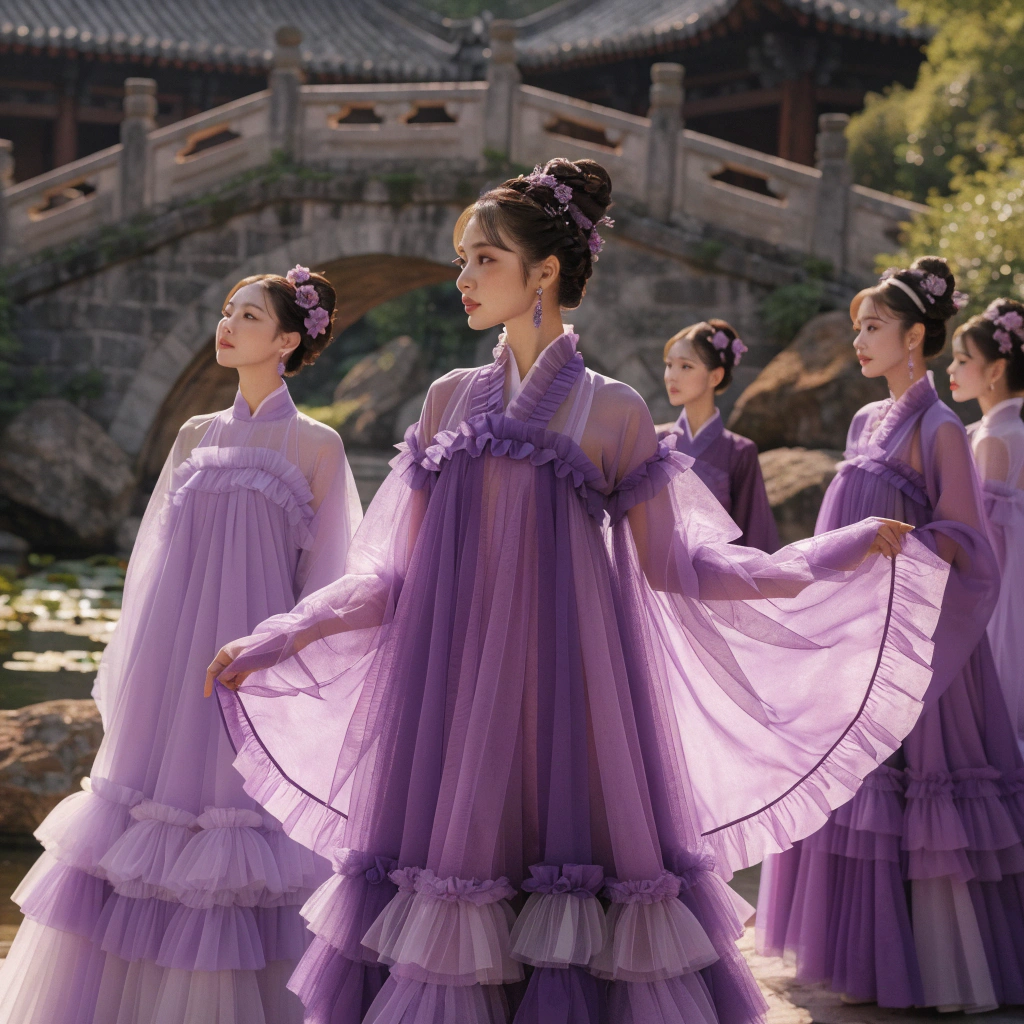
Beautiful Clothes in China
China has a very old style of clothes. People call it Hanfu. Hanfu is beautiful and very long. It has many colors like red, blue, and white. Today, many young people in China wear Hanfu. They wear it in parks and at schools.
Hanfu is different from the Qipao. It is very loose. It has long sleeves. People like Hanfu because it is part of Chinese history. They feel happy when they wear these clothes. It is a special tradition for the Han people.
语法聚焦
句型: Present Simple (to be)
"Hanfu is beautiful and very long."
We use 'is' for singular subjects to describe things. It shows a fact or a state.
句型: Present Simple (regular verbs)
"They wear it in parks and at schools."
We use the base form of the verb for 'they' to talk about habits or things people do often.
测试你的理解
10 个问题 · A1 初学 · 1 次免费预览
测试你从这篇文章中学到的知识。回答所有问题即可获得经验值!
题目详情
What is Hanfu?
你的回答:
正确答案: A style of clothes
Hanfu is only for old people.
你的回答:
正确答案: 错误
What does 'loose' mean?
你的回答:
正确答案: Not tight; has space
Hanfu has many _____ like red, blue, and white.
你的回答:
正确答案: colors
The Return of Hanfu: China's Traditional Fashion
Many people think the Qipao is the only traditional dress in China. However, another style is becoming very popular today. It is called Hanfu. Hanfu is the traditional clothing of the Han people. It is much older than the Qipao.
In the past, people wore Hanfu for thousands of years. It has long robes and wide sleeves. In the 17th century, people stopped wearing it. But now, the style is back. Today, young people wear Hanfu in big cities like Beijing and Shanghai. They wear it because it is beautiful and they are proud of their history.
Hanfu is different from modern clothes. It is more colorful and the materials are very soft. Some people wear it for festivals, but others wear it to go to school or work. It is more than just fashion. It helps people feel connected to their culture. Now, there are many Hanfu clubs and shops in China. It is an exciting time for traditional fashion.
语法聚焦
句型: Comparatives
"It is much older than the Qipao."
We use the comparative form to compare two things. For short adjectives, we add '-er' and use the word 'than'.
句型: Past Simple
"In the past, people wore Hanfu for thousands of years."
The past simple is used to talk about finished actions in the past. 'Wore' is the irregular past tense of the verb 'wear'.
测试你的理解
11 个问题 · A2 基础 · 1 次免费预览
测试你从这篇文章中学到的知识。回答所有问题即可获得经验值!
题目详情
What is Hanfu?
你的回答:
正确答案: Traditional clothing
Hanfu is a newer style than the Qipao.
你的回答:
正确答案: 错误
What does 'popular' mean?
你的回答:
正确答案: Liked by many people
Young people wear Hanfu because they are _____ of their history.
你的回答:
正确答案: proud
Where do young people wear Hanfu today?
你的回答:
正确答案: In big cities like Beijing
Hanfu: The Return of China's Traditional Fashion
In recent years, a beautiful fashion trend has returned to the busy streets of China. While many people around the world have seen the Qipao, which is a famous tight dress, a much older style has become popular again. This style is called Hanfu.
Hanfu refers to the traditional clothing that was worn by the Han ethnic group for more than three thousand years. It was the main style of dress from the era of the Yellow Emperor until the end of the Ming Dynasty in the 17th century. Unlike the Qipao, which has different origins, Hanfu is characterized by long, flowing robes and collars that cross over. These clothes are often made of soft silk and are decorated with patterns that have been used for centuries.
The movement to bring back Hanfu started about twenty years ago, but the interest has grown significantly in the last decade. Today, thousands of young people can be seen wearing these traditional outfits in public places like parks and museums. For these enthusiasts, Hanfu is not just a costume for a party. It is a meaningful way to connect with their long history and express their cultural identity.
Social media has played a very important role in this cultural renaissance. Beautiful photos of people in Hanfu are shared by millions of users every day, which has inspired others to try the style. Because of this high demand, many successful businesses have been created to design and sell these garments. Although Hanfu was almost forgotten for a long time, it has been rediscovered by a new generation that is proud of its heritage. This trend shows that traditional culture can still be relevant in the modern world.
语法聚焦
句型: Present Perfect
"The interest has grown significantly in the last decade."
This pattern uses 'has/have' plus the past participle. It describes an action that started in the past and continues to be important or true in the present.
句型: Relative Clauses
"the Qipao, which is a famous tight dress"
A relative clause uses words like 'which' or 'that' to give more information about a noun. In this sentence, it explains what the Qipao is without starting a new sentence.
测试你的理解
11 个问题 · B1 中级 · 1 次免费预览
测试你从这篇文章中学到的知识。回答所有问题即可获得经验值!
What is the main physical feature of Hanfu mentioned in the text?
题目详情
What is the main physical feature of Hanfu mentioned in the text?
你的回答:
正确答案: It has long, flowing robes and crossed collars.
Hanfu was the main style of dress for the Han people for over 3,000 years.
你的回答:
正确答案: 正确
What is the meaning of 'garments'?
你的回答:
正确答案: Pieces of clothing
Hanfu is often made of soft _____, which is a traditional material.
你的回答:
正确答案: silk
Why do young people wear Hanfu today?
你的回答:
正确答案: To connect with their history and cultural identity.
The Hanfu Renaissance: Reclaiming Ancient Identity in Modern China
In recent years, the streets of major Chinese cities have witnessed a remarkable cultural phenomenon: the resurgence of Hanfu. While many international observers might associate Chinese fashion primarily with the Qipao, this form-fitting dress actually has Manchu origins. In contrast, Hanfu represents the traditional attire of the Han ethnic group, which dominated Chinese history for over three millennia. This movement is not merely a fashion trend; it is a profound exploration of cultural identity and historical pride among the younger generation.
The revival began in the early 2000s, driven by enthusiasts who felt that a significant part of their heritage had been overlooked. Unlike the modern Qipao, Hanfu is characterized by its flowing robes, wide sleeves, and crossed collars. These garments are often layered, creating an elegant silhouette that reflects ancient aesthetic values. Furthermore, the resurgence has been significantly accelerated by social media platforms, where 'Hanfu influencers' showcase elaborate outfits in historical settings, blending traditional styles with contemporary life.
However, the movement is not without its complexities. Some critics argue that the focus on Hanfu might unintentionally exclude other ethnic minorities within China. Nevertheless, proponents suggest that celebrating Hanfu is a way to reconnect with a lost aesthetic and philosophical past. For many young people, wearing these clothes is an act of reclaiming their history. They are not simply dressing up; they are participating in a cultural renaissance that seeks to integrate ancient wisdom into a modern context.
As this trend continues to evolve, it has also sparked a booming industry. From high-end silk robes to affordable daily wear, the market for Hanfu has expanded rapidly. It is now common to see students or office workers incorporating Hanfu elements into their everyday wardrobes. Ultimately, the Hanfu renaissance illustrates how a society can look backward to move forward, finding new meaning in the threads of the past.
语法聚焦
句型: Passive Voice
"the resurgence has been significantly accelerated by social media platforms"
The passive voice is used here to emphasize the action (the acceleration of the trend) and its cause (social media) rather than the person doing it. It is formed using 'has been' + the past participle.
句型: Relative Clauses
"enthusiasts who felt that a significant part of their heritage had been overlooked"
The relative pronoun 'who' introduces a defining relative clause that provides essential information about the 'enthusiasts'. This structure is common in B2 writing to combine ideas smoothly.
句型: Modal Verbs for Possibility
"While many international observers might associate Chinese fashion primarily with the Qipao"
The modal verb 'might' is used to express a possibility or a common assumption. It suggests that while the association exists, it may not be the complete picture.
测试你的理解
11 个问题 · B2 中高级 · 1 次免费预览
测试你从这篇文章中学到的知识。回答所有问题即可获得经验值!
What is the primary difference mentioned between the Qipao and Hanfu?
题目详情
What is the primary difference mentioned between the Qipao and Hanfu?
你的回答:
正确答案: The Qipao has Manchu origins, while Hanfu is the traditional dress of the Han group
The Hanfu revival is driven solely by the fashion industry without any cultural motivation.
你的回答:
正确答案: 错误
What does 'contemporary' mean in the context of the article?
你的回答:
正确答案: Relating to the current time
This movement is not merely a fashion _____; it is a profound exploration of cultural identity.
你的回答:
正确答案: trend
How has social media influenced the Hanfu movement?
你的回答:
正确答案: By allowing influencers to showcase outfits and blend styles
The Hanfu Resurgence: Cultural Reclamation or Commodified Nostalgia?
For decades, the global imagination of Chinese fashion was dominated by the Qipao, a form-fitting garment with Manchu roots. Yet, in recent years, this narrative has been radically disrupted by the meteoric rise of Hanfu. Seldom has a sartorial shift in contemporary China been as evocative or as contentious as this resurgence of Han ethnic dress. Spanning three millennia of history, Hanfu represents a complex tapestry of cultural reclamation, often positioned as a more 'authentic' alternative to the Qing-era styles that preceded the modern age. It is not merely the aesthetic appeal of flowing robes and crossed collars that captivates the younger generation; rather, it is the underlying desire for a distinct cultural identity in an increasingly globalized world.
To many enthusiasts, donning Hanfu is an act of historical restoration, a way to bridge the chasm between the disparate vestiges of ancient dynasties and the hyper-modernity of the 21st century. The construction of Hanfu itself is steeped in symbolism; the crossed collars, for instance, are often interpreted as a representation of balance, while the flowing sleeves embody the Confucian ideal of grace and restraint. This philosophical depth provides a stark contrast to the utilitarian nature of Western-style clothing. However, this movement is not without its critics, who argue that the trend occasionally borders on anachronistic romanticism or, more significantly, a form of ethnocentric signaling.
The juxtaposition of these ancient silhouettes against the backdrop of glass-and-steel metropolises serves as a visual testament to a nation grappling with its heritage. As the burgeoning industry around Hanfu grows, reaching billions in market value, the line between genuine cultural appreciation and the commodification of heritage becomes increasingly blurred. Critics point out that the rapid commercialization of these garments often strips them of their ritualistic significance, reducing a complex social hierarchy of dress to a mere fashion statement or a social media aesthetic.
Furthermore, the hegemony of the Hanfu movement within the broader context of Chinese diversity raises nuanced questions about inclusivity. While the movement celebrates the quintessential beauty of Han culture, some scholars worry it might overshadow the rich sartorial traditions of China’s 55 other ethnic minorities. Despite these debates, the Hanfu renaissance remains a powerful paradigm of how a society can look backward to move forward, utilizing the threads of the past to weave a new sense of national belonging. Whether viewed as a profound reclamation of history or a transient trend fueled by consumerism, Hanfu has undeniably altered the landscape of Chinese identity.
语法聚焦
句型: Negative Inversion
"Seldom has a sartorial shift in contemporary China been as evocative or as contentious as this resurgence of Han ethnic dress."
When negative or restrictive adverbs (like seldom, rarely, never) start a sentence, the auxiliary verb moves before the subject for emphasis. This is common in formal and C1-level writing.
句型: It-Cleft Sentence
"It is not merely the aesthetic appeal of flowing robes and crossed collars that captivates the younger generation."
Cleft sentences use 'It + be + [focus] + relative clause' to emphasize a specific part of the sentence. Here, it emphasizes that the 'desire for identity' is more important than the 'aesthetic appeal'.
句型: Nominalisation
"The rapid commercialization of these garments often strips them of their ritualistic significance."
Nominalisation is the use of a noun phrase ('rapid commercialization') instead of a verb ('commercialize quickly'). It makes the writing more objective, formal, and concise.
测试你的理解
12 个问题 · C1 高级 · 1 次免费预览
测试你从这篇文章中学到的知识。回答所有问题即可获得经验值!
What is the primary motivation for the Hanfu movement among the younger generation according to the text?
题目详情
What is the primary motivation for the Hanfu movement among the younger generation according to the text?
你的回答:
正确答案: A desire for a distinct cultural identity in a globalized world
The author suggests that the Hanfu movement is universally praised without any controversy.
你的回答:
正确答案: 错误
What does 'anachronistic' mean in the context of the article?
你的回答:
正确答案: Belonging to a different time period than the present
The _____ of ancient silhouettes against modern cities serves as a visual testament to China's heritage.
你的回答:
正确答案: juxtaposition
What concern do critics have regarding the commercialization of Hanfu?
你的回答:
正确答案: It removes the clothing's philosophical and ritualistic meaning
The article states that Hanfu was used for three millennia until the end of the Ming Dynasty.
你的回答:
正确答案: 正确
The Sartorial Reclamation: Hanfu and the Ontological Renaissance of Traditional Chinese Dress
The sartorial landscape of the People’s Republic of China has, in recent decades, undergone a metamorphosis so profound that it borders on the revolutionary. While the global imagination has long been captivated by the body-conscious silhouettes of the Qipao—a garment whose origins are inextricably linked to the Manchu-led Qing Dynasty—a more ancient and arguably more significant tradition has re-emerged from the shadows of historical obscurity. This is the Hanfu: the traditional attire of the Han ethnicity, which enjoyed a hegemony lasting over three millennia before its abrupt suppression in the 17th century. The current resurgence, termed the 'Hanfu Movement,' is not merely a whimsical flirtation with historical cosplay; it represents a sophisticated, grassroots endeavor to reclaim a cultural identity that was once thought to have been irrevocably subsumed by the tides of modernity and foreign imposition.
Should the observer peer beneath the aesthetic surface of this revival, they would find a complex tapestry of socio-political yearnings. The movement, spearheaded primarily by the Gen-Z and Millennial cohorts, seeks to navigate the precarious balance between a globalized future and an idealized past. It is imperative that this phenomenon be understood not as a monolithic retreat into isolationist nationalism, but as a nuanced search for ontological security. In an era where the homogenization of global fashion threatens to erase local idiosyncrasies, the act of donning flowing robes and crossed collars becomes a potent semiotic statement. It is a performance of 'Chineseness' that transcends the Western-centric paradigms of modernity, offering instead a vision of a future that is deeply rooted in the aesthetic and philosophical tenets of the Ming, Song, and Tang dynasties.
Historical records elucidate that Hanfu is characterized by its 'Y-shaped' collar, wrapped from left to right, and its voluminous sleeves, which stand in stark contrast to the structured tailoring of Western garments. These features were not merely stylistic but were imbued with Confucian symbolism, representing harmony between the wearer and the natural world. However, one must be cautious not to conflate the Hanfu movement with a simple desire for stagnant historical accuracy. The contemporary iteration of these garments often incorporates modern fabrics and conveniences, reflecting a living tradition rather than a vestigial relic. This synthesis has birthed a burgeoning 'Hanfu economy,' where high-end designers and mass-market retailers alike cater to a demographic eager to manifest their cultural pride through consumption. The juxtaposition of these ancient silhouettes against the backdrop of hyper-modern skyscrapers creates a visual dissonance that is uniquely evocative of the current Chinese zeitgeist. It is a testament to the enduring power of dress as a vehicle for identity, proving that even in the face of radical technological change, the threads of the past remain integral to the fabric of the present.
语法聚焦
句型: Inversion with 'Should' in Conditionals
"Should the observer peer beneath the aesthetic surface of this revival, they would find a complex tapestry of socio-political yearnings."
This formal alternative to 'If' uses inversion to create a more academic or literary tone. It is formed by placing 'Should' at the beginning followed by the subject and the base form of the verb.
句型: The Subjunctive Mood after 'Imperative'
"It is imperative that this phenomenon be understood not as a monolithic retreat into isolationist nationalism."
The subjunctive 'be understood' is used after adjectives of urgency or importance (imperative, crucial, essential). This structure uses the base form of the verb regardless of the subject.
句型: Nominalization for Analytical Precision
"The juxtaposition of these ancient silhouettes against the backdrop of hyper-modern skyscrapers creates a visual dissonance."
Nominalization involves turning verbs or adjectives into nouns (e.g., 'juxtapose' to 'juxtaposition'). This is a hallmark of C2 writing, allowing the author to treat complex actions as abstract concepts.
测试你的理解
12 个问题 · C2 精通 · 1 次免费预览
测试你从这篇文章中学到的知识。回答所有问题即可获得经验值!
What distinguishes Hanfu from the Qipao according to the text?
题目详情
What distinguishes Hanfu from the Qipao according to the text?
你的回答:
正确答案: Hanfu predates the Qipao and was the dominant style for three millennia.
The Hanfu movement is primarily a government-led initiative to promote nationalism.
你的回答:
正确答案: 错误
What does the term 'ontological' refer to in the context of the article?
你的回答:
正确答案: The nature of being and cultural identity.
The author argues that Hanfu is a living tradition rather than a _____ relic.
你的回答:
正确答案: vestigial
Which demographic is noted as being the primary driver of the Hanfu revival?
你的回答:
正确答案: Gen-Z and Millennial cohorts
Modern Hanfu often incorporates contemporary materials and fabrics.
你的回答:
正确答案: 正确

