Bastille Day in France
July 14th is a big holiday in France. People call it Bastille Day. It is the French National Day. France is a beautiful country in Europe.
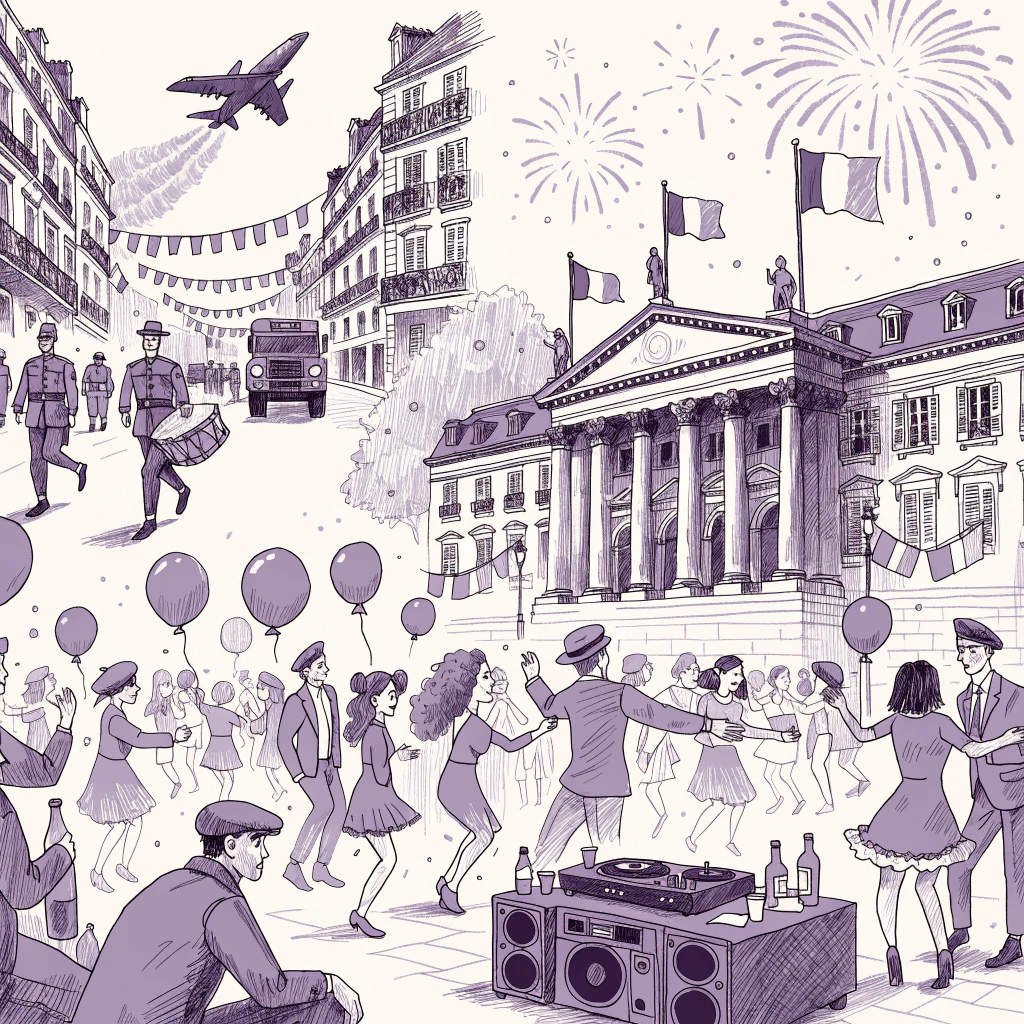
There is a big parade in Paris. The soldiers walk on the street. People watch the parade and they are happy. There are many blue, white, and red flags.
In the evening, there are fireworks in the sky. People dance and eat good food. Families celebrate together. It is a very special day for French people.
语法聚焦
句型: Present Simple 'To Be'
"France is a beautiful country in Europe."
We use 'is' with singular subjects like 'France' to describe facts. It is formed by using the subject followed by the correct form of the verb 'to be'.
句型: There is / There are
"There are many blue, white, and red flags."
We use 'there is' for one thing and 'there are' for more than one thing. This pattern helps us describe what we can see in a location.
测试你的理解
10 个问题 · A1 初学 · 1 次免费预览
测试你从这篇文章中学到的知识。回答所有问题即可获得经验值!
题目详情
Where is the big parade?
你的回答:
正确答案: Paris
Bastille Day is on July 14th.
你的回答:
正确答案: 正确
What are 'fireworks'?
你的回答:
正确答案: Bright lights in the sky
Families _____ together.
你的回答:
正确答案: celebrate
Bastille Day: France's Big Celebration
Every July 14th, French people celebrate their national holiday. It is a very important day in France. People call it "La Fête Nationale." It is a special time for joy and history across the whole country.
In 1789, people in Paris were very unhappy with the king and his rules. They attacked a big, dark prison called the Bastille. This event started the French Revolution. The prison was a symbol of the king's power, so its fall was a symbol of freedom for everyone.
Today, the celebrations are bigger than in the past. There is a famous military parade on the Champs-Élysées in Paris. Soldiers, tanks, and planes move through the city. In the evening, people look at the sky to watch beautiful fireworks. Families eat delicious food together and dance in the streets because they are happy and proud of their country. It is definitely the most famous festival in France.
语法聚焦
句型: Past Simple
"They attacked a big, dark prison called the Bastille."
We use the past simple to talk about finished actions in the past. For regular verbs like 'attack', we add '-ed' to the end.
句型: Comparatives
"Today, the celebrations are bigger than in the past."
We use comparatives to compare two things. For short adjectives like 'big', we double the last letter and add '-er' followed by 'than'.
测试你的理解
11 个问题 · A2 基础 · 1 次免费预览
测试你从这篇文章中学到的知识。回答所有问题即可获得经验值!
When do people celebrate Bastille Day?
题目详情
When do people celebrate Bastille Day?
你的回答:
正确答案: July 14th
The Bastille was a famous palace for the king.
你的回答:
正确答案: 错误
What does 'freedom' mean?
你的回答:
正确答案: The state of being free
In the evening, people watch beautiful _____ in the sky.
你的回答:
正确答案: fireworks
Why did people attack the prison in 1789?
你的回答:
正确答案: They were unhappy with the king
Bastille Day: A Celebration of Freedom in France
Every year on July 14th, the streets of France are filled with music, flags, and joy. This day is known as 'La Fête Nationale,' or Bastille Day. It is the most important public holiday in the country, and it has been celebrated since the late 19th century. This day marks the anniversary of a key moment in history.
The history of this day began in 1789 during the French Revolution. At that time, many people were unhappy with the king's absolute power. On July 14th, a large crowd attacked the Bastille, which was a medieval fortress and prison in Paris. Although there were only seven prisoners inside, the building was a powerful symbol of the monarchy. The storming of the Bastille showed that the people wanted change and freedom.
Today, the celebrations are very impressive. In Paris, a famous military parade is held on the Champs-Élysées, which is the most famous street in the city. This parade is watched by the President of France and thousands of citizens. It is considered one of the oldest and largest military parades in Europe.
In the evening, the sky is lit up by spectacular fireworks. People also gather for 'Firemen’s Balls,' where local fire stations open their doors for public parties and dancing. These events have become a beloved tradition for families and friends. Bastille Day represents the values of liberty, equality, and fraternity. These ideas, which were born during the revolution, are still very important to French people today. Through these celebrations, the history of the nation is remembered and its future is celebrated.
语法聚焦
句型: Passive Voice
"In Paris, a famous military parade is held on the Champs-Élysées."
The passive voice is used when the action is more important than the person performing it. It is formed using the verb 'to be' followed by the past participle of the main verb.
句型: Relative Clauses
"On July 14th, a large crowd attacked the Bastille, which was a medieval fortress and prison in Paris."
Relative clauses provide extra information about a noun. We use 'which' to add details about objects or places, helping to combine two sentences into one.
测试你的理解
11 个问题 · B1 中级 · 1 次免费预览
测试你从这篇文章中学到的知识。回答所有问题即可获得经验值!
When is Bastille Day celebrated in France?
题目详情
When is Bastille Day celebrated in France?
你的回答:
正确答案: July 14th
The Bastille was originally a royal palace for the king.
你的回答:
正确答案: 错误
What does the word 'spectacular' mean?
你的回答:
正确答案: Impressive and beautiful
In the evening, the sky is lit up by spectacular _____.
你的回答:
正确答案: fireworks
What values does Bastille Day represent?
你的回答:
正确答案: Liberty, equality, and fraternity
Bastille Day: The Enduring Symbol of French Liberty
Bastille Day, known in France as 'La Fête Nationale,' is a cornerstone of French identity, celebrated annually on July 14th. This date commemorates the storming of the Bastille in 1789, an event that heralded the end of absolute monarchy and the birth of the modern Republic. While the fortress itself held only a handful of prisoners, its symbolic weight was unprecedented, representing the collapse of the Ancien Régime’s tyranny. One could argue that if the Bastille had not been taken, the revolution might have stalled.
The celebrations are characterized by a unique blend of military solemnity and popular fervor. Every year, the oldest and largest regular military parade in Europe is held on the Champs-Élysées. The parade, which is attended by the French President and various international dignitaries, showcases the nation's military prowess. This tradition serves not only as a display of strength but also as a reminder of the historical sacrifices made for democratic values. Despite the formal nature of the morning events, the atmosphere shifts significantly as evening approaches.
Across the country, citizens participate in 'Bals des pompiers,' or firemen’s balls, where fire stations open their doors to the public for vibrant street parties. The festivities culminate in spectacular firework displays that illuminate the Eiffel Tower and town halls nationwide. These communal gatherings foster a sense of national solidarity, bridging the gap between historical remembrance and contemporary joy. Through these rituals, the abolition of the old order is celebrated as a continuous process of renewal.
Ultimately, Bastille Day is more than just a historical anniversary; it is an analysis of the French national motto: Liberté, Égalité, Fraternité. The day provides an opportunity for the public to evaluate the progress of these ideals in modern society. By merging the historical spectacle of the 1789 uprising with modern-day festivities, France ensures that the revolutionary spirit remains a living part of its cultural heritage.
语法聚焦
句型: Third Conditional
"One could argue that if the Bastille had not been taken, the revolution might have stalled."
Used to talk about hypothetical situations in the past. It is formed with 'if + past perfect' and 'would/might/could + have + past participle'.
句型: Non-defining Relative Clause
"The parade, which is attended by the French President and various international dignitaries, showcases the nation's military prowess."
Provides extra information about a noun that is already clearly identified. It is separated by commas and uses 'which' for things.
句型: Passive Voice
"The oldest and largest regular military parade in Europe is held on the Champs-Élysées."
Used when the focus is on the action or the object rather than the subject performing the action. Formed with 'to be + past participle'.
测试你的理解
11 个问题 · B2 中高级 · 1 次免费预览
测试你从这篇文章中学到的知识。回答所有问题即可获得经验值!
What does Bastille Day primarily commemorate?
题目详情
What does Bastille Day primarily commemorate?
你的回答:
正确答案: The storming of a fortress-prison in 1789
The Bastille was filled with hundreds of prisoners when it was stormed.
你的回答:
正确答案: 错误
What does 'unprecedented' mean?
你的回答:
正确答案: Never done or known before
The military parade serves as a display of the nation's military _____.
你的回答:
正确答案: prowess
What are 'Bals des pompiers'?
你的回答:
正确答案: Parties held at fire stations
The Bastille Paradigm: Orchestrating National Identity in Modern France
Rarely has a single historical event been so thoroughly woven into the fabric of a nation's soul as the storming of the Bastille. Every July 14th, France undergoes a profound transformation, oscillating between the rigid solemnity of military tradition and the unbridled fervor of public celebration. While the international community often views the date solely as a commemoration of the 1789 uprising, the reality is far more nuanced. It is not merely the destruction of a fortress that the French celebrate, but rather the birth of a republican paradigm that continues to shape the contemporary zeitgeist.
The Bastille itself, a monolithic structure that once dominated the Parisian skyline, served as a potent symbol of royal authority. However, by 1789, it had become a vestige of a fading era, housing only seven prisoners at the time of its fall. The dismantling of the monarchy's perceived omnipotence was the primary catalyst for the revolutionary fervor that followed. This act of defiance was less about the literal liberation of individuals and more about the symbolic erasure of the Ancien Régime’s absolute power. Seldom is it remembered that the current holiday also commemorates the 1790 Fête de la Fédération, a moment of brief reconciliation that sought to unify the disparate factions of a burgeoning nation under the banner of constitutional monarchy.
In the modern era, the celebration serves as a complex manifestation of egalitarianism. It is through the juxtaposition of the grand military parade on the Champs-Élysées and the populist 'Bals des pompiers' (firemen’s balls) that the French state reconciles its martial history with its democratic present. This duality suggests that the holiday is not a stagnant relic of the past but a living, breathing precursor to modern civic engagement. Furthermore, the sociological impact of these local dances cannot be overstated; they provide a communal space where social hierarchies are momentarily suspended, echoing the egalitarian spirit of the revolution.
From a critical perspective, one might question whether such a display of nationalistic pride is compatible with the increasingly globalised and multicultural reality of 21st-century France. Does the monolithic narrative of the Revolution still resonate with a diverse population? The answer lies in the holiday's capacity for evolution. Rather than being a rigid adherence to 18th-century dogma, the festivities have adapted to include various cultural expressions, reflecting a more inclusive interpretation of what it means to be French. Ultimately, La Fête Nationale is a testament to the enduring power of myth-making in the construction of national unity. It serves as a reminder that the foundation of the Republic was not built solely on the debris of a prison, but on the shared aspiration for a society governed by the people, for the people.
语法聚焦
句型: Negative Inversion
"Seldom is it remembered that the current holiday also commemorates the 1790 Fête de la Fédération..."
This pattern places a negative or restrictive adverb at the beginning of the sentence for emphasis, requiring the auxiliary verb to come before the subject. It is commonly used in formal C1-level writing to create a sophisticated rhetorical effect.
句型: Cleft Sentences
"It is through the juxtaposition of the grand military parade on the Champs-Élysées and the populist 'Bals des pompiers' that the French state reconciles its martial history..."
A cleft sentence divides a single clause into two parts to focus on specific information, typically starting with 'It is/was'. This structure highlights the 'how' or 'why' of a situation, making the argument more persuasive.
句型: Nominalisation
"The dismantling of the monarchy's perceived omnipotence was the primary catalyst for the revolutionary fervor that followed."
Nominalisation involves turning verbs or adjectives into nouns (e.g., 'dismantling'). This allows for a higher density of information and shifts the focus from actions to abstract concepts, which is a hallmark of academic and advanced English.
测试你的理解
12 个问题 · C1 高级 · 1 次免费预览
测试你从这篇文章中学到的知识。回答所有问题即可获得经验值!
According to the article, what is the 'Bastille Paradigm'?
题目详情
According to the article, what is the 'Bastille Paradigm'?
你的回答:
正确答案: A model of national identity that influences modern French thought
The 1790 Fête de la Fédération was intended to be a moment of national reconciliation.
你的回答:
正确答案: 正确
Which word describes the defining spirit or mood of a particular historical period?
你的回答:
正确答案: Zeitgeist
The fall of the Bastille served as a ______ for the revolutionary fervor that followed.
你的回答:
正确答案: catalyst
What does the author suggest about the 'Bals des pompiers'?
你的回答:
正确答案: They provide a communal space where social hierarchies are suspended
The article argues that Bastille Day has become a stagnant relic with no relevance to modern multicultural France.
你的回答:
正确答案: 错误
The Dialectics of Commemoration: Deconstructing the Semiotics of July 14th
The commemoration of July 14th, colloquially known as Bastille Day, represents a profound semiotic junction in French national identity. To the casual observer, the day manifests as a vibrant tapestry of tricolor flags and pyrotechnic displays; however, to the scholar of historiography, it serves as a palimpsest of revolutionary fervor and institutionalized myth-making. The storming of the Bastille in 1789 was not merely a tactical acquisition of gunpowder but a definitive rupture with the ossified structures of the Ancien Régime. Scarcely had the fortress fallen when the symbolic weight of the event began to eclipse its tactical insignificance, transforming a dilapidated prison into a monolithic emblem of monarchical arbitrariness. This historical pivot was not achieved through simple consensus but through a complex interplay of political subterfuge and genuine ideological conviction.
Central to the philosophical underpinnings of this date is the tension between the radicality of 1789 and the conciliatory aspirations of 1790. The latter saw the inauguration of the Fête de la Fédération, an event designed to harmonize the disparate factions of a burgeoning republic. It is essential that the observer recognize the Fête de la Fédération not merely as a party, but as a calculated act of national synthesis. Had the Bourbon monarchy proved more malleable in the face of Enlightenment critiques, the subsequent bloodshed of the Terror might have been averted, yet the date remains an apotheosis of the transition from subjecthood to citizenship. Furthermore, the intellectual climate of July 1789 cannot be decoupled from the burgeoning discourse on human rights. The fall of the Bastille acted as a physical manifestation of the principles later enshrined in the Declaration of the Rights of Man and of the Citizen. This document, which sought to dismantle the vestigial remains of feudalism, provided the legal framework that the revolutionary crowd so viscerally demanded.
Throughout the 19th century, the celebration’s status remained precarious, often inimical to the restorative impulses of subsequent regimes. It was only under the Third Republic that July 14th was codified as the national holiday, a move intended to provide a secular liturgy for a nation still reeling from internecine strife and the humiliation of the Franco-Prussian War. By anchoring the national mythos in the dual legacy of the storming and the federation, the state sought to exert a cultural hegemony that transcended class divisions. Even today, the vestige of this 19th-century nation-building is visible in the meticulous choreography of the military parade on the Champs-Élysées.
Modern observations of La Fête Nationale continue to oscillate between solemnity and jubilation. The morning’s martial displays, characterized by an almost liturgical precision, offer a stark contrast to the evening’s communal bals des pompiers. This dichotomy reflects the enduring complexity of the French Republic—a state that prides itself on revolutionary origins while maintaining a highly centralized, almost Napoleonic, administrative rigor. The fireworks that illuminate the Parisian sky are not merely aesthetic; they are a periodic re-affirmation of the social contract, a luminous reminder of the Enlightenment values that continue to define the Gallic spirit. In an era of global fragmentation, the holiday serves as a crucial locus for collective memory, ensuring that the foundational principles of the Republic remain at the forefront of the national consciousness.
语法聚焦
句型: Negative Inversion
"Scarcely had the fortress fallen when the symbolic weight of the event began to eclipse its tactical insignificance."
When negative or restrictive adverbials like 'scarcely' or 'hardly' start a sentence, the auxiliary verb precedes the subject. This is used for dramatic effect and formal emphasis.
句型: The Subjunctive Mood
"It is essential that the observer recognize the Fête de la Fédération not merely as a party, but as a calculated act of national synthesis."
The base form of the verb ('recognize' instead of 'recognizes') is used after certain expressions of necessity or importance. It emphasizes the requirement or hypothetical nature of the action.
句型: Inverted Conditional (Third Conditional)
"Had the Bourbon monarchy proved more malleable in the face of Enlightenment critiques, the subsequent bloodshed of the Terror might have been averted."
The 'if' is omitted and the auxiliary 'had' is moved to the front. This is a highly formal way to express a hypothetical past situation and its potential alternative outcome.
测试你的理解
12 个问题 · C2 精通 · 1 次免费预览
测试你从这篇文章中学到的知识。回答所有问题即可获得经验值!
What is the primary argument regarding the storming of the Bastille?
题目详情
What is the primary argument regarding the storming of the Bastille?
你的回答:
正确答案: Its symbolic importance far outweighed its actual tactical value.
The Fête de la Fédération in 1790 was intended to promote national unity rather than radical division.
你的回答:
正确答案: 正确
What does the word 'hegemony' refer to in the context of the Third Republic?
你的回答:
正确答案: The cultural and political dominance of the state
The prison was viewed as a monolithic emblem of monarchical _____.
你的回答:
正确答案: arbitrariness
Why was July 14th officially codified as a holiday during the Third Republic?
你的回答:
正确答案: To create a secular national mythos following internal and external strife.
The author suggests that modern celebrations of Bastille Day are entirely celebratory and lack serious reflection.
你的回答:
正确答案: 错误

