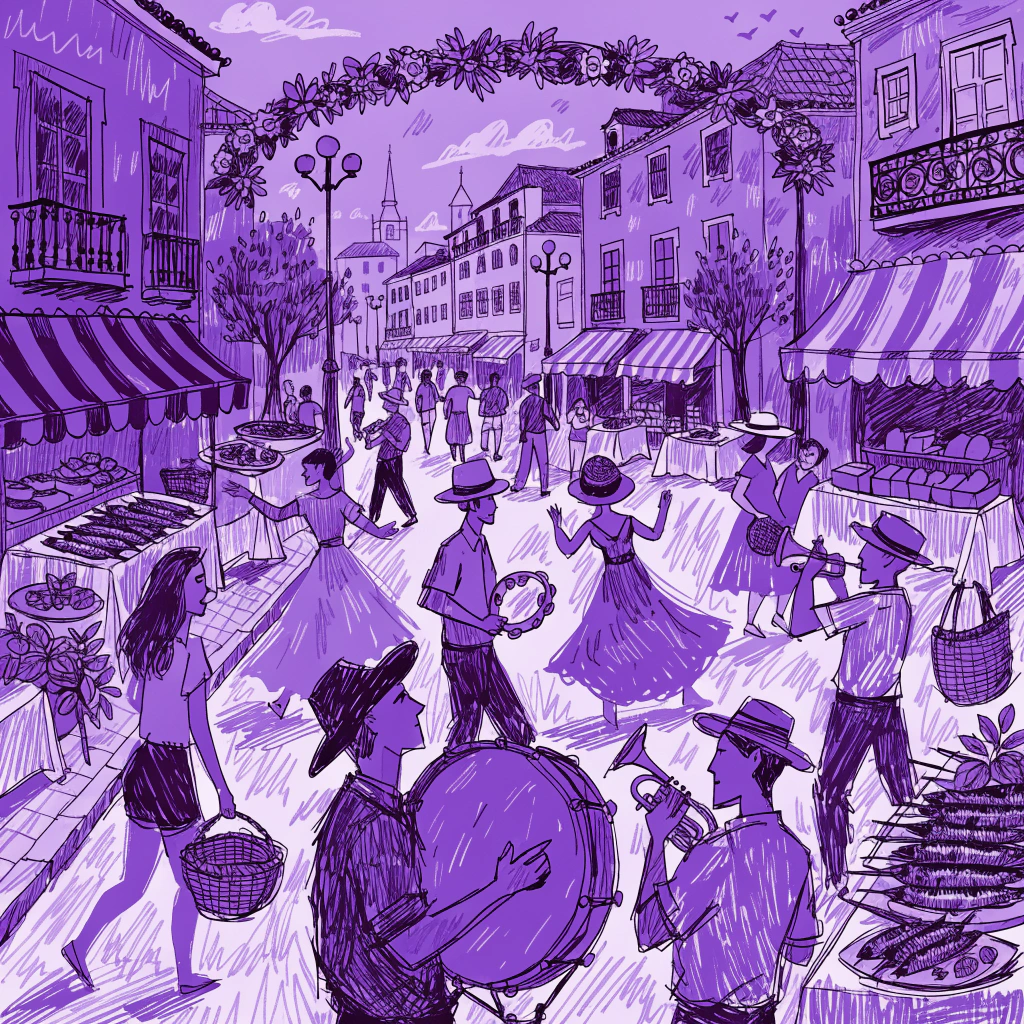
A Big Party in Lisbon
June is a special month in Lisbon, Portugal. It is the time for a big party. This party is for Saint Anthony. He is a very popular saint.
On June 12th, the city is very busy. There are many decorations in the streets. People eat grilled sardines and bread. They also drink and dance. The music is loud and happy.
Men give small green plants to women. These plants are called basil. People are very happy during this festival. It is a beautiful tradition in Lisbon.
语法聚焦
句型: Present Simple (to be)
"The city is very busy."
We use 'is' with singular subjects like 'the city' to describe a state or situation. It is the most common verb in English for descriptions.
句型: Present Simple (Action Verbs)
"People eat grilled sardines."
With plural subjects like 'People', we use the base form of the verb without adding 's'. This describes a regular habit or a general fact.
测试你的理解
10 个问题 · A1 初学 · 1 次免费预览
测试你从这篇文章中学到的知识。回答所有问题即可获得经验值!
题目详情
Where is the big party?
你的回答:
正确答案: Lisbon
The party is in December.
你的回答:
正确答案: 错误
What are 'sardines'?
你的回答:
正确答案: Fish
Men give small green _____ to women.
你的回答:
正确答案: plants
The Big Festival of Saint Anthony in Lisbon
June is a very special month in Lisbon because people celebrate Saint Anthony. He is the most popular saint in the city. People call him a matchmaker because he helps people find love. Many couples get married together on this day.
The biggest party happens on the night of June 12th. People walk to old neighborhoods like Alfama and Mouraria. These streets are more colorful than usual because there are many paper decorations and lights. It is a very happy atmosphere.
The air smells like grilled sardines. This is the traditional food of the festival. People eat sardines with bread and drink cold drinks. They also listen to 'Pimba' music and dance in the streets until the morning.
On June 13th, there is a big parade on Avenida da Liberdade. Many groups from different parts of the city dance and wear beautiful costumes. The festival is better than a normal party because the whole city celebrates together.
语法聚焦
句型: Comparatives (Adjective + er / More + Adjective)
"These streets are more colorful than usual because there are many paper decorations and lights."
We use comparatives to compare two things. For long adjectives like 'colorful', we use 'more' before the word and 'than' after it.
句型: Connectors of Reason (Because)
"June is a very special month in Lisbon because people celebrate Saint Anthony."
We use 'because' to give a reason for something. It connects a result with its cause in one sentence.
测试你的理解
11 个问题 · A2 基础 · 1 次免费预览
测试你从这篇文章中学到的知识。回答所有问题即可获得经验值!
When does the biggest party in Lisbon happen?
题目详情
When does the biggest party in Lisbon happen?
你的回答:
正确答案: June 12th
Saint Anthony is known for helping people find love.
你的回答:
正确答案: 正确
What does 'traditional' mean?
你的回答:
正确答案: Following the customs of the past
The traditional food of the festival is grilled _____.
你的回答:
正确答案: sardines
Where is the big parade located?
你的回答:
正确答案: On Avenida da Liberdade
Lisbon's Biggest Party: The Feast of Saint Anthony
June is a very special month in Portugal because of the 'Santos Populares' (Popular Saints). In Lisbon, the biggest celebration is for Saint Anthony, who is known as the city's patron saint. Although his official day is June 13th, the party has already started by the night of the 12th.
The historic neighborhoods, which are decorated with colorful paper ribbons, become very crowded. Local streets in Alfama and Mouraria have been transformed into huge outdoor parties. People eat grilled sardines and bread while listening to traditional music. The smell of sardines is everywhere, and the atmosphere is full of joy.
Saint Anthony is often called the 'matchmaker' saint. According to tradition, young people give small pots of basil to their partners to show their love. These pots usually contain a small poem. Furthermore, many couples have been married in collective weddings sponsored by the city, which are known as the 'Casamentos de Santo António'. This tradition helps couples who might not have enough money for a big wedding.
The highlight of the night is the grand parade on Avenida da Liberdade. Beautiful costumes have been designed by local groups who compete for the best performance. They dance and sing through the streets until the early morning. If you visit Lisbon in June, you will experience a tradition that has lasted for centuries. It is an unforgettable experience that combines history, religion, and fun.
语法聚焦
句型: Passive Voice
"The historic neighborhoods, which are decorated with colorful paper ribbons, become very crowded."
The passive voice (are decorated) is used here because the action of decorating is more important than who did it. It is formed using 'to be' + the past participle.
句型: Present Perfect
"The party has already started by the night of the 12th."
The present perfect (has started) connects the past to the present. We use it here to show that the event is already in progress by a specific time.
测试你的理解
11 个问题 · B1 中级 · 1 次免费预览
测试你从这篇文章中学到的知识。回答所有问题即可获得经验值!
When does the main celebration in Lisbon begin?
题目详情
When does the main celebration in Lisbon begin?
你的回答:
正确答案: On the night of June 12th
Saint Anthony is known as the protector of animals in this text.
你的回答:
正确答案: 错误
What does 'matchmaker' mean in the context of Saint Anthony?
你的回答:
正确答案: Someone who helps people find romantic partners
The highlight of the night is the grand _____ on Avenida da Liberdade.
你的回答:
正确答案: parade
What food is most commonly eaten during the festival?
你的回答:
正确答案: Grilled sardines
The Soul of Lisbon: Analyzing the Cultural Fervor of Saint Anthony’s Feast
The month of June in Lisbon is characterized by an unparalleled sense of communal fervor as the city prepares for the 'Festas de Lisboa'. While several saints are celebrated during this period, none holds as much significance as Saint Anthony, the patron saint of the Portuguese capital. Although his official feast day falls on June 13th, the festivities reach their zenith on the preceding night. This celebration is not merely a religious event; rather, it represents a complex tapestry of historical heritage, urban identity, and social cohesion.
As dusk falls on June 12th, the historic districts of Alfama, Mouraria, and Graça undergo a remarkable transformation. The narrow, winding streets are adorned with intricate decorations and the pungent aroma of grilled sardines fills the air. It is often argued that to truly understand the soul of Lisbon, one must experience this night. Residents set up makeshift stalls outside their homes, offering traditional food and drinks to locals and tourists alike. Furthermore, the presence of 'manjerico'—a type of basil plant accompanied by a small poem—serves as a symbolic gesture of affection, rooted in the saint’s reputation as a matchmaker.
One of the most captivating aspects of the festival is the 'Casamentos de Santo António'. This tradition involves several couples who are married in a collective ceremony at the Lisbon Cathedral. Historically, this initiative was established to assist couples who lacked the financial means to afford a wedding. Consequently, the saint is revered not only as a spiritual figure but also as a protector of the poor. If these social programs had not been initiated decades ago, many families might not have felt the same deep-rooted connection to the municipal authorities that they do today.
The highlight of the evening is arguably the 'Marchas Populares', a grand parade held on Avenida da Liberdade. Each neighborhood presents a choreographed performance featuring vibrant costumes and original music. These marches are highly competitive, with participants spending months preparing to represent their local community. The event showcases a paradoxical blend of fierce local rivalry and city-wide solidarity.
In conclusion, the Festas de Lisboa serve as a vital reminder of the city's enduring cultural legacy. Despite the pressures of modern globalization, the traditions of Saint Anthony continue to flourish. By participating in these festivities, the people of Lisbon reaffirm their collective history while welcoming the future with open arms.
语法聚焦
句型: Passive Voice
"The narrow, winding streets are adorned with intricate decorations."
The passive voice is used here to focus on the streets (the object) rather than who decorated them. It is formed using 'to be' + the past participle.
句型: Third Conditional
"If these social programs had not been initiated decades ago, many families might not have felt the same deep-rooted connection."
This structure is used to imagine a different past and its hypothetical result. It uses 'if' + past perfect, followed by 'would/might have' + past participle.
句型: Relative Clauses
"This tradition involves several couples who are married in a collective ceremony at the Lisbon Cathedral."
The relative pronoun 'who' introduces a defining relative clause that provides essential information about the 'couples' mentioned.
测试你的理解
11 个问题 · B2 中高级 · 1 次免费预览
测试你从这篇文章中学到的知识。回答所有问题即可获得经验值!
When do the festivities in Lisbon reach their peak?
题目详情
When do the festivities in Lisbon reach their peak?
你的回答:
正确答案: On the night of June 12th
The 'Casamentos de Santo António' were originally designed to help wealthy families.
你的回答:
正确答案: 错误
What does 'pungent' mean in the context of the article?
你的回答:
正确答案: A strong and sharp smell
Saint Anthony is historically known in Lisbon as a _____, helping people find love and marriage.
你的回答:
正确答案: matchmaker
What is the primary purpose of the 'Marchas Populares'?
你的回答:
正确答案: To represent local neighborhoods in a choreographed parade
The Paradox of Patronage: Lisbon’s Festas and the Dialectic of Tradition
Seldom does a city witness such a total socio-cultural metamorphosis as Lisbon does during the month of June. As the heat of early summer descends upon the Portuguese capital, the city prepares for the Festas de Lisboa, a month-long celebration culminating in the feast of Santo António on June 13th. Far from being a mere series of street parties, these festivities represent a veritable tapestry of historical vestige and modern communal identity. It is the juxtaposition of the sacred and the profane that defines the quintessential Lisbon experience. While Santo António is officially the patron saint of finding lost objects and a celestial matchmaker, his celebration is marked by raucous 'arraiais' where the air is thick with the ephemeral scent of charcoal-grilled sardines and 'manjerico'. The historic neighborhoods of Alfama, Mouraria, and Graça become labyrinthine stages for collective fervor, adorned with colorful bunting and paper lanterns.
The centerpiece of the festivities, the 'Marchas Populares', involves a fierce competition between different districts. Each neighborhood designs elaborate costumes and choreography, performing down the Avenida da Liberdade. This display is not merely aesthetic; it is a profound expression of local pride. Yet, the preservation of such traditions is increasingly complicated by the rapid gentrification of the city’s historic core. As long-term residents are displaced by short-term holiday rentals, the idiosyncratic soul of the 'bairros' faces a precarious future. The manjerico, often called the 'herb of lovers,' is traditionally gifted in a small clay pot, accompanied by a 'quadra'—a four-line poem expressing affection. This practice highlights the romantic undercurrent of the festival. Historically, Santo António, though born in Lisbon, is often associated with Padua, yet Lisboetas claim him with a fierce, almost possessive devotion. This theological tug-of-war adds another layer to the festival's complexity, as the city asserts its historical primacy over the saint’s legacy.
Furthermore, the 'Casamentos de Santo António'—a mass wedding ceremony sponsored by the municipality—serves as a fascinating example of how institutional patronage maintains social customs. Originally established to help poor couples marry, it has evolved into a televised spectacle. Critics argue that the commodification of these rituals risks stripping them of their original sincerity, transforming lived heritage into a curated tourist attraction. Nevertheless, should one venture into the narrow alleys of Alfama on the night of June 12th, the sheer vitality of the celebration remains undeniable. The collective singing of 'Fado' and the shared meals on communal tables suggest that the spirit of the festival transcends its commercial veneers. The dialectic between the old and the new, the local and the global, is played out every June. Ultimately, the Festas de Lisboa are a testament to the city's resilience. The transformation of the urban space into a site of shared joy provides a necessary counter-narrative to the atomization of modern life. Whether the festival can maintain its authenticity amidst growing global pressure remains to be seen, but for now, the fervor of the Lisbon night continues to captivate all who experience it.
语法聚焦
句型: Negative Inversion
"Seldom does a city witness such a total socio-cultural metamorphosis as Lisbon does during the month of June."
Inversion is used for emphasis by placing a negative or restrictive adverb at the beginning of the sentence, followed by an auxiliary verb and then the subject.
句型: Cleft Sentences
"It is the juxtaposition of the sacred and the profane that defines the quintessential Lisbon experience."
Cleft sentences focus on a specific part of the sentence (the focus) by introducing it with 'It is/was'. This highlights the importance of the juxtaposition over other elements.
句型: Nominalisation
"The transformation of the urban space into a site of shared joy provides a necessary counter-narrative."
Nominalisation involves turning verbs (transform) into nouns (transformation) to create a more formal, academic, and objective tone characteristic of C1 level writing.
测试你的理解
12 个问题 · C1 高级 · 1 次免费预览
测试你从这篇文章中学到的知识。回答所有问题即可获得经验值!
What is the primary objective of the article's analysis of the Festas de Lisboa?
题目详情
What is the primary objective of the article's analysis of the Festas de Lisboa?
你的回答:
正确答案: To examine the tension between traditional heritage and modern urban shifts.
The 'Marchas Populares' are described as a purely decorative parade without competitive elements.
你的回答:
正确答案: 错误
What does 'ephemeral' mean in the context of the article?
你的回答:
正确答案: Transitory and short-lived
The idiosyncratic soul of the historic neighborhoods is threatened by the rapid _____ of the city center.
你的回答:
正确答案: gentrification
What does the 'manjerico' tradition signify within the festival?
你的回答:
正确答案: A romantic gesture involving affection and poetry.
The author suggests that despite commercialization, the festival still maintains a sense of communal vitality.
你的回答:
正确答案: 正确
里斯本圣安东尼节:世俗狂欢与神圣象征的交织
六月,对于葡萄牙而言,无疑是“圣徒节”(Santos Populares)的季节,而在这诸多庆典之中,里斯本的圣安东尼节(Santo António)则以其无与伦比的盛况与深厚的文化底蕴,独占鳌头。与其说这是一场单纯的宗教纪念,不如说它是里斯本人集体记忆与身份认同的具象化呈现,一场将世俗狂欢与神圣象征巧妙融合的城市史诗。
毋庸置疑,圣安东尼,这位被誉为“牵线搭桥”的爱神和“济贫扶弱”的守护者,在里斯本市民心中占据着无可替代的地位。尽管官方的节庆日定于6月13日,但真正的狂潮却在12日夜晚便已拉开帷幕,将整座城市——尤其是阿尔法玛(Alfama)、莫拉里亚(Mouraria)和格拉萨(Graça)等历史悠久的街区——瞬间点燃,使其蜕变为一个色彩斑斓、香气四溢的露天剧场。这些古老的街巷,平日里固然充满历史韵味,但在节庆期间,却被彩旗、花环、气球以及圣安东尼的画像装点得面目一新,仿佛在无声地诉说着这座城市千年来的变迁与坚守。
当夜幕降临,空气中弥漫着烤沙丁鱼的独特焦香,佐以冰镇的桑格利亚汽酒或啤酒,伴随着葡萄牙民间音乐——尤其是法多(Fado)的悠扬旋律——人们涌上街头,载歌载舞。这不仅是感官的盛宴,更是一种社群凝聚力的极致体现。年轻的情侣们手捧九重葛,祈求圣安东尼赐予永恒的爱情;而未婚男女则可能在街角偶遇,期盼着这位“媒人圣徒”能为他们牵起红线。这种全民参与的态势,使得节庆不再是旁观者的奇观,而是每一个里斯本人都能亲身投入、情感共鸣的集体行为。
然而,圣安东尼节的意义远不止于此。它是一个复杂的文化符码,承载着历史的沉淀与现代的活力。一年一度的圣安东尼游行(Marchas Populares),各街区精心编排的方阵以其独特的服饰、歌舞和主题,不仅仅是一场视觉盛宴,更是各社区之间友谊与竞争的体现,亦或可视为对传统文化的一次集体致敬与再创造。这种看似无序的狂欢,实则蕴含着深层的社会肌理与文化传承。
从某种程度上讲,圣安东尼节是里斯本对抗全球化同质文化冲击的一种方式。它通过对本土传统的坚守与创新,强化了地域特色与民族认同。无论是庄重的宗教仪式,还是街头巷尾的市井喧嚣,都共同构筑了一个多维度、多层次的文化景观。对于学者而言,这无疑是一个研究集体记忆、城市符号学以及节庆人类学的绝佳案例。其深邃之处,绝非三言两语所能尽述。
综上所述,里斯本圣安东尼节已超越了其宗教本源,升华为一种独特的城市文化现象。它以其无与伦比的魅力,每年吸引着无数海内外游客,共同体验这座城市在六月所绽放出的勃勃生机与深厚情感。这场盛大的狂欢,不仅是里斯本的骄傲,更是葡萄牙文化多样性的一面镜子,折射出其人民对生活的热爱、对传统的尊重以及对未来的憧憬。
语法聚焦
句型: 与其说…不如说… (yǔ qí shuō… bù rú shuō…)
"与其说这是一场单纯的宗教纪念,不如说它是里斯本人集体记忆与身份认同的具象化呈现,一场将世俗狂欢与神圣象征巧妙融合的城市史诗。"
这个句式用于表达两种判断或观点之间的比较,强调后者比前者更准确或更符合实际情况。它通常暗示说话者认为前者的说法不够准确或片面,而后者更能揭示事物的本质。结构是“与其说A,不如说B”。
句型: 固然…,但/却… (gù rán…, dàn/què…)
"这些古老的街巷,平日里固然充满历史韵味,但在节庆期间,却被彩旗、花环、气球以及圣安东尼的画像装点得面目一新,仿佛在无声地诉说着这座城市千年来的变迁与坚守。"
“固然…,但/却…”用于承认某事物的某个方面是真实的或有道理的,但随即转折强调另一个更重要或对比的方面。它表达了一种让步关系,使得论述更加全面和客观。其中“固然”表示承认某种事实,而“但/却”则引导出转折部分。
句型: 亦或可视为… (yì huò kě shì wéi…)
"一年一度的圣安东尼游行(Marchas Populares),各街区精心编排的方阵以其独特的服饰、歌舞和主题,不仅仅是一场视觉盛宴,更是各社区之间友谊与竞争的体现,亦或可视为对传统文化的一次集体致敬与再创造。"
这个句式用于提出另一种可能性或解读,表示除了之前提到的观点之外,还有另一种角度可以看待或理解事物。它常用于学术或分析性语境中,以展现思考的深度和多面性,传达一种委婉的推测或补充。其中“亦或”表示“或者”或“也可以是”。
测试你的理解
12 个问题 · C2 精通 · 1 次免费预览
测试你从这篇文章中学到的知识。回答所有问题即可获得经验值!
题目详情
文章中提到,里斯本圣安东尼节的狂潮通常在什么时候拉开帷幕?
你的回答:
正确答案: 6月12日夜晚
圣安东尼在里斯本被誉为“牵线搭桥”的爱神和“济贫扶弱”的守护者。
你的回答:
正确答案: 正确
“具象化”在文章中的意思是什么?
你的回答:
正确答案: 使抽象概念变得具体可见
当夜幕降临,空气中弥漫着烤沙丁鱼的独特焦香,佐以冰镇的桑格利亚汽酒或啤酒,伴随着葡萄牙民间音乐——尤其是_______的悠扬旋律——人们涌上街头,载歌载舞。
你的回答:
正确答案: 法多
根据文章,圣安东尼节对里斯本的意义不仅仅是宗教纪念,还包括什么?
你的回答:
正确答案: 增强社群凝聚力与文化传承
文章指出,圣安东尼节的狂欢是无序且缺乏社会肌理的。
你的回答:
正确答案: 错误

