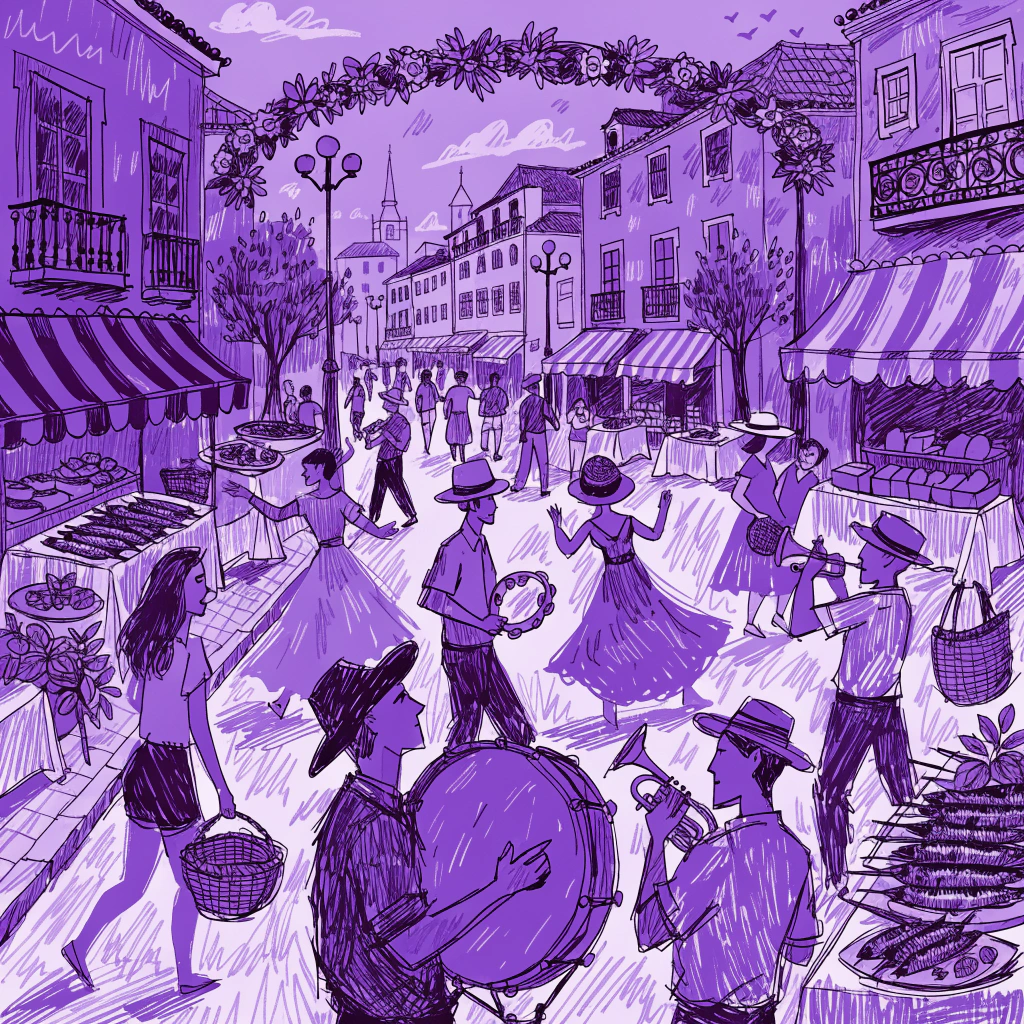
A Big Party in Lisbon
June is a special month in Lisbon, Portugal. It is the time for a big party. This party is for Saint Anthony. He is a very popular saint.
On June 12th, the city is very busy. There are many decorations in the streets. People eat grilled sardines and bread. They also drink and dance. The music is loud and happy.
Men give small green plants to women. These plants are called basil. People are very happy during this festival. It is a beautiful tradition in Lisbon.
문법 스포트라이트
패턴: Present Simple (to be)
"The city is very busy."
We use 'is' with singular subjects like 'the city' to describe a state or situation. It is the most common verb in English for descriptions.
패턴: Present Simple (Action Verbs)
"People eat grilled sardines."
With plural subjects like 'People', we use the base form of the verb without adding 's'. This describes a regular habit or a general fact.
이해도를 테스트하세요
10 질문 · A1 초급 · 무료 미리보기 1회
이 기사에서 배운 내용을 테스트하세요. 모든 질문에 답하여 XP를 획득하세요!
Where is the big party?
문제별 결과
Where is the big party?
내 답변:
정답: Lisbon
The party is in December.
내 답변:
정답: 거짓
What are 'sardines'?
내 답변:
정답: Fish
Men give small green _____ to women.
내 답변:
정답: plants
The Big Festival of Saint Anthony in Lisbon
June is a very special month in Lisbon because people celebrate Saint Anthony. He is the most popular saint in the city. People call him a matchmaker because he helps people find love. Many couples get married together on this day.
The biggest party happens on the night of June 12th. People walk to old neighborhoods like Alfama and Mouraria. These streets are more colorful than usual because there are many paper decorations and lights. It is a very happy atmosphere.
The air smells like grilled sardines. This is the traditional food of the festival. People eat sardines with bread and drink cold drinks. They also listen to 'Pimba' music and dance in the streets until the morning.
On June 13th, there is a big parade on Avenida da Liberdade. Many groups from different parts of the city dance and wear beautiful costumes. The festival is better than a normal party because the whole city celebrates together.
문법 스포트라이트
패턴: Comparatives (Adjective + er / More + Adjective)
"These streets are more colorful than usual because there are many paper decorations and lights."
We use comparatives to compare two things. For long adjectives like 'colorful', we use 'more' before the word and 'than' after it.
패턴: Connectors of Reason (Because)
"June is a very special month in Lisbon because people celebrate Saint Anthony."
We use 'because' to give a reason for something. It connects a result with its cause in one sentence.
이해도를 테스트하세요
11 질문 · A2 초등급 · 무료 미리보기 1회
이 기사에서 배운 내용을 테스트하세요. 모든 질문에 답하여 XP를 획득하세요!
When does the biggest party in Lisbon happen?
문제별 결과
When does the biggest party in Lisbon happen?
내 답변:
정답: June 12th
Saint Anthony is known for helping people find love.
내 답변:
정답: 참
What does 'traditional' mean?
내 답변:
정답: Following the customs of the past
The traditional food of the festival is grilled _____.
내 답변:
정답: sardines
Where is the big parade located?
내 답변:
정답: On Avenida da Liberdade
포르투갈 리스본의 특별한 축제: 산투 안토니우 축제
포르투갈에서는 6월이 '산투스 포풀라레스(Santos Populares)'라는 전통적인 축제의 달입니다. 특히 리스본에서는 산투 안토니우(Santo António) 성인을 기념하는 축제가 가장 큰 열정으로 기념되어 왔습니다. 산투 안토니우는 리스본 사람들이 가장 사랑하는 성인으로, 중매쟁이이자 가난한 사람들의 수호자로 알려져 있습니다. 그의 축일은 6월 13일이지만, 사실 리스본의 축제는 6월 12일 밤부터 시작되어 도시 전체가 활기로 가득 차게 됩니다.
이 축제 기간 동안 리스본의 역사적인 동네들, 예를 들어 알파마(Alfama), 모우라리아(Mouraria), 그라사(Graça) 등은 화려한 색깔의 장식으로 꾸며집니다. 거리마다 작은 전등과 종이꽃이 걸려 있고, 맛있는 정어리 구이 냄새가 퍼집니다. 사람들은 전통 음악인 파두(Fado)를 들으며 춤을 추고, 친구들과 가족들과 함께 밤새도록 즐거운 시간을 보냅니다. 많은 사람들이 이 축제를 보기 위해 리스본을 방문합니다.
산투 안토니우 축제는 단순한 종교 행사가 아닙니다. 이것은 리스본의 문화와 전통이 살아 숨 쉬는 중요한 행사입니다. 특히 젊은 연인들은 이 축제 기간에 서로에게 사랑을 고백하거나 결혼을 약속하기도 합니다. 산투 안토니우가 중매쟁이로 알려져 있기 때문입니다. 또한, 리스본 대성당 근처에서는 산투 안토니우의 작은 화분을 사서 행운을 비는 전통도 있습니다. 이 축제는 몇 주 동안 계속되며, 도시를 방문하는 모든 사람에게 잊지 못할 추억을 선물합니다.
문법 스포트라이트
패턴: ~아/어 오다 (과거부터 현재까지의 지속)
"특히 리스본에서는 산투 안토니우(Santo António) 성인을 기념하는 축제가 가장 큰 열정으로 기념되어 왔습니다."
동사 뒤에 '~아/어 오다'를 붙이면, 과거부터 지금까지 어떤 행동이나 상태가 계속되어 왔음을 나타냅니다. 현재까지 영향을 미치는 경험이나 지속된 상황을 표현할 때 사용합니다.
패턴: ~는/은/을 명사 (관형절)
"산투 안토니우는 리스본 사람들이 가장 사랑하는 성인으로, 중매쟁이이자 가난한 사람들의 수호자로 알려져 있습니다."
동사나 형용사 뒤에 '~는/은/을'을 붙여서 뒤에 오는 명사를 꾸며주는 역할을 합니다. 영어의 관계대명사와 비슷하게, 명사에 대한 추가 정보를 설명할 때 사용됩니다.
이해도를 테스트하세요
11 질문 · B1 중급 · 무료 미리보기 1회
이 기사에서 배운 내용을 테스트하세요. 모든 질문에 답하여 XP를 획득하세요!
산투 안토니우 성인은 주로 무엇으로 알려져 있습니까?
문제별 결과
산투 안토니우 성인은 주로 무엇으로 알려져 있습니까?
내 답변:
정답: 중매쟁이와 가난한 사람들의 수호자
산투 안토니우의 축일은 6월 13일입니다.
내 답변:
정답: 참
'열정'의 의미는 무엇입니까?
내 답변:
정답: 뜨겁고 강한 마음
리스본의 역사적인 _____들은 화려한 색깔의 장식으로 꾸며집니다.
내 답변:
정답: 동네들
다음 중 축제 기간 동안 장식되는 리스본의 역사적인 동네가 아닌 곳은 어디입니까?
내 답변:
정답: 벨렘
The Soul of Lisbon: Analyzing the Cultural Fervor of Saint Anthony’s Feast
The month of June in Lisbon is characterized by an unparalleled sense of communal fervor as the city prepares for the 'Festas de Lisboa'. While several saints are celebrated during this period, none holds as much significance as Saint Anthony, the patron saint of the Portuguese capital. Although his official feast day falls on June 13th, the festivities reach their zenith on the preceding night. This celebration is not merely a religious event; rather, it represents a complex tapestry of historical heritage, urban identity, and social cohesion.
As dusk falls on June 12th, the historic districts of Alfama, Mouraria, and Graça undergo a remarkable transformation. The narrow, winding streets are adorned with intricate decorations and the pungent aroma of grilled sardines fills the air. It is often argued that to truly understand the soul of Lisbon, one must experience this night. Residents set up makeshift stalls outside their homes, offering traditional food and drinks to locals and tourists alike. Furthermore, the presence of 'manjerico'—a type of basil plant accompanied by a small poem—serves as a symbolic gesture of affection, rooted in the saint’s reputation as a matchmaker.
One of the most captivating aspects of the festival is the 'Casamentos de Santo António'. This tradition involves several couples who are married in a collective ceremony at the Lisbon Cathedral. Historically, this initiative was established to assist couples who lacked the financial means to afford a wedding. Consequently, the saint is revered not only as a spiritual figure but also as a protector of the poor. If these social programs had not been initiated decades ago, many families might not have felt the same deep-rooted connection to the municipal authorities that they do today.
The highlight of the evening is arguably the 'Marchas Populares', a grand parade held on Avenida da Liberdade. Each neighborhood presents a choreographed performance featuring vibrant costumes and original music. These marches are highly competitive, with participants spending months preparing to represent their local community. The event showcases a paradoxical blend of fierce local rivalry and city-wide solidarity.
In conclusion, the Festas de Lisboa serve as a vital reminder of the city's enduring cultural legacy. Despite the pressures of modern globalization, the traditions of Saint Anthony continue to flourish. By participating in these festivities, the people of Lisbon reaffirm their collective history while welcoming the future with open arms.
문법 스포트라이트
패턴: Passive Voice
"The narrow, winding streets are adorned with intricate decorations."
The passive voice is used here to focus on the streets (the object) rather than who decorated them. It is formed using 'to be' + the past participle.
패턴: Third Conditional
"If these social programs had not been initiated decades ago, many families might not have felt the same deep-rooted connection."
This structure is used to imagine a different past and its hypothetical result. It uses 'if' + past perfect, followed by 'would/might have' + past participle.
패턴: Relative Clauses
"This tradition involves several couples who are married in a collective ceremony at the Lisbon Cathedral."
The relative pronoun 'who' introduces a defining relative clause that provides essential information about the 'couples' mentioned.
이해도를 테스트하세요
11 질문 · B2 중상급 · 무료 미리보기 1회
이 기사에서 배운 내용을 테스트하세요. 모든 질문에 답하여 XP를 획득하세요!
When do the festivities in Lisbon reach their peak?
문제별 결과
When do the festivities in Lisbon reach their peak?
내 답변:
정답: On the night of June 12th
The 'Casamentos de Santo António' were originally designed to help wealthy families.
내 답변:
정답: 거짓
What does 'pungent' mean in the context of the article?
내 답변:
정답: A strong and sharp smell
Saint Anthony is historically known in Lisbon as a _____, helping people find love and marriage.
내 답변:
정답: matchmaker
What is the primary purpose of the 'Marchas Populares'?
내 답변:
정답: To represent local neighborhoods in a choreographed parade
The Paradox of Patronage: Lisbon’s Festas and the Dialectic of Tradition
Seldom does a city witness such a total socio-cultural metamorphosis as Lisbon does during the month of June. As the heat of early summer descends upon the Portuguese capital, the city prepares for the Festas de Lisboa, a month-long celebration culminating in the feast of Santo António on June 13th. Far from being a mere series of street parties, these festivities represent a veritable tapestry of historical vestige and modern communal identity. It is the juxtaposition of the sacred and the profane that defines the quintessential Lisbon experience. While Santo António is officially the patron saint of finding lost objects and a celestial matchmaker, his celebration is marked by raucous 'arraiais' where the air is thick with the ephemeral scent of charcoal-grilled sardines and 'manjerico'. The historic neighborhoods of Alfama, Mouraria, and Graça become labyrinthine stages for collective fervor, adorned with colorful bunting and paper lanterns.
The centerpiece of the festivities, the 'Marchas Populares', involves a fierce competition between different districts. Each neighborhood designs elaborate costumes and choreography, performing down the Avenida da Liberdade. This display is not merely aesthetic; it is a profound expression of local pride. Yet, the preservation of such traditions is increasingly complicated by the rapid gentrification of the city’s historic core. As long-term residents are displaced by short-term holiday rentals, the idiosyncratic soul of the 'bairros' faces a precarious future. The manjerico, often called the 'herb of lovers,' is traditionally gifted in a small clay pot, accompanied by a 'quadra'—a four-line poem expressing affection. This practice highlights the romantic undercurrent of the festival. Historically, Santo António, though born in Lisbon, is often associated with Padua, yet Lisboetas claim him with a fierce, almost possessive devotion. This theological tug-of-war adds another layer to the festival's complexity, as the city asserts its historical primacy over the saint’s legacy.
Furthermore, the 'Casamentos de Santo António'—a mass wedding ceremony sponsored by the municipality—serves as a fascinating example of how institutional patronage maintains social customs. Originally established to help poor couples marry, it has evolved into a televised spectacle. Critics argue that the commodification of these rituals risks stripping them of their original sincerity, transforming lived heritage into a curated tourist attraction. Nevertheless, should one venture into the narrow alleys of Alfama on the night of June 12th, the sheer vitality of the celebration remains undeniable. The collective singing of 'Fado' and the shared meals on communal tables suggest that the spirit of the festival transcends its commercial veneers. The dialectic between the old and the new, the local and the global, is played out every June. Ultimately, the Festas de Lisboa are a testament to the city's resilience. The transformation of the urban space into a site of shared joy provides a necessary counter-narrative to the atomization of modern life. Whether the festival can maintain its authenticity amidst growing global pressure remains to be seen, but for now, the fervor of the Lisbon night continues to captivate all who experience it.
문법 스포트라이트
패턴: Negative Inversion
"Seldom does a city witness such a total socio-cultural metamorphosis as Lisbon does during the month of June."
Inversion is used for emphasis by placing a negative or restrictive adverb at the beginning of the sentence, followed by an auxiliary verb and then the subject.
패턴: Cleft Sentences
"It is the juxtaposition of the sacred and the profane that defines the quintessential Lisbon experience."
Cleft sentences focus on a specific part of the sentence (the focus) by introducing it with 'It is/was'. This highlights the importance of the juxtaposition over other elements.
패턴: Nominalisation
"The transformation of the urban space into a site of shared joy provides a necessary counter-narrative."
Nominalisation involves turning verbs (transform) into nouns (transformation) to create a more formal, academic, and objective tone characteristic of C1 level writing.
이해도를 테스트하세요
12 질문 · C1 고급 · 무료 미리보기 1회
이 기사에서 배운 내용을 테스트하세요. 모든 질문에 답하여 XP를 획득하세요!
What is the primary objective of the article's analysis of the Festas de Lisboa?
문제별 결과
What is the primary objective of the article's analysis of the Festas de Lisboa?
내 답변:
정답: To examine the tension between traditional heritage and modern urban shifts.
The 'Marchas Populares' are described as a purely decorative parade without competitive elements.
내 답변:
정답: 거짓
What does 'ephemeral' mean in the context of the article?
내 답변:
정답: Transitory and short-lived
The idiosyncratic soul of the historic neighborhoods is threatened by the rapid _____ of the city center.
내 답변:
정답: gentrification
What does the 'manjerico' tradition signify within the festival?
내 답변:
정답: A romantic gesture involving affection and poetry.
The author suggests that despite commercialization, the festival still maintains a sense of communal vitality.
내 답변:
정답: 참
The Hagiography of Revelry: Deciphering the Socio-Anthropological Fabric of Lisbon’s Festas de Santo António
The kaleidoscopic metamorphosis of Lisbon during the month of June is not merely a testament to religious piety but serves as a profound socio-anthropological case study. At the heart of this transformation lies the Festas de Lisboa, a month-long celebration culminating in the eve of Saint Anthony’s feast day on June 12th. To the uninitiated, the spectacle may appear as a chaotic assemblage of grilled sardines and folk music; however, a more nuanced analysis reveals a complex hagiography interwoven with atavistic rituals and modern urban identity. Seldom has a metropolis managed to balance such fervent ebullience with the preservation of its archaic, labyrinthine soul.
Saint Anthony, though born in Lisbon, is often erroneously associated solely with Padua. In the Lusitanian capital, he is revered not just as a doctor of the church, but as a matchmaker and the benevolent protector of the impoverished. This duality is reflected in the city's topography. While the majestic Lisbon Cathedral hosts the 'Casamentos de Santo António'—a collective wedding ceremony for couples who might otherwise lack the financial means—the surrounding alleys of Alfama and Mouraria descend into a jubilant, secular frenzy. This juxtaposition of the liturgical and the profane is the hallmark of the festivities. The saint’s role as the 'Saint of the Poor' is further underscored by the distribution of the 'Pão de Santo António' (Saint Anthony’s Bread), a tradition that persists in many of the city’s older parishes, emphasizing a community-wide commitment to social cohesion.
The sensory palette of the night is dominated by an olfactory signature: the pungent aroma of sardines grilling over charcoal, mingling with the delicate scent of manjerico (bush basil). The manjerico, often accompanied by a paper carnation and a 'quadra' (a four-line poem), serves as a tacit medium for romantic expression. It is a tradition that harks back to courtly love, yet it persists amidst the secularization of contemporary society. Lest the cultural significance of these small pots of basil be overlooked, one must recognize them as ephemeral tokens of affection that bridge the gap between the ancestral and the fleeting present. The sardine itself, once a humble staple of the poor, has been elevated to an iconic status, appearing on everything from ceramic tiles to haute couture, illustrating the commodification of local symbols.
Central to the visual grandeur are the 'Marchas Populares', a choreographed parade where various neighborhoods compete for prestige. Each 'bairro' presents a theme, showcasing elaborate costumes and original compositions. This competition is more than mere entertainment; it is an expression of local idiosyncrasy and communal pride. Historically, these marches were repurposed during the mid-20th century by the Estado Novo regime to promote nationalistic values, yet they have since been reclaimed by the populace as a genuine celebration of localism. Had the city planners of the mid-20th century succeeded in their total modernization of these districts, the visceral connection to these local identities might have been severed. Fortunately, the resilient spirit of the 'marchantes' ensures that the historical narrative remains vibrantly intact.
However, the festivities are not immune to the pressures of globalization and gentrification. As the historic centers become increasingly commodified for tourism, the authenticity of the 'arraiais' (street parties) faces a precarious future. There is an ongoing scholarly debate regarding whether the influx of international visitors dilutes the intrinsic value of the celebration or provides the necessary economic impetus for its survival. Academic hedging suggests that while the form remains robust, the underlying social fabric is undergoing a subtle yet irreversible shift. The tension between the 'authentic' experience sought by residents and the 'packaged' experience offered to tourists remains a point of contention among urban sociologists.
In conclusion, the Festas de Lisboa represent a multifaceted phenomenon where the sacred, the romantic, and the communal converge. It is an annual reassertion of Lisbon’s identity—a moment where the city pauses its pursuit of modernity to embrace its atavistic roots. Whether through the smoke of the grills or the rhythm of the 'pimba' music, the spirit of Santo António continues to permeate the cobblestones, reminding both residents and visitors alike of the enduring power of shared cultural heritage. The festival serves as a reminder that even in an era of rapid technological advancement, the human need for collective ritual and communal belonging remains undiminished.
문법 스포트라이트
패턴: Inversion with Negative Adverbials
"Seldom has a metropolis managed to balance such fervent ebullience with the preservation of its archaic, labyrinthine soul."
When a negative or restrictive adverb (like 'seldom') starts a sentence, the subject and auxiliary verb are inverted to create emphasis. This is a common rhetorical device in formal C2 English.
패턴: Subjunctive with 'Lest'
"Lest the cultural significance of these small pots of basil be overlooked, one must recognize them as ephemeral tokens of affection..."
The word 'lest' is used to express fear that something might happen. It is followed by the subjunctive mood (the base form of the verb 'be'), which is highly formal and academic.
패턴: Inverted Third Conditional
"Had the city planners of the mid-20th century succeeded in their total modernization of these districts, the visceral connection to these local identities might have been severed."
In formal English, 'if' can be omitted in third conditional sentences by inverting the subject and 'had'. This structure is used to discuss hypothetical past situations and their potential consequences.
이해도를 테스트하세요
12 질문 · C2 마스터 · 무료 미리보기 1회
이 기사에서 배운 내용을 테스트하세요. 모든 질문에 답하여 XP를 획득하세요!
What is the primary objective of the article?
문제별 결과
What is the primary objective of the article?
내 답변:
정답: To analyze the socio-anthropological and historical dimensions of the Festas de Lisboa.
Saint Anthony was originally from Padua, Italy, before moving to Lisbon.
내 답변:
정답: 거짓
What does 'ephemeral' mean in the context of the manjerico pots?
내 답변:
정답: Lasting for a very short time
The city's soul is described as _____, referring to its complex and maze-like historic streets.
내 답변:
정답: labyrinthine
What does the 'juxtaposition of the liturgical and the profane' refer to?
내 답변:
정답: The contrast between religious weddings and the wild street parties.
The 'Marchas Populares' were once used for political purposes by a previous regime.
내 답변:
정답: 참

