A Big Party in Porto
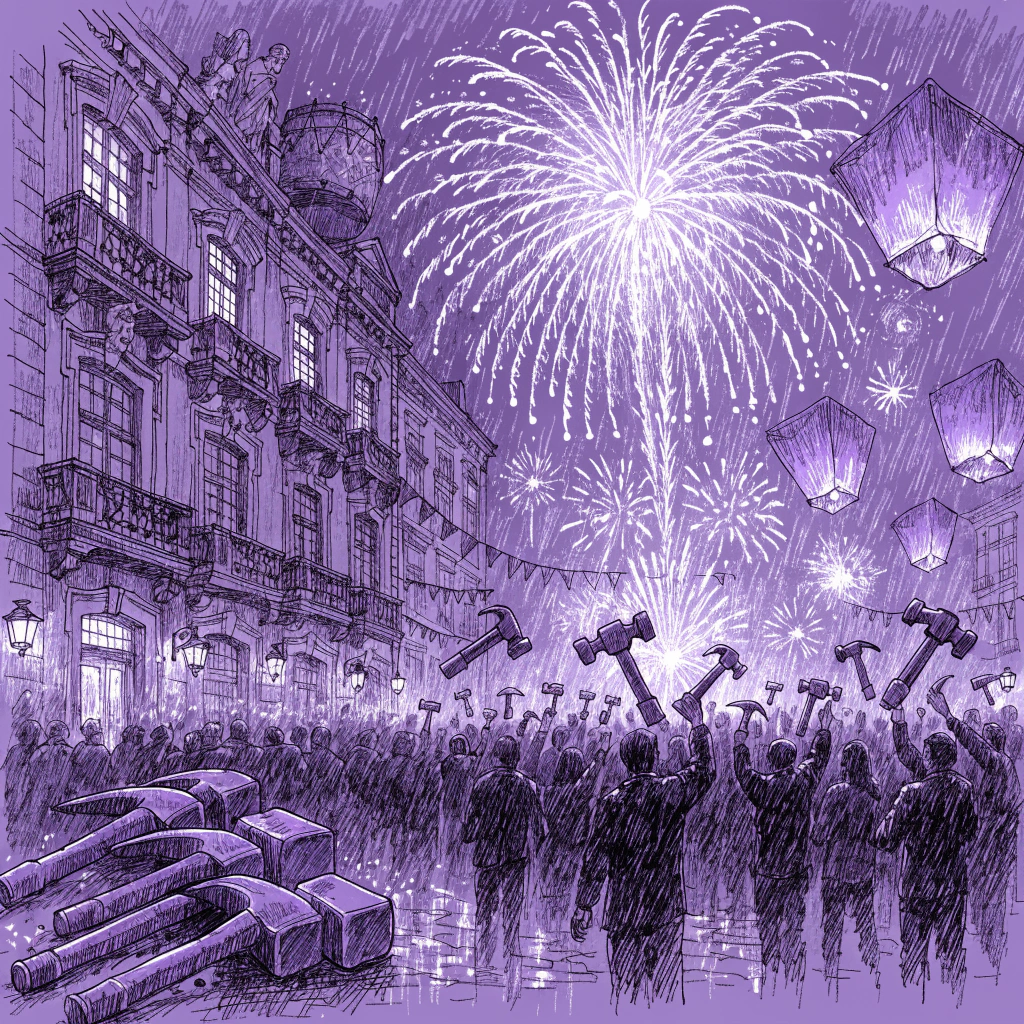
Porto is a beautiful city in Portugal. Every year in June, the city has a big party. It is the Festa de São João. Many people walk in the streets at night. They carry small plastic hammers. People hit their friends on the head with the hammers. It is a funny tradition.
There is music and dancing everywhere. People eat delicious food. They like grilled sardines and fresh bread. At midnight, there are colorful fireworks over the river. The sky is very bright. Families and friends are happy together. It is a special day in Porto.
语法聚焦
句型: Present Simple: To Be
"Porto is a beautiful city in Portugal."
We use 'is' with singular subjects like Porto to describe a fact. It connects the subject to a description.
句型: Present Simple: Plural Verbs
"Many people walk in the streets at night."
With plural subjects like 'people', we use the base form of the verb. We do not add -s to the verb.
测试你的理解
10 个问题 · A1 初学 · 1 次免费预览
测试你从这篇文章中学到的知识。回答所有问题即可获得经验值!
题目详情
Where is the Festa de São João?
你的回答:
正确答案: Porto
People eat grilled sardines during the festival.
你的回答:
正确答案: 正确
What does 'tradition' mean?
你的回答:
正确答案: Something people do for a long time
At ______, there are colorful fireworks over the river.
你的回答:
正确答案: midnight
A Big Party in Porto: The Festa de São João
Porto is a beautiful city in Portugal. Every year in June, thousands of people celebrate a big party called the Festa de São João. This festival is more than six hundred years old and it is very popular.
On the night of June 23rd, the streets are full of people. They eat grilled sardines and drink wine with their friends. But the most interesting part of the festival is the plastic hammers. People hit each other on the head with soft, colorful hammers! It is a funny tradition and everyone smiles.
The city is brighter than usual because there are many lanterns in the sky. People also jump over small fires in the streets for good luck. They do this because they want to be happy and healthy in the future.
At midnight, there are beautiful fireworks over the Douro River. The party is louder and bigger than other festivals in Portugal. It is a special night because the whole city celebrates together in the streets until the morning.
语法聚焦
句型: Comparatives
"The party is louder and bigger than other festivals in Portugal."
We use comparatives to look at the differences between two things. For short adjectives, we add -er and then use the word 'than'.
句型: Connectors: Because
"The city is brighter than usual because there are many lanterns in the sky."
We use the word 'because' to give a reason for something. It connects the result with the cause in one sentence.
测试你的理解
11 个问题 · A2 基础 · 1 次免费预览
测试你从这篇文章中学到的知识。回答所有问题即可获得经验值!
When do people celebrate the Festa de São João?
题目详情
When do people celebrate the Festa de São João?
你的回答:
正确答案: On June 23rd
People hit each other with heavy metal hammers during the festival.
你的回答:
正确答案: 错误
What does 'popular' mean?
你的回答:
正确答案: Liked by many people
People jump over small _____ in the streets for good luck.
你的回答:
正确答案: fires
Where are the fireworks at midnight?
你的回答:
正确答案: Over the Douro River
A Night of Hammers and Fireworks in Porto
Every year on June 23rd, the city of Porto in Portugal transforms into a huge party. This is the Festa de São João, a celebration that has been part of the city’s identity for over six centuries. Although it started as a pagan tradition for the summer solstice, it is now a religious and cultural event that brings the whole population together.
The festival is known for being quite eccentric. In the past, people used large garlic flowers to hit their friends on the head for good luck. Today, these flowers have been replaced by colorful plastic hammers. If you walk through the streets, you will be hit many times, but do not worry! It is all done in a spirit of brotherhood and joy.
The streets are decorated with bright lights and paper balloons. At midnight, thousands of these balloons are released into the sky, creating a beautiful sight. The air is also filled with the smell of grilled sardines, which is the traditional food eaten during the night.
One of the most exciting moments happens at the Douro River. A massive fireworks display is organized near the Dom Luís I Bridge. The bridge, which connects Porto to Gaia, becomes the center of attention as the sky lights up.
Porto is a city that loves its history, and this festival is the perfect example of how old traditions can stay alive. Whether you are a local or a tourist, the Festa de São João is an experience that should not be missed. It is a night where everyone is a friend and the party never seems to end.
语法聚焦
句型: Present Perfect
"This is the Festa de São João, a celebration that has been part of the city’s identity for over six centuries."
The present perfect (has/have + past participle) is used here to show an action or state that started in the past and continues until now. It often uses 'for' to show duration.
句型: Passive Voice
"The streets are decorated with bright lights and paper balloons."
The passive voice is used when the action itself is more important than who is doing it. It is formed using the verb 'to be' and the past participle of the main verb.
测试你的理解
11 个问题 · B1 中级 · 1 次免费预览
测试你从这篇文章中学到的知识。回答所有问题即可获得经验值!
When is the Festa de São João celebrated in Porto?
题目详情
When is the Festa de São João celebrated in Porto?
你的回答:
正确答案: June 23rd
People nowadays use garlic flowers to hit each other on the head during the festival.
你的回答:
正确答案: 错误
What does 'massive' mean?
你的回答:
正确答案: Extremely large
The air is filled with the smell of grilled _____, the traditional food of the festival.
你的回答:
正确答案: sardines
Where does the massive fireworks display take place?
你的回答:
正确答案: Near the Dom Luís I Bridge
The Vibrant Legacy of Porto’s São João Festival
The city of Porto, nestled along the Douro River, undergoes a remarkable transformation every June. While many European festivals are celebrated with solemnity, the Festa de São João is characterized by an exuberant display of communal joy. Having originated as a pagan ritual to honor the summer solstice, the event was eventually integrated into the Christian calendar to commemorate Saint John the Baptist. Nevertheless, its ancient roots remain visible in the symbolic use of fire and water, elements that have defined the celebration for over six centuries.
As the sun sets on June 23rd, the atmosphere becomes electric. Thousands of residents and tourists alike take to the streets, armed with peculiar tools of celebration. In decades past, it was customary for participants to hit fellow revelers with leeks; however, this tradition has largely been replaced by the use of colorful plastic hammers. Although it might seem intrusive to a newcomer, the rhythmic squeaking of these hammers creates a unique soundscape that defines the night. This playful interaction serves to dissolve social barriers, allowing strangers to engage in a shared experience of merriment without the constraints of formal etiquette.
Furthermore, the visual spectacle is equally captivating. Hot air balloons, crafted from delicate paper, are released into the midnight sky, symbolizing the ascent of prayers and wishes. This is followed by a magnificent fireworks display over the Ribeira district, which illuminates the historic bridges and riverbanks. Many participants also partake in the ancient tradition of jumping over bonfires, a practice believed to ensure good health and fertility. The sheer scale of the event requires significant coordination, yet it maintains an air of spontaneous enthusiasm.
Beyond the visual and auditory elements, the culinary traditions of São João are indispensable. The aroma of grilled sardines wafts through the narrow alleys of the historic center, inviting everyone to partake in a communal feast. This gastronomic aspect, combined with the traditional 'caldo verde' soup, reinforces the social fabric of the city. As families and friends sit together at long outdoor tables, the festival acts as a catalyst for strengthening community bonds. Consequently, the Festa de São João has managed to preserve its authentic character despite the pressures of globalization. For those seeking to understand the soul of Porto, there is no better occasion than this vibrant nocturnal celebration, where history and modernity coexist in perfect harmony.
语法聚焦
句型: Perfect Participle Clauses
"Having originated as a pagan ritual to honor the summer solstice, the event was eventually integrated into the Christian calendar."
Perfect participle clauses (having + past participle) are used to show that one action happened before another. It provides a formal way to explain the cause or background of the main clause.
句型: Passive Voice for Formal Tone
"the Festa de São João is characterized by an exuberant display of communal joy."
The passive voice is used here to focus on the festival itself rather than the people who characterize it. This is common in formal writing to maintain an objective or descriptive tone.
句型: Non-defining Relative Clauses
"the Ribeira district, which illuminates the historic bridges and riverbanks."
A non-defining relative clause adds extra information about a noun that is already clearly identified. It is separated by commas and is typical of B2 level academic or descriptive writing.
测试你的理解
11 个问题 · B2 中高级 · 1 次免费预览
测试你从这篇文章中学到的知识。回答所有问题即可获得经验值!
What is the primary function of the plastic hammers according to the text?
题目详情
What is the primary function of the plastic hammers according to the text?
你的回答:
正确答案: To facilitate playful interaction between strangers
The festival of São João has purely Christian origins with no pagan influence.
你的回答:
正确答案: 错误
What does 'merriment' mean?
你的回答:
正确答案: High-spirited fun and enjoyment
The festival has managed to preserve its _____ character despite globalization.
你的回答:
正确答案: authentic
What do the paper balloons released at midnight symbolize?
你的回答:
正确答案: The ascent of prayers and wishes
The Sonic and Symbolic Tapestry of São João: A Porto Phenomenon
Never before has a city embraced the summer solstice with such unbridled fervor as Porto does during the Festa de São João. While Lisbon may boast its stately processions for Saint Anthony, it is in the undulating streets of Porto that the true essence of Portuguese revelry is distilled. The festival, which has its roots in ancient pagan sun-worshiping rituals, represents a sophisticated transmutation of historical vestiges into a contemporary cultural juggernaut. Rarely does one encounter a festival where the boundaries between the sacred and the profane are so inextricably blurred. On the night of June 23rd, the city undergoes a metamorphosis. The air becomes a thick cacophony of laughter, music, and the rhythmic squeaking of plastic hammers. It is this specific auditory landscape—the juxtaposition of traditional fado with the whimsical thumping of hammers—that defines the nocturnal experience. What began as a ritual involving leeks and garlic flowers to ward off evil spirits has evolved into a more playful, yet no less significant, display of camaraderie. The preservation of these idiosyncratic customs serves as a bulwark against the homogenizing forces of modern globalization. While the plastic hammers are a relatively modern addition, replacing the more aggressive leeks of yesteryear, the spirit remains one of egalitarian joy. It is the collective participation of the citizenry that transforms Porto into a living tapestry of light and sound. From the affluent neighborhoods of Foz to the labyrinthine alleys of Ribeira, the social hierarchy is momentarily suspended. In this ephemeral space, the santo festeiro reigns supreme. Furthermore, the launch of balões de São João—illuminated paper lanterns—creates a celestial spectacle that demands critical reflection. While aesthetically breathtaking, the practice has faced scrutiny due to fire hazards, leading to a nuanced debate between the sanctity of tradition and the pragmatism of modern safety regulations. This tension highlights the festival's status not merely as a relic of the past, but as a dynamic, evolving entity that must navigate the complexities of the 21st century. Ultimately, the Festa de São João is more than a mere street party; it is a profound expression of regional identity. The sheer scale of the fireworks display over the Douro River is not just a pyrotechnic feat, but a symbolic affirmation of the city's resilience and vitality. To witness São João is to witness the heart of Porto, beating in a synchronized rhythm of fire, water, and plastic hammers.
语法聚焦
句型: Negative Inversion
"Rarely does one encounter a festival where the boundaries between the sacred and the profane are so inextricably blurred."
Inversion is used after negative or restrictive adverbs (rarely, never, seldom) to add emphasis. The auxiliary verb 'does' is placed before the subject 'one'.
句型: Cleft Sentences
"It is the collective participation of the citizenry that transforms Porto into a living tapestry of light and sound."
Cleft sentences use 'It is/was... that' to focus on a specific part of the sentence. Here, it emphasizes that the 'participation' is the key factor of transformation.
句型: Nominalisation
"The preservation of these idiosyncratic customs serves as a bulwark against the homogenizing forces of modern globalization."
Nominalisation involves turning verbs (preserve) into nouns (preservation). This creates a more formal, academic tone typical of C1 level writing.
测试你的理解
12 个问题 · C1 高级 · 1 次免费预览
测试你从这篇文章中学到的知识。回答所有问题即可获得经验值!
According to the text, how does São João in Porto differ from Saint Anthony in Lisbon?
题目详情
According to the text, how does São João in Porto differ from Saint Anthony in Lisbon?
你的回答:
正确答案: It is described as more energetic and involves more revelry.
The plastic hammers used today were always the primary tradition of the festival.
你的回答:
正确答案: 错误
What does 'ephemeral' mean in the context of the article?
你的回答:
正确答案: A short-lived, temporary state
The author argues that the festival acts as a _____ against globalization.
你的回答:
正确答案: bulwark
What is the 'nuanced debate' mentioned regarding the paper lanterns?
你的回答:
正确答案: The safety risks of fire versus the importance of tradition.
The social hierarchy in Porto remains strictly enforced during the night of June 23rd.
你的回答:
正确答案: 错误
波尔图圣若昂节:异彩纷呈的狂欢与深邃的文化溯源
在伊比利亚半岛的西端,葡萄牙的文化版图中,若里斯本以其圣安多尼节的庄重与浪漫著称,那么北部的港口城市波尔图,则以其对圣若昂(São João,即圣施洗约翰)的狂热崇敬,呈现出一种截然不同、或可说更为炽热奔放的节庆风貌。波尔图圣若昂节,这一历经逾六个世纪风雨洗礼的古老盛典,其肇始于异教信仰的夏至祭祀,原为对太阳神的崇拜与生命丰饶的祈愿,后经历史的涤荡与文化的涵化,逐渐被赋予了基督教的圣徒崇拜色彩。然而,其内在的原始活力与狂野不羁的特质却始终未曾消弭,反而与日俱增,成为波尔图城市精神的鲜明写照。
毋庸置疑,圣若昂节的魅力核心在于其独树一帜的习俗与仪式。每年的6月23日夜晚,波尔图全城便会沉浸在一片喧嚣与沸腾之中。届时,塑料锤的“叩击”声此起彼伏,人们手持蒜苗或罗勒草,轻触路人的头顶,象征着好运与驱邪。这并非寻常的恶作剧,而是一种充满善意的互动,一种打破日常界限、促进人际联结的独特方式。此外,空中弥漫着烤沙丁鱼的诱人香气,各色烤肉摊位与街头音乐表演交织成一幅生动的市井画卷,将整个城市转化为一个巨大的露天派对。
火与水,作为圣若昂节的两大核心元素,其象征意义深邃而古老。篝火熊熊燃烧,不仅是对夏至太阳能量的呼应,更承载着净化与重生的意涵,人们相信跳过篝火可以涤除厄运,带来福祉。而午夜时分,杜罗河畔的烟花表演将夜空点缀得璀璨夺目,为节庆的高潮增添了无与伦比的视觉冲击力。许多人会前往河边,或乘坐传统木船游弋,或在河岸边静候,感受水边弥散的清凉与浪漫。这难道不正是一种对生命本源的礼赞,一种对自然力量的敬畏与亲近吗?
从社会学角度审视,圣若昂节超越了单纯的宗教或民俗范畴,它更像是一场全民参与的社会聚合仪式。在这一夜,社会阶层的壁垒似乎被暂时消解,无论贫富贵贱,所有人都融汇于同一片欢乐的海洋中。人们在街头巷尾载歌载舞,分享食物与美酒,互致祝福,这无疑强化了社区的凝聚力与身份认同感。它提供了一个宣泄情感、释放压力的出口,也为人们创造了一个共同记忆的载体,使波尔图的居民得以在狂欢中重申其独特的文化归属。
鉴于此,波尔图圣若昂节并非仅仅是葡萄牙的一个地方性节日,它以其独特的历史深度、鲜明的文化符号以及强大的社会整合功能,成为人类学与文化研究的绝佳案例。它向世人展示了传统如何在现代社会中焕发新生,以及一个城市如何通过传承其根植于本土的节庆文化,来维系其独特的精神面貌与社群活力。这场异彩纷呈的狂欢,实则蕴含着对生命、社群与历史的深邃思考,其魅力之所在,或许正是这份在不羁表象下所流淌的,源远流长的文化血脉。
语法聚焦
句型: “或可说” / “或可被视为” (Academic Hedging/Possibility)
"若里斯本以其圣安多尼节的庄重与浪漫著称,那么北部的港口城市波尔图,则以其对圣若昂的狂热崇敬,呈现出一种截然不同、或可说更为炽热奔放的节庆风貌。"
“或可说”或“或可被视为”是一种常见的学术性或正式语体中的委婉表达,用于提出一种可能性、推测或观点,以避免过于绝对的论断,体现了严谨的逻辑。它通常放在句子中间,修饰其后的论述。
句型: “毋庸置疑,……” (Emphatic Assertion)
"毋庸置疑,圣若昂节的魅力核心在于其独树一帜的习俗与仪式。"
“毋庸置疑”意为“不必怀疑”,用于引出一个非常确定、不容争辩的事实或观点,具有强调和肯定的语气。它常作为句首的状语,引导出文章或段落的核心论点,增强说服力。
句型: “这难道不正是一种对……的礼赞吗?” (Rhetorical Question for Emphasis)
"这难道不正是一种对生命本源的礼赞,一种对自然力量的敬畏与亲近吗?"
这种反问句式用于加强语气,表达强烈的肯定或否定,其答案不言自明。通过提出疑问,引导读者思考并认同作者的观点,使表达更具感染力和深刻性。这种结构常用于文章的论证或情感升华部分。
测试你的理解
12 个问题 · C2 精通 · 1 次免费预览
测试你从这篇文章中学到的知识。回答所有问题即可获得经验值!
题目详情
文章指出,波尔图圣若昂节最初的起源是什么?
你的回答:
正确答案: 异教信仰的夏至祭祀
圣若昂节期间,人们用塑料锤敲打路人头部是一种带有恶意的行为。
你的回答:
正确答案: 错误
“不羁”在文章中形容的是什么?
你的回答:
正确答案: 节日的原始活力与狂野特质
篝火熊熊燃烧,不仅是对夏至太阳能量的呼应,更承载着净化与______的意涵。
你的回答:
正确答案: 重生
文章认为圣若昂节在社会学上的意义是什么?
你的回答:
正确答案: 强化社区凝聚力与身份认同感
烤沙丁鱼的香气是圣若昂节夜晚的特色之一。
你的回答:
正确答案: 正确

