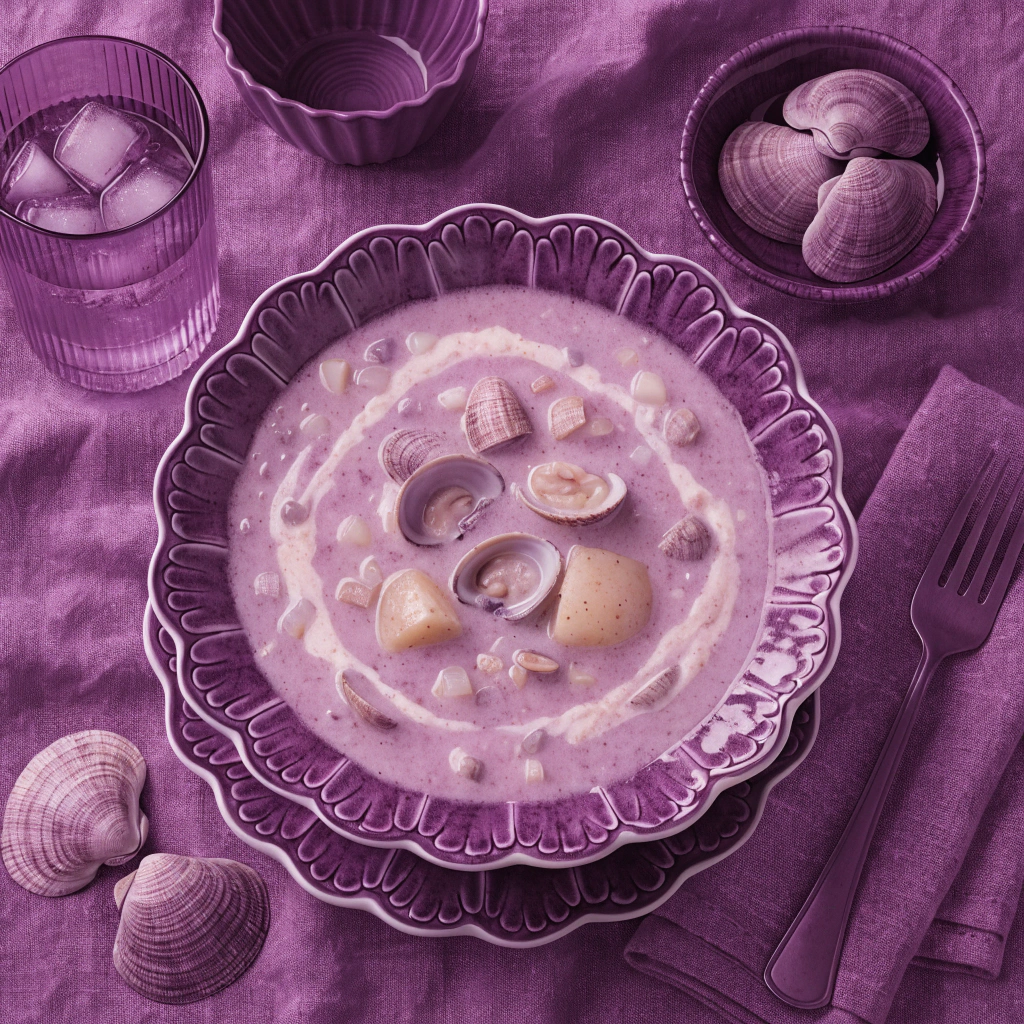
A Famous Soup from America
New England Clam Chowder is a very famous soup in America. It comes from the Northeast coast. People there love the ocean and seafood.
The soup has many ingredients. It has fresh clams from the cold water. It also has white potatoes and onions. The soup is white because it has milk or cream. It is very thick and warm.
Many people eat this soup in the winter. They eat it with small crackers. It is a traditional meal for families. It is delicious and popular.
نکته دستوری
الگو: Present Simple 'to be'
"New England Clam Chowder is a very famous soup in America."
We use 'is' for singular subjects to describe facts or states. In this sentence, it describes what the soup is.
الگو: Present Simple with 'have'
"The soup has many ingredients."
We use 'has' with singular nouns like 'the soup' to talk about possession or parts of something.
درک خود را بسنجید
10 سوال · A1 مبتدی · 1 پیشنمایش رایگان
آنچه از این مقاله آموختید را بسنجید. به همه سؤالات پاسخ دهید و XP کسب کنید!
Where does the soup come from?
آیا میخواهید آزمون را تمام کنید؟
9 سؤال دیگر منتظر شماست. ثبتنام رایگان کنید تا آزمون کامل را باز کنید و XP کسب کنید!
ثبتنام رایگانقبلاً ثبتنام کردی؟ ورود
جزئیات سؤالات
Where does the soup come from?
پاسخ شما:
پاسخ درست: The Northeast coast
The soup is red.
پاسخ شما:
پاسخ درست: نادرست
What does 'thick' mean?
پاسخ شما:
پاسخ درست: Heavy and not like water
Many people eat this soup in the _____.
پاسخ شما:
پاسخ درست: winter
A Classic American Soup: New England Clam Chowder
New England Clam Chowder is a very famous soup in the United States. It comes from the Northeast coast. This soup is a special symbol of the Atlantic Ocean. It is white, creamy, and very delicious.
The name 'chowder' probably comes from a French word for a large cooking pot. Many years ago, sailors from Europe arrived in America. They saw many fresh clams in the cold water. They mixed these clams with milk, potatoes, and onions. This soup became very popular because it was warm and filling for the workers.
Today, New England Clam Chowder is more famous than other regional soups. It is thicker and richer than vegetable soup because it uses heavy cream. People usually eat it with small, salty crackers called 'oyster crackers.' It is the best meal to eat on a cold, rainy day by the sea. Many families have their own special recipes for this traditional American dish.
نکته دستوری
الگو: Past Simple
"Many years ago, sailors from Europe arrived in America."
We use the past simple to talk about completed actions in the past. For regular verbs like 'arrive', we add '-ed' to the end.
الگو: Comparatives with 'More'
"New England Clam Chowder is more famous than other regional soups."
To compare two things with long adjectives (like 'famous'), we use 'more' + adjective + 'than'. It shows one thing has more of a quality than another.
درک خود را بسنجید
11 سوال · A2 مقدماتی · 1 پیشنمایش رایگان
آنچه از این مقاله آموختید را بسنجید. به همه سؤالات پاسخ دهید و XP کسب کنید!
Where does New England Clam Chowder come from?
آیا میخواهید آزمون را تمام کنید؟
10 سؤال دیگر منتظر شماست. ثبتنام رایگان کنید تا آزمون کامل را باز کنید و XP کسب کنید!
ثبتنام رایگانقبلاً ثبتنام کردی؟ ورود
جزئیات سؤالات
Where does New England Clam Chowder come from?
پاسخ شما:
پاسخ درست: The Northeast coast
The name 'chowder' likely comes from a French word for a cooking pot.
پاسخ شما:
پاسخ درست: درست
What does the word 'filling' mean in the article?
پاسخ شما:
پاسخ درست: Makes you feel full
The soup is white and _____ because it uses heavy cream.
پاسخ شما:
پاسخ درست: creamy
What are 'oyster crackers'?
پاسخ شما:
پاسخ درست: Small, salty crackers
A Taste of the Coast: New England Clam Chowder
New England Clam Chowder is more than just a soup; it is a symbol of the American Northeast. This creamy dish, which is famous for its rich flavor, has been a favorite for centuries. It is often served in a bread bowl or with small, salty crackers called "oyster crackers."
The word "chowder" has an interesting history. It probably comes from the French word "chaudière," which was a large pot used by fishermen. In the past, sailors combined their fresh catch with whatever ingredients they had. Over time, the recipe was changed by settlers who found abundant clams along the Atlantic coast.
To make a traditional New England chowder, several ingredients are needed. These include fresh clams, potatoes, onions, and heavy cream. Unlike the version from Manhattan, New England chowder is never made with tomatoes. Many people believe that adding tomatoes to this soup is a serious mistake!
In modern times, this dish has become a popular comfort food across the United States. It is especially enjoyed during the cold winter months when people want something warm and filling. Although there are many different types of seafood stews, this specific recipe remains the most iconic. It represents the history and the rugged spirit of the people who live by the sea.
نکته دستوری
الگو: Relative Clauses
"This creamy dish, which is famous for its rich flavor, has been a favorite for centuries."
Relative clauses provide extra information about a noun. Here, 'which' introduces details about the dish without starting a new sentence.
الگو: Passive Voice
"To make a traditional New England chowder, several ingredients are needed."
The passive voice focuses on the action or the object rather than who is doing it. It is formed using 'to be' + the past participle.
درک خود را بسنجید
11 سوال · B1 متوسط · 1 پیشنمایش رایگان
آنچه از این مقاله آموختید را بسنجید. به همه سؤالات پاسخ دهید و XP کسب کنید!
What is the main difference between New England chowder and Manhattan chowder?
آیا میخواهید آزمون را تمام کنید؟
10 سؤال دیگر منتظر شماست. ثبتنام رایگان کنید تا آزمون کامل را باز کنید و XP کسب کنید!
ثبتنام رایگانقبلاً ثبتنام کردی؟ ورود
جزئیات سؤالات
What is the main difference between New England chowder and Manhattan chowder?
پاسخ شما:
پاسخ درست: New England chowder never uses tomatoes.
The name 'chowder' likely comes from a French word for a large pot.
پاسخ شما:
پاسخ درست: درست
What does 'iconic' mean in the context of the article?
پاسخ شما:
پاسخ درست: Very famous and representative.
New England clam chowder is often served in a bread _____.
پاسخ شما:
پاسخ درست: bowl
Where did the settlers find many clams?
پاسخ شما:
پاسخ درست: Along the Atlantic coast.
A Taste of History: The Evolution of New England Clam Chowder
New England Clam Chowder stands as a definitive pillar of American culinary heritage, representing more than just a simple seafood stew. Its origins are deeply rooted in the history of the Northeastern United States, where the rugged Atlantic coastline provided an abundant supply of quahogs, which are hard-shell clams that were a staple for indigenous populations long before European arrival. The dish is thought to have derived its name from the French 'chaudière,' referring to the heavy iron cauldrons used by Breton fishermen to prepare communal meals.
The evolution of this soup reflects a fascinating intersection of cultures. As English and French settlers adapted to the new environment, they combined European techniques with local ingredients. Unlike its counterparts in other regions, the New England variety is characterized by its creamy, white base, typically composed of milk or heavy cream, potatoes, and salt pork. This specific composition has become a matter of regional pride, often leading to substantial debates regarding the authenticity of various recipes.
Perhaps the most famous of these debates involves the historical rivalry between New England and Manhattan clam chowders. While the New England version remains loyal to its dairy-based roots, the Manhattan style incorporates tomatoes, a variation that many traditionalists in the North consider a culinary transgression. In fact, the opposition to tomatoes was so intense that in 1939, a bill was introduced in the Maine legislature to effectively ban the use of tomatoes in clam chowder. Although the bill did not become law, it illustrates the profound cultural significance attached to this dish.
Today, clam chowder is celebrated not only as a comforting meal but also as a symbol of the resilience and resourcefulness of early coastal communities. To appreciate a bowl of authentic chowder is to engage with centuries of history. Consequently, many modern chefs continue to respect the traditional preparation methods, ensuring that the essence of the dish remains unchanged. Whether enjoyed in a sophisticated restaurant or a seaside shack, New England Clam Chowder continues to be a substantial part of the American identity, bridging the gap between the past and the present.
نکته دستوری
الگو: Passive Voice with 'It' and 'Thought'
"The dish is thought to have derived its name from the French 'chaudière'..."
This structure is used to report general beliefs or opinions in a formal way. It is formed by 'it' or the subject + the passive form of a reporting verb (think, believe, say) + to + infinitive.
الگو: Non-defining Relative Clauses
"...quahogs, which are hard-shell clams that were a staple for indigenous populations..."
These clauses provide extra information about a noun that is already identified. They are separated by commas and use 'which' for objects or animals.
الگو: Concessive Clauses with 'Although'
"Although the bill did not become law, it illustrates the profound cultural significance..."
Used to show contrast or a surprising connection between two ideas. 'Although' is followed by a subject and a verb.
درک خود را بسنجید
11 سوال · B2 بالاتر از متوسط · 1 پیشنمایش رایگان
آنچه از این مقاله آموختید را بسنجید. به همه سؤالات پاسخ دهید و XP کسب کنید!
Where does the word 'chowder' likely originate from?
آیا میخواهید آزمون را تمام کنید؟
10 سؤال دیگر منتظر شماست. ثبتنام رایگان کنید تا آزمون کامل را باز کنید و XP کسب کنید!
ثبتنام رایگانقبلاً ثبتنام کردی؟ ورود
جزئیات سؤالات
Where does the word 'chowder' likely originate from?
پاسخ شما:
پاسخ درست: A French word for a heavy cauldron
The 1939 Maine bill successfully banned tomatoes in clam chowder.
پاسخ شما:
پاسخ درست: نادرست
Which word means 'originating naturally in a particular place'?
پاسخ شما:
پاسخ درست: Indigenous
The debate over ingredients has become a _____ part of the American identity.
پاسخ شما:
پاسخ درست: substantial
What distinguishes New England Clam Chowder from the Manhattan variety?
پاسخ شما:
پاسخ درست: The use of a creamy white base instead of tomatoes
A Culinary Anchor: The Sophisticated Legacy of New England Clam Chowder
Rarely does a dish evoke such intense provincial fervor as New England Clam Chowder, a culinary staple that serves as a shorthand for the rugged Atlantic coastline of the American Northeast. While many contemporary diners perceive it as a mere comfort food, it is, in fact, a complex historical artifact that mirrors the socio-economic evolution of the region. The etymological roots of the word 'chowder' likely trace back to the French 'chaudière,' referring to the heavy cauldrons utilized by Breton fishermen for their communal stews. This linguistic heritage suggests a shared maritime culture that crossed the Atlantic, eventually taking root in the rocky soils of New England.
It was the interaction between European settlers and the indigenous peoples of the Americas that catalyzed the evolution of this dish. The abundance of quahogs—hard-shell clams found in the frigid coastal waters—provided the necessary sustenance for early colonies, shifting the culinary focus from the fish stews of the Old World to the shellfish-centric identity of the New. These clams were not merely a food source; they were integral to the local economy and culture, with their shells even being used for wampum. As the colonies grew, so did the specific requirements for what constituted an 'authentic' chowder.
The codification of these culinary norms, however, was not without significant controversy. The divergence between the white, cream-based New England variety and the red, tomato-based Manhattan version sparked a cultural feud so profound that it reached the halls of government. In 1939, a Maine legislator proposed a bill to forbid the use of tomatoes in chowder, arguing that such an addition was a culinary sacrilege. Such legislative fervor underscores the degree to which regional identity is inextricably tied to the communal pot. To the New Englander, the inclusion of tomatoes was not merely a matter of taste, but a betrayal of historical purity.
Central to the sensory appeal of the dish is the careful juxtaposition of textures and flavors. The saltiness of the salt pork—a preservation necessity in the days before refrigeration—complements the sweetness of the clams. Potatoes, another staple of the region, provide a starchy thickness that anchors the soup. The nominalization of the cooking process—the transition from 'to stew' as an action to 'the stew' as a cultural icon—reflects a broader societal shift toward the institutionalization of heritage. Every ingredient serves a purpose, both culinary and historical, creating a layered narrative within a single bowl.
Furthermore, the resilience of New England Clam Chowder in the face of modern culinary globalization is remarkable. Despite the influx of international cuisines and the trend toward fusion cooking, the traditional recipe remains largely unchanged in its heartland. It serves as a culinary anchor, grounding the local population in a shared past while inviting outsiders to experience a taste of the Atlantic’s rugged history. Whether it is enjoyed in a sophisticated Boston establishment or a humble seaside shack, the chowder remains a testament to the enduring power of regional tradition and the nuanced history of the American Northeast.
نکته دستوری
الگو: Inversion
"Rarely does a dish evoke such intense provincial fervor as New England Clam Chowder..."
This pattern places the auxiliary verb before the subject after a negative or restrictive adverb. It is used in formal writing to emphasize the rarity or intensity of the action.
الگو: Cleft Sentences
"It was the interaction between European settlers and the indigenous peoples of the Americas that catalyzed the evolution of this dish."
Cleft sentences use the structure 'It + be + focus + relative clause' to highlight a specific piece of information. Here, it emphasizes the specific cause of the dish's evolution.
الگو: Nominalization
"The codification of these culinary norms, however, was not without significant controversy."
Nominalization turns verbs (codify) into nouns (codification). This creates a more formal, academic tone and allows the writer to discuss complex concepts as abstract entities.
درک خود را بسنجید
12 سوال · C1 پیشرفته · 1 پیشنمایش رایگان
آنچه از این مقاله آموختید را بسنجید. به همه سؤالات پاسخ دهید و XP کسب کنید!
What is the likely linguistic origin of the word 'chowder'?
آیا میخواهید آزمون را تمام کنید؟
11 سؤال دیگر منتظر شماست. ثبتنام رایگان کنید تا آزمون کامل را باز کنید و XP کسب کنید!
ثبتنام رایگانقبلاً ثبتنام کردی؟ ورود
جزئیات سؤالات
What is the likely linguistic origin of the word 'chowder'?
پاسخ شما:
پاسخ درست: A French word for a heavy cauldron
In 1939, a Maine legislator attempted to legally ban the use of tomatoes in clam chowder.
پاسخ شما:
پاسخ درست: درست
What does the word 'sustenance' mean in the context of the article?
پاسخ شما:
پاسخ درست: Nourishment for survival
The author uses the word _____ to describe the capacity of the dish to remain unchanged despite globalization.
پاسخ شما:
پاسخ درست: resilience
What role did salt pork play in the original recipe?
پاسخ شما:
پاسخ درست: It was a flavor enhancer and a preservation necessity.
The article suggests that the New England variety of chowder is red and tomato-based.
پاسخ شما:
پاسخ درست: نادرست
The Gastronomic Semiotics of the Quahog: A Discursive Analysis of New England Clam Chowder
To contemplate the cultural landscape of the American Northeast without acknowledging the New England clam chowder is to overlook a foundational pillar of its regional identity. This ivory-hued concoction, far from being a mere culinary curiosity, serves as a semiotic vessel for the maritime heritage of the Atlantic coastline. The etymological provenance of the term 'chowder' remains a subject of academic debate, though consensus leans toward the French 'chaudière', the heavy iron cauldron utilized by Breton fishermen for communal stews. Were one to trace the lineage of the dish, one would find a complex amalgam of European technique and the indigenous bounty of the Americas. The quahog, a hard-shelled clam indigenous to these frigid waters, became the centerpiece of a dish that evolved from a humble subsistence meal into a quintessential symbol of Yankee stoicism.
The development of the chowder was not merely a matter of convenience but a sophisticated adaptation to the environmental constraints of the New England littoral. Early settlers, influenced by the culinary traditions of their homelands, found the abundance of bivalves a necessary substitute for more familiar European proteins. However, the true genius of the dish lies in its textural integrity. Unlike the ephemeral nature of a clear broth, the New England variety demands a specific viscosity, achieved through the judicious application of salt pork, potatoes, and heavy cream. It is imperative that the potato be rendered soft yet retain its structural form, providing a starchy counterpoint to the resilient, saline bite of the clam. This interplay of textures reflects the rugged, uncompromising environment from which the dish emerged.
Perhaps the most fascinating aspect of clam chowder’s history is the fierce parochialism it inspires, most notably manifested in the ideological schism between the New England and Manhattan varieties. To the purist of the Northeast, the inclusion of tomatoes—a hallmark of the Manhattan style—is nothing short of culinary blasphemy. This is not merely a preference of palate but a profound cultural boundary. So fervent was this sentiment that in 1939, a bill was introduced to the Maine legislature proposing that the addition of tomatoes to clam chowder be declared a statutory offense. While the bill failed to pass, its existence underscores the extent to which the dish is intertwined with regional pride and the preservation of a perceived authentic heritage. Had the legislators been successful, the culinary landscape of the United States might have been legally partitioned by soup ingredients.
Furthermore, the consumption of chowder in the contemporary era necessitates a degree of academic hedging regarding its sustainability and the shifting ecology of the Atlantic. While the quahog remains abundant, the industrialization of its harvest has prompted discussions on the ethical provenance of our seafood. Nevertheless, the dish persists as a communal ritual. Whether served in a modest coastal shack or a high-end urban establishment, the act of consuming clam chowder is a performance of history. It is a sensory engagement with the past, where the briny aroma of the clams and the richness of the cream evoke the mist-laden piers of a bygone era. In essence, the New England clam chowder is an enduring testament to the power of food to define a people, proving that even the simplest ingredients, when simmered in the cauldron of history, can become a profound expression of cultural continuity.
نکته دستوری
الگو: Inverted Conditionals (Were/Had)
"Were one to trace the lineage of the dish, one would find a complex amalgam of European technique and the indigenous bounty of the Americas."
This formal structure replaces 'if' with the auxiliary verb at the start of the clause. It is used in C2 academic writing to express hypothetical situations with a high degree of sophistication.
الگو: Subjunctive Mood
"It is imperative that the potato be rendered soft yet retain its structural form..."
The subjunctive 'be rendered' is used after adjectives of necessity (imperative, crucial). It lacks the '-s' ending in the third person and provides a formal, prescriptive tone.
الگو: Nominalization
"The development of the chowder was not merely a matter of convenience but a sophisticated adaptation..."
Nominalization involves turning verbs (develop, adapt) into nouns (development, adaptation). This shifts the focus from the action to the concept, a hallmark of scholarly and analytical prose.
درک خود را بسنجید
12 سوال · C2 تسلط · 1 پیشنمایش رایگان
آنچه از این مقاله آموختید را بسنجید. به همه سؤالات پاسخ دهید و XP کسب کنید!
According to the article, what is the most likely origin of the word 'chowder'?
آیا میخواهید آزمون را تمام کنید؟
11 سؤال دیگر منتظر شماست. ثبتنام رایگان کنید تا آزمون کامل را باز کنید و XP کسب کنید!
ثبتنام رایگانقبلاً ثبتنام کردی؟ ورود
جزئیات سؤالات
According to the article, what is the most likely origin of the word 'chowder'?
پاسخ شما:
پاسخ درست: A French term for a type of cooking vessel
The bill proposed in Maine in 1939 successfully criminalized the use of tomatoes in clam chowder.
پاسخ شما:
پاسخ درست: نادرست
Which word describes the 'thickness' or 'flow' of the soup's liquid?
پاسخ شما:
پاسخ درست: Viscosity
The author argues that the dish is a _____ symbol of Yankee stoicism.
پاسخ شما:
پاسخ درست: quintessential
What does the author suggest about the relationship between potatoes and clams in the dish?
پاسخ شما:
پاسخ درست: The potato should be soft but distinct against the resilient clam.
The article suggests that the contemporary consumption of chowder is a form of 'performance of history'.
پاسخ شما:
پاسخ درست: درست

