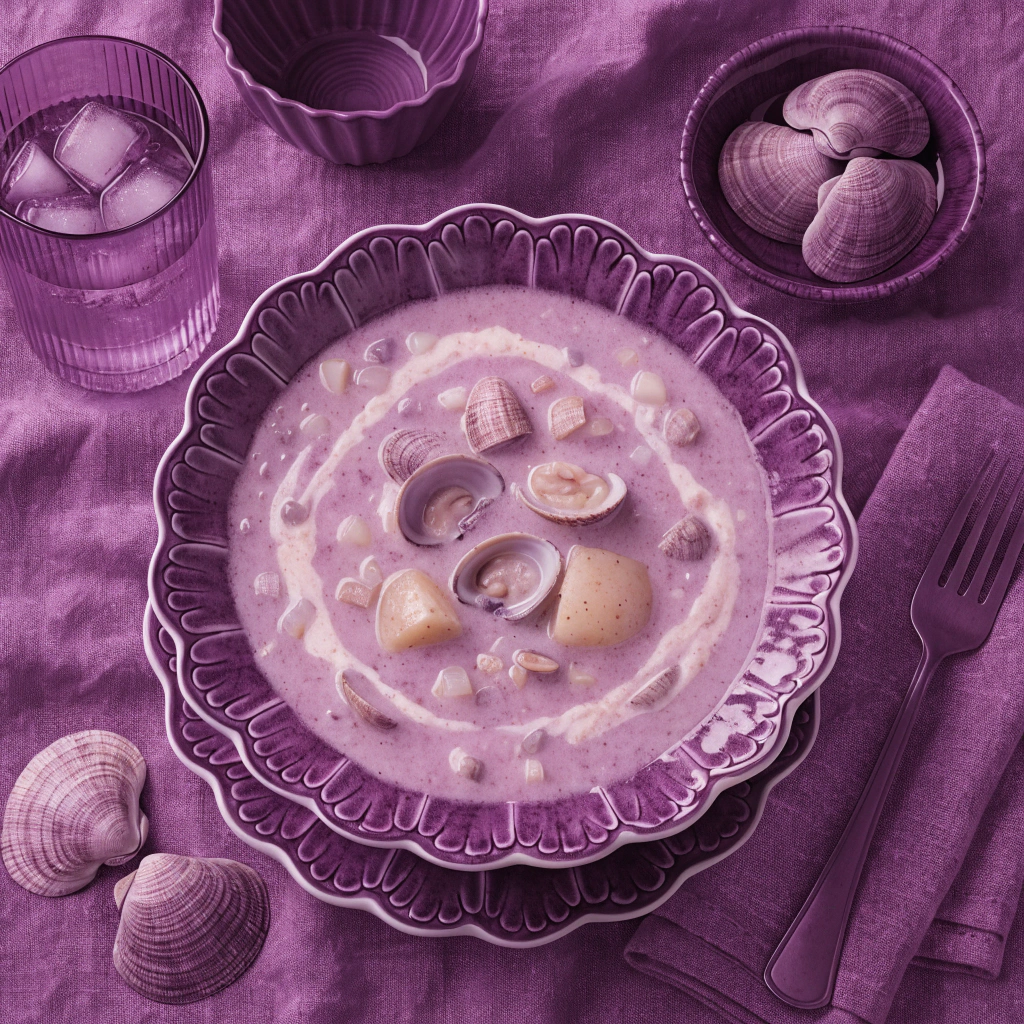
A Famous Soup from America
New England Clam Chowder is a very famous soup in America. It comes from the Northeast coast. People there love the ocean and seafood.
The soup has many ingredients. It has fresh clams from the cold water. It also has white potatoes and onions. The soup is white because it has milk or cream. It is very thick and warm.
Many people eat this soup in the winter. They eat it with small crackers. It is a traditional meal for families. It is delicious and popular.
Gramática em destaque
Padrão: Present Simple 'to be'
"New England Clam Chowder is a very famous soup in America."
We use 'is' for singular subjects to describe facts or states. In this sentence, it describes what the soup is.
Padrão: Present Simple with 'have'
"The soup has many ingredients."
We use 'has' with singular nouns like 'the soup' to talk about possession or parts of something.
Teste sua compreensão
10 perguntas · A1 Iniciante · 1 pré-visualização grátis
Teste o que aprendeu neste artigo. Responda todas as perguntas para ganhar XP!
Where does the soup come from?
Quer finalizar o quiz?
9 perguntas a mais estão esperando por você. Cadastre-se grátis para desbloquear o quiz completo e ganhar XP!
Cadastrar grátisJá tem conta? Entrar
Detalhamento das perguntas
Where does the soup come from?
Sua resposta:
Resposta correta: The Northeast coast
The soup is red.
Sua resposta:
Resposta correta: Falso
What does 'thick' mean?
Sua resposta:
Resposta correta: Heavy and not like water
Many people eat this soup in the _____.
Sua resposta:
Resposta correta: winter
A Classic American Soup: New England Clam Chowder
New England Clam Chowder is a very famous soup in the United States. It comes from the Northeast coast. This soup is a special symbol of the Atlantic Ocean. It is white, creamy, and very delicious.
The name 'chowder' probably comes from a French word for a large cooking pot. Many years ago, sailors from Europe arrived in America. They saw many fresh clams in the cold water. They mixed these clams with milk, potatoes, and onions. This soup became very popular because it was warm and filling for the workers.
Today, New England Clam Chowder is more famous than other regional soups. It is thicker and richer than vegetable soup because it uses heavy cream. People usually eat it with small, salty crackers called 'oyster crackers.' It is the best meal to eat on a cold, rainy day by the sea. Many families have their own special recipes for this traditional American dish.
Gramática em destaque
Padrão: Past Simple
"Many years ago, sailors from Europe arrived in America."
We use the past simple to talk about completed actions in the past. For regular verbs like 'arrive', we add '-ed' to the end.
Padrão: Comparatives with 'More'
"New England Clam Chowder is more famous than other regional soups."
To compare two things with long adjectives (like 'famous'), we use 'more' + adjective + 'than'. It shows one thing has more of a quality than another.
Teste sua compreensão
11 perguntas · A2 Elementar · 1 pré-visualização grátis
Teste o que aprendeu neste artigo. Responda todas as perguntas para ganhar XP!
Where does New England Clam Chowder come from?
Quer finalizar o quiz?
10 perguntas a mais estão esperando por você. Cadastre-se grátis para desbloquear o quiz completo e ganhar XP!
Cadastrar grátisJá tem conta? Entrar
Detalhamento das perguntas
Where does New England Clam Chowder come from?
Sua resposta:
Resposta correta: The Northeast coast
The name 'chowder' likely comes from a French word for a cooking pot.
Sua resposta:
Resposta correta: Verdadeiro
What does the word 'filling' mean in the article?
Sua resposta:
Resposta correta: Makes you feel full
The soup is white and _____ because it uses heavy cream.
Sua resposta:
Resposta correta: creamy
What are 'oyster crackers'?
Sua resposta:
Resposta correta: Small, salty crackers
A Taste of the Coast: New England Clam Chowder
New England Clam Chowder is more than just a soup; it is a symbol of the American Northeast. This creamy dish, which is famous for its rich flavor, has been a favorite for centuries. It is often served in a bread bowl or with small, salty crackers called "oyster crackers."
The word "chowder" has an interesting history. It probably comes from the French word "chaudière," which was a large pot used by fishermen. In the past, sailors combined their fresh catch with whatever ingredients they had. Over time, the recipe was changed by settlers who found abundant clams along the Atlantic coast.
To make a traditional New England chowder, several ingredients are needed. These include fresh clams, potatoes, onions, and heavy cream. Unlike the version from Manhattan, New England chowder is never made with tomatoes. Many people believe that adding tomatoes to this soup is a serious mistake!
In modern times, this dish has become a popular comfort food across the United States. It is especially enjoyed during the cold winter months when people want something warm and filling. Although there are many different types of seafood stews, this specific recipe remains the most iconic. It represents the history and the rugged spirit of the people who live by the sea.
Gramática em destaque
Padrão: Relative Clauses
"This creamy dish, which is famous for its rich flavor, has been a favorite for centuries."
Relative clauses provide extra information about a noun. Here, 'which' introduces details about the dish without starting a new sentence.
Padrão: Passive Voice
"To make a traditional New England chowder, several ingredients are needed."
The passive voice focuses on the action or the object rather than who is doing it. It is formed using 'to be' + the past participle.
Teste sua compreensão
11 perguntas · B1 Intermediário · 1 pré-visualização grátis
Teste o que aprendeu neste artigo. Responda todas as perguntas para ganhar XP!
What is the main difference between New England chowder and Manhattan chowder?
Quer finalizar o quiz?
10 perguntas a mais estão esperando por você. Cadastre-se grátis para desbloquear o quiz completo e ganhar XP!
Cadastrar grátisJá tem conta? Entrar
Detalhamento das perguntas
What is the main difference between New England chowder and Manhattan chowder?
Sua resposta:
Resposta correta: New England chowder never uses tomatoes.
The name 'chowder' likely comes from a French word for a large pot.
Sua resposta:
Resposta correta: Verdadeiro
What does 'iconic' mean in the context of the article?
Sua resposta:
Resposta correta: Very famous and representative.
New England clam chowder is often served in a bread _____.
Sua resposta:
Resposta correta: bowl
Where did the settlers find many clams?
Sua resposta:
Resposta correta: Along the Atlantic coast.
A Taste of History: The Evolution of New England Clam Chowder
New England Clam Chowder stands as a definitive pillar of American culinary heritage, representing more than just a simple seafood stew. Its origins are deeply rooted in the history of the Northeastern United States, where the rugged Atlantic coastline provided an abundant supply of quahogs, which are hard-shell clams that were a staple for indigenous populations long before European arrival. The dish is thought to have derived its name from the French 'chaudière,' referring to the heavy iron cauldrons used by Breton fishermen to prepare communal meals.
The evolution of this soup reflects a fascinating intersection of cultures. As English and French settlers adapted to the new environment, they combined European techniques with local ingredients. Unlike its counterparts in other regions, the New England variety is characterized by its creamy, white base, typically composed of milk or heavy cream, potatoes, and salt pork. This specific composition has become a matter of regional pride, often leading to substantial debates regarding the authenticity of various recipes.
Perhaps the most famous of these debates involves the historical rivalry between New England and Manhattan clam chowders. While the New England version remains loyal to its dairy-based roots, the Manhattan style incorporates tomatoes, a variation that many traditionalists in the North consider a culinary transgression. In fact, the opposition to tomatoes was so intense that in 1939, a bill was introduced in the Maine legislature to effectively ban the use of tomatoes in clam chowder. Although the bill did not become law, it illustrates the profound cultural significance attached to this dish.
Today, clam chowder is celebrated not only as a comforting meal but also as a symbol of the resilience and resourcefulness of early coastal communities. To appreciate a bowl of authentic chowder is to engage with centuries of history. Consequently, many modern chefs continue to respect the traditional preparation methods, ensuring that the essence of the dish remains unchanged. Whether enjoyed in a sophisticated restaurant or a seaside shack, New England Clam Chowder continues to be a substantial part of the American identity, bridging the gap between the past and the present.
Gramática em destaque
Padrão: Passive Voice with 'It' and 'Thought'
"The dish is thought to have derived its name from the French 'chaudière'..."
This structure is used to report general beliefs or opinions in a formal way. It is formed by 'it' or the subject + the passive form of a reporting verb (think, believe, say) + to + infinitive.
Padrão: Non-defining Relative Clauses
"...quahogs, which are hard-shell clams that were a staple for indigenous populations..."
These clauses provide extra information about a noun that is already identified. They are separated by commas and use 'which' for objects or animals.
Padrão: Concessive Clauses with 'Although'
"Although the bill did not become law, it illustrates the profound cultural significance..."
Used to show contrast or a surprising connection between two ideas. 'Although' is followed by a subject and a verb.
Teste sua compreensão
11 perguntas · B2 Intermediário superior · 1 pré-visualização grátis
Teste o que aprendeu neste artigo. Responda todas as perguntas para ganhar XP!
Where does the word 'chowder' likely originate from?
Quer finalizar o quiz?
10 perguntas a mais estão esperando por você. Cadastre-se grátis para desbloquear o quiz completo e ganhar XP!
Cadastrar grátisJá tem conta? Entrar
Detalhamento das perguntas
Where does the word 'chowder' likely originate from?
Sua resposta:
Resposta correta: A French word for a heavy cauldron
The 1939 Maine bill successfully banned tomatoes in clam chowder.
Sua resposta:
Resposta correta: Falso
Which word means 'originating naturally in a particular place'?
Sua resposta:
Resposta correta: Indigenous
The debate over ingredients has become a _____ part of the American identity.
Sua resposta:
Resposta correta: substantial
What distinguishes New England Clam Chowder from the Manhattan variety?
Sua resposta:
Resposta correta: The use of a creamy white base instead of tomatoes
A Essência Atlântica em Caldeirada: Uma Análise da New England Clam Chowder
A New England Clam Chowder, icônico prato da culinária norte-americana, transcende a mera função de alimento; é, com efeito, um epítome da identidade cultural e gastronômica da robusta costa atlântica do Nordeste dos Estados Unidos. Mais do que uma simples sopa, ela evoca a resiliência e a confluência de culturas que moldaram a região. A sua origem, intrinsecamente ligada à história da colonização, revela um fascinante intercâmbio de saberes e ingredientes.
Etimologicamente, o termo 'chowder' presume-se derivar do francês 'chaudière', um tipo de caldeirão pesado e de grandes dimensões, primordialmente utilizado por pescadores bretões para preparar guisados comunitários. Esta prática, de cozinhar coletivamente os frutos do mar recém-pescados em um único recipiente, foi importada para o Novo Mundo. Contudo, a singularidade da versão americana reside na sua adaptação engenhosa. Foi a interação entre os colonos ingleses e franceses e as populações indígenas, nomeadamente os nativos americanos que habitavam a costa, que propiciou a inclusão das abundantes amêijoas de casca dura – as quahogs – encontradas nas águas frias da região.
Não se trata, portanto, de uma mera transposição de uma receita europeia, mas sim de uma genuína fusão cultural. A cremosidade que hoje caracteriza a New England Clam Chowder, com a adição de leite ou creme e batatas, é um desenvolvimento posterior, embora inexoravelmente associado à sua imagem atual. A versão original era, provavelmente, mais rústica e menos espessa, centrada na simplicidade dos ingredientes disponíveis: amêijoas, porco salgado (bacon ou toucinho), cebola e biscoitos de marinheiro para engrossar.
A complexidade de sua elaboração, embora pareça descomplicada, subjaz na busca pelo equilíbrio perfeito entre a doçura das amêijoas, o salgado defumado do porco e a maciez das batatas, tudo envolto em uma base aveludada. É essa harmonia de sabores e texturas que a elevou ao status de ícone culinário, um verdadeiro paradigma de conforto e tradição.
Para o aprendiz de português, a New England Clam Chowder oferece uma lente através da qual se pode apreciar não apenas a gastronomia, mas também a história e a sociologia de uma nação. A sua persistência no paladar coletivo e a reverência com que é tratada nas mesas do Nordeste americano são testemunhos de um legado que resiste ao tempo. É, inegavelmente, um prato que, ao ser degustado, narra séculos de encontros e transformações culturais, perpetuando a memória de um passado marítimo e comunitário.
Gramática em destaque
Padrão: Inversão do Sujeito com Verbos Impessoais ou de Ligação
"Foi a interação entre os colonos ingleses e franceses e as populações indígenas, nomeadamente os nativos americanos que habitavam a costa, que propiciou a inclusão das abundantes amêijoas de casca dura."
Neste exemplo, a inversão do sujeito ('a interação') após o verbo de ligação 'foi' e o uso do 'que' enfatiza a importância da interação. Esta construção é comum para dar destaque a uma parte específica da frase, conferindo maior formalidade e ênfase ao discurso.
Padrão: Nominalização
"A complexidade de sua elaboração, embora pareça descomplicada, subjaz na busca pelo equilíbrio perfeito entre a doçura das amêijoas, o salgado defumado do porco e a maciez das batatas, tudo envolto em uma base aveludada."
A nominalização transforma verbos ou adjetivos em substantivos ('elaborar' em 'elaboração', 'complexo' em 'complexidade'). Isso permite condensar informações e expressar ideias de forma mais abstrata e formal, típica do registro C1, focando no conceito em si e não na ação ou qualidade.
Padrão: Voz Passiva Sintética (com 'se')
"Não se trata, portanto, de uma mera transposição de uma receita europeia, mas sim de uma genuína fusão cultural."
A voz passiva sintética com 'se' é utilizada para indicar uma ação sem especificar o agente que a realiza, tornando o discurso mais impessoal e objetivo. É frequentemente empregada em contextos formais ou para generalizar uma afirmação, como em 'Não se trata', que significa 'Não é o caso de'.
Teste sua compreensão
12 perguntas · C1 Avançado · 1 pré-visualização grátis
Teste o que aprendeu neste artigo. Responda todas as perguntas para ganhar XP!
Qual é a principal função cultural da New England Clam Chowder, de acordo com o texto?
Quer finalizar o quiz?
11 perguntas a mais estão esperando por você. Cadastre-se grátis para desbloquear o quiz completo e ganhar XP!
Cadastrar grátisJá tem conta? Entrar
Detalhamento das perguntas
Qual é a principal função cultural da New England Clam Chowder, de acordo com o texto?
Sua resposta:
Resposta correta: Representar a identidade cultural e gastronômica da costa atlântica do Nordeste dos EUA.
O termo 'chowder' tem origem provável no francês 'chaudière', um tipo de caldeirão usado por pescadores.
Sua resposta:
Resposta correta: Verdadeiro
O que significa 'epítome' no contexto do artigo?
Sua resposta:
Resposta correta: A representação perfeita de algo.
A inclusão das amêijoas de casca dura na chowder foi propiciada pela interação entre colonos e populações _____.
Sua resposta:
Resposta correta: indígenas
Qual característica da New England Clam Chowder é descrita como um desenvolvimento posterior?
Sua resposta:
Resposta correta: A cremosidade com leite ou creme e batatas.
A versão original da chowder era mais espessa e cremosa do que a atual.
Sua resposta:
Resposta correta: Falso
The Gastronomic Semiotics of the Quahog: A Discursive Analysis of New England Clam Chowder
To contemplate the cultural landscape of the American Northeast without acknowledging the New England clam chowder is to overlook a foundational pillar of its regional identity. This ivory-hued concoction, far from being a mere culinary curiosity, serves as a semiotic vessel for the maritime heritage of the Atlantic coastline. The etymological provenance of the term 'chowder' remains a subject of academic debate, though consensus leans toward the French 'chaudière', the heavy iron cauldron utilized by Breton fishermen for communal stews. Were one to trace the lineage of the dish, one would find a complex amalgam of European technique and the indigenous bounty of the Americas. The quahog, a hard-shelled clam indigenous to these frigid waters, became the centerpiece of a dish that evolved from a humble subsistence meal into a quintessential symbol of Yankee stoicism.
The development of the chowder was not merely a matter of convenience but a sophisticated adaptation to the environmental constraints of the New England littoral. Early settlers, influenced by the culinary traditions of their homelands, found the abundance of bivalves a necessary substitute for more familiar European proteins. However, the true genius of the dish lies in its textural integrity. Unlike the ephemeral nature of a clear broth, the New England variety demands a specific viscosity, achieved through the judicious application of salt pork, potatoes, and heavy cream. It is imperative that the potato be rendered soft yet retain its structural form, providing a starchy counterpoint to the resilient, saline bite of the clam. This interplay of textures reflects the rugged, uncompromising environment from which the dish emerged.
Perhaps the most fascinating aspect of clam chowder’s history is the fierce parochialism it inspires, most notably manifested in the ideological schism between the New England and Manhattan varieties. To the purist of the Northeast, the inclusion of tomatoes—a hallmark of the Manhattan style—is nothing short of culinary blasphemy. This is not merely a preference of palate but a profound cultural boundary. So fervent was this sentiment that in 1939, a bill was introduced to the Maine legislature proposing that the addition of tomatoes to clam chowder be declared a statutory offense. While the bill failed to pass, its existence underscores the extent to which the dish is intertwined with regional pride and the preservation of a perceived authentic heritage. Had the legislators been successful, the culinary landscape of the United States might have been legally partitioned by soup ingredients.
Furthermore, the consumption of chowder in the contemporary era necessitates a degree of academic hedging regarding its sustainability and the shifting ecology of the Atlantic. While the quahog remains abundant, the industrialization of its harvest has prompted discussions on the ethical provenance of our seafood. Nevertheless, the dish persists as a communal ritual. Whether served in a modest coastal shack or a high-end urban establishment, the act of consuming clam chowder is a performance of history. It is a sensory engagement with the past, where the briny aroma of the clams and the richness of the cream evoke the mist-laden piers of a bygone era. In essence, the New England clam chowder is an enduring testament to the power of food to define a people, proving that even the simplest ingredients, when simmered in the cauldron of history, can become a profound expression of cultural continuity.
Gramática em destaque
Padrão: Inverted Conditionals (Were/Had)
"Were one to trace the lineage of the dish, one would find a complex amalgam of European technique and the indigenous bounty of the Americas."
This formal structure replaces 'if' with the auxiliary verb at the start of the clause. It is used in C2 academic writing to express hypothetical situations with a high degree of sophistication.
Padrão: Subjunctive Mood
"It is imperative that the potato be rendered soft yet retain its structural form..."
The subjunctive 'be rendered' is used after adjectives of necessity (imperative, crucial). It lacks the '-s' ending in the third person and provides a formal, prescriptive tone.
Padrão: Nominalization
"The development of the chowder was not merely a matter of convenience but a sophisticated adaptation..."
Nominalization involves turning verbs (develop, adapt) into nouns (development, adaptation). This shifts the focus from the action to the concept, a hallmark of scholarly and analytical prose.
Teste sua compreensão
12 perguntas · C2 Domínio · 1 pré-visualização grátis
Teste o que aprendeu neste artigo. Responda todas as perguntas para ganhar XP!
According to the article, what is the most likely origin of the word 'chowder'?
Quer finalizar o quiz?
11 perguntas a mais estão esperando por você. Cadastre-se grátis para desbloquear o quiz completo e ganhar XP!
Cadastrar grátisJá tem conta? Entrar
Detalhamento das perguntas
According to the article, what is the most likely origin of the word 'chowder'?
Sua resposta:
Resposta correta: A French term for a type of cooking vessel
The bill proposed in Maine in 1939 successfully criminalized the use of tomatoes in clam chowder.
Sua resposta:
Resposta correta: Falso
Which word describes the 'thickness' or 'flow' of the soup's liquid?
Sua resposta:
Resposta correta: Viscosity
The author argues that the dish is a _____ symbol of Yankee stoicism.
Sua resposta:
Resposta correta: quintessential
What does the author suggest about the relationship between potatoes and clams in the dish?
Sua resposta:
Resposta correta: The potato should be soft but distinct against the resilient clam.
The article suggests that the contemporary consumption of chowder is a form of 'performance of history'.
Sua resposta:
Resposta correta: Verdadeiro

