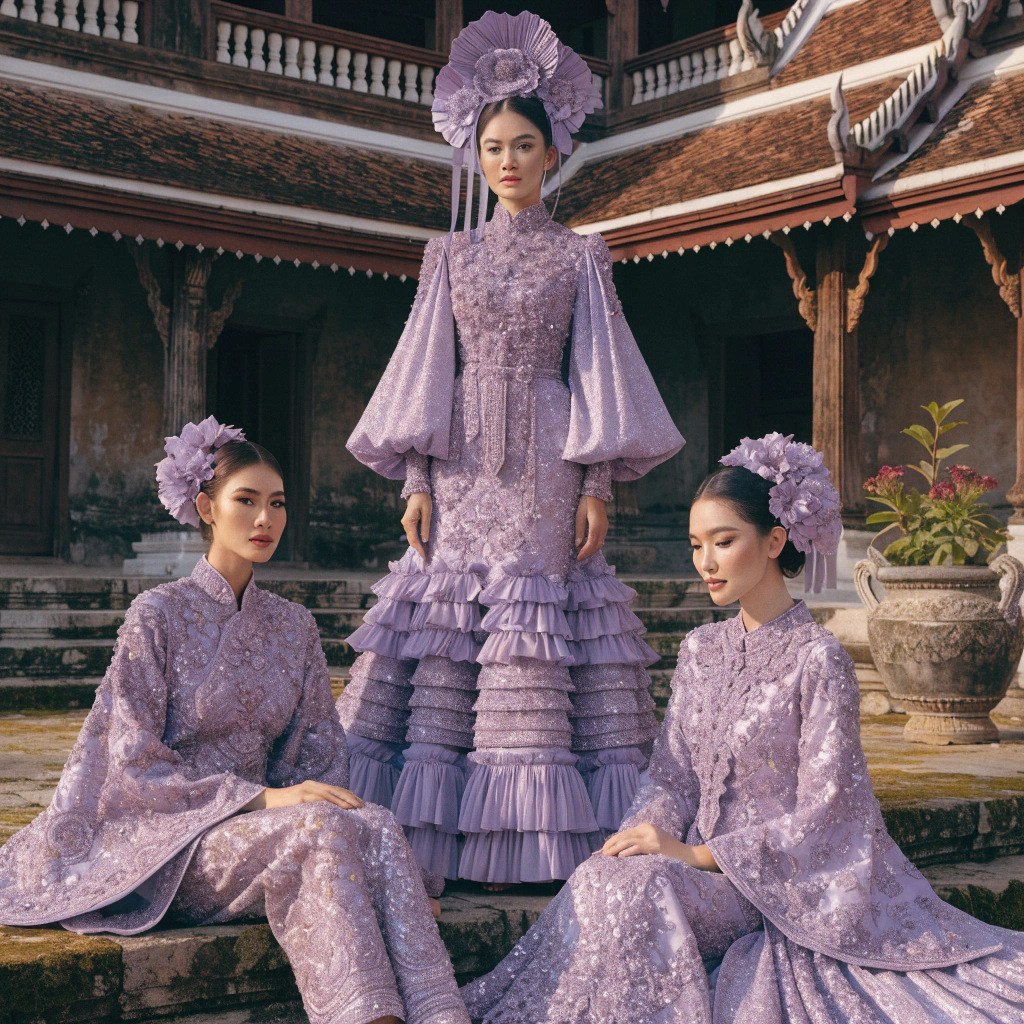
Chut Thai: Beautiful Clothes from Thailand
Chut Thai is the national dress of Thailand. It is very beautiful and elegant. People in Thailand wear these clothes for special days and festivals.
Queen Sirikit loves Thai fashion. She helps to design the national dress. Now, there are many different styles for women and men.
The clothes use silk and many bright colors. Men often wear a special shirt and pants. Women wear a long skirt and a top. Chut Thai is an important part of Thai culture.
Point grammaire
Structure: Present Simple 'be'
"Chut Thai is the national dress of Thailand."
We use 'is' with singular subjects to describe what something is. To form it, use the subject followed by 'is' and then a noun or adjective.
Structure: Present Simple Plural Verbs
"People in Thailand wear these clothes for special days..."
We use the base form of the verb for plural subjects like 'people'. We do not add '-s' to the verb when the subject is more than one person.
Teste ta compréhension
10 questions · A1 Débutant · 1 aperçu gratuit
Teste ce que tu as appris dans cet article. Réponds à toutes les questions pour gagner des XP !
What is Chut Thai?
Tu veux terminer le quiz ?
9 questions supplémentaires t'attendent. Inscris-toi gratuitement pour débloquer le quiz complet et gagner des XP !
S'inscrire gratuitementTu as dj un compte ? Connexion
Bien joué !
Continue à pratiquer !
Déjà terminé — pas de XP supplémentaire
Inscris-toi pour gagner des XPDétail des questions
What is Chut Thai?
Ta réponse:
Bonne réponse: The national dress
People wear Chut Thai for special days and festivals.
Ta réponse:
Bonne réponse: Vrai
What does 'silk' mean?
Ta réponse:
Bonne réponse: A soft and expensive cloth
Chut Thai is the national _____ of Thailand.
Ta réponse:
Bonne réponse: dress
Chut Thai: The Beautiful Clothes of Thailand
Long ago, people in Thailand wore many different styles of clothes. In the 1960s, Queen Sirikit noticed that Thailand did not have a formal national dress for women. She wanted something special for international visits. She worked with designers and historians to create eight official styles. Today, we call these clothes 'Chut Thai.' It simply means 'Thai Outfit.'
Chut Thai is more elegant than casual clothes. Women usually wear a long skirt called a 'pha nung' and a beautiful top. Sometimes they wear a 'sabai.' This is a long piece of silk that goes over one shoulder. Men often wear a 'suea phraratchathan.' This is a formal shirt with a high collar.
Thai people wear Chut Thai for weddings and festivals because it is an important part of their history. These clothes are more colorful and expensive than modern clothes. Thais are very proud of Chut Thai because it shows their beautiful culture to the world. It is a famous symbol of Thai grace.
Point grammaire
Structure: Past Simple
"She worked with designers and historians to create eight official styles."
We use the past simple to talk about finished actions in the past. For regular verbs like 'work', we add '-ed' to the end of the verb.
Structure: Comparatives (Long Adjectives)
"Chut Thai is more elegant than casual clothes."
To compare two things with long adjectives (2+ syllables), we use 'more' + adjective + 'than'. It shows that one thing has more of a quality than the other.
Teste ta compréhension
11 questions · A2 mentaire · 1 aperçu gratuit
Teste ce que tu as appris dans cet article. Réponds à toutes les questions pour gagner des XP !
Who wanted to create a formal national dress for Thailand?
Tu veux terminer le quiz ?
10 questions supplémentaires t'attendent. Inscris-toi gratuitement pour débloquer le quiz complet et gagner des XP !
S'inscrire gratuitementTu as dj un compte ? Connexion
Bien joué !
Continue à pratiquer !
Déjà terminé — pas de XP supplémentaire
Inscris-toi pour gagner des XPDétail des questions
Who wanted to create a formal national dress for Thailand?
Ta réponse:
Bonne réponse: Queen Sirikit
The name 'Chut Thai' means 'Thai Outfit' in English.
Ta réponse:
Bonne réponse: Vrai
What does the word 'symbol' mean?
Ta réponse:
Bonne réponse: A sign that represents an idea
Thai people often wear these clothes for _____ and festivals.
Ta réponse:
Bonne réponse: weddings
What is a 'sabai'?
Ta réponse:
Bonne réponse: A long piece of silk over the shoulder
Chut Thai: The Elegance of National Fashion
Chut Thai, which literally means 'Thai Outfit,' is the beautiful national dress of Thailand. For many years, it has been a symbol of the country’s rich culture and history. Although Thai people have worn traditional clothes for centuries, the formal styles that we recognize today were created in the middle of the 20th century.
In the 1960s, Queen Sirikit realized that Thailand did not have a formal national costume for women to wear during international visits. Because of this, she worked with historians and designers to develop several official styles. These outfits were designed to look elegant while keeping traditional Thai elements. Since then, these clothes have been worn by royalty and citizens alike on special occasions.
The outfits are often made from high-quality Thai silk, which is famous for its bright colors and unique patterns. A popular style for women includes the 'Pha Sin,' a long wrap-around skirt, and a 'Sabai,' which is a piece of fabric that is worn over one shoulder. These garments are often decorated with gold or silver threads.
Today, Chut Thai is still very popular. It is frequently seen at weddings, religious ceremonies, and national festivals. Recently, more young people have started wearing these traditional clothes to celebrate their heritage. Chut Thai has become more than just fashion; it is a way for Thai people to show their identity to the world.
Point grammaire
Structure: Relative Clauses
"Chut Thai, which literally means 'Thai Outfit,' is the beautiful national dress of Thailand."
Relative clauses start with words like 'which' or 'who' to give more information about a noun. In this sentence, 'which literally means...' adds extra information about Chut Thai.
Structure: Passive Voice
"These outfits were designed to look elegant while keeping traditional Thai elements."
The passive voice (be + past participle) is used when the person who did the action is less important than the action itself. Here, the focus is on the outfits being created.
Teste ta compréhension
11 questions · B1 Intermédiaire · 1 aperçu gratuit
Teste ce que tu as appris dans cet article. Réponds à toutes les questions pour gagner des XP !
Who helped develop the modern official Chut Thai styles?
Tu veux terminer le quiz ?
10 questions supplémentaires t'attendent. Inscris-toi gratuitement pour débloquer le quiz complet et gagner des XP !
S'inscrire gratuitementTu as dj un compte ? Connexion
Bien joué !
Continue à pratiquer !
Déjà terminé — pas de XP supplémentaire
Inscris-toi pour gagner des XPDétail des questions
Who helped develop the modern official Chut Thai styles?
Ta réponse:
Bonne réponse: Queen Sirikit and historians
Chut Thai is only worn by members of the royal family today.
Ta réponse:
Bonne réponse: Faux
What does 'heritage' mean?
Ta réponse:
Bonne réponse: Traditions and culture from the past
Chut Thai is frequently seen at _____ and religious ceremonies.
Ta réponse:
Bonne réponse: weddings
What is the 'Sabai' in a Chut Thai outfit?
Ta réponse:
Bonne réponse: A fabric worn over one shoulder
Chut Thai: The Evolution of Thailand's National Identity through Fashion
Chut Thai, which translates literally to "Thai Outfit," represents far more than mere clothing; it is the pinnacle of the nation’s aesthetic elegance and cultural heritage. Although the history of Thai textiles stretches back through the ancient Dvaravati and Ayutthaya periods, the specific styles recognized as the national dress today were largely codified in the mid-20th century. This formalization was driven by a need to project a unified cultural identity on the global stage.
In the 1960s, Queen Sirikit observed that Thailand lacked a formal national costume for women to wear during international state visits. Consequently, she collaborated with historians and designers to develop a series of outfits that would reflect both tradition and modernity. Queen Sirikit's dedication to reviving Thai silk was not merely about fashion; it was a socio-economic project aimed at providing supplementary income for rural weavers. By wearing these garments during her travels abroad, she effectively became the primary ambassador for Thai craftsmanship. This initiative resulted in the creation of eight distinct styles, collectively known as "Chut Thai Phra Ratcha Niyom."
The craftsmanship involved in producing Chut Thai is remarkably sophisticated. Most outfits are constructed from hand-woven Thai silk, often featuring intricate patterns created through the "Mudmee" or "Yok" techniques. The "Yok" technique, for instance, involves raising certain warp threads to create a raised pattern, often using gold or silver threads to add a sense of luxury. The "Sabai," a shawl-like garment that wraps around the chest and drapes over one shoulder, is perhaps the most iconic element. The meticulous attention to detail in the embroidery and the selection of vibrant colors highlight the artistic prowess of Thai weavers.
While these outfits were originally intended for formal diplomatic functions, their influence has permeated various aspects of contemporary Thai society. Today, Chut Thai is frequently worn at weddings, religious ceremonies, and national festivals. Furthermore, there has been a resurgence of interest among the younger generation, who often incorporate traditional elements into modern fashion to express their cultural pride.
Ultimately, Chut Thai serves as a bridge between Thailand's storied past and its dynamic present. By preserving traditional weaving techniques while adapting to modern sensibilities, the nation ensures that its fashion remains a living testament to its unique identity. It is not merely a costume, but a sophisticated expression of Thai values and craftsmanship that continues to captivate the world.
Point grammaire
Structure: Passive Voice
"the specific styles recognized as the national dress today were largely codified in the mid-20th century."
The passive voice is used here to emphasize the action (codifying the styles) rather than the specific people who did it. It is formed using the verb 'to be' plus the past participle.
Structure: Non-defining Relative Clauses
"The 'Sabai,' a shawl-like garment that wraps around the chest and drapes over one shoulder, is perhaps the most iconic element."
This pattern adds extra, non-essential information about a noun. It is separated from the rest of the sentence by commas.
Structure: Present Perfect Simple
"their influence has permeated various aspects of contemporary Thai society."
This tense is used to describe an action that started in the past and has a result or impact that continues into the present. It is formed with 'have/has' and the past participle.
Teste ta compréhension
11 questions · B2 Intermédiaire supérieur · 1 aperçu gratuit
Teste ce que tu as appris dans cet article. Réponds à toutes les questions pour gagner des XP !
What was the primary reason for the formalization of Chut Thai in the 1960s?
Tu veux terminer le quiz ?
10 questions supplémentaires t'attendent. Inscris-toi gratuitement pour débloquer le quiz complet et gagner des XP !
S'inscrire gratuitementTu as dj un compte ? Connexion
Bien joué !
Continue à pratiquer !
Déjà terminé — pas de XP supplémentaire
Inscris-toi pour gagner des XPDétail des questions
What was the primary reason for the formalization of Chut Thai in the 1960s?
Ta réponse:
Bonne réponse: To provide a formal national dress for international visits
Queen Sirikit collaborated with historians to develop the national outfits.
Ta réponse:
Bonne réponse: Vrai
What does 'meticulous' mean?
Ta réponse:
Bonne réponse: Very careful and precise
Today, Chut Thai is frequently worn at _____ and national festivals.
Ta réponse:
Bonne réponse: weddings
What is the 'Sabai' in Thai fashion?
Ta réponse:
Bonne réponse: A shawl-like garment
Sartorial Sovereignty: The Codification and Cultural Resonance of Chut Thai
In the realm of cultural semiotics, few symbols are as evocative of a nation’s soul as its traditional attire. For Thailand, this is embodied in Chut Thai—a term that translates literally to 'Thai outfit' but carries a weight of history, diplomacy, and meticulous craftsmanship far beyond its linguistic simplicity. Seldom has a national costume undergone such a deliberate and sophisticated process of formalization as Chut Thai. While the historical vestiges of Thai attire can be traced through the intricate tapestries of the Dvaravati and Ayutthaya periods, the contemporary paradigm of 'national dress' is a relatively modern construct, born of a necessity to project a unified identity on the international stage.
It was through the visionary leadership of Queen Sirikit in the 1960s that the diverse threads of regional attire were woven into a unified national identity. During her international state visits alongside King Bhumibol Adulyadej, the Queen observed a glaring absence: Thailand lacked a standardized formal costume that could stand as a peer to Western haute couture or other Asian national dresses. This realization prompted a rigorous collaboration with historians and designers to synthesize centuries of sartorial evolution into a coherent system. The result was the establishment of eight distinct styles for women, ranging from the relatively simple Chut Thai Ruean Ton to the regal complexity of Chut Thai Boromphiman.
The systematization of these eight distinct styles allowed for a versatile yet cohesive representation of Thai heritage. Each variant is distinguished by its specific drapery, the inclusion of the 'sabai' (a breast cloth or shawl), and the type of 'pha nung' (skirt) employed. Central to the allure of Chut Thai is the use of Thai silk, a fabric celebrated for its unique luster and structural integrity. The juxtaposition of traditional hand-weaving techniques with contemporary tailoring reflects a broader Thai philosophy: the preservation of ancient wisdom within the framework of modern utility.
Critically, Chut Thai is not a static relic of the past but a dynamic instrument of soft power. In an era of ephemeral fashion trends, the enduring appeal of these garments lies in their ability to command respect and convey a sense of 'Thai-ness' that transcends political or social shifts. The meticulous attention to detail—from the gold-thread embroidery to the specific folding of the pleats—serves as a testament to the nation’s commitment to its aesthetic sovereignty.
Furthermore, the resurgence of Chut Thai in contemporary popular culture, fueled by historical dramas and social media, indicates a profound psychological shift. No longer is the costume reserved solely for the elite or for formal state functions. Instead, it has become a quintessential symbol of pride for the younger generation, who see in its folds a connection to a storied past. This cultural reclamation suggests that while the formalization of Chut Thai was an act of deliberate statecraft, its survival is dependent on its continued resonance with the collective consciousness of the Thai people. Ultimately, Chut Thai represents the pinnacle of Thai aesthetic elegance, a sartorial bridge between the vestiges of history and the aspirations of the future.
Point grammaire
Structure: Inversion after negative or restrictive adverbials
"Seldom has a national costume undergone such a deliberate and sophisticated process of formalization as Chut Thai."
When 'seldom' or other negative adverbs start a sentence, the auxiliary verb moves before the subject for emphasis and formal tone.
Structure: Cleft Sentences
"It was through the visionary leadership of Queen Sirikit in the 1960s that the diverse threads of regional attire were woven into a unified national identity."
This 'It is/was... that' structure is used to focus on a specific piece of information, in this case, the source of the leadership.
Structure: Nominalisation
"The systematization of these eight distinct styles allowed for a versatile yet cohesive representation of Thai heritage."
Using the noun 'systematization' instead of the verb 'systematize' makes the writing more abstract, objective, and formal.
Teste ta compréhension
12 questions · C1 Avancé · 1 aperçu gratuit
Teste ce que tu as appris dans cet article. Réponds à toutes les questions pour gagner des XP !
What was the primary motivation for the formal codification of Chut Thai in the 1960s?
Tu veux terminer le quiz ?
11 questions supplémentaires t'attendent. Inscris-toi gratuitement pour débloquer le quiz complet et gagner des XP !
S'inscrire gratuitementTu as dj un compte ? Connexion
Bien joué !
Continue à pratiquer !
Déjà terminé — pas de XP supplémentaire
Inscris-toi pour gagner des XPDétail des questions
What was the primary motivation for the formal codification of Chut Thai in the 1960s?
Ta réponse:
Bonne réponse: To provide a standardized formal dress for international diplomacy.
Chut Thai is described as a static relic that has remained unchanged for centuries.
Ta réponse:
Bonne réponse: Faux
What does the word 'ephemeral' imply about fashion trends?
Ta réponse:
Bonne réponse: They are short-lived and transient.
The _____ of these eight distinct styles allowed for a versatile yet cohesive representation of Thai heritage.
Ta réponse:
Bonne réponse: systematization
Which material is highlighted as central to the structural integrity and luster of Chut Thai?
Ta réponse:
Bonne réponse: Thai silk
The contemporary resurgence of Chut Thai is partly attributed to historical dramas and social media.
Ta réponse:
Bonne réponse: Vrai
Sartorial Sovereignty: The Ontological Synthesis of Chut Thai
The concept of 'Chut Thai' is frequently misconstrued by the casual observer as an immutable relic of antiquity, yet its contemporary manifestation is a masterclass in the deliberate construction of national identity. Far from being a mere vestigial remnant of the Dvaravati or Ayutthaya epochs, the Chut Thai Phra Ratchaniyom—the royal favor outfits—represents a sophisticated ontological synthesis of historical motifs and modern exigencies. This sartorial paradigm was crystallized in the mid-20th century, primarily through the visionary agency of Queen Sirikit. Observing that Thailand lacked a formal, unified national costume suitable for the rigors of international diplomacy during her 1960 state visits, Her Majesty, in collaboration with esteemed historians and couturiers, embarked upon a project to codify a series of ensembles that would articulate Thai heritage within a globalized context.
Were one to scrutinize the intricate weaving techniques of Thai silk, one would discern the subtle interplay between regional idiosyncrasies and a centralized aesthetic vision. The eight distinct styles of Chut Thai—ranging from the informal Thai Ruean Ton to the regal Thai Boromphiman—serve as a complex semiotic system, conveying status, occasion, and cultural fidelity. This codification did not merely preserve the past; it reinvented it, ensuring that the ephemeral nature of fashion was anchored by the enduring weight of tradition. The use of the pha nung, a wrap-around cloth, and the sabai, a breast cloth or shawl, evokes a bygone elegance, yet the structural integrity and tailoring reflect a contemporary sensibility that demands both functionality and grace. These garments are not static; they are a living discourse between the weaver’s loom and the world stage.
Moreover, the proliferation of Chut Thai in the modern era invites a scholarly analysis of 'invented traditions.' As articulated by the historian Eric Hobsbawm, such traditions often emerge during periods of rapid social transformation to provide a sense of continuity and legitimacy. In the Thai context, Chut Thai serves as a bulwark against the homogenizing forces of Western fashion. It is not merely a costume but a manifestation of sovereignty, a visual declaration that Thailand possesses an aesthetic lineage capable of commanding respect on the world stage. Seldom has a garment been so inextricably linked to the preservation of a nation’s soul, functioning as both a protective shield and a diplomatic bridge.
The craftsmanship involved in producing these garments—often utilizing hand-woven silk and gold thread, known as khit—underscores a commitment to artisanal excellence that transcends mere ornamentation. The tactile quality of the fabric, combined with the symbolic weight of the patterns, creates a sensory experience that reinforces the wearer’s connection to their heritage. It is imperative that this legacy be viewed not through a lens of static nostalgia, but as a dynamic, evolving discourse. Should the global community continue to disregard the nuances of indigenous craftsmanship, the world risks losing the rich tapestry of cultural diversity that Chut Thai so eloquently represents. Ultimately, the elegance of Chut Thai lies in its ability to navigate the tension between the parochial and the universal, standing as a testament to the enduring power of aesthetic sovereignty and the resilience of a nation's visual identity.
Point grammaire
Structure: Subjunctive Mood with 'Were'
"Were one to scrutinize the intricate weaving techniques of Thai silk, one would discern the subtle interplay between regional idiosyncrasies and a centralized aesthetic vision."
This is a formal, hypothetical conditional structure. 'Were' replaces 'If one were to' to emphasize the speculative nature of the statement, common in C2 academic prose.
Structure: Negative Inversion
"Seldom has a garment been so inextricably linked to the preservation of a nation’s soul, functioning as both a protective shield and a diplomatic bridge."
Inversion occurs when a negative or restrictive adverb (like 'seldom') starts the sentence, requiring the auxiliary verb to come before the subject for rhetorical emphasis.
Structure: Conditional with 'Should'
"Should the global community continue to disregard the nuances of indigenous craftsmanship, the world risks losing the rich tapestry of cultural diversity."
This structure is used to express a possible future situation in a formal way, acting as a more sophisticated version of 'If the global community should continue'.
Teste ta compréhension
12 questions · C2 Maîtrise · 1 aperçu gratuit
Teste ce que tu as appris dans cet article. Réponds à toutes les questions pour gagner des XP !
According to the article, what was the primary catalyst for the codification of Chut Thai in the 1960s?
Tu veux terminer le quiz ?
11 questions supplémentaires t'attendent. Inscris-toi gratuitement pour débloquer le quiz complet et gagner des XP !
S'inscrire gratuitementTu as dj un compte ? Connexion
Bien joué !
Continue à pratiquer !
Déjà terminé — pas de XP supplémentaire
Inscris-toi pour gagner des XPDétail des questions
According to the article, what was the primary catalyst for the codification of Chut Thai in the 1960s?
Ta réponse:
Bonne réponse: The need for a formal national costume for international state visits
The article suggests that Chut Thai is an unchanging, ancient costume that has remained identical for centuries.
Ta réponse:
Bonne réponse: Faux
What does the word 'ephemeral' mean in the context of the article?
Ta réponse:
Bonne réponse: Short-lived and fleeting
In the Thai context, Chut Thai serves as a _____ against the homogenizing forces of Western fashion.
Ta réponse:
Bonne réponse: bulwark
Which historian's concept is used to analyze the emergence of Chut Thai?
Ta réponse:
Bonne réponse: Eric Hobsbawm
The 'semiotic system' mentioned refers to how the different styles of Chut Thai convey status and occasion.
Ta réponse:
Bonne réponse: Vrai

