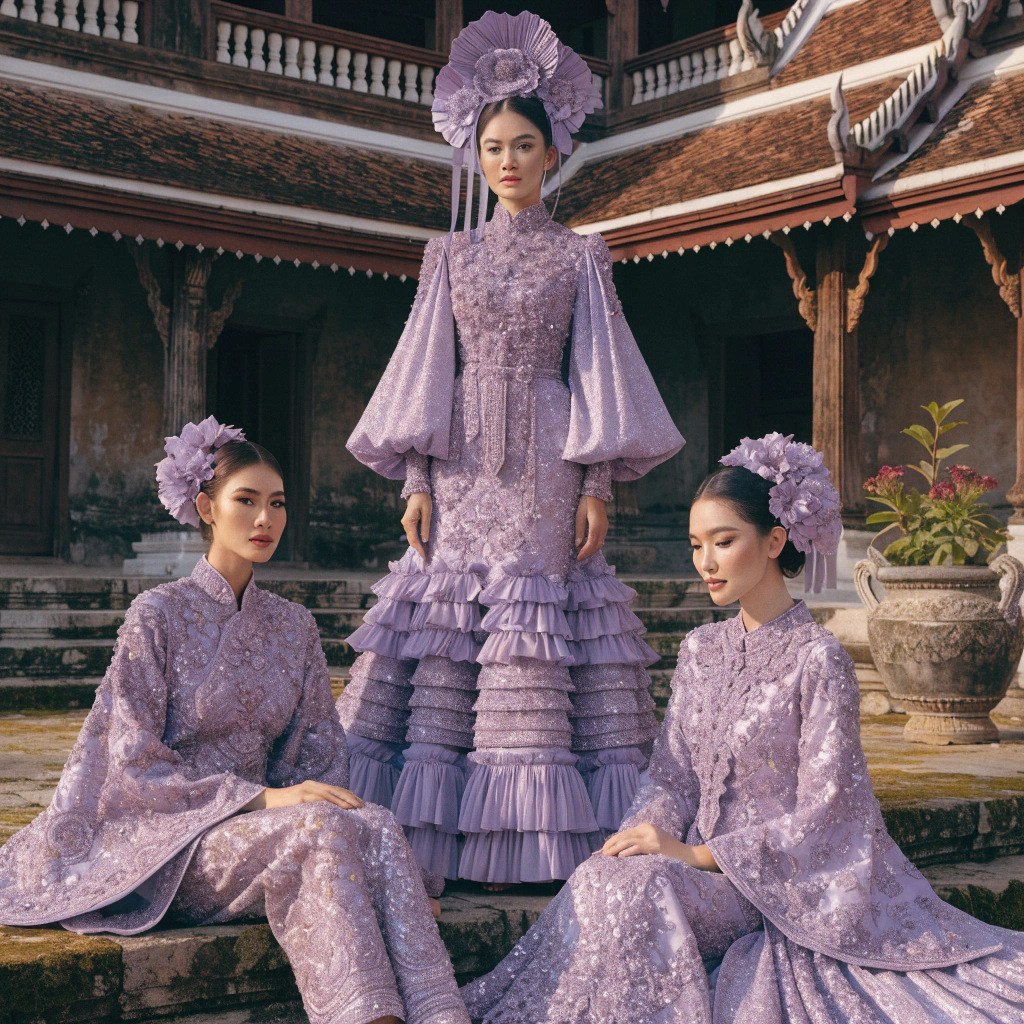
Chut Thai: Beautiful Clothes from Thailand
Chut Thai is the national dress of Thailand. It is very beautiful and elegant. People in Thailand wear these clothes for special days and festivals.
Queen Sirikit loves Thai fashion. She helps to design the national dress. Now, there are many different styles for women and men.
The clothes use silk and many bright colors. Men often wear a special shirt and pants. Women wear a long skirt and a top. Chut Thai is an important part of Thai culture.
Gramática em destaque
Padrão: Present Simple 'be'
"Chut Thai is the national dress of Thailand."
We use 'is' with singular subjects to describe what something is. To form it, use the subject followed by 'is' and then a noun or adjective.
Padrão: Present Simple Plural Verbs
"People in Thailand wear these clothes for special days..."
We use the base form of the verb for plural subjects like 'people'. We do not add '-s' to the verb when the subject is more than one person.
Teste sua compreensão
10 perguntas · A1 Iniciante · 1 pré-visualização grátis
Teste o que aprendeu neste artigo. Responda todas as perguntas para ganhar XP!
What is Chut Thai?
Quer finalizar o quiz?
9 perguntas a mais estão esperando por você. Cadastre-se grátis para desbloquear o quiz completo e ganhar XP!
Cadastrar grátisJá tem conta? Entrar
Detalhamento das perguntas
What is Chut Thai?
Sua resposta:
Resposta correta: The national dress
People wear Chut Thai for special days and festivals.
Sua resposta:
Resposta correta: Verdadeiro
What does 'silk' mean?
Sua resposta:
Resposta correta: A soft and expensive cloth
Chut Thai is the national _____ of Thailand.
Sua resposta:
Resposta correta: dress
Chut Thai: A Elegância da Moda Nacional da Tailândia
O Chut Thai é a vestimenta tradicional da Tailândia. O nome significa "roupa tailandesa". Ele mostra a beleza e a rica cultura do país. Esta roupa é muito elegante e tem uma história longa, que começou há muitos séculos. É um dos símbolos mais importantes da Tailândia.
Por exemplo, a vestimenta tailandesa existia em tempos antigos como Dvaravati e Ayutthaya. Contudo, os estilos específicos que hoje chamamos de "vestido nacional" foram criados e padronizados mais tarde, no meio do século XX.
Nos anos 1960, a Rainha Sirikit da Tailândia fez uma observação importante. Ela percebeu que as mulheres tailandesas não tinham um traje nacional formal para usar durante visitas de estado a outros países. Por causa disso, a Rainha trabalhou com designers e historiadores. Juntos, eles desenvolveram os estilos de Chut Thai que conhecemos atualmente. Essas roupas são bonitas e representam a identidade da Tailândia com muita elegância. Elas são usadas em ocasiões especiais e mostram a cultura tailandesa ao mundo.
Gramática em destaque
Padrão: Pretérito Perfeito Simples (Passado Simples)
"Nos anos 1960, a Rainha Sirikit da Tailândia fez uma observação importante."
Usamos o Pretérito Perfeito Simples para falar de ações que começaram e terminaram no passado. É usado para contar eventos específicos que já aconteceram.
Padrão: Verbo 'ser' para descrever e identificar
"O Chut Thai é a vestimenta tradicional da Tailândia."
O verbo 'ser' é usado para descrever características permanentes, identificar algo ou alguém, ou dizer o que algo é. Ele conecta o sujeito a uma qualidade ou identidade.
Teste sua compreensão
11 perguntas · A2 Elementar · 1 pré-visualização grátis
Teste o que aprendeu neste artigo. Responda todas as perguntas para ganhar XP!
O que significa 'Chut Thai'?
Quer finalizar o quiz?
10 perguntas a mais estão esperando por você. Cadastre-se grátis para desbloquear o quiz completo e ganhar XP!
Cadastrar grátisJá tem conta? Entrar
Detalhamento das perguntas
O que significa 'Chut Thai'?
Sua resposta:
Resposta correta: Roupa Tailandesa
Os estilos modernos de Chut Thai foram criados em tempos muito antigos.
Sua resposta:
Resposta correta: Falso
Qual o significado da palavra 'elegância'?
Sua resposta:
Resposta correta: Qualidade de ser bonito e sofisticado
Nos anos 1960, a Rainha Sirikit observou que as mulheres não tinham um ______ nacional formal.
Sua resposta:
Resposta correta: traje
Quem trabalhou com designers e historiadores para desenvolver os estilos modernos de Chut Thai?
Sua resposta:
Resposta correta: A Rainha Sirikit
A Elegância do Chut Thai: A Moda Nacional da Tailândia
A Tailândia, um país conhecido por sua rica cultura e tradições, possui uma vestimenta nacional que reflete sua história e beleza: o Chut Thai. Este termo significa 'Traje Tailandês' e representa a elegância e a arte da moda local. Embora a história da roupa tailandesa seja muito antiga, com raízes nos períodos Dvaravati e Ayutthaya, os estilos que hoje são reconhecidos como 'traje nacional' foram mais formalizados no século XX.
No passado, as pessoas na Tailândia usavam roupas que mudavam com o tempo e a região. Contudo, foi na década de 1960 que uma iniciativa importante transformou a percepção do traje nacional. A Rainha Sirikit, uma figura muito influente, percebeu que a Tailândia não tinha um traje formal para as mulheres usarem em visitas de estado internacionais. Ela desejava que as mulheres tailandesas pudessem representar seu país com uma vestimenta que mostrasse a identidade cultural da nação.
Para resolver essa questão, a Rainha Sirikit trabalhou com historiadores e designers talentosos. Juntos, eles pesquisaram e adaptaram trajes tradicionais de diferentes períodos históricos, criando vários estilos de Chut Thai. Esses estilos foram pensados para diferentes ocasiões, desde eventos diurnos até cerimônias noturnas de grande gala. O resultado foi uma coleção de vestimentas que combinam história, arte e funcionalidade.
Hoje, o Chut Thai não é apenas usado pela família real ou em eventos diplomáticos. Ele se tornou popular entre os tailandeses para casamentos, festivais e outras celebrações importantes. Cada estilo de Chut Thai tem um nome e características próprias, como o 'Ruean Ton' (mais simples e casual) e o 'Chakkraphat' (muito formal e elaborado). Essa diversidade tem permitido que a moda nacional seja apreciada e mantida viva por novas gerações, que têm orgulho de usar essas belas peças.
Gramática em destaque
Padrão: Voz Passiva com 'ser'
"os estilos que hoje são reconhecidos como 'traje nacional' foram mais formalizados no século XX."
Usamos a voz passiva para dar importância à ação ou ao objeto que recebe a ação, em vez de quem a faz. É formada com o verbo 'ser' (no tempo verbal correto) mais o particípio passado do verbo principal.
Padrão: Cláusulas Relativas com 'que'
"uma vestimenta nacional que reflete sua história e beleza"
As cláusulas relativas com 'que' servem para adicionar informações sobre um substantivo ou pronome sem repetir a palavra. A palavra 'que' substitui o substantivo e conecta as duas partes da frase, tornando-a mais completa.
Teste sua compreensão
11 perguntas · B1 Intermediário · 1 pré-visualização grátis
Teste o que aprendeu neste artigo. Responda todas as perguntas para ganhar XP!
Qual é o principal objetivo do artigo?
Quer finalizar o quiz?
10 perguntas a mais estão esperando por você. Cadastre-se grátis para desbloquear o quiz completo e ganhar XP!
Cadastrar grátisJá tem conta? Entrar
Detalhamento das perguntas
Qual é o principal objetivo do artigo?
Sua resposta:
Resposta correta: Descrever a história e a importância do Chut Thai
A Rainha Sirikit não gostava do Chut Thai e queria que as mulheres tailandesas usassem roupas ocidentais.
Sua resposta:
Resposta correta: Falso
O que significa a palavra 'influente' no contexto do artigo?
Sua resposta:
Resposta correta: Que tem grande poder ou capacidade de mudar coisas
A Rainha Sirikit trabalhou com historiadores e designers para _______ novos estilos de Chut Thai.
Sua resposta:
Resposta correta: criar
Para quais ocasiões o Chut Thai é usado hoje em dia, além de eventos diplomáticos?
Sua resposta:
Resposta correta: Para casamentos, festivais e celebrações importantes
Chut Thai: The Evolution of Thailand's National Identity through Fashion
Chut Thai, which translates literally to "Thai Outfit," represents far more than mere clothing; it is the pinnacle of the nation’s aesthetic elegance and cultural heritage. Although the history of Thai textiles stretches back through the ancient Dvaravati and Ayutthaya periods, the specific styles recognized as the national dress today were largely codified in the mid-20th century. This formalization was driven by a need to project a unified cultural identity on the global stage.
In the 1960s, Queen Sirikit observed that Thailand lacked a formal national costume for women to wear during international state visits. Consequently, she collaborated with historians and designers to develop a series of outfits that would reflect both tradition and modernity. Queen Sirikit's dedication to reviving Thai silk was not merely about fashion; it was a socio-economic project aimed at providing supplementary income for rural weavers. By wearing these garments during her travels abroad, she effectively became the primary ambassador for Thai craftsmanship. This initiative resulted in the creation of eight distinct styles, collectively known as "Chut Thai Phra Ratcha Niyom."
The craftsmanship involved in producing Chut Thai is remarkably sophisticated. Most outfits are constructed from hand-woven Thai silk, often featuring intricate patterns created through the "Mudmee" or "Yok" techniques. The "Yok" technique, for instance, involves raising certain warp threads to create a raised pattern, often using gold or silver threads to add a sense of luxury. The "Sabai," a shawl-like garment that wraps around the chest and drapes over one shoulder, is perhaps the most iconic element. The meticulous attention to detail in the embroidery and the selection of vibrant colors highlight the artistic prowess of Thai weavers.
While these outfits were originally intended for formal diplomatic functions, their influence has permeated various aspects of contemporary Thai society. Today, Chut Thai is frequently worn at weddings, religious ceremonies, and national festivals. Furthermore, there has been a resurgence of interest among the younger generation, who often incorporate traditional elements into modern fashion to express their cultural pride.
Ultimately, Chut Thai serves as a bridge between Thailand's storied past and its dynamic present. By preserving traditional weaving techniques while adapting to modern sensibilities, the nation ensures that its fashion remains a living testament to its unique identity. It is not merely a costume, but a sophisticated expression of Thai values and craftsmanship that continues to captivate the world.
Gramática em destaque
Padrão: Passive Voice
"the specific styles recognized as the national dress today were largely codified in the mid-20th century."
The passive voice is used here to emphasize the action (codifying the styles) rather than the specific people who did it. It is formed using the verb 'to be' plus the past participle.
Padrão: Non-defining Relative Clauses
"The 'Sabai,' a shawl-like garment that wraps around the chest and drapes over one shoulder, is perhaps the most iconic element."
This pattern adds extra, non-essential information about a noun. It is separated from the rest of the sentence by commas.
Padrão: Present Perfect Simple
"their influence has permeated various aspects of contemporary Thai society."
This tense is used to describe an action that started in the past and has a result or impact that continues into the present. It is formed with 'have/has' and the past participle.
Teste sua compreensão
11 perguntas · B2 Intermediário superior · 1 pré-visualização grátis
Teste o que aprendeu neste artigo. Responda todas as perguntas para ganhar XP!
What was the primary reason for the formalization of Chut Thai in the 1960s?
Quer finalizar o quiz?
10 perguntas a mais estão esperando por você. Cadastre-se grátis para desbloquear o quiz completo e ganhar XP!
Cadastrar grátisJá tem conta? Entrar
Detalhamento das perguntas
What was the primary reason for the formalization of Chut Thai in the 1960s?
Sua resposta:
Resposta correta: To provide a formal national dress for international visits
Queen Sirikit collaborated with historians to develop the national outfits.
Sua resposta:
Resposta correta: Verdadeiro
What does 'meticulous' mean?
Sua resposta:
Resposta correta: Very careful and precise
Today, Chut Thai is frequently worn at _____ and national festivals.
Sua resposta:
Resposta correta: weddings
What is the 'Sabai' in Thai fashion?
Sua resposta:
Resposta correta: A shawl-like garment
Sartorial Sovereignty: The Codification and Cultural Resonance of Chut Thai
In the realm of cultural semiotics, few symbols are as evocative of a nation’s soul as its traditional attire. For Thailand, this is embodied in Chut Thai—a term that translates literally to 'Thai outfit' but carries a weight of history, diplomacy, and meticulous craftsmanship far beyond its linguistic simplicity. Seldom has a national costume undergone such a deliberate and sophisticated process of formalization as Chut Thai. While the historical vestiges of Thai attire can be traced through the intricate tapestries of the Dvaravati and Ayutthaya periods, the contemporary paradigm of 'national dress' is a relatively modern construct, born of a necessity to project a unified identity on the international stage.
It was through the visionary leadership of Queen Sirikit in the 1960s that the diverse threads of regional attire were woven into a unified national identity. During her international state visits alongside King Bhumibol Adulyadej, the Queen observed a glaring absence: Thailand lacked a standardized formal costume that could stand as a peer to Western haute couture or other Asian national dresses. This realization prompted a rigorous collaboration with historians and designers to synthesize centuries of sartorial evolution into a coherent system. The result was the establishment of eight distinct styles for women, ranging from the relatively simple Chut Thai Ruean Ton to the regal complexity of Chut Thai Boromphiman.
The systematization of these eight distinct styles allowed for a versatile yet cohesive representation of Thai heritage. Each variant is distinguished by its specific drapery, the inclusion of the 'sabai' (a breast cloth or shawl), and the type of 'pha nung' (skirt) employed. Central to the allure of Chut Thai is the use of Thai silk, a fabric celebrated for its unique luster and structural integrity. The juxtaposition of traditional hand-weaving techniques with contemporary tailoring reflects a broader Thai philosophy: the preservation of ancient wisdom within the framework of modern utility.
Critically, Chut Thai is not a static relic of the past but a dynamic instrument of soft power. In an era of ephemeral fashion trends, the enduring appeal of these garments lies in their ability to command respect and convey a sense of 'Thai-ness' that transcends political or social shifts. The meticulous attention to detail—from the gold-thread embroidery to the specific folding of the pleats—serves as a testament to the nation’s commitment to its aesthetic sovereignty.
Furthermore, the resurgence of Chut Thai in contemporary popular culture, fueled by historical dramas and social media, indicates a profound psychological shift. No longer is the costume reserved solely for the elite or for formal state functions. Instead, it has become a quintessential symbol of pride for the younger generation, who see in its folds a connection to a storied past. This cultural reclamation suggests that while the formalization of Chut Thai was an act of deliberate statecraft, its survival is dependent on its continued resonance with the collective consciousness of the Thai people. Ultimately, Chut Thai represents the pinnacle of Thai aesthetic elegance, a sartorial bridge between the vestiges of history and the aspirations of the future.
Gramática em destaque
Padrão: Inversion after negative or restrictive adverbials
"Seldom has a national costume undergone such a deliberate and sophisticated process of formalization as Chut Thai."
When 'seldom' or other negative adverbs start a sentence, the auxiliary verb moves before the subject for emphasis and formal tone.
Padrão: Cleft Sentences
"It was through the visionary leadership of Queen Sirikit in the 1960s that the diverse threads of regional attire were woven into a unified national identity."
This 'It is/was... that' structure is used to focus on a specific piece of information, in this case, the source of the leadership.
Padrão: Nominalisation
"The systematization of these eight distinct styles allowed for a versatile yet cohesive representation of Thai heritage."
Using the noun 'systematization' instead of the verb 'systematize' makes the writing more abstract, objective, and formal.
Teste sua compreensão
12 perguntas · C1 Avançado · 1 pré-visualização grátis
Teste o que aprendeu neste artigo. Responda todas as perguntas para ganhar XP!
What was the primary motivation for the formal codification of Chut Thai in the 1960s?
Quer finalizar o quiz?
11 perguntas a mais estão esperando por você. Cadastre-se grátis para desbloquear o quiz completo e ganhar XP!
Cadastrar grátisJá tem conta? Entrar
Detalhamento das perguntas
What was the primary motivation for the formal codification of Chut Thai in the 1960s?
Sua resposta:
Resposta correta: To provide a standardized formal dress for international diplomacy.
Chut Thai is described as a static relic that has remained unchanged for centuries.
Sua resposta:
Resposta correta: Falso
What does the word 'ephemeral' imply about fashion trends?
Sua resposta:
Resposta correta: They are short-lived and transient.
The _____ of these eight distinct styles allowed for a versatile yet cohesive representation of Thai heritage.
Sua resposta:
Resposta correta: systematization
Which material is highlighted as central to the structural integrity and luster of Chut Thai?
Sua resposta:
Resposta correta: Thai silk
The contemporary resurgence of Chut Thai is partly attributed to historical dramas and social media.
Sua resposta:
Resposta correta: Verdadeiro
Sartorial Sovereignty: The Ontological Synthesis of Chut Thai
The concept of 'Chut Thai' is frequently misconstrued by the casual observer as an immutable relic of antiquity, yet its contemporary manifestation is a masterclass in the deliberate construction of national identity. Far from being a mere vestigial remnant of the Dvaravati or Ayutthaya epochs, the Chut Thai Phra Ratchaniyom—the royal favor outfits—represents a sophisticated ontological synthesis of historical motifs and modern exigencies. This sartorial paradigm was crystallized in the mid-20th century, primarily through the visionary agency of Queen Sirikit. Observing that Thailand lacked a formal, unified national costume suitable for the rigors of international diplomacy during her 1960 state visits, Her Majesty, in collaboration with esteemed historians and couturiers, embarked upon a project to codify a series of ensembles that would articulate Thai heritage within a globalized context.
Were one to scrutinize the intricate weaving techniques of Thai silk, one would discern the subtle interplay between regional idiosyncrasies and a centralized aesthetic vision. The eight distinct styles of Chut Thai—ranging from the informal Thai Ruean Ton to the regal Thai Boromphiman—serve as a complex semiotic system, conveying status, occasion, and cultural fidelity. This codification did not merely preserve the past; it reinvented it, ensuring that the ephemeral nature of fashion was anchored by the enduring weight of tradition. The use of the pha nung, a wrap-around cloth, and the sabai, a breast cloth or shawl, evokes a bygone elegance, yet the structural integrity and tailoring reflect a contemporary sensibility that demands both functionality and grace. These garments are not static; they are a living discourse between the weaver’s loom and the world stage.
Moreover, the proliferation of Chut Thai in the modern era invites a scholarly analysis of 'invented traditions.' As articulated by the historian Eric Hobsbawm, such traditions often emerge during periods of rapid social transformation to provide a sense of continuity and legitimacy. In the Thai context, Chut Thai serves as a bulwark against the homogenizing forces of Western fashion. It is not merely a costume but a manifestation of sovereignty, a visual declaration that Thailand possesses an aesthetic lineage capable of commanding respect on the world stage. Seldom has a garment been so inextricably linked to the preservation of a nation’s soul, functioning as both a protective shield and a diplomatic bridge.
The craftsmanship involved in producing these garments—often utilizing hand-woven silk and gold thread, known as khit—underscores a commitment to artisanal excellence that transcends mere ornamentation. The tactile quality of the fabric, combined with the symbolic weight of the patterns, creates a sensory experience that reinforces the wearer’s connection to their heritage. It is imperative that this legacy be viewed not through a lens of static nostalgia, but as a dynamic, evolving discourse. Should the global community continue to disregard the nuances of indigenous craftsmanship, the world risks losing the rich tapestry of cultural diversity that Chut Thai so eloquently represents. Ultimately, the elegance of Chut Thai lies in its ability to navigate the tension between the parochial and the universal, standing as a testament to the enduring power of aesthetic sovereignty and the resilience of a nation's visual identity.
Gramática em destaque
Padrão: Subjunctive Mood with 'Were'
"Were one to scrutinize the intricate weaving techniques of Thai silk, one would discern the subtle interplay between regional idiosyncrasies and a centralized aesthetic vision."
This is a formal, hypothetical conditional structure. 'Were' replaces 'If one were to' to emphasize the speculative nature of the statement, common in C2 academic prose.
Padrão: Negative Inversion
"Seldom has a garment been so inextricably linked to the preservation of a nation’s soul, functioning as both a protective shield and a diplomatic bridge."
Inversion occurs when a negative or restrictive adverb (like 'seldom') starts the sentence, requiring the auxiliary verb to come before the subject for rhetorical emphasis.
Padrão: Conditional with 'Should'
"Should the global community continue to disregard the nuances of indigenous craftsmanship, the world risks losing the rich tapestry of cultural diversity."
This structure is used to express a possible future situation in a formal way, acting as a more sophisticated version of 'If the global community should continue'.
Teste sua compreensão
12 perguntas · C2 Domínio · 1 pré-visualização grátis
Teste o que aprendeu neste artigo. Responda todas as perguntas para ganhar XP!
According to the article, what was the primary catalyst for the codification of Chut Thai in the 1960s?
Quer finalizar o quiz?
11 perguntas a mais estão esperando por você. Cadastre-se grátis para desbloquear o quiz completo e ganhar XP!
Cadastrar grátisJá tem conta? Entrar
Detalhamento das perguntas
According to the article, what was the primary catalyst for the codification of Chut Thai in the 1960s?
Sua resposta:
Resposta correta: The need for a formal national costume for international state visits
The article suggests that Chut Thai is an unchanging, ancient costume that has remained identical for centuries.
Sua resposta:
Resposta correta: Falso
What does the word 'ephemeral' mean in the context of the article?
Sua resposta:
Resposta correta: Short-lived and fleeting
In the Thai context, Chut Thai serves as a _____ against the homogenizing forces of Western fashion.
Sua resposta:
Resposta correta: bulwark
Which historian's concept is used to analyze the emergence of Chut Thai?
Sua resposta:
Resposta correta: Eric Hobsbawm
The 'semiotic system' mentioned refers to how the different styles of Chut Thai convey status and occasion.
Sua resposta:
Resposta correta: Verdadeiro

