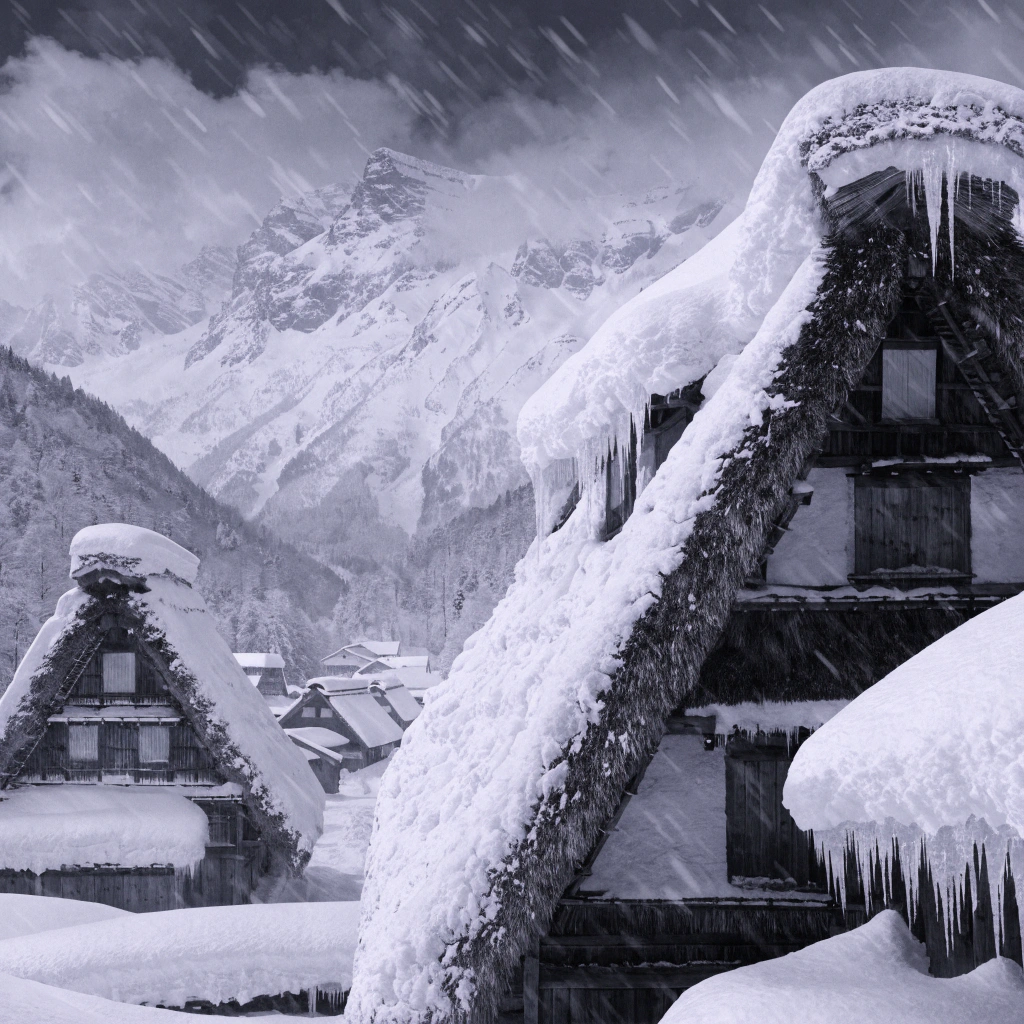
A Beautiful Village in Japan
Shirakawa-go is a very small village in Japan. It is high in the mountains. This place is famous because it is very old. Many people visit it every year. The houses in the village are very special. They have big, tall roofs made of grass. These roofs look like hands in prayer. They are strong for the heavy snow in winter. Some houses are more than 250 years old. You can walk inside the farmhouses. The village is quiet and peaceful. It is a beautiful place to see.
文法スポットライト
パターン: Present Simple of 'To Be'
"Shirakawa-go is a very small village in Japan."
We use 'is' for singular subjects to describe facts or states. It connects the subject to a description.
パターン: Adjectives Before Nouns
"It is a beautiful place to see."
In English, we put the describing word (adjective) before the thing (noun). For example, 'beautiful' comes before 'place'.
理解度をチェック
10 問 · A1 初級 · 無料プレビュー 1回
この記事で学んだことをテストしよう。全問正解してXPを獲得!
Where is the village of Shirakawa-go?
問題の内訳
Where is the village of Shirakawa-go?
あなたの回答:
正解: In Japan
The houses in the village are new.
あなたの回答:
正解: 間違い
What does 'peaceful' mean?
あなたの回答:
正解: Quiet and calm
The village is high in the _____.
あなたの回答:
正解: mountains
The Beautiful Village of Shirakawa-go
Shirakawa-go is a very old and beautiful village in Japan. It is located in the mountains of Gifu. Many people visit this place because it looks like a storybook. In the past, the village was very quiet because the mountains were difficult to cross.
The village is famous for its special houses. They are called 'gassho-zukuri' houses. These houses have very steep roofs made of straw. The roofs look like hands in prayer. This shape is very important because it snows a lot in winter. The snow is heavier than in other parts of Japan, but it slides off the steep roofs easily.
Some of these houses are more than 250 years old. People still live in them today, and they take care of the village together. In 1995, Shirakawa-go became a UNESCO World Heritage site. Now, it is more popular than before. Visitors love to see the village in winter when everything is white and quiet. It is a peaceful place to learn about Japanese history.
文法スポットライト
パターン: Comparative Adjectives
"The snow is heavier than in other parts of Japan."
We use comparative adjectives to compare two things. For short words, we add '-er' and 'than'. For long words, we use 'more' before the adjective.
パターン: Past Simple
"In 1995, Shirakawa-go became a UNESCO World Heritage site."
The past simple is used for actions that finished in the past. 'Became' is the past form of the irregular verb 'become'.
理解度をチェック
11 問 · A2 初級 · 無料プレビュー 1回
この記事で学んだことをテストしよう。全問正解してXPを獲得!
Where is the village of Shirakawa-go located?
問題の内訳
Where is the village of Shirakawa-go located?
あなたの回答:
正解: In the mountains of Gifu
The roofs of the houses are flat.
あなたの回答:
正解: 間違い
What does 'famous' mean?
あなたの回答:
正解: Known by many people
The roofs of the houses look like _____ in prayer.
あなたの回答:
正解: hands
Why are the roofs very steep?
あなたの回答:
正解: Because of the heavy snow in winter
Shirakawa-go: The Village of Prayer Hands
Deep in the mountains of Gifu Prefecture, you can find a village that looks like a scene from a fairy tale. This place is called Shirakawa-go, and it has been a UNESCO World Heritage site since 1995. It is famous for its traditional farmhouses, which are called 'gassho-zukuri'.
The name 'gassho-zukuri' means 'constructed like hands in prayer'. This refers to the steep, triangular roofs that are designed to withstand the heavy snow in this region. During the winter, the village is covered in deep, white snow, and the houses must be very strong. These roofs are made from straw, and they are built without using any nails. Instead, the villagers use ropes to hold the wooden beams together.
For hundreds of years, the people of Shirakawa-go have lived in harmony with nature. Because the village was isolated for a long time, the locals developed a unique culture. They have maintained these beautiful buildings through a tradition called 'yui'. This is a system where the whole community works together to replace the thatched roofs. It is a difficult job that requires many people to help.
Today, some of these farmhouses have been turned into museums or guest houses. Visitors who stay overnight can experience the traditional way of life. They can sit by the open fire and eat local food that has been prepared by the hosts. Shirakawa-go is a place where history has been preserved perfectly, offering a peaceful escape from the busy modern world.
文法スポットライト
パターン: Passive Voice
"This place is called Shirakawa-go, and it has been a UNESCO World Heritage site since 1995."
The passive voice is used here because the focus is on the village itself, not on who named it or who designated it. It is formed using the verb 'to be' and the past participle.
パターン: Relative Clauses
"It is famous for its traditional farmhouses, which are called 'gassho-zukuri'."
The relative pronoun 'which' introduces extra information about the farmhouses. This helps connect ideas into longer, more complex sentences typical of B1 English.
理解度をチェック
11 問 · B1 中級 · 無料プレビュー 1回
この記事で学んだことをテストしよう。全問正解してXPを獲得!
Why are the roofs in Shirakawa-go built with a steep, triangular shape?
問題の内訳
Why are the roofs in Shirakawa-go built with a steep, triangular shape?
あなたの回答:
正解: To withstand the heavy snow in the region
The villagers use metal nails to hold the wooden beams of the houses together.
あなたの回答:
正解: 間違い
What does 'isolated' mean in the context of the article?
あなたの回答:
正解: Far away from other places and people
Shirakawa-go has been a UNESCO World Heritage _____ since 1995.
あなたの回答:
正解: site
What is 'yui'?
あなたの回答:
正解: A system where the community works together
The Architectural Resilience of Shirakawa-go: A Living Testament to Tradition
Tucked away in the mountainous Shogawa River valley of Gifu Prefecture, Shirakawa-go represents a remarkable fusion of human ingenuity and natural adaptation. This remote village, which was once largely inaccessible during the winter months, is world-renowned for its unique 'gassho-zukuri' farmhouses. These structures, some of which have stood for over two centuries, serve as a poignant reminder of a traditional lifestyle that has mostly vanished from modern Japan. Despite the challenges of the 21st century, the village remains a UNESCO World Heritage site, preserved as a symbol of cultural endurance.
The defining feature of these dwellings is their steep, thatched roofs, which are said to resemble hands pressed together in prayer. This design is not merely aesthetic; rather, it is a practical necessity born out of the region’s harsh climate. Given that the area experiences some of the heaviest snowfall in the world, the roofs must be constructed at a sharp angle to prevent the weight of the snow from crushing the buildings. Furthermore, the roofs are built without the use of nails, instead utilizing intricate wooden joints and ropes that allow the building to sway slightly during earthquakes, adding to its structural resilience.
Historically, the internal layout of these massive farmhouses was dictated by the local economy. The upper floors were primarily utilized for the cultivation of silkworms. This industry flourished because the heat rising from the ground floor—where families lived and maintained a constant fire in an open hearth—provided the ideal temperature for the larvae. Consequently, the architecture reflects a sophisticated understanding of thermodynamics and resource management. The community spirit, known as 'Yui', remains essential to this day, as the entire village collaborates to re-thatch a single roof, a labor-intensive process that requires dozens of workers.
While Shirakawa-go has transitioned from an isolated agricultural community into a global tourist destination, it faces the ongoing challenge of balancing commercial success with authentic preservation. The influx of tourists has undoubtedly boosted the local economy; however, it has also placed a strain on the delicate infrastructure. Efforts are being made to ensure that the village remains a living community rather than a mere open-air museum. By maintaining these ancient traditions, the residents of Shirakawa-go continue to honor their ancestors while successfully adapting to the demands of the modern era.
文法スポットライト
パターン: Participle Phrases for Providing Context
"Tucked away in the mountainous Shogawa River valley, Shirakawa-go represents a remarkable fusion..."
The past participle 'Tucked' begins a phrase that describes the subject 'Shirakawa-go'. This is a concise way to provide background information or setting at the start of a sentence.
パターン: Relative Clauses with 'of which'
"These structures, some of which have stood for over two centuries, serve as a poignant reminder..."
This formal structure uses a quantifier (some) followed by 'of which' to provide additional information about a preceding noun (structures). It is common in academic or formal descriptive writing.
パターン: Present Continuous Passive
"Efforts are being made to ensure that the village remains a living community..."
The structure 'are being made' focuses on the ongoing action rather than the person performing it. It is used to describe current trends, projects, or institutional actions.
理解度をチェック
11 問 · B2 中上級 · 無料プレビュー 1回
この記事で学んだことをテストしよう。全問正解してXPを獲得!
What is the primary practical reason for the steep angle of the 'gassho-zukuri' roofs?
問題の内訳
What is the primary practical reason for the steep angle of the 'gassho-zukuri' roofs?
あなたの回答:
正解: To prevent heavy snow from damaging the structure
The farmhouses are constructed using metal nails to withstand earthquakes.
あなたの回答:
正解: 間違い
Which word describes the ability of the buildings to withstand pressure or return to their original state?
あなたの回答:
正解: Resilience
The village is protected as a _____ World Heritage site.
あなたの回答:
正解: UNESCO
What does the term 'Yui' refer to in the context of the article?
あなたの回答:
正解: The communal spirit of helping each other
The Architectural Resilience of Shirakawa-go: A Synthesis of Tradition and Modernity
Nestled within the rugged topography of the Shogawa River valley in Gifu Prefecture, Shirakawa-go stands as a profound testament to human adaptability and cultural resilience. This UNESCO World Heritage site is not merely a picturesque relic of Japan’s pre-modern past; rather, it is a living embodiment of the 'gassho-zukuri' architectural style. Seldom has a community demonstrated such profound synergy between architectural design and environmental necessity. These farmhouses, characterized by their steep, thatched roofs, were engineered to withstand the region’s exceptionally heavy snowfall, which is among the most substantial in the world. The term 'gassho-zukuri' literally translates to 'constructed like hands in prayer,' a poignant metaphor for the structural form that prevents the accumulation of snow from crushing these wooden edifices.
The ingenuity of these structures extends beyond their aesthetic appeal. The vast attic spaces within these homes were historically utilized for sericulture—the rearing of silkworms—which provided a vital source of sustenance for the villagers during the long, isolated winters. This multifaceted use of space reflects a sophisticated understanding of resource management. Furthermore, the maintenance of these massive roofs requires a level of social cohesion that is increasingly rare in the contemporary world. It is the communal spirit, known as 'Yui,' that ensures the longevity of these thatched structures. Every few decades, the entire village converges to re-thatch a single roof, a labor-intensive process that underscores the interdependence of the inhabitants. Without this collective effort, the preservation of the village’s physical heritage would be an insurmountable challenge.
However, the transition of Shirakawa-go from a secluded agrarian community to a global tourist destination has not been without its complications. The commercialization of the village presents a stark dichotomy between economic viability and the erosion of cultural authenticity. While the influx of tourism has provided the financial capital necessary for the upkeep of the farmhouses, it has simultaneously transformed a private living space into a public spectacle. The precarious balance between welcoming visitors and maintaining the sanctity of the residents' daily lives is a central theme in the modern discourse surrounding the site. Some critics argue that the 'museumification' of the village risks stripping it of its ephemeral, lived-in quality, reducing a vibrant culture to a curated exhibit.
What remains clear is that the future of Shirakawa-go depends on a nuanced approach to heritage management. The integration of modern amenities within these ancient frames must be handled with extreme delicacy. The preservation of the village is not merely about maintaining the physical integrity of the wood and straw; it is about sustaining the intangible cultural heritage that gave rise to these forms. As globalization continues to homogenize architectural styles across the globe, the idiosyncratic beauty of Shirakawa-go serves as a reminder of the importance of localized knowledge. Ultimately, the village stands as a monument to a time when human habitation was dictated not by the mastery of nature, but by a harmonious, albeit arduous, dialogue with it.
文法スポットライト
パターン: Inversion after negative or restrictive adverbs
"Seldom has a community demonstrated such profound synergy between architectural design and environmental necessity."
Inversion is used for emphasis by placing the auxiliary verb before the subject. This structure is common in formal C1 writing to highlight rarity or importance.
パターン: Cleft Sentences for Focus
"It is the communal spirit, known as 'Yui,' that ensures the longevity of these thatched structures."
Cleft sentences use 'It is/was... that...' to focus on a specific piece of information. Here, it emphasizes that the 'Yui' spirit, rather than any other factor, is responsible for the preservation.
パターン: Nominalisation
"The commercialization of the village presents a stark dichotomy between economic viability and the erosion of cultural authenticity."
Nominalisation involves turning verbs or adjectives into nouns (e.g., 'commercialization', 'viability', 'erosion'). This creates a more academic, abstract, and sophisticated tone suitable for C1 analysis.
理解度をチェック
12 問 · C1 上級 · 無料プレビュー 1回
この記事で学んだことをテストしよう。全問正解してXPを獲得!
What is the primary architectural purpose of the steep roofs in Shirakawa-go?
問題の内訳
What is the primary architectural purpose of the steep roofs in Shirakawa-go?
あなたの回答:
正解: To withstand the immense weight of heavy snowfall
The 'Yui' system refers to the financial capital provided by tourists to maintain the village.
あなたの回答:
正解: 間違い
What does 'precarious' mean in the context of the article?
あなたの回答:
正解: Dangerously unstable or uncertain
The rearing of silkworms, or _____, was a vital source of income for the villagers.
あなたの回答:
正解: sericulture
What does the author suggest is a risk of 'museumification'?
あなたの回答:
正解: The living, vibrant culture will be lost to a static exhibit.
The article argues that the future of the village depends on balancing modern needs with ancient preservation.
あなたの回答:
正解: 正しい
白川郷:峻厳な自然と共生する「生きる遺産」の深淵
岐阜県、飛騨山脈の懐深く抱かれた庄川流域に、時が止まったかのような趣を湛える集落がある。世界遺産にも登録された白川郷、その中でも特に目を引くのが、250年以上の歴史を刻むものも少なくない「合掌造り」の家々である。この特異な建築様式は、日本の伝統的な木造建築の粋を集めたものとして、国内外から高い評価を受けている。
「合掌造り」という名称は、その急勾配な茅葺き屋根が、まるで手を合わせて祈るかのような形状をしていることに由来する。この特徴的な屋根は、単なる意匠的な美しさに留まらない。冬期には2メートルを超える積雪に見舞われるこの地域の峻厳な気候風土に適応すべく、自然の摂理と先人の知恵が結晶化した結果と看做されよう。雪が滑り落ちやすいよう角度がつけられ、また、屋根裏空間は、かつてこの地の基幹産業であった養蚕のために有効活用された。釘を一切使わず、縄と木組みだけで頑強な構造を実現している点も、その技術的卓越性を物語っている。
合掌造りの維持には、個々の家屋の努力だけでは到底賄いきれない労力が必要とされる。特に茅葺き屋根の葺き替えは、膨大な時間と人手を要する大掛かりな作業であり、かつては「結(ゆい)」と呼ばれる集落全体での共同作業によって支えられてきた。この「結」の精神こそ、白川郷が単なる歴史的建造物の群れに留まらず、「生きる遺産」として現代に息づく所以であろう。住民同士が互いに助け合い、共同体の維持に努めるという、ある種の社会契約が、この地の文化を継承する上で不可欠な要素であったことは言うに及ばない。
しかしながら、隔絶された山村という地理的条件が、かえってこの独特な文化と景観の保存に寄与してきた側面も否定できない。近代化の波が押し寄せる中で、交通網の整備や産業構造の変化が、多くの伝統集落に変容を迫った一方で、白川郷はその隔絶性ゆえに、旧来の生活様式を色濃く残すことができた。それはあたかも、外部からの影響を遮断することで、固有の生態系を守り抜いた孤島のようである。
現代において、白川郷は年間を通じて多くの観光客が訪れる国際的な観光地となった。観光客誘致による経済的恩恵は計り知れないものの、一方で、過度な商業化やインフラ整備が、集落本来の静謐な雰囲気を損なうのではないかという懸念もまた、常に指摘されてきた。世界遺産としての登録が、その保存に法的・経済的な後ろ盾を与えたことは紛れもない事実であるが、同時に、その「商品化」という側面が、伝統的な共同体の営みにどのような影響を及ぼすかという問いは、我々に持続可能性という普遍的な課題を突きつけている。
白川郷の事例は、単に古民家を保存するという行為に止まらない、より深遠な意味合いを帯びている。それは、自然の猛威と向き合いながらも、それを巧みに利用し、持続可能な生活を築き上げてきた人間の叡智と、共同体としての連帯が織りなす文化の結晶である。グローバル化が進展し、画一的な価値観が蔓延しがちな現代社会において、白川郷が提示する「共生」と「継承」のメッセージは、我々が未来を構想する上で、改めて立ち返るべき原点を示唆していると言えよう。この地を訪れる人々は、単に美しい景観を享受するだけでなく、その背景にある深い歴史と、人々が培ってきた精神性に触れることで、現代社会における自身のあり方を再考する契機を得るのではないだろうか。
文法スポットライト
パターン: 〜と看做されよう
"この特徴的な屋根は、単なる意匠的な美しさに留まらない。冬期には2メートルを超える積雪に見舞われるこの地域の峻厳な気候風土に適応すべく、自然の摂理と先人の知恵が結晶化した結果と看做されよう。"
動詞の未然形に「〜よう」を付けて推量を表す古典的な表現です。「〜と看做されるだろう」よりも、書き言葉としてより格式高く、客観的な推量を述べる際に用いられます。論説文などで筆者の見解を控えめに提示する際に有効です。
パターン: 〜は言うに及ばない
"住民同士が互いに助け合い、共同体の維持に努めるという、ある種の社会契約が、この地の文化を継承する上で不可欠な要素であったことは言うに及ばない。"
「〜を言うまでもない」と同様に、ある事柄が自明である、あるいは重要すぎて改めて述べる必要がない、というニュアンスを強調する表現です。主に書き言葉で用いられ、読者に強い同意を促す効果があります。
パターン: 〜という問いは、我々に〜という普遍的な課題を突きつけている
"その「商品化」という側面が、伝統的な共同体の営みにどのような影響を及ぼすかという問いは、我々に持続可能性という普遍的な課題を突きつけている。"
ある問題提起が、読者や社会に対して具体的な課題や問いを突きつける状況を表現する際に使われます。「〜が課題を提起する」よりも、より切迫感や重要性を強調し、読者への直接的な訴えかけが強い表現です。
理解度をチェック
12 問 · C2 マスター · 無料プレビュー 1回
この記事で学んだことをテストしよう。全問正解してXPを獲得!
白川郷の合掌造り家屋の屋根が急勾配である主な理由は何ですか?
問題の内訳
白川郷の合掌造り家屋の屋根が急勾配である主な理由は何ですか?
あなたの回答:
正解: 雪が滑り落ちやすくするため
合掌造りの茅葺き屋根の葺き替えは、個々の家屋の努力だけで行われます。
あなたの回答:
正解: 間違い
「峻厳」の最も適切な意味は何ですか?
あなたの回答:
正解: 厳しく、容易ではない様子
白川郷の合掌造りは、釘を一切使わず、縄と_____だけで頑強な構造を実現している。
あなたの回答:
正解: 木組み
記事によると、白川郷が近代化の波の中で旧来の生活様式を色濃く残せた主な要因は何ですか?
あなたの回答:
正解: 地理的に隔絶されていたため
白川郷は世界遺産に登録されたことで、商業化による悪影響の懸念は完全に解消された。
あなたの回答:
正解: 間違い

