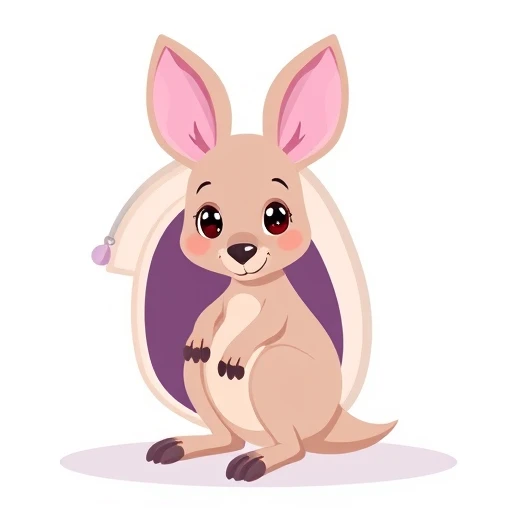
joey 30초 만에
- A joey is the specific term for a baby marsupial, most famously the kangaroo, but also including koalas and wombats.
- The word originates from an Aboriginal Australian language and is now used globally in biological and casual contexts.
- Joeys are born very small and complete their development inside their mother's pouch before becoming independent.
- Informally, 'Joey' can also be a nickname for a young boy, often derived from the name Joseph.
The term joey is a specialized noun primarily used in the biological and zoological context to describe the young of any marsupial. While most people immediately associate the word with a baby kangaroo, it technically applies to a wide range of species including wallabies, koalas, wombats, opossums, and even Tasmanian devils. The word captures a specific stage of development unique to marsupials: because these animals give birth to relatively undeveloped young, the joey must complete its growth inside the mother's pouch. This biological necessity makes the word 'joey' synonymous with the concept of a protected, developing infant that is not yet ready to face the world independently. In a broader, more informal sense, particularly in Australian and British English, 'joey' can serve as a term of endearment or a nickname for a young boy, often derived from the name Joseph, but also used independently to suggest youth and energy.
- Biological Context
- In the wild, a joey is born at an extremely early stage of development, often no larger than a jellybean. It must instinctively crawl from the birth canal into the mother's pouch, where it attaches to a teat and continues to grow for several months. This period of 'pouch life' is what defines the joey's early existence.
The tourists gasped in delight as a tiny joey poked its head out of its mother's pouch for the first time.
The usage of 'joey' is deeply rooted in Australian culture and natural history. When you visit a wildlife sanctuary or watch a nature documentary, the term is used exclusively to refer to these young animals. It is rarely substituted with more generic terms like 'baby' or 'infant' in professional or enthusiast circles because 'joey' conveys the specific marsupial identity. Furthermore, the word evokes a sense of vulnerability and cuteness, making it a popular subject for photography and children's literature. In the context of the Australian outback, seeing a joey 'at foot'—meaning it has left the pouch but still stays close to its mother—is a common sight that signals the health and continuity of the local wildlife population.
- Colloquial Usage
- Informally, 'joey' can refer to a young child, particularly a boy. This usage is more common in certain dialects and often carries a friendly, slightly old-fashioned tone. It can also be a shortened form of the name Joseph, though in this case, it is usually capitalized.
Historically, the word is believed to have originated from the Gamilaraay language, an Aboriginal Australian language, where 'yuwaay' referred to a young kangaroo. Over time, this was adapted into English as 'joey.' This etymological journey highlights the word's deep connection to the Australian landscape and its indigenous heritage. Today, the word is recognized globally, even by those who have never seen a kangaroo in person, thanks to its frequent appearance in media and educational materials about the unique fauna of the Southern Hemisphere.
A rescued joey requires specialized care and a warm, pouch-like environment to survive without its mother.
- Conservation Context
- In wildlife rescue, 'joey' is a technical term. Rescuers often check the pouches of female marsupials killed in road accidents to see if a joey has survived, as the pouch provides significant protection.
In summary, 'joey' is a word that bridges the gap between scientific precision and everyday affection. Whether you are discussing the reproductive cycle of a Red Kangaroo or simply calling out to a young boy named Joseph, the word carries a sense of youth, growth, and the unique wonders of the natural world. Its specific application to marsupials makes it an essential part of the vocabulary for anyone interested in biology, ecology, or Australian culture.
Using the word joey correctly involves understanding its grammatical role as a countable noun and its specific semantic range. Most frequently, it appears in sentences describing the behavior, growth, or care of young marsupials. Because a joey is defined by its relationship to its mother and her pouch, you will often see it paired with possessive pronouns or prepositions indicating location. For example, 'The kangaroo's joey' or 'The joey in the pouch.' When using it in a sentence, it is important to treat it like any other common noun, requiring an article (a, an, the) or a plural marker (-s).
- Subject and Object Placement
- As a subject: 'The joey hopped tentatively across the grass.' As an object: 'The wildlife ranger fed the orphaned joey with a bottle.'
After six months, the joey finally became too large to fit back into its mother's pouch.
In more advanced writing, 'joey' can be used to illustrate specific biological concepts. For instance, you might discuss the 'joey's developmental milestones' or the 'joey's transition to solid food.' In these cases, the word is used with technical precision. It is also common to see the word in compound structures or modified by adjectives that describe its state of health or age, such as 'newborn joey,' 'fledgling joey,' or 'healthy joey.' In Australian English, you might encounter the phrase 'joey at foot,' which describes a young kangaroo that has permanently left the pouch but still follows its mother for protection and milk.
- Descriptive Adjectives
- Common adjectives used with joey include: tiny, vulnerable, playful, inquisitive, and orphaned. These words help paint a picture of the joey's current state and its dependence on its environment.
When using 'joey' as a nickname or informal term for a boy, the capitalization depends on the context. If it is being used as a proper name (a nickname for Joseph), it should be capitalized: 'Hey, Joey, come over here!' If it is being used generically to mean 'a young lad' (though this is rarer and more regional), it remains lowercase. However, in 99% of international English contexts, the word refers to the animal and should be lowercase unless it starts a sentence. Understanding this distinction is key to clear communication, especially in written form where the lack of capitalization could lead to confusion between a person and an animal.
We watched as the mother kangaroo gently cleaned her joey while it rested in the shade.
- Verbs Associated with Joeys
- Joeys: hop, peek, nurse, grow, emerge, retreat, and play. These verbs capture the dynamic and often shy nature of these young marsupials.
Finally, consider the register of your sentence. In a scientific paper, you might write, 'The survival rate of the joey is dependent on the mother's nutritional intake.' In a casual conversation, you might say, 'Look at that cute little joey!' Both are correct, but the word 'joey' itself is versatile enough to fit into both formal and informal registers without losing its core meaning. It is a precise, evocative, and culturally rich word that adds specificity to your descriptions of the natural world.
The word joey is most frequently encountered in environments related to nature, education, and Australian culture. If you are watching a high-quality nature documentary narrated by someone like David Attenborough, you will hear 'joey' used to describe the offspring of kangaroos, wallabies, and koalas. These programs often focus on the dramatic struggle of a newborn joey making its way to the pouch, or the playful antics of an older joey learning to hop. In these settings, the word is used with a sense of wonder and scientific accuracy, emphasizing the unique evolutionary path of marsupials.
- In the Wild and Sanctuaries
- If you visit Australia, you will hear 'joey' everywhere—from tour guides at the Great Ocean Road to locals in rural towns. Wildlife sanctuaries and zoos use the term on their signage and in their educational talks. 'Come meet our newest joey!' is a common marketing phrase used to attract visitors.
The zookeeper explained that the joey would remain in the pouch for another three months before venturing out.
In children's literature and educational media, 'joey' is a staple. Characters like Kanga and Roo from A.A. Milne's 'Winnie-the-Pooh' have popularized the concept of a mother kangaroo and her joey for generations of children worldwide. While Roo is the character's name, he is often referred to as a joey in descriptive text. This makes the word one of the first 'animal baby' names that many English-speaking children learn, alongside 'puppy,' 'kitten,' and 'foal.' In classrooms, teachers use the word when discussing different types of animals and their habitats, often contrasting marsupials with placental mammals.
- News and Current Events
- During the devastating Australian bushfires of 2019-2020, the word 'joey' appeared frequently in international news. Reports often featured stories of rescued joeys being cared for by volunteers, highlighting the vulnerability of these young animals in the face of environmental disasters.
Another place you will hear 'joey' is in the context of wildlife rescue and rehabilitation. In Australia, there are thousands of dedicated 'joey carers' who take in orphaned marsupials. In their community, the word is used with great frequency and technical detail. They might discuss 'pinkies' (very young, hairless joeys) or 'furred joeys.' This specialized vocabulary demonstrates how the word 'joey' serves as the foundation for a whole subculture of animal care. Even outside of Australia, in places like North America, wildlife rehabilitators who work with Virginia opossums will use the term 'joey' to refer to the young found in a mother's pouch.
The documentary filmmaker captured a rare shot of a joey falling out of the pouch while its mother was jumping.
- Pop Culture and Names
- In the hit TV show 'Friends,' the character Joey Tribbiani is a household name. While this is a proper name, the association with the word is so strong that people often make jokes or puns connecting the character to the baby animal, especially when he is acting 'childish' or 'innocent.'
In summary, 'joey' is a word that resonates through various layers of society—from the scientific and educational to the cultural and emotional. It is a word that brings to mind the unique landscapes of Australia and the fascinating biological diversity of our planet. Whether you are reading a news report, watching a movie, or visiting a zoo, 'joey' is the standard, most evocative term for the young of the marsupial world.
While joey is a relatively straightforward word, there are several common mistakes that learners and even native speakers can make. The most frequent error is misapplying the term to non-marsupial animals. Because 'joey' is so strongly associated with 'baby,' some people mistakenly use it for baby deer (fawns), baby bears (cubs), or baby cows (calves). It is crucial to remember that 'joey' is biologically specific to marsupials. Using it for a baby deer, for example, would be factually incorrect and might confuse your audience.
- Species Misidentification
- Incorrect: 'The deer was followed by its joey.' Correct: 'The deer was followed by its fawn.' Remember: Joey = Kangaroo, Wallaby, Koala, Wombat, Opossum.
Don't call a baby panda a joey; that term is reserved for marsupials like the kangaroo.
Another common mistake involves capitalization. As mentioned earlier, 'joey' (the animal) is a common noun and should not be capitalized unless it is the first word in a sentence. However, because 'Joey' is also a very common nickname for Joseph, people often capitalize it out of habit. In a sentence like 'I saw a Joey in the park,' a reader might think you saw a person named Joey rather than a baby kangaroo. Always check your context and ensure that you are using lowercase for the animal and uppercase for the person.
- Spelling and Pluralization
- The plural of 'joey' is 'joeys.' A common spelling error is 'joies' or 'joeies.' Additionally, some people mistakenly use 'joey' as a verb (e.g., 'the kangaroo was joeying around'), which is not standard English. While 'horsing around' is an idiom, 'joeying around' is not.
There is also a subtle mistake related to the developmental stage of the animal. Some people use 'joey' only for the tiny, pink, undeveloped stage. However, the animal remains a 'joey' until it is fully independent and has permanently left the mother's side. Calling a large, hopping young kangaroo a 'joey' is perfectly correct, even if it no longer fits in the pouch. Conversely, some might think 'joey' only refers to kangaroos. Remember that a baby koala is also a joey, as is a baby wombat. Expanding your use of the word to all marsupials will make your English sound more natural and scientifically accurate.
The student lost marks for writing that the joey was born in a nest; joeys are born and then move to a pouch.
- Regional Slang Pitfalls
- In some very specific, older British dialects, 'joey' was a slang term for a fourpenny coin or even a derisive term for a person with a disability. While these uses are almost entirely extinct, it's good to be aware that words can have dark histories. Stick to the animal meaning to be safe.
In conclusion, the key to avoiding mistakes with 'joey' is to remember its biological specificity, its status as a common noun, and its correct plural form. By keeping these points in mind, you can use the word confidently in any context, whether you're discussing Australian wildlife or writing a story about a young animal's adventures.
When discussing young animals, there are many words similar to joey, but each has its own specific application. Understanding these differences is essential for precise communication. The most direct alternative to 'joey' is the generic term 'baby' or 'infant.' While 'baby kangaroo' is perfectly understandable, 'joey' is the preferred, more professional term. In scientific contexts, you might see 'offspring' or 'juvenile,' but these are much broader and can apply to any species at any stage of early development.
- Joey vs. Cub
- A 'cub' is the young of carnivorous mammals like lions, tigers, bears, and foxes. While both joeys and cubs are young and vulnerable, 'cub' implies a future predator, whereas 'joey' is specific to the marsupial family, most of whom are herbivores.
While a lion has a cub, a kangaroo has a joey; the distinction is vital for biologists.
Another set of similar words includes 'fawn' (baby deer), 'calf' (baby cow, elephant, or whale), and 'foal' (baby horse). These words, like 'joey,' are species-specific. Using the correct term shows a high level of English proficiency. For example, calling a baby elephant a 'joey' would be a significant error. Within the world of marsupials, you might also hear the term 'pouchling.' This is a more descriptive, less formal term that emphasizes the animal's location within the mother's pouch. While not as common as 'joey,' it is sometimes used in poetic or very descriptive writing.
- Joey vs. Pinky
- In wildlife rescue, a 'pinky' is a specific type of joey—one that is so young it hasn't grown fur yet and its skin is pink. All pinkies are joeys, but not all joeys are pinkies. This distinction is important for those providing specialized care.
In the context of nicknames, 'Joey' is similar to 'Johnny,' 'Billy,' or 'Bobby.' These are all diminutive forms of longer names (Joseph, John, William, Robert). They all carry a sense of familiarity and youth. However, 'Joey' is unique because of its strong double-meaning with the animal. This makes it a popular choice for characters in stories who might be small, jumpy, or particularly attached to their mothers. When choosing between 'Joey' and 'Joseph,' consider the level of formality: 'Joseph' is for the office, 'Joey' is for the playground.
The author used the word 'pouchling' to create a more intimate feel, though joey would have been more standard.
- Technical Alternatives
- In academic papers, you might see 'neonate marsupial' to describe a newborn joey. This is highly formal and used only in scientific research. For general purposes, 'joey' remains the most effective and widely understood term.
In conclusion, while there are many ways to describe a young creature, 'joey' holds a special place in the English language. Its biological specificity, cultural resonance, and phonetic simplicity make it an irreplaceable part of our vocabulary. By understanding its synonyms and alternatives, you can choose the perfect word for every situation, whether you're writing a scientific report or a children's book.
How Formal Is It?
""
""
""
""
""
재미있는 사실
The word 'joey' didn't become common in English until the 1830s. Before that, settlers often just called them 'pups' or 'cubs'. It is one of the few Aboriginal words that has become a standard part of global English.
발음 가이드
- Pronouncing it like 'joy'.
- Making the 'j' sound like a 'y' (yoey).
- Not making the 'ee' sound long enough at the end.
- Confusing the 'oe' sound with 'oo' (jooey).
- Stress on the second syllable.
난이도
Easy to recognize in context, especially with animal themes.
Requires remembering the specific spelling and plural form.
Simple pronunciation, though the 'oe' can be tricky for some.
Clear sound, but can be confused with 'joy' if spoken quickly.
다음에 무엇을 배울까
선수 학습
다음에 배울 것
고급
알아야 할 문법
Irregular Plurals of Animals
While 'joey' becomes 'joeys', 'sheep' stays 'sheep'.
Possessive Nouns
The joey's ears are very large.
Compound Adjectives
The joey-sized backpack was perfect for the child.
Articles with Specific Nouns
A joey (general) vs. The joey (specific).
Collective Nouns
A mob of kangaroos often includes several joeys.
수준별 예문
The joey is very small.
The baby kangaroo is very small.
Subject + verb + adjective.
I see a joey.
I see a baby kangaroo.
Simple present tense.
A joey lives in a pouch.
A baby kangaroo lives in a pocket.
Third person singular 'lives'.
The joey can hop.
The baby kangaroo can jump.
Modal verb 'can' + base verb.
Is that a joey?
Is that a baby kangaroo?
Question form.
The joey is cute.
The baby kangaroo is pretty.
Adjective 'cute'.
Two joeys are playing.
Two baby kangaroos are playing.
Plural 'joeys' + 'are'.
The joey likes milk.
The baby kangaroo likes milk.
Simple present tense.
The mother kangaroo carries her joey.
The mom kangaroo has her baby in her pouch.
Possessive 'her'.
A joey stays in the pouch for months.
A baby kangaroo lives in the pocket for a long time.
Prepositional phrase 'for months'.
We saw a joey at the zoo.
We saw a baby kangaroo at the animal park.
Past tense 'saw'.
The joey is eating green grass.
The baby kangaroo is eating grass.
Present continuous tense.
Joeys are born very small.
Baby kangaroos are tiny when they are born.
Passive voice 'are born'.
My favorite animal is the joey.
I like the baby kangaroo best.
Possessive 'My'.
The joey peeks out of the pouch.
The baby kangaroo looks out of the pocket.
Verb 'peeks'.
A baby koala is also called a joey.
A baby koala has the same name.
Adverb 'also'.
The wildlife ranger rescued an orphaned joey.
The ranger saved a baby kangaroo with no mother.
Adjective 'orphaned'.
A joey must crawl to the pouch immediately after birth.
The baby must move to the pocket right away.
Modal 'must' for necessity.
Many people don't realize that a baby wombat is a joey.
People don't know the name for a baby wombat.
Negative 'don't realize'.
The joey is finally old enough to leave the pouch.
The baby kangaroo can now go outside.
Adverbial phrase 'finally old enough'.
During the tour, we learned how a joey develops.
We learned about the baby's growth.
Indirect question 'how a joey develops'.
The joey felt safe inside its mother's warm pouch.
The baby was safe in the pocket.
Linking verb 'felt' + adjective.
Is the joey still nursing?
Is the baby still drinking milk?
Present continuous question.
The joey's fur is very soft and gray.
The baby's hair is soft.
Possessive 'joey's'.
The joey's survival in the wild is often precarious.
The baby's life is often in danger.
Noun 'survival' as subject.
A joey at foot still relies on its mother for protection.
A young kangaroo outside the pouch still needs its mom.
Phrase 'at foot'.
The documentary highlighted the bond between the mother and her joey.
The film showed the connection.
Verb 'highlighted'.
If a joey is lost, it has little chance of surviving alone.
A lost baby will likely die.
First conditional.
The joey's hind legs grow stronger every day.
The baby's legs are getting more powerful.
Comparative 'stronger'.
Researchers are studying the vocalizations of the joey.
Scientists are listening to the baby's sounds.
Present continuous 'are studying'.
The joey retreated into the pouch when it heard a loud noise.
The baby went back into the pocket.
Past tense 'retreated'.
An inquisitive joey poked its head out to see the visitors.
A curious baby looked out.
Adjective 'inquisitive'.
The term 'joey' is derived from an indigenous Australian language.
The word comes from an Aboriginal language.
Passive 'is derived from'.
The joey's transition to a herbivorous diet is a gradual process.
The change to eating plants takes time.
Noun phrase 'transition to a herbivorous diet'.
Conservationists emphasize the importance of protecting joey habitats.
Protecting where they live is important.
Verb 'emphasize'.
The joey exhibited signs of distress after being separated from its mob.
The baby looked upset after leaving its group.
Verb 'exhibited'.
In Australian folklore, the joey is often portrayed as a symbol of innocence.
Stories show the baby as innocent.
Passive 'is portrayed as'.
The joey's physiological development is uniquely adapted to pouch life.
The baby's body is made for the pocket.
Adverb 'uniquely'.
Despite its small size, the joey is remarkably resilient.
Even though it is small, it is strong.
Preposition 'Despite'.
The joey's presence in the pouch can be detected by a slight bulge.
You can see the baby is there by the bump.
Modal passive 'can be detected'.
The joey's embryonic journey to the pouch is a marvel of evolutionary biology.
The baby's trip to the pocket is amazing.
Complex noun phrase.
Anthropomorphism often colors our perception of the joey's behavior.
We think of the baby as human-like.
Subject 'Anthropomorphism'.
The joey's dependence on its mother is absolute during its early stages.
The baby needs its mom for everything.
Adjective 'absolute'.
Linguistic analysis reveals the Gamilaraay origins of the word 'joey'.
Studying the word shows its roots.
Subject 'Linguistic analysis'.
The joey's eventual independence is marked by its refusal to return to the pouch.
The baby is grown when it won't go back.
Passive 'is marked by'.
The joey's survival is intrinsically linked to the health of the ecosystem.
The baby's life depends on the environment.
Adverb 'intrinsically'.
The joey's playfulness serves a vital role in its motor skill development.
Playing helps the baby learn to move.
Possessive 'joey's' + 'playfulness'.
The joey's niche in the Australian fauna is unparalleled elsewhere in the world.
The baby's place in nature is unique.
Adjective 'unparalleled'.
자주 쓰는 조합
자주 쓰는 구문
cute as a joey
a joey in the pouch
hopping like a joey
peeking like a joey
joey's first hop
back to the pouch
a mob of joeys
joey-sized
mother and joey
save the joeys
자주 혼동되는 단어
Sounds similar but means happiness.
Sounds similar but means happy/cheerful.
Phonetically different but can be confused by beginners.
관용어 및 표현
"to have a joey in the pouch"
To be pregnant (Australian slang).
Did you hear? Sarah has a joey in the pouch!
informal"to act like a joey"
To behave in a youthful or inexperienced way.
Stop acting like a joey and take this seriously.
informal"a joey's jump"
A very short distance.
The store is just a joey's jump away.
informal"to be a joey"
To be the youngest member of a group.
In this office, I'm definitely the joey.
informal"to pouch a joey"
To protect someone very closely.
She really pouches her joey when they go out.
informal"joey's luck"
Good luck that comes from being young and innocent.
He won by joey's luck, I think.
informal"as shy as a joey"
Extremely timid or bashful.
The new student was as shy as a joey.
neutral"to hop out of the pouch"
To become independent for the first time.
He's finally hopping out of the pouch and moving to the city.
informal"a joey's dream"
A simple, innocent wish.
It was just a joey's dream to see the ocean.
literary"to be in the joey stage"
To be in the early, developing phase of a project.
The startup is still in the joey stage.
informal혼동하기 쉬운
Both refer to baby animals.
Cub is for predators (lions, bears); joey is for marsupials.
The bear has a cub, but the kangaroo has a joey.
Both refer to baby animals.
Calf is for large mammals (cows, whales); joey is for marsupials.
An elephant has a calf, not a joey.
Both are small, cute baby animals.
Fawn is specifically for deer.
The deer's fawn was hiding in the grass.
Both are young animals.
Foal is for horses and zebras.
The mare stood by her foal.
A very common word for baby animals.
Pup is for dogs, seals, and some rodents.
The seal pup was lying on the ice.
문장 패턴
The [noun] is [adjective].
The joey is small.
I saw a [noun] at the [place].
I saw a joey at the zoo.
The [noun] lives in the [place] for [time].
The joey lives in the pouch for months.
Despite [noun], the [noun] [verb].
Despite the cold, the joey stayed warm.
The [noun]'s [noun] is [adverb] [adjective].
The joey's development is remarkably fast.
[Gerund] a [noun] requires [noun].
Rearing a joey requires immense patience.
Is that [noun] [verb]-ing?
Is that joey hopping?
My [noun] is a [noun].
My favorite animal is a joey.
어휘 가족
명사
형용사
관련
사용법
Common in Australia; moderate globally.
-
Calling a baby deer a joey.
→
Calling it a fawn.
Joeys are only for marsupials. Deer are placental mammals.
-
Spelling the plural as 'joies'.
→
Spelling it as 'joeys'.
Words ending in -ey just add -s for the plural.
-
Capitalizing 'joey' in the middle of a sentence.
→
Using lowercase 'joey'.
It is a common noun, not a proper noun, when referring to the animal.
-
Using 'joey' for a baby bird.
→
Using 'chick' or 'fledgling'.
Birds are not marsupials, so they cannot have joeys.
-
Pronouncing it like 'joy'.
→
Pronouncing it with two syllables (JOE-ee).
The 'y' at the end creates a second syllable.
팁
Be Specific
Always use 'joey' when talking about kangaroos to sound like a native speaker. 'Baby kangaroo' is okay, but 'joey' is better.
Plural Rule
Remember the plural is 'joeys', not 'joies'. It follows the standard rule for words ending in 'y' preceded by a vowel.
Australian Pride
Using the word 'joey' correctly is a great way to show respect for Australian culture and wildlife.
Beyond Kangaroos
Impress your friends by calling a baby koala or wombat a joey. Most people only think of kangaroos!
Long 'O'
Make sure the 'o' sound is long, like in 'boat'. This helps distinguish it from the word 'joy'.
Avoid Slang
In professional writing, stick to the animal definition. Avoid using 'joey' as a nickname unless the context is very casual.
Look for the Pouch
If you see a pouch, the baby inside is a joey. This is the easiest way to remember the term.
Aboriginal Roots
Remembering that 'joey' comes from an indigenous language can help you appreciate its unique history.
Wildlife Rescue
If you ever find an injured marsupial in Australia, check the pouch for a joey. It could save a life!
Nicknames
If you have a friend named Joseph, calling him Joey is a common and friendly thing to do.
암기하기
기억법
Think of a boy named Joey who loves to jump like a baby kangaroo.
시각적 연상
Imagine a small, cute head with big ears peeking out of a pocket. The pocket is the pouch, and the head is the joey.
Word Web
챌린지
Try to use the word 'joey' in three different sentences today: one about a kangaroo, one about a koala, and one about a person named Joey.
어원
The word 'joey' is believed to have originated from the Gamilaraay language, an Aboriginal Australian language spoken in New South Wales. In Gamilaraay, the word 'yuwaay' was used to refer to a young kangaroo. This was later adopted and adapted by European settlers in the late 18th or early 19th century.
원래 의미: Young kangaroo.
Pama-Nyungan (Aboriginal Australian).문화적 맥락
Be aware that 'joey' was once used as a slur in the UK; while rare now, avoid using it to describe people unless it's a known nickname.
In Australia, the word is used daily. In the US and UK, it is mostly used in educational or zoo contexts.
실생활에서 연습하기
실제 사용 상황
At the Zoo
- Where is the joey?
- Is the joey out of the pouch?
- The joey is so cute!
- Can we see the joey?
Wildlife Documentary
- The joey emerges.
- Survival of the joey.
- The joey's first steps.
- A vulnerable joey.
Australian Travel
- Watch out for joeys.
- A joey on the road.
- National park joeys.
- Seeing a joey in the wild.
Children's Story
- Little joey Roo.
- Joey's big adventure.
- The joey and his friends.
- Joey's warm home.
Science Class
- Marsupial joeys.
- Joey development.
- Pouch life of a joey.
- Comparing joeys and cubs.
대화 시작하기
"Did you know that a baby koala is also called a joey?"
"Have you ever seen a joey peeking out of a kangaroo's pouch?"
"I saw a documentary about how joeys are born; it was fascinating!"
"If you had a pet joey, what would you name it?"
"Why do you think joeys stay in the pouch for so long?"
일기 주제
Imagine you are a joey seeing the world for the first time. Describe what you see.
Write about a time you saw a young animal. How did it remind you of a joey?
Why is the word 'joey' more special than just saying 'baby kangaroo'?
If you were a wildlife ranger, how would you take care of an orphaned joey?
Research another marsupial and write about its joey's life cycle.
자주 묻는 질문
10 질문The term 'joey' is used for the young of all marsupials. This includes kangaroos, wallabies, koalas, wombats, opossums, and Tasmanian devils. If it has a pouch, its baby is likely called a joey.
Yes, a baby koala is definitely a joey. Like kangaroos, koalas are marsupials and their young develop in a pouch. You can use the word 'joey' for them with confidence.
The word comes from an Aboriginal Australian language, Gamilaraay. The original word was 'yuwaay,' which meant a young kangaroo. English speakers adapted this into 'joey' in the early 1800s.
It depends on the species. A kangaroo joey might stay in the pouch for 6 to 9 months, while a koala joey stays for about 6 months before moving to its mother's back.
Informally, yes, especially if the boy's name is Joseph. Sometimes people use it as a cute nickname for a small child, but it's not a standard English term for a human baby.
A 'pinky' is a very young joey that has not yet grown fur. Its skin is pink and translucent. This term is often used by wildlife rescuers and vets.
No. While kangaroo and wallaby joeys hop, koala joeys climb and wombat joeys walk or burrow. The word 'joey' refers to the animal's group (marsupials), not how it moves.
Only if it is a person's name (e.g., Joey Tribbiani) or at the start of a sentence. When referring to the animal, it is a common noun and should be lowercase.
The plural is 'joeys.' You simply add an 's' to the end of the word. For example: 'There were three joeys in the field.'
Yes, the word is used globally by biologists, zookeepers, and in educational materials. It is also used in North America for baby opossums.
셀프 테스트 200 질문
Write a sentence using the word 'joey' and 'pouch'.
Well written! Good try! Check the sample answer below.
Describe what a joey looks like.
Well written! Good try! Check the sample answer below.
Explain why a joey needs a pouch.
Well written! Good try! Check the sample answer below.
Compare a joey to a kitten.
Well written! Good try! Check the sample answer below.
Write a short story about an orphaned joey.
Well written! Good try! Check the sample answer below.
What is the cultural significance of the joey in Australia?
Well written! Good try! Check the sample answer below.
Discuss the etymology of the word 'joey'.
Well written! Good try! Check the sample answer below.
How does a joey's life change when it becomes 'at foot'?
Well written! Good try! Check the sample answer below.
Describe a scene at a zoo involving a joey.
Well written! Good try! Check the sample answer below.
Why is it important to use the word 'joey' instead of 'baby kangaroo'?
Well written! Good try! Check the sample answer below.
Write a dialogue between two people seeing a joey for the first time.
Well written! Good try! Check the sample answer below.
What are the challenges of rearing an orphaned joey?
Well written! Good try! Check the sample answer below.
How does the term 'joey' apply to koalas?
Well written! Good try! Check the sample answer below.
Write a poem about a joey.
Well written! Good try! Check the sample answer below.
Explain the difference between a 'pinky' and a furred joey.
Well written! Good try! Check the sample answer below.
What would you do if you found a joey in the wild?
Well written! Good try! Check the sample answer below.
How does a joey's diet change as it grows?
Well written! Good try! Check the sample answer below.
Describe the relationship between a mother kangaroo and her joey.
Well written! Good try! Check the sample answer below.
Write a news headline about a joey rescue.
Well written! Good try! Check the sample answer below.
Why is the word 'joey' easy to remember?
Well written! Good try! Check the sample answer below.
Pronounce the word 'joey' correctly.
Read this aloud:
당신의 답변:
Speech recognition is not supported in your browser. Try Chrome or Edge.
Describe a joey in three words.
Read this aloud:
당신의 답변:
Speech recognition is not supported in your browser. Try Chrome or Edge.
Tell a friend about a joey you saw (real or in a video).
Read this aloud:
당신의 답변:
Speech recognition is not supported in your browser. Try Chrome or Edge.
Explain what a marsupial is using the word 'joey'.
Read this aloud:
당신의 답변:
Speech recognition is not supported in your browser. Try Chrome or Edge.
What are the differences between a joey and a puppy?
Read this aloud:
당신의 답변:
Speech recognition is not supported in your browser. Try Chrome or Edge.
How would you describe a joey to someone who has never seen one?
Read this aloud:
당신의 답변:
Speech recognition is not supported in your browser. Try Chrome or Edge.
Why is the joey important to Australian tourism?
Read this aloud:
당신의 답변:
Speech recognition is not supported in your browser. Try Chrome or Edge.
What does 'joey at foot' mean in your own words?
Read this aloud:
당신의 답변:
Speech recognition is not supported in your browser. Try Chrome or Edge.
Can you name three animals that have joeys?
Read this aloud:
당신의 답변:
Speech recognition is not supported in your browser. Try Chrome or Edge.
How do you feel when you see a joey?
Read this aloud:
당신의 답변:
Speech recognition is not supported in your browser. Try Chrome or Edge.
Talk about the life cycle of a joey.
Read this aloud:
당신의 답변:
Speech recognition is not supported in your browser. Try Chrome or Edge.
Why do you think the word 'joey' is used as a nickname?
Read this aloud:
당신의 답변:
Speech recognition is not supported in your browser. Try Chrome or Edge.
What are some threats to joeys in the wild?
Read this aloud:
당신의 답변:
Speech recognition is not supported in your browser. Try Chrome or Edge.
How would you help an orphaned joey?
Read this aloud:
당신의 답변:
Speech recognition is not supported in your browser. Try Chrome or Edge.
Is 'joey' a scientific word or a casual word?
Read this aloud:
당신의 답변:
Speech recognition is not supported in your browser. Try Chrome or Edge.
What is the best part about being a joey?
Read this aloud:
당신의 답변:
Speech recognition is not supported in your browser. Try Chrome or Edge.
Do you think joeys are the cutest baby animals?
Read this aloud:
당신의 답변:
Speech recognition is not supported in your browser. Try Chrome or Edge.
How does a joey move?
Read this aloud:
당신의 답변:
Speech recognition is not supported in your browser. Try Chrome or Edge.
What is a joey's mother called?
Read this aloud:
당신의 답변:
Speech recognition is not supported in your browser. Try Chrome or Edge.
Where can you find joeys in the wild?
Read this aloud:
당신의 답변:
Speech recognition is not supported in your browser. Try Chrome or Edge.
Listen to the sentence: 'The joey is hopping.' What is the joey doing?
Listen to the sentence: 'A joey lives in a pouch.' Where does the joey live?
Listen to the sentence: 'The orphaned joey was rescued.' What happened to the joey?
Listen to the sentence: 'Joeys are born very small.' Are joeys big when they are born?
Listen to the sentence: 'The joey's fur is gray.' What color is the fur?
Listen to the sentence: 'We saw three joeys at the park.' How many joeys were there?
Listen to the sentence: 'The joey peeks out of the pouch.' What does the joey do?
Listen to the sentence: 'A baby koala is a joey.' Is a baby koala called a joey?
Listen to the sentence: 'The joey needs its mother's milk.' What does the joey need?
Listen to the sentence: 'The joey is finally independent.' Is the joey still in the pouch?
Listen to the sentence: 'Watch out for joeys on the road.' Where should you look for joeys?
Listen to the sentence: 'The joey is a symbol of Australia.' What is the joey a symbol of?
Listen to the sentence: 'The joey's ears are twitching.' What is twitching?
Listen to the sentence: 'The joey is hiding.' What is the joey doing?
Listen to the sentence: 'The joey is growing fast.' How is the joey growing?
/ 200 correct
Perfect score!
Summary
The word 'joey' is the essential term for any young marsupial. For example, 'The joey spent six months in its mother's pouch before hopping out to explore the Australian outback.'
- A joey is the specific term for a baby marsupial, most famously the kangaroo, but also including koalas and wombats.
- The word originates from an Aboriginal Australian language and is now used globally in biological and casual contexts.
- Joeys are born very small and complete their development inside their mother's pouch before becoming independent.
- Informally, 'Joey' can also be a nickname for a young boy, often derived from the name Joseph.
Be Specific
Always use 'joey' when talking about kangaroos to sound like a native speaker. 'Baby kangaroo' is okay, but 'joey' is better.
Plural Rule
Remember the plural is 'joeys', not 'joies'. It follows the standard rule for words ending in 'y' preceded by a vowel.
Australian Pride
Using the word 'joey' correctly is a great way to show respect for Australian culture and wildlife.
Beyond Kangaroos
Impress your friends by calling a baby koala or wombat a joey. Most people only think of kangaroos!