









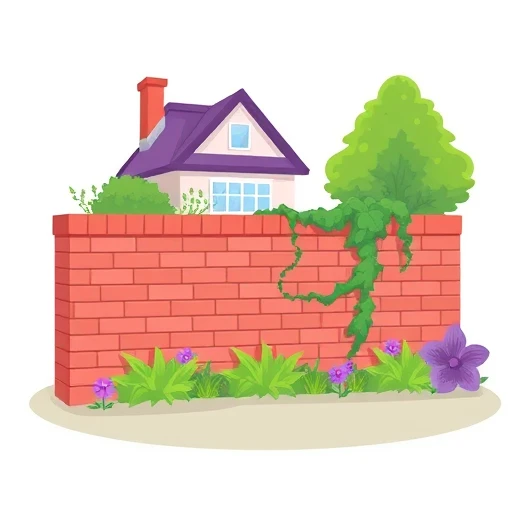
wall in 30 Seconds
- A wall is a vertical structure made of materials like brick or stone, used to enclose, divide, or protect spaces in buildings and outdoors.
- Commonly used to describe the sides of a room, walls can also be metaphorical barriers that prevent progress or communication in various life situations.
- In technical contexts, walls can be load-bearing (supporting weight), digital (firewalls for security), or biological (cell walls in plants and bacteria).
- Idioms like 'hitting a wall' or 'the writing is on the wall' are frequent in English, expanding the word's meaning beyond its physical form.
The term wall primarily describes a solid, vertical structure that serves several fundamental purposes in human civilization: protection, division, and support. At its most basic level, a wall is what keeps the roof of your house up and keeps the wind from blowing through your living room. However, the concept of a wall extends far beyond simple bricks and mortar. In architectural terms, we distinguish between load-bearing walls, which are essential for a building's stability, and partition walls, which simply divide a large space into smaller rooms. When you walk through a city, you are surrounded by walls of various materials—glass in modern skyscrapers, ancient stone in historic districts, and common red brick in residential neighborhoods. People use the word 'wall' daily to describe their immediate environment, such as when they decide to hang a picture on the wall or paint a wall a new color. Beyond the physical, the word is used to describe barriers of all kinds. For instance, a 'firewall' in computing is a virtual wall that protects your data from intruders. In sports, a 'wall' of players might stand together to block a free kick in soccer. The word carries a sense of permanence and strength, often implying something that is difficult to pass through or overcome. Whether it is the Great Wall of China, designed to protect an entire empire, or the four walls of a tiny bedroom providing a sense of private sanctuary, the wall is a foundational element of how humans organize and inhabit space.
- Physical Structure
- A vertical construction made of stone, brick, wood, or metal that encloses an area or supports a building.
- Metaphorical Barrier
- An obstacle that prevents progress or communication, such as a 'wall of silence' or an 'emotional wall'.
- Biological Boundary
- In biology, the cell wall is a rigid layer surrounding certain types of cells, providing structural support and protection.
The artist spent three weeks painting a beautiful mural on the side wall of the community center.
We need to build a stone wall around the garden to keep the rabbits out.
He leaned his bicycle against the wall and went inside the shop.
The heavy curtains hung from the wall to block out the morning sunlight.
The climber searched for a small crack in the rock wall to place her fingers.
Historically, walls have defined the boundaries of civilizations. The Great Wall of China is perhaps the most famous example, stretching thousands of miles to protect against invasions. In medieval Europe, city walls were essential for defense, and many cities today still retain parts of these ancient fortifications as tourist attractions. The Berlin Wall, on the other hand, became a symbol of political division during the Cold War, representing the physical and ideological separation between East and West. In modern architecture, the 'curtain wall' is a common feature of skyscrapers—a non-structural outer covering made of glass or metal that keeps the weather out but doesn't support the weight of the building. Even in our digital lives, the term persists. Social media platforms often have a 'wall' where users post updates, a metaphor for a physical space where people leave messages. Understanding the word 'wall' requires recognizing this blend of physical reality and symbolic meaning. It is a word that describes both the things that keep us safe and the things that keep us apart. Whether you are talking about the drywall in your apartment or the great sea walls protecting coastal cities from rising tides, the 'wall' is an omnipresent concept in human life.
Using the word wall correctly involves understanding its role as a countable noun and the specific prepositions that accompany it. In its most literal sense, 'wall' refers to the vertical surfaces of a structure. You will frequently find it paired with the preposition 'on'. For example, 'The clock is on the wall.' This indicates that the object is attached to the surface. If something is positioned next to a wall, we use 'against' or 'beside'. 'He leaned his ladder against the wall' suggests the ladder is touching the wall for support. If you are talking about something located inside the structure of the wall itself, such as wiring or insulation, you would say it is 'in the wall'. For instance, 'The electrical wires are hidden in the wall.' When discussing boundaries, we often talk about 'building a wall' or 'tearing down a wall'. These actions can be physical, like a construction project, or metaphorical, like two people resolving a conflict and 'tearing down the walls' between them. The word also appears in many common verb phrases. You can 'climb a wall', 'paint a wall', 'hit a wall', or even 'talk to a brick wall' when someone isn't listening to you. In more technical contexts, such as geography or geology, a 'wall' might refer to a steep cliff face or the side of a canyon. For example, 'The north wall of the Eiger is a famous challenge for mountain climbers.' In sports, particularly soccer, the 'wall' is a line of players standing side-by-side to block a free kick. In this context, 'the wall' is a collective noun acting as a single defensive unit. When using 'wall' in the plural, 'walls', it often refers to the entire enclosure of a room or the boundaries of a person's private life. 'Within these four walls' is a common idiom meaning 'inside this house' or 'in private'.
- Preposition: On
- Used for items attached to the surface. Example: 'Hang your coat on the wall hook.'
- Preposition: Against
- Used for items leaning or touching the surface. Example: 'The sofa is pushed against the wall.'
- Preposition: Through
- Used for sound or physical passage. Example: 'I can hear the neighbors through the thin wall.'
She decided to decorate the nursery wall with colorful animal stickers.
The old castle walls were over three meters thick to withstand cannon fire.
If you hit a wall while studying, it is often best to take a short break.
In more advanced usage, 'wall' can function as a verb, though this is less common. To 'wall something off' means to isolate it or enclose it within walls. For example, 'They walled off the construction site for safety.' You might also hear the term 'stonewalling' in political or legal contexts, which means refusing to answer questions or cooperate. When writing about architecture, you might use more specific terms like 'retaining wall' (a wall that holds back soil) or 'sea wall' (a wall that protects the land from the ocean). In literature, walls often symbolize isolation or the lack of freedom. Robert Frost's famous poem 'Mending Wall' explores the idea of why humans feel the need to build barriers between themselves and their neighbors, famously stating, 'Good fences make good neighbors.' Whether you are using the word in a simple A1-level sentence like 'The wall is white' or a more complex C2-level philosophical discussion about the 'walls of the mind', the word remains a versatile and essential part of the English language. Always remember that walls can be both protective and restrictive, and your choice of adjectives—such as 'sturdy', 'impenetrable', 'crumbling', or 'transparent'—will greatly influence the meaning you convey.
The word wall is ubiquitous, appearing in a vast range of daily environments from the domestic to the professional. In a typical home setting, you will hear it during renovation projects or simple decorating tasks. A parent might tell a child, 'Don't draw on the walls!' or a couple might debate which 'accent wall' should be painted a different color. In the world of construction and real estate, 'wall' is a technical term used constantly. Architects discuss 'load-bearing walls' that support the weight of the roof, while contractors talk about 'stud walls' or 'drywalling' a new room. If you are watching a home improvement show, you'll hear experts discuss 'knocking down a wall' to create an open-plan living space. In the workplace, especially in modern office environments, you might hear about 'cubicle walls' or 'glass walls' that provide a sense of transparency. Metaphorically, in business meetings, a manager might say, 'We've hit a wall with this project,' meaning they have encountered a problem they cannot easily solve. In the realm of technology, 'firewall' is a term every computer user should know, referring to the security software that acts as a barrier against cyber threats. If you follow sports, particularly soccer, the commentator will often shout about the 'defensive wall' during a free kick. In marathon running, athletes often talk about 'hitting the wall' around the 20-mile mark, describing the sudden onset of extreme fatigue. In news reports, 'walls' often take on political significance, such as discussions about border walls or the historical significance of the Berlin Wall. Even in music and entertainment, the word is prominent—Pink Floyd's famous album 'The Wall' uses the structure as a metaphor for mental isolation. You'll also hear it in common idioms in casual conversation, such as 'the writing is on the wall' (meaning a failure is imminent) or 'driving me up the wall' (meaning someone is making you very annoyed). From the physical structures that surround us to the metaphorical barriers we face in life and work, 'wall' is a word that resonates in almost every facet of human experience.
- Home & DIY
- 'We need to hang this mirror on the bedroom wall.' or 'The wallpaper is peeling off the wall.'
- Business & Strategy
- 'We've hit a brick wall in our negotiations with the supplier.'
- Technology & Security
- 'Make sure your computer's firewall is turned on before connecting to public Wi-Fi.'
The construction crew is finishing the outer wall of the new library today.
The marathon runner hit the wall at mile 22 but managed to keep going.
In academic settings, particularly in history or sociology, you will hear 'wall' used to describe significant cultural and physical divides. Professors might lecture on the 'Hadrian's Wall' in Britain or the 'Iron Curtain', which was a metaphorical wall dividing Europe. In biology, the 'cell wall' is a fundamental concept taught in every introductory science class. In literature, walls are often used as symbols of the human condition—think of the walls in Kafka's stories or the literal and figurative walls in modern dystopian novels. Even in the kitchen, you might hear about the 'wall' of a pot or pan. In essence, whether you are talking about the physical world, the digital world, the biological world, or the world of ideas, the word 'wall' is an inescapable part of the vocabulary. Its frequency in the English language is high because it describes one of the most basic elements of human-made environments. From the moment we are born within the walls of a hospital to the homes we live in and the offices we work in, walls define the geometry of our lives. Listening for the word in different contexts will help you appreciate its versatility and the many ways it can be used to describe both safety and separation.
While the word wall seems simple, learners often make specific mistakes regarding its usage, especially when distinguishing it from similar structures like 'fences' or 'partitions'. One of the most common errors is using 'wall' when 'fence' is more appropriate. A wall is typically a solid, heavy structure made of brick, stone, or concrete. A fence, however, is usually made of wood, wire, or metal and is often see-through or lighter in construction. For example, you wouldn't usually say 'the wooden wall around the garden' if it's made of thin slats; that's a 'fence'. Another frequent mistake involves prepositions. Many learners say 'in the wall' when they mean 'on the wall'. Remember: pictures, clocks, and shelves are on the wall (attached to the surface). Wires, pipes, and insulation are in the wall (inside the structure). Another point of confusion is the difference between a 'wall' and a 'partition'. While all partitions are walls of a sort, a partition is specifically a thin wall used to divide a room, often temporary or non-structural. In an office, you have 'partitions' or 'cubicle walls', but in a house, the permanent structures are just 'walls'. There's also the common error of using 'wall' instead of 'ceiling' or 'floor'. A room has four walls, one floor, and one ceiling. Sometimes learners mistakenly refer to the ceiling as the 'top wall', which is incorrect in English. In metaphorical usage, learners sometimes confuse 'hitting a wall' with 'hitting the ceiling'. 'Hitting a wall' means you can't progress further due to exhaustion or a problem. 'Hitting the ceiling' (or 'roof') means someone has become very angry. Using the wrong idiom can lead to significant misunderstandings! Finally, be careful with the plural form. While 'walls' is the standard plural, in certain idiomatic expressions like 'the writing is on the wall', the singular is always used, even if the 'writing' might technically be on multiple surfaces. Understanding these nuances will help you sound more natural and avoid the common pitfalls that even intermediate learners sometimes encounter.
- Wall vs. Fence
- Walls are solid and heavy (brick/stone); fences are lighter and often made of wood or wire.
- On vs. In
- Use 'on' for things on the surface (posters) and 'in' for things inside the structure (pipes).
- Wall vs. Ceiling
- Walls are vertical; the ceiling is the horizontal surface above you.
Incorrect: I hung the photo in the wall. Correct: I hung the photo on the wall.
Incorrect: The sheep jumped over the stone fence. Correct: The sheep jumped over the stone wall.
Another subtle mistake is using 'wall' for the side of a container. While you can say 'the walls of the pot', it is more common to say 'the sides of the pot'. However, in technical or scientific contexts, 'wall' is perfectly acceptable (e.g., 'the arterial wall'). In casual English, stick to 'sides' for small objects. Furthermore, when talking about social barriers, don't confuse 'wall' with 'bridge'. You 'build a bridge' to connect with someone, but you 'build a wall' to distance yourself. Some learners mistakenly say 'build a wall between us' when they mean they want to get closer—this is the opposite of the intended meaning! Also, pay attention to the verb 'to wallow'. It sounds similar to 'wall' but means something completely different (to roll around in something or to indulge in an emotion). Lastly, in the context of sports, specifically soccer, the 'wall' is always singular even though it is made of multiple people. You say 'The wall blocked the shot,' not 'The walls blocked the shot.' By keeping these common errors in mind, you can use the word 'wall' with greater precision and confidence in both its literal and figurative senses.
While wall is the most common term for a vertical barrier, several other words offer more specific meanings depending on the context. Understanding these alternatives will enrich your vocabulary and allow you to be more descriptive. For instance, a barrier is a general term for anything that prevents movement or access. While a wall is a type of barrier, a barrier could also be a gate, a fence, or even a psychological hesitation. A partition is a thin wall used to divide a room into smaller areas, often found in offices or large shared spaces. If you are talking about a wall built for defense, you might use words like fortification, rampart, or bulwark. These words carry a historical or military connotation. In geography, a steep, wall-like rock face is often called a precipice or a cliff. If the wall is specifically designed to hold back water, it is a dam, a levee, or a sea wall. For interior design, you might hear the term divider, which can be a piece of furniture or a folding screen that acts like a temporary wall. In biology, the term membrane is sometimes used as a functional alternative to 'wall', though a cell wall is much more rigid than a cell membrane. When discussing emotional or social distance, you might use obstacle, hurdle, or blockade. Each of these words suggests a different kind of difficulty to overcome. For example, a 'hurdle' is something you jump over, while a 'wall' is something you must climb or break through. By choosing the right word, you can convey the exact nature of the structure or barrier you are describing.
- Wall vs. Barrier
- A wall is a specific physical structure; a barrier is any obstacle (physical or abstract).
- Wall vs. Partition
- A wall is usually permanent and structural; a partition is often thin and used for dividing space.
- Wall vs. Fortification
- A wall is a general term; a fortification is a wall specifically built for military defense.
The office used glass partitions to create private meeting rooms without blocking the light.
The heavy barrier at the entrance of the parking lot only opens for authorized vehicles.
In more poetic or literary contexts, you might encounter words like enclosure or confines. These words emphasize the feeling of being trapped or surrounded by walls. For example, 'the confines of the prison walls' sounds more dramatic than just 'the prison walls'. If you are describing a wall that is falling apart, you might use ruin or debris. In modern urban environments, a wall covered in art is a mural, while a wall covered in unwanted writing is graffiti. When discussing technology, a firewall is a specific type of digital wall, but you might also hear about a paywall, which is a digital barrier that requires users to pay before they can access content on a website. In the world of finance, a Chinese wall (now often called an 'ethical wall') is an information barrier within an organization to prevent conflicts of interest. As you can see, while 'wall' is a great starting point, the English language offers a rich palette of alternatives that can help you describe everything from a simple room divider to a complex digital security system. Learning these synonyms and related terms will help you express yourself with more nuance and precision in any situation.
How Formal Is It?
Fun Fact
The Latin root 'vallum' is also related to the word 'valley' (the space between 'walls' of hills) and 'interval' (the space between the stakes of a wall).
Pronunciation Guide
- Pronouncing the 'a' like the 'a' in 'cat' (wrong: /wæl/).
- Making the 'l' too light or clear.
- Confusing the vowel with 'well' (/wɛl/).
Difficulty Rating
A very basic word found in early reading materials.
Simple spelling and clear usage patterns.
Commonly used in daily descriptions of the environment.
Easily recognizable in most contexts.
What to Learn Next
Prerequisites
Learn Next
Advanced
Grammar to Know
Prepositions of Place
Use 'on' for surfaces: 'The poster is on the wall.'
Countable Nouns
Walls can be counted: 'One wall, two walls.'
Compound Nouns
Combining 'wall' with other words: 'Wallpaper', 'Firewall'.
Noun as Adjective
Using 'wall' to describe another noun: 'Wall clock', 'Wall paint'.
Phrasal Verbs
Using 'wall' with particles: 'Wall off' (to enclose).
Examples by Level
The wall is white.
La pared es blanca.
Subject + verb + adjective.
There is a clock on the wall.
Hay un reloj en la pared.
Use 'on' for items attached to the surface.
The room has four walls.
La habitación tiene cuatro paredes.
Plural form 'walls'.
I see a red brick wall.
Veo una pared de ladrillo rojo.
Adjective order: color + material.
The cat is near the wall.
El gato está cerca de la pared.
Preposition 'near' shows proximity.
Touch the wall.
Toca la pared.
Imperative sentence.
Is the wall high?
¿Es alta la pared?
Question form with 'is'.
The wall is made of stone.
La pared está hecha de piedra.
Passive structure 'is made of'.
He is painting the kitchen wall blue.
Él está pintando la pared de la cocina de azul.
Present continuous tense.
Don't lean against the wet wall.
No te apoyes contra la pared mojada.
Negative imperative + 'against'.
The garden wall is very old.
La pared del jardín es muy vieja.
Noun as an adjective: 'garden wall'.
We put the sofa against the wall.
Pusimos el sofá contra la pared.
Past simple tense.
She hung a mirror on the wall.
Ella colgó un espejo en la pared.
Irregular verb 'hang' -> 'hung'.
The city walls are famous.
Las murallas de la ciudad son famosas.
Plural subject with 'are'.
Can you see through the glass wall?
¿Puedes ver a través de la pared de cristal?
Preposition 'through'.
The wallpaper is coming off the wall.
El papel tapiz se está despegando de la pared.
Phrasal verb 'come off'.
I hit a wall while trying to solve the math problem.
Me bloqueé mientras intentaba resolver el problema de matemáticas.
Idiomatic use of 'hit a wall'.
The workers are building a retaining wall to stop the soil from sliding.
Los trabajadores están construyendo un muro de contención para evitar que la tierra se deslice.
Technical term 'retaining wall'.
You need to drill a hole in the wall for the shelf.
Necesitas taladrar un agujero en la pared para el estante.
Preposition 'in' for internal changes.
The noise from the street comes through the thin walls.
El ruido de la calle entra a través de las paredes delgadas.
Adjective 'thin' modifying 'walls'.
They decided to knock down the wall between the kitchen and the dining room.
Decidieron derribar la pared entre la cocina y el comedor.
Phrasal verb 'knock down'.
The Great Wall of China is a remarkable feat of engineering.
La Gran Muralla China es una hazaña notable de la ingeniería.
Proper noun usage.
If the wall isn't strong enough, the roof might collapse.
Si la pared no es lo suficientemente fuerte, el techo podría colapsar.
First conditional sentence.
He was leaning his bike against the wall when it started to rain.
Estaba apoyando su bicicleta contra la pared cuando empezó a llover.
Past continuous + 'against'.
The writing is on the wall for the failing company.
El destino de la empresa fallida está sellado (lo que va a pasar es obvio).
Idiom: 'the writing is on the wall'.
She has built an emotional wall to protect herself from being hurt again.
Ella ha construido un muro emocional para protegerse de volver a ser lastimada.
Metaphorical use of 'wall'.
With his back against the wall, he had no choice but to confess.
Con la espalda contra la pared (en una situación difícil), no tuvo más remedio que confesar.
Idiom: 'back against the wall'.
The firewall prevented the hacker from accessing the sensitive data.
El cortafuegos evitó que el hacker accediera a los datos sensibles.
Compound noun 'firewall'.
The marathon runner hit the wall at the twenty-mile mark.
El maratonista se agotó por completo en la marca de las veinte millas.
Idiom: 'hit the wall' (sports context).
The new office design uses glass walls to encourage transparency.
El nuevo diseño de la oficina utiliza paredes de cristal para fomentar la transparencia.
Infinitive of purpose: 'to encourage'.
The castle walls were reinforced to withstand a prolonged siege.
Las murallas del castillo fueron reforzadas para resistir un asedio prolongado.
Passive voice: 'were reinforced'.
He's like a fly on the wall in these high-level meetings.
Él es como un observador invisible en estas reuniones de alto nivel.
Idiom: 'fly on the wall'.
The government is being accused of stonewalling the investigation into the scandal.
Se acusa al gobierno de obstaculizar la investigación del escándalo.
Verb 'stonewall' in present continuous passive.
The cell wall provides structural support and protection to the plant cell.
La pared celular proporciona soporte estructural y protección a la célula vegetal.
Scientific/Biological context.
The architect specified a non-load-bearing curtain wall for the building's facade.
El arquitecto especificó un muro cortina no portante para la fachada del edificio.
Technical architectural terminology.
The thick stone walls acted as a thermal mass, keeping the house cool in summer.
Las gruesas paredes de piedra actuaron como una masa térmica, manteniendo la casa fresca en verano.
Complex noun phrase as subject.
The protagonist's internal walls began to crumble as he learned to trust again.
Las barreras internas del protagonista comenzaron a desmoronarse a medida que aprendía a confiar de nuevo.
Literary metaphor.
There is a 'Chinese wall' between the research and trading departments to prevent conflicts of interest.
Existe una 'muralla china' (barrera ética) entre los departamentos de investigación y trading para evitar conflictos de intereses.
Specialized financial/legal idiom.
The sea wall was breached during the unprecedented storm surge.
El malecón fue sobrepasado durante la marejada ciclónica sin precedentes.
Passive voice with 'breached'.
Breaking the fourth wall is a common technique in modern television comedies.
Romper la cuarta pared es una técnica común en las comedias de televisión modernas.
Theatrical/Media terminology.
The philosopher argued that the walls of language define the limits of our world.
El filósofo argumentó que los muros del lenguaje definen los límites de nuestro mundo.
Abstract philosophical usage.
The city's ancient ramparts stand as a silent testament to its turbulent past.
Las antiguas murallas de la ciudad se erigen como un testimonio silencioso de su pasado turbulento.
High-level literary style.
The patient suffered from a thickening of the arterial walls, leading to hypertension.
El paciente sufría de un engrosamiento de las paredes arteriales, lo que provocaba hipertensión.
Advanced medical terminology.
The geopolitical landscape is increasingly defined by the construction of both physical and digital walls.
El panorama geopolítico se define cada vez más por la construcción de muros tanto físicos como digitales.
Complex sociological analysis.
The sheer rock wall of the canyon loomed over the tiny raft below.
La escarpada pared de roca del cañón se alzaba sobre la pequeña balsa de abajo.
Descriptive geological context.
In his later years, the reclusive author lived entirely within the walls of his own imagination.
En sus últimos años, el autor solitario vivió enteramente dentro de los muros de su propia imaginación.
Sophisticated metaphorical expression.
The sudden wall of silence from the witness indicated that the questioning had hit a sensitive nerve.
El repentino muro de silencio del testigo indicó que el interrogatorio había tocado una fibra sensible.
Idiomatic 'wall of silence'.
The project's failure was attributed to the impenetrable wall of bureaucracy within the organization.
El fracaso del proyecto se atribuyó al impenetrable muro de burocracia dentro de la organización.
Metaphorical 'wall of bureaucracy'.
Synonyms
Antonyms
Common Collocations
Common Phrases
— Attached to the vertical surface. Used for decorations or fixtures.
Hang the calendar on the wall.
— Touching or leaning on the wall. Used for furniture or people.
Push the desk against the wall.
— Passing from one side to the other, often referring to sound.
I can hear them talking through the wall.
— Covering the entire floor or space. Often used for carpets.
The bedroom has wall-to-wall carpeting.
— To move up a vertical surface using hands and feet.
The kids love to climb the rock wall at the gym.
— To apply color to the surface of a wall.
We are going to paint the wall light green.
— To demolish a wall to create more space.
They knocked down a wall to enlarge the kitchen.
— Inside this building or home; in private.
What happens within these walls stays here.
— A person's home or immediate surroundings, often implying confinement.
She felt trapped within the four walls of her apartment.
Often Confused With
A fence is usually lighter, made of wood or wire, and often see-through. A wall is solid and heavy (brick/stone).
The ceiling is the top surface of a room; walls are the vertical sides.
A partition is a thin, often temporary wall used to divide a space.
Idioms & Expressions
— To reach a point where you cannot make any more progress or are too tired to continue.
I've hit a wall with this essay; I need a break.
Informal— There are clear signs that something is going to fail or end soon.
The writing is on the wall for the local bookstore.
Neutral— To be in a very difficult situation with few options for escape.
With his back against the wall, he had to sell his car.
Neutral— To make someone very annoyed or frustrated.
That constant clicking noise is driving me up the wall!
Informal— An unnoticed observer of a private conversation or event.
I'd love to be a fly on the wall during that meeting.
Informal— To speak to someone who refuses to listen or respond.
Trying to reason with him is like talking to a brick wall.
Informal— Very unusual, strange, or unexpected.
He has some really off-the-wall ideas about art.
Informal— A small, often unassuming place, like a tiny restaurant or an ATM.
It's just a little hole-in-the-wall place, but the food is great.
Informal— A shy person who stays on the sidelines at a social event.
She was a bit of a wallflower at the party.
Neutral— To delay or block a process by refusing to answer questions or cooperate.
The witness continued to stonewall the prosecutor.
Formal/LegalEasily Confused
Similar spelling and sound.
'Wall' is a vertical structure; 'well' can mean healthy, a deep hole for water, or an adverb for 'good'.
The wall is strong. I am feeling well.
Similar sound.
'Wall' is a noun; 'will' is a modal verb for the future or a noun for desire/legal document.
The wall is tall. I will go home.
Similar vowel sound in some accents.
'Wall' is a structure; 'wool' is the hair of a sheep.
The wall is brick. The sweater is made of wool.
Similar 'wa-' start.
'Wall' is a structure; 'walk' is a verb meaning to move on foot.
Don't walk into the wall!
Similar 'wa-' start.
'Wall' is a structure; 'whale' is a large sea mammal.
The wall is high. The whale is big.
Sentence Patterns
The [noun] is on the wall.
The mirror is on the wall.
I am [verb-ing] the wall.
I am painting the wall.
We need to [verb] the wall between [place] and [place].
We need to knock down the wall between the kitchen and the hall.
He has [verb-ed] a wall of [noun].
He has built a wall of silence.
The [adjective] wall was [verb-ed] by [noun].
The ancient wall was breached by the invaders.
The [noun] of [noun] acts as a [noun] wall.
The complexity of the law acts as a bureaucratic wall.
There is a [noun] [preposition] the wall.
There is a chair against the wall.
If you [verb], you will hit a wall.
If you work too hard, you will hit a wall.
Word Family
Nouns
Verbs
Adjectives
Related
How to Use It
Extremely high; one of the top 1000 most common words in English.
-
I put the clock in the wall.
→
I put the clock on the wall.
Objects attached to the surface use 'on'. 'In' implies the object is inside the wall's structure.
-
The sheep jumped over the stone fence.
→
The sheep jumped over the stone wall.
Solid structures made of stone or brick are called 'walls'. 'Fences' are usually made of wood or wire.
-
I hit the ceiling with my work.
→
I hit a wall with my work.
'Hit a wall' means you can't progress. 'Hit the ceiling' means you are very angry. They are different idioms.
-
The room has a white top wall.
→
The room has a white ceiling.
In English, the top horizontal surface is always called the 'ceiling', never the 'top wall'.
-
The soccer players made a walls.
→
The soccer players made a wall.
Even though it's made of many people, the defensive formation in soccer is referred to as a single 'wall'.
Tips
Preposition Choice
Always use 'on' for decorations. If you say 'the picture is in the wall', people will think it's buried inside the bricks!
Material Matters
Try to specify the material of the wall (brick, stone, wood) to sound more descriptive and advanced in your writing.
Hitting the Wall
Use 'hit a wall' when you feel stuck. It's a very common and natural-sounding idiom in both work and sports contexts.
Double 'L'
Remember that 'wall' always ends with a double 'l'. Don't confuse it with 'wal', which is not a word in English.
Interior vs. Exterior
In professional contexts, distinguish between interior walls (inside) and exterior walls (outside) for better precision.
Symbolism
When reading literature, look for 'walls' as symbols of isolation or protection. It's a very common literary motif.
Rhyme Time
Practice saying 'wall', 'tall', and 'ball' together to master the vowel sound. They all rhyme perfectly.
Avoid Repetition
Instead of saying 'wall' every time, use synonyms like 'barrier', 'partition', or 'divider' to keep your writing fresh.
Compound Words
Be alert for compound words like 'wallpaper' or 'drywall'. They are very common in home-related conversations.
Visual Cues
Associate the word 'wall' with the Great Wall of China. It's the ultimate 'wall' and helps cement the meaning.
Memorize It
Mnemonic
Think of the word 'Wall' as a 'Window' that is 'All' closed up. W + ALL = WALL.
Visual Association
Imagine a tall stack of red bricks forming a vertical line. Visualize hanging a bright yellow clock on those bricks.
Word Web
Challenge
Look around your room. Count how many walls you see. Describe the color of each wall in a full sentence.
Word Origin
The word 'wall' comes from the Old English 'weall', which was borrowed from the Latin 'vallum'. The Latin term referred to a rampart or a row of stakes used for defense. It has been a core part of the English language for over a thousand years.
Original meaning: A defensive rampart or fortification made of earth and stakes.
Germanic (Old English) with Latin roots.Cultural Context
Be mindful when discussing 'border walls' as they can be a highly sensitive political topic in many regions.
In many English-speaking countries, 'drywall' is the standard interior wall material. The idiom 'the writing is on the wall' has biblical origins (the Book of Daniel).
Practice in Real Life
Real-World Contexts
Home Decoration
- hang a picture on the wall
- paint the walls
- wallpaper the room
- accent wall
Construction
- load-bearing wall
- retaining wall
- knock down a wall
- brick and mortar
Sports
- climbing wall
- defensive wall
- hit the wall
- soccer wall
Technology
- firewall settings
- social media wall
- paywall access
- digital barrier
Idiomatic/Metaphorical
- hit a brick wall
- writing on the wall
- back to the wall
- fly on the wall
Conversation Starters
"What color would you like to paint the walls in your bedroom?"
"Have you ever seen the Great Wall of China in person?"
"Do you prefer hanging pictures or mirrors on your walls?"
"What do you do when you hit a wall while working on a difficult task?"
"Do you think glass walls in offices are a good idea for transparency?"
Journal Prompts
Describe the walls of the room you are in right now. What do they look like?
Write about a time you 'hit a wall' in your life. How did you overcome it?
If these walls could talk, what stories would they tell about your home?
Discuss the pros and cons of building walls between different countries.
Imagine a world without walls. How would our lives and architecture change?
Frequently Asked Questions
10 questionsIt is a countable noun. You can say 'one wall' or 'many walls'. For example, 'The room has four walls.' In very specific technical contexts like 'wall-to-wall carpeting', it functions as part of a compound adjective.
Use 'on the wall' for things attached to the surface, like a painting or a clock. Use 'in the wall' for things that are inside the structure, like electrical wires, pipes, or insulation. For example, 'I hung a picture on the wall' vs. 'There is a mouse in the wall.'
It is an idiom that means you have reached a point where you cannot make any more progress. This can be due to physical exhaustion (common in running) or a mental block (common in work or studying). For example, 'I hit a wall with my research and had to stop for the day.'
Yes, but it is less common. As a verb, 'to wall' means to enclose or block something with a wall. It is often used as 'wall off' or 'wall in'. For example, 'They walled off the garden to keep it private.' It also appears in the verb 'stonewall'.
A firewall is a security system in computing that acts as a barrier between a trusted network and an untrusted one (like the internet). It monitors and controls incoming and outgoing traffic based on security rules. It is a digital 'wall' for protection.
In theater and film, the 'fourth wall' is the imaginary wall between the actors and the audience. When an actor looks directly at the camera or speaks to the audience, they are 'breaking the fourth wall'.
No. A wall is typically a solid, heavy structure made of brick, stone, or concrete. A fence is usually made of lighter materials like wood, wire, or metal and often has gaps you can see through. Walls are more permanent and structural.
This idiom means that there are clear signs that something bad is going to happen or that something is going to fail. It suggests that the outcome is already determined and obvious. For example, 'With sales dropping every month, the writing is on the wall for the company.'
A retaining wall is a wall specifically designed to hold back soil or earth. It is often used on sloped land to create flat areas or to prevent erosion and landslides. They are common in landscaping and civil engineering.
City walls are fortifications used to protect a city from invaders in ancient and medieval times. Many historic cities still have remains of these walls, which are now often preserved as historical landmarks or tourist attractions.
Test Yourself 200 questions
Describe the walls in your favorite room.
Well written! Good try! Check the sample answer below.
Explain a time when you 'hit a wall' in your studies.
Well written! Good try! Check the sample answer below.
Write a short story about an old stone wall.
Well written! Good try! Check the sample answer below.
Discuss the importance of the Great Wall of China.
Well written! Good try! Check the sample answer below.
Compare a 'wall' and a 'fence'.
Well written! Good try! Check the sample answer below.
Write a dialogue about painting a room.
Well written! Good try! Check the sample answer below.
Explain the concept of a 'firewall' to a child.
Well written! Good try! Check the sample answer below.
Describe a 'mural' you have seen.
Well written! Good try! Check the sample answer below.
Discuss the metaphorical 'walls' people build.
Well written! Good try! Check the sample answer below.
Write about the history of city walls.
Well written! Good try! Check the sample answer below.
Describe the process of building a brick wall.
Well written! Good try! Check the sample answer below.
Explain the idiom 'the writing is on the wall'.
Well written! Good try! Check the sample answer below.
Write a poem about a garden wall.
Well written! Good try! Check the sample answer below.
Discuss the use of glass walls in modern architecture.
Well written! Good try! Check the sample answer below.
Write a review of a 'hole-in-the-wall' restaurant.
Well written! Good try! Check the sample answer below.
Explain why 'load-bearing walls' are important.
Well written! Good try! Check the sample answer below.
Describe a time you felt like a 'fly on the wall'.
Well written! Good try! Check the sample answer below.
Discuss the impact of the Berlin Wall.
Well written! Good try! Check the sample answer below.
Write about the 'walls of the mind'.
Well written! Good try! Check the sample answer below.
Explain the biological function of a cell wall.
Well written! Good try! Check the sample answer below.
Describe the walls of your room to a partner.
Read this aloud:
You said:
Speech recognition is not supported in your browser. Try Chrome or Edge.
Talk about a time you hit a wall in a project.
Read this aloud:
You said:
Speech recognition is not supported in your browser. Try Chrome or Edge.
Explain the difference between a wall and a fence.
Read this aloud:
You said:
Speech recognition is not supported in your browser. Try Chrome or Edge.
Discuss the pros and cons of open-plan offices vs. walls.
Read this aloud:
You said:
Speech recognition is not supported in your browser. Try Chrome or Edge.
Tell a story about a famous wall you know.
Read this aloud:
You said:
Speech recognition is not supported in your browser. Try Chrome or Edge.
Role-play a conversation with a painter.
Read this aloud:
You said:
Speech recognition is not supported in your browser. Try Chrome or Edge.
Explain how a firewall works.
Read this aloud:
You said:
Speech recognition is not supported in your browser. Try Chrome or Edge.
Discuss the meaning of 'the writing is on the wall'.
Read this aloud:
You said:
Speech recognition is not supported in your browser. Try Chrome or Edge.
Talk about the importance of sea walls.
Read this aloud:
You said:
Speech recognition is not supported in your browser. Try Chrome or Edge.
Describe a mural you would like to paint.
Read this aloud:
You said:
Speech recognition is not supported in your browser. Try Chrome or Edge.
Discuss the symbolism of walls in movies.
Read this aloud:
You said:
Speech recognition is not supported in your browser. Try Chrome or Edge.
Explain the concept of 'stonewalling'.
Read this aloud:
You said:
Speech recognition is not supported in your browser. Try Chrome or Edge.
Talk about the 'fourth wall' in your favorite show.
Read this aloud:
You said:
Speech recognition is not supported in your browser. Try Chrome or Edge.
Describe a 'hole-in-the-wall' place you love.
Read this aloud:
You said:
Speech recognition is not supported in your browser. Try Chrome or Edge.
Discuss the history of the Berlin Wall.
Read this aloud:
You said:
Speech recognition is not supported in your browser. Try Chrome or Edge.
Talk about the challenges of climbing a rock wall.
Read this aloud:
You said:
Speech recognition is not supported in your browser. Try Chrome or Edge.
Explain what a 'wallflower' is.
Read this aloud:
You said:
Speech recognition is not supported in your browser. Try Chrome or Edge.
Discuss the ethics of border walls.
Read this aloud:
You said:
Speech recognition is not supported in your browser. Try Chrome or Edge.
Talk about the 'walls' we build in relationships.
Read this aloud:
You said:
Speech recognition is not supported in your browser. Try Chrome or Edge.
Describe the process of wallpapering a room.
Read this aloud:
You said:
Speech recognition is not supported in your browser. Try Chrome or Edge.
Listen to a description of a room and identify the wall colors.
Listen to a conversation about home renovation.
Listen to a news report about a wall being built.
Listen to an idiom explanation and identify the meaning of 'hit a wall'.
Listen to a lecture on the Great Wall of China.
Listen to a technical talk about firewalls.
Listen to a podcast about the Berlin Wall.
Listen to a poem being read aloud.
Listen to a contractor explaining load-bearing walls.
Listen to a sports commentator describing a 'wall' in soccer.
Listen to a story about a 'wallflower'.
Listen to an interview with a mural artist.
Listen to a discussion about 'stonewalling'.
Listen to a description of a sea wall project.
Listen to a dialogue about hanging pictures.
/ 200 correct
Perfect score!
Summary
The word 'wall' is a fundamental noun describing a vertical barrier. While its primary use is architectural (supporting roofs and dividing rooms), it is also widely used metaphorically to describe obstacles, security measures, and social boundaries. For example: 'The painting is on the wall' (literal) vs. 'I've hit a wall with my work' (metaphorical).
- A wall is a vertical structure made of materials like brick or stone, used to enclose, divide, or protect spaces in buildings and outdoors.
- Commonly used to describe the sides of a room, walls can also be metaphorical barriers that prevent progress or communication in various life situations.
- In technical contexts, walls can be load-bearing (supporting weight), digital (firewalls for security), or biological (cell walls in plants and bacteria).
- Idioms like 'hitting a wall' or 'the writing is on the wall' are frequent in English, expanding the word's meaning beyond its physical form.
Preposition Choice
Always use 'on' for decorations. If you say 'the picture is in the wall', people will think it's buried inside the bricks!
Material Matters
Try to specify the material of the wall (brick, stone, wood) to sound more descriptive and advanced in your writing.
Hitting the Wall
Use 'hit a wall' when you feel stuck. It's a very common and natural-sounding idiom in both work and sports contexts.
Double 'L'
Remember that 'wall' always ends with a double 'l'. Don't confuse it with 'wal', which is not a word in English.
Example
The painter applied a fresh coat of white paint to the bedroom walls.
Related Content
See it in Videos



Learn it in Context
This Word in Other Languages
Related Phrases
More Home words
aisle
B2A long, narrow passage between rows of seats in a church, theater, or aircraft, or between shelves in a supermarket. It serves as a designated walkway for movement within a structured space.
wipe
A1A piece of soft cloth or paper, often wet, used for cleaning a surface or someone's skin. It is usually designed to be used once and then thrown away.
renovate
A1A renovation is the act of repairing, cleaning, or improving a room or a building. It involves making an old or damaged place look new and functional again.
paint
A1Paint is a colored liquid that you put on a surface such as a wall, door, or piece of furniture. It dries to form a thin, hard, colored layer that protects or decorates the surface.
box
B2Describing something that has the shape of a box or is contained within a specific square or rectangular boundary. In academic and technical contexts, it often refers to structured data representations or specific container-based models used for analysis.
beams
B2As a noun, 'beams' are long, sturdy pieces of wood or metal used to support a building's roof or floor. It can also refer to rays or shafts of light or another form of radiation. As a verb, it means to smile very happily and radiantly or to send out light.
facility
B1A place, amenity, or piece of equipment provided for a particular purpose, or a natural ability to do something easily.
facilities
B1Buildings, equipment, or services that are provided for a particular purpose. It can also refer to special features or amenities available for use.
repair
A1The act of fixing something that is broken, damaged, or not working correctly. It describes the work you do to make an object good and useful again.
bottles
B1Glass or plastic containers with a narrow neck, typically used for storing liquids such as water, milk, or soda. It can also refer to the contents of these containers or act as a verb meaning to put liquid into them.

