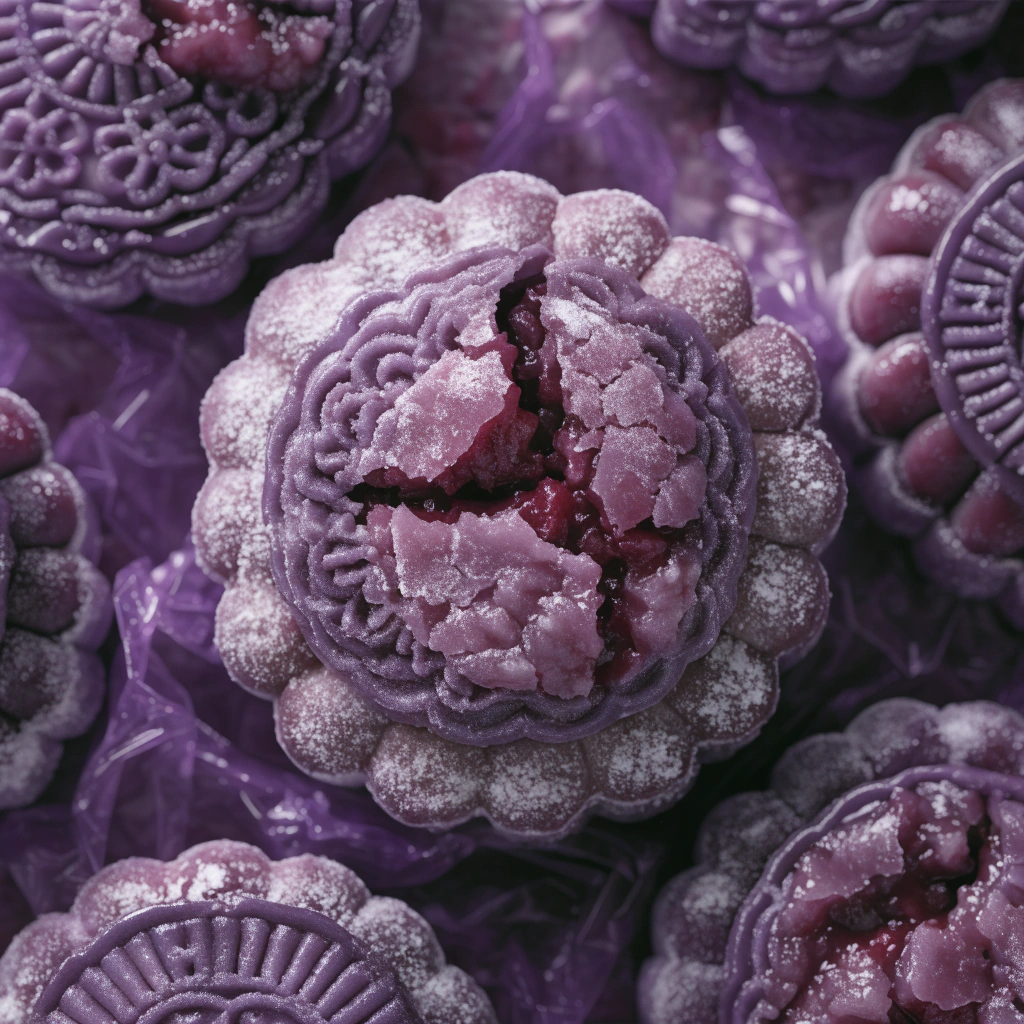
Mooncakes: A Special Chinese Tradition
Mooncakes are special cakes from China. People eat them during the Mid-Autumn Festival. This holiday is in autumn. The moon is big and round at this time.
The cakes are round like the moon. Round shapes mean family and unity in China. Families sit together and look at the moon. They drink tea and eat mooncakes.
Mooncakes are very sweet. Some have eggs inside. Others have nuts or beans. They are very delicious. People give mooncakes to friends and family. It is a beautiful tradition.
Gramática em destaque
Padrão: Present Simple (to be)
"Mooncakes are special cakes from China."
We use 'am', 'is', or 'are' to describe things. In this sentence, 'are' is used because mooncakes is plural.
Padrão: Present Simple (Regular Verbs)
"People eat them during the Mid-Autumn Festival."
We use the base form of the verb for habits or facts. For plural subjects like 'people', we do not add 's' to the verb.
Teste sua compreensão
10 perguntas · A1 Iniciante · 1 pré-visualização grátis
Teste o que aprendeu neste artigo. Responda todas as perguntas para ganhar XP!
Where are mooncakes from?
Quer finalizar o quiz?
9 perguntas a mais estão esperando por você. Cadastre-se grátis para desbloquear o quiz completo e ganhar XP!
Cadastrar grátisJá tem conta? Entrar
Detalhamento das perguntas
Where are mooncakes from?
Sua resposta:
Resposta correta: China
Mooncakes are square in shape.
Sua resposta:
Resposta correta: Falso
What does the word 'round' mean?
Sua resposta:
Resposta correta: A shape like a circle
Families sit _____ and look at the moon.
Sua resposta:
Resposta correta: together
Mooncakes: The Sweet Taste of the Full Moon
Mooncakes are special snacks from China. People eat them during the Mid-Autumn Festival. This holiday is on the fifteenth day of the eighth month of the lunar calendar. On this day, the moon is big and bright.
Mooncakes are round because they look like the full moon. In Chinese culture, a circle represents family unity and harmony. These cakes are usually small, but they are very heavy. Inside, they have sweet fillings like beans or lotus seeds. Some mooncakes even have a salty egg yolk in the middle.
The tradition of eating mooncakes started a long time ago. One famous story says that people used mooncakes to hide secret messages. They wanted to start a revolution against their leaders. Today, mooncakes are more popular than ever. People buy them in beautiful boxes and give them to their friends and family. It is a time to be happy and stay together.
Gramática em destaque
Padrão: Present Simple for Facts
"Mooncakes are special snacks from China."
We use the present simple to talk about things that are always true or general facts. Form it using the base verb or 'am/is/are' for descriptions.
Padrão: Comparatives (More + Adjective)
"Today, mooncakes are more popular than ever."
For long adjectives, we use 'more' + adjective + 'than' to compare two things. It shows that something has a higher quality than another.
Teste sua compreensão
11 perguntas · A2 Elementar · 1 pré-visualização grátis
Teste o que aprendeu neste artigo. Responda todas as perguntas para ganhar XP!
When do people eat mooncakes?
Quer finalizar o quiz?
10 perguntas a mais estão esperando por você. Cadastre-se grátis para desbloquear o quiz completo e ganhar XP!
Cadastrar grátisJá tem conta? Entrar
Detalhamento das perguntas
When do people eat mooncakes?
Sua resposta:
Resposta correta: During the Mid-Autumn Festival
Mooncakes are round because they look like the sun.
Sua resposta:
Resposta correta: Falso
What does 'harmony' mean?
Sua resposta:
Resposta correta: A peaceful agreement
On this day, the moon is big and _____.
Sua resposta:
Resposta correta: bright
What did people hide inside the cakes in the legend?
Sua resposta:
Resposta correta: Messages
Mooncakes: The Sweet Symbol of the Mid-Autumn Festival
The Mid-Autumn Festival is one of the most important traditional holidays in China. It is celebrated on the 15th day of the 8th month of the lunar calendar, when the moon is at its brightest. During this special time, families gather together to enjoy mooncakes, which are dense, circular pastries. These cakes are designed to look like the full moon. In Chinese culture, the round shape represents unity and completeness for the whole family.
Mooncakes have been part of Chinese history for centuries. According to a famous legend, they were used by revolutionaries to hide secret messages. By putting papers inside the cakes, the rebels could communicate without being caught. This helped them to start a successful uprising against their rulers. Today, although people no longer hide secrets in them, the tradition of sharing mooncakes remains very strong.
The fillings of these pastries have changed over time. Traditional mooncakes are often filled with sweet lotus seed paste or red bean paste. Sometimes, a salted duck egg yolk is placed in the center to represent the moon. However, modern versions have become very popular recently. Nowadays, you can find mooncakes that are made of chocolate, ice cream, or even fruit.
In recent years, mooncakes have also become a common gift for friends and business partners. They are usually sold in beautiful boxes that show how much the giver respects the receiver. Even though the flavors have evolved, the meaning of the festival stays the same: it is a time for family members who live far away to come back home and be together.
Gramática em destaque
Padrão: Passive Voice
"It is celebrated on the 15th day of the 8th month of the lunar calendar..."
The passive voice is used when the action is more important than the person doing it. It is formed using 'to be' + the past participle of the main verb.
Padrão: Relative Clauses
"...families gather together to enjoy mooncakes, which are dense, circular pastries."
Relative clauses provide extra information about a noun. In this example, the word 'which' starts a clause that describes what mooncakes are.
Teste sua compreensão
11 perguntas · B1 Intermediário · 1 pré-visualização grátis
Teste o que aprendeu neste artigo. Responda todas as perguntas para ganhar XP!
Why are mooncakes usually round?
Quer finalizar o quiz?
10 perguntas a mais estão esperando por você. Cadastre-se grátis para desbloquear o quiz completo e ganhar XP!
Cadastrar grátisJá tem conta? Entrar
Detalhamento das perguntas
Why are mooncakes usually round?
Sua resposta:
Resposta correta: To look like the full moon
Modern mooncakes can be made of ice cream.
Sua resposta:
Resposta correta: Verdadeiro
What does 'unity' mean?
Sua resposta:
Resposta correta: Being joined together as one
In the legend, the cakes were used to hide secret _____.
Sua resposta:
Resposta correta: messages
When is the Mid-Autumn Festival celebrated?
Sua resposta:
Resposta correta: 15th day of the 8th lunar month
Beyond the Pastry: The Cultural Significance of Mooncakes in Contemporary China
Mooncakes are far more than mere confectionery; they serve as the edible embodiment of the Mid-Autumn Festival, one of China’s most significant traditional holidays. Celebrated on the fifteenth day of the eighth lunar month, this festival coincides with the full moon, which is perceived in Chinese culture as a symbol of family unity and harmony. Consequently, the circular shape of the mooncake is not accidental; it meticulously mirrors the lunar cycle to represent completeness.
Historically, the origins of these dense pastries are shrouded in fascinating legends. One of the most enduring narratives suggests that mooncakes played a pivotal role in the overthrow of the Mongol-led Yuan Dynasty. It is often claimed that Ming Dynasty revolutionaries, led by Zhu Yuanzhang, utilized the cakes to distribute clandestine messages. By hiding slips of paper within the filling, they were able to coordinate a simultaneous uprising without alerting their occupiers. Had these secret messages not been successfully delivered, the historical trajectory of China might have been significantly different.
In the contemporary era, the diversity of mooncakes reflects the vast geographical and cultural landscape of China. While the Cantonese-style mooncake, characterized by its thin crust and sweet lotus seed paste, remains the most globally recognized variety, other regions boast their own unique interpretations. For instance, the Suzhou-style version features a flaky, multilayered pastry that can be filled with either sweet or savory ingredients. This regional variety highlights how traditional heritage adapts to local tastes over centuries.
Furthermore, the mooncake industry has undergone a remarkable evolution due to modern commercialization. While traditional fillings like salted egg yolk and red bean paste remain indispensable, contemporary bakers have introduced innovative flavors such as chocolate, green tea, and even ice cream. Some critics argue that this commercialization has diluted the spiritual essence of the festival. However, others maintain that such adaptation is necessary for the tradition to remain relevant to younger generations.
Ultimately, the act of sharing mooncakes remains a vital ritual for family reunions. Despite the influx of modern variations, the core sentiment of the festival—gratitude and togetherness—persists. As families gather to appreciate the moon, these pastries continue to act as a bridge between ancient folklore and the complexities of modern life.
Gramática em destaque
Padrão: Passive Reporting Verbs
"It is often claimed that Ming Dynasty revolutionaries, led by Zhu Yuanzhang, utilized the cakes to distribute clandestine messages."
This structure is used to report opinions or beliefs held by a group of people without naming them. It uses 'It + passive verb + that clause' to maintain a formal, objective tone.
Padrão: Inverted Third Conditional
"Had these secret messages not been successfully delivered, the historical trajectory of China might have been significantly different."
This is a formal alternative to 'If these secret messages had not been...'. It describes a hypothetical past situation and its potential result, using inversion for emphasis.
Padrão: Non-defining Relative Clauses
"Celebrated on the fifteenth day of the eighth lunar month, this festival coincides with the full moon, which is perceived in Chinese culture as a symbol of family unity and harmony."
This clause adds extra information about the 'full moon'. It is separated by a comma and uses 'which' because the information is descriptive rather than essential for identifying the noun.
Teste sua compreensão
11 perguntas · B2 Intermediário superior · 1 pré-visualização grátis
Teste o que aprendeu neste artigo. Responda todas as perguntas para ganhar XP!
According to the article, what was the legendary use of mooncakes during the Yuan Dynasty?
Quer finalizar o quiz?
10 perguntas a mais estão esperando por você. Cadastre-se grátis para desbloquear o quiz completo e ganhar XP!
Cadastrar grátisJá tem conta? Entrar
Detalhamento das perguntas
According to the article, what was the legendary use of mooncakes during the Yuan Dynasty?
Sua resposta:
Resposta correta: To hide and transport secret messages for an uprising
Suzhou-style mooncakes are strictly limited to sweet fillings only.
Sua resposta:
Resposta correta: Falso
What does 'indispensable' mean in the context of the article?
Sua resposta:
Resposta correta: Absolutely necessary
Historically, the origins of these dense pastries are shrouded in fascinating _____.
Sua resposta:
Resposta correta: legends
What does the circular shape of the mooncake represent in Chinese culture?
Sua resposta:
Resposta correta: Completeness and family unity
The Celestial Pastry: Deconstructing the Cultural Semantics of the Mooncake
Rarely has a culinary artifact carried such a profound burden of historical narrative and cultural symbolism as the mooncake. As the autumnal equinox approaches, the ubiquity of these dense, circular pastries across China signals the arrival of the Mid-Autumn Festival, a period defined by the veneration of the full moon and the celebration of familial cohesion. While the mooncake is ostensibly a gastronomic delight, its significance transcends mere sustenance, acting instead as a vessel for complex social and political histories. To understand the mooncake is to navigate the intricate intersection of legend, tradition, and the modern commodification of heritage.
Historical lore suggests that the mooncake’s role was not always purely celebratory. Folklore surrounding the Ming Dynasty revolutionaries under Zhu Yuanzhang posits that these pastries served as clandestine conduits for strategic intelligence. By concealing secret messages within the fillings, the revolutionaries allegedly orchestrated a subversion of the Mongol-led Yuan Dynasty. Whether this account is historically verifiable or merely a romanticized myth, the narrative underscores the mooncake’s identity as an object of unity and collective resistance. In contemporary society, this sense of unity is maintained through the arduous process of gifting, where the exchange of mooncakes reinforces social hierarchies and familial bonds.
It is the communal act of sharing that imbues the mooncake with its most profound significance. Traditionally, the pastry is meticulously sliced into portions equal to the number of family members, reflecting the Chinese ideal of 'yuanman'—a state of completeness and harmony. However, the modern era has introduced a tension between this traditional sentimentality and the relentless tide of commercialization. The sheer homogeneity of mass-produced mooncakes often clashes with the artisanal craftsmanship of regional varieties. From the flaky, savory crusts of the Suzhou style to the rich, lotus seed paste of the Cantonese tradition, the regional diversity of mooncakes serves as a rebuttal to the increasing globalization of the Chinese palate.
Furthermore, the evolution of fillings reflects broader shifts in socio-economic status. While traditional salted duck egg yolks and red bean paste remain staples, the emergence of luxury ingredients like abalone or truffle, and even contemporary iterations like ice cream mooncakes, highlights a shift toward conspicuous consumption. Critics argue that the commodification of the festival has diluted its spiritual essence, turning a moment of lunar reflection into a high-stakes arena for corporate branding and social signaling. Yet, despite these criticisms, the mooncake remains an ephemeral bridge between the past and the present. Its persistence in the digital age suggests that even as lifestyles undergo rapid transformation, the human desire for symbolic continuity remains unshakable. Ultimately, the mooncake is less about the pastry itself and more about the enduring pursuit of wholeness in an increasingly fragmented world.
Gramática em destaque
Padrão: Inversion with Negative Adverbials
"Rarely has a culinary artifact carried such a profound burden of historical narrative and cultural symbolism as the mooncake."
When a negative or restrictive adverbial (like 'rarely') starts a sentence, the auxiliary verb comes before the subject. This structure is used for emphasis and to create a more formal, literary tone.
Padrão: It-Cleft Sentences
"It is the communal act of sharing that imbues the mooncake with its most profound significance."
A cleft sentence is used to focus on a specific part of the information. By using 'It is... that...', the writer emphasizes the 'communal act' as the primary source of meaning.
Padrão: Nominalization
"The sheer homogeneity of mass-produced mooncakes often clashes with the artisanal craftsmanship of regional varieties."
Nominalization involves turning verbs or adjectives into nouns (e.g., 'commodification', 'subversion'). This is a hallmark of C1 writing as it allows for a more objective, abstract, and dense academic style.
Teste sua compreensão
12 perguntas · C1 Avançado · 1 pré-visualização grátis
Teste o que aprendeu neste artigo. Responda todas as perguntas para ganhar XP!
What does the author suggest about the historical legend of the Ming Dynasty revolutionaries?
Quer finalizar o quiz?
11 perguntas a mais estão esperando por você. Cadastre-se grátis para desbloquear o quiz completo e ganhar XP!
Cadastrar grátisJá tem conta? Entrar
Detalhamento das perguntas
What does the author suggest about the historical legend of the Ming Dynasty revolutionaries?
Sua resposta:
Resposta correta: It highlights the mooncake's role as a symbol of resistance, regardless of its factual accuracy.
The author argues that modern mooncakes have completely lost their spiritual essence due to commercialization.
Sua resposta:
Resposta correta: Falso
Which word describes something that is present everywhere at the same time?
Sua resposta:
Resposta correta: Ubiquity
The exchange of mooncakes in modern society helps reinforce social _____.
Sua resposta:
Resposta correta: hierarchies
What is the primary function of the concept of 'yuanman' in the text?
Sua resposta:
Resposta correta: To represent the ideal of family completeness and harmony.
Regional variations of mooncakes are described as a reaction against the globalization of taste.
Sua resposta:
Resposta correta: Verdadeiro
Semicircular Synecdoche: The Ontological and Socio-Political Dimensions of the Mooncake
The Mid-Autumn Festival, an epochal event in the Sinitic calendar, finds its most potent gastronomic expression in the mooncake. Beyond its saccharine exterior lies a palimpsest of historical narrative and socio-cultural stratification. To the uninitiated, it is merely a dense pastry; however, to the scholar of semiotics, it represents a confluence of lunar worship and familial cohesion. Were one to scrutinize the intricate patterns embossed upon the crust, one might discern the vestiges of an era where communication was clandestine. The legend of the Ming uprising, wherein secret missives were purportedly concealed within these crusts to overthrow the Yuan Dynasty, serves as a testament to the cake's role as a vessel of political agency, regardless of the historical veracity of such claims. This narrative, apocryphal though it may be, imbues the pastry with a revolutionary subtext that transcends its culinary utility.
Furthermore, the mooncake functions as a vehicle for 'guanxi'—the intricate web of social relations that underpins Chinese society. In the contemporary milieu, the gift-giving culture surrounding these pastries has evolved into a performative display of social capital. The aestheticization of packaging and the infusion of exotic ingredients—ranging from abalone to black truffle—suggest a shift from communal sustenance to conspicuous consumption. Nevertheless, the core remains: the salted egg yolk, a golden orb ensconced in lotus seed paste, mirroring the full moon. This visual synecdoche reinforces the concept of 'tuanyuan' (reunion), an ideal that persists despite the centrifugal forces of globalization and urban migration. The circularity of the cake is not a mere aesthetic choice; it is an ontological anchor, tethering the individual to the ancestral collective through the act of shared consumption.
Seldom has a culinary artifact been so burdened with the weight of national identity. It might be argued that the mooncake has transcended its status as a mere comestible to become a semiotic marker of 'Chineseness.' While the regional variations—from the flaky, savory crusts of Suzhou to the tender, syrup-infused skins of Canton—reflect the vast geographical diversity of the nation, they all coalesce around the same central theme: the cyclical nature of time and the indissolubility of the family unit. In an era characterized by rapid flux and digital alienation, the mooncake offers a tangible, albeit ephemeral, sense of ontological security. It provides a moment of stasis, where the historical past and the hyper-modern present converge on a single porcelain plate.
The commercialization of the festival, while often decried by purists as a dilution of tradition, actually highlights the resilience of the mooncake as a cultural icon. Even as the ingredients evolve to cater to a globalized palate, the fundamental geometry of the cake—the circle—remains inviolate. This geometric constancy serves as a bulwark against the fragmentation of modern life. Furthermore, the environmental critique of the 'over-packaging' phenomenon represents a modern dialectic between traditional prestige and contemporary sustainability. Thus, the mooncake is not merely a seasonal treat but a complex cultural text, waiting to be decoded by those who seek to understand the enduring spirit of the Middle Kingdom. It remains a profound intersection of history, philosophy, and the persistent human desire for wholeness.
Gramática em destaque
Padrão: Inverted Conditional (Subjunctive Mood)
"Were one to scrutinize the intricate patterns embossed upon the crust, one might discern the vestiges of an era where communication was clandestine."
This formal structure replaces 'If one were to...' by inverting the subject and the verb 'were'. It is used in C2 English to express hypothetical or counterfactual situations with a high degree of formality.
Padrão: Negative Inversion for Emphasis
"Seldom has a culinary artifact been so burdened with the weight of national identity."
When a negative or limiting adverb like 'seldom' or 'never' starts a sentence, the auxiliary verb and subject are inverted. This creates a more dramatic and scholarly tone.
Padrão: Modal Hedging in Academic Prose
"It might be argued that the mooncake has transcended its status as a mere comestible."
The use of 'might be argued' is a common academic hedging device. It allows the author to propose a theory without making an absolute, unprovable claim, which is characteristic of C2 proficiency.
Teste sua compreensão
12 perguntas · C2 Domínio · 1 pré-visualização grátis
Teste o que aprendeu neste artigo. Responda todas as perguntas para ganhar XP!
What does the author suggest about the historical legend of the Ming uprising?
Quer finalizar o quiz?
11 perguntas a mais estão esperando por você. Cadastre-se grátis para desbloquear o quiz completo e ganhar XP!
Cadastrar grátisJá tem conta? Entrar
Detalhamento das perguntas
What does the author suggest about the historical legend of the Ming uprising?
Sua resposta:
Resposta correta: Its historical accuracy is less important than its symbolic meaning.
The author views the modern aestheticization of mooncake packaging as a purely positive development for tradition.
Sua resposta:
Resposta correta: Falso
What is the meaning of 'synecdoche' as used in the text?
Sua resposta:
Resposta correta: A part that represents a larger whole.
The egg yolk is described as being _____ in lotus seed paste.
Sua resposta:
Resposta correta: ensconced
What are the 'centrifugal forces' mentioned in the second paragraph?
Sua resposta:
Resposta correta: Social factors like globalization that pull people away from their roots.
According to the text, the fundamental geometry of the mooncake has changed significantly over time.
Sua resposta:
Resposta correta: Falso

