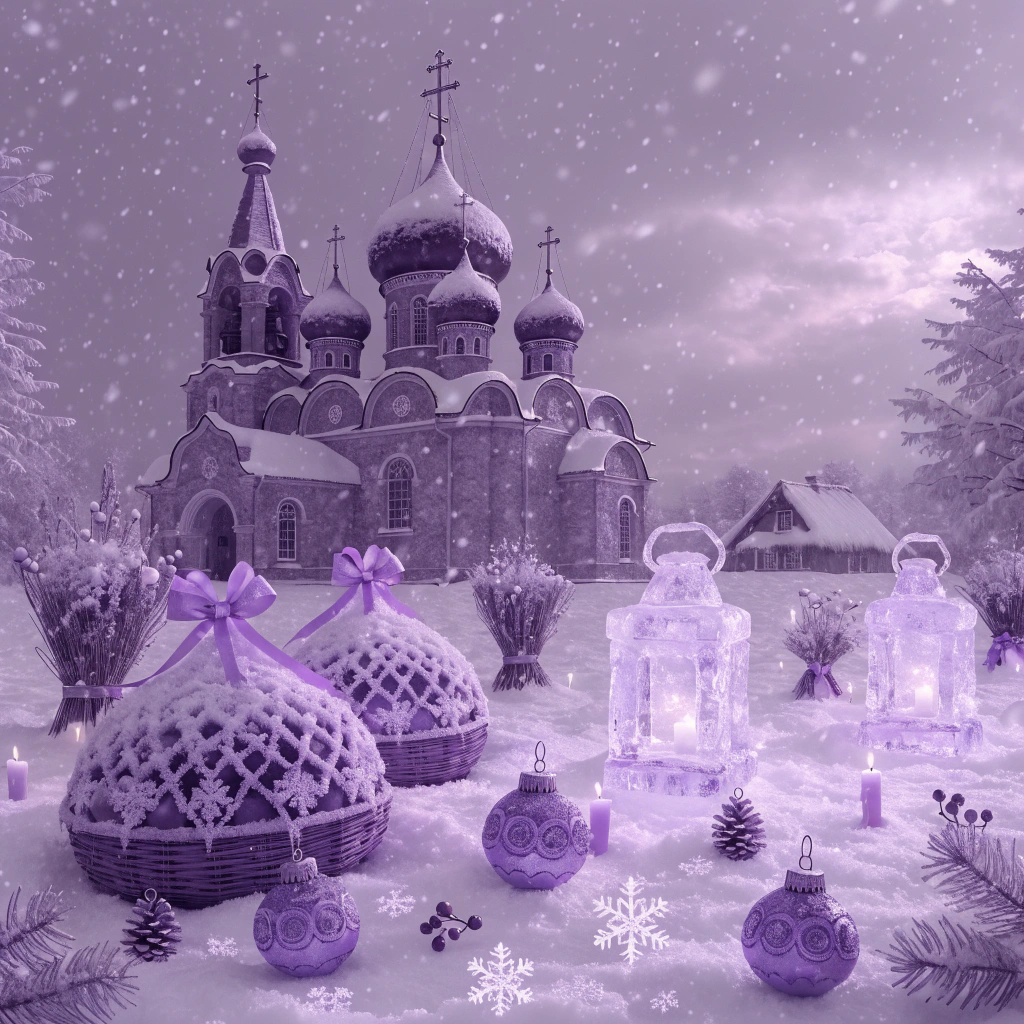
Christmas in Russia
Christmas in Russia is special. It is not in December. Russian people celebrate Christmas on January 7th. They call it Rozhdestvo. It is a very quiet holiday.
Families stay together at home. On Christmas Eve, many people go to church. The service is very long and beautiful. After church, they have a big dinner. They eat traditional food and talk.
In Russia, children get gifts on New Year’s Eve. So, Christmas is a time for prayer and family. It is a peaceful day for everyone.
Gramática em destaque
Padrão: Present Simple 'to be'
"Christmas in Russia is special."
We use 'is' with singular subjects like 'Christmas' to describe a fact or state. This is the most common way to give information in English.
Padrão: Present Simple 'Action Verbs'
"Families stay together at home."
We use the base form of the verb (stay) with plural subjects like 'Families'. This pattern describes regular habits or general truths.
Teste sua compreensão
10 perguntas · A1 Iniciante · 1 pré-visualização grátis
Teste o que aprendeu neste artigo. Responda todas as perguntas para ganhar XP!
When do Russian people celebrate Christmas?
Quer finalizar o quiz?
9 perguntas a mais estão esperando por você. Cadastre-se grátis para desbloquear o quiz completo e ganhar XP!
Cadastrar grátisJá tem conta? Entrar
Detalhamento das perguntas
When do Russian people celebrate Christmas?
Sua resposta:
Resposta correta: January 7th
Russian Christmas is a very loud and busy holiday.
Sua resposta:
Resposta correta: Falso
What does the word 'gifts' mean?
Sua resposta:
Resposta correta: Things you give to someone
After church, families have a big _____.
Sua resposta:
Resposta correta: dinner
A Special Christmas in Russia
In Russia, Orthodox Christmas is a very special holiday. People celebrate it on January 7th because they use an old calendar. It is different from Christmas in Europe or America. For Russians, New Year’s Eve is the time for big parties and many gifts. Christmas is a more quiet and religious day.
Families usually stay together at home. Many people go to church for a long service at night. After the service, they eat a big dinner. A famous dish is called 'kutia'. It is a sweet porridge with grains, honey, and nuts. This meal is important because it brings good luck for the new year.
Orthodox Christmas is more spiritual than New Year. Children like it because it is a peaceful time. The streets are beautiful with white snow and bright lights. It is a wonderful time to visit Russia because the traditions are very old and interesting.
Gramática em destaque
Padrão: Comparative Adjectives (more + adjective + than)
"Orthodox Christmas is more spiritual than New Year."
Use 'more' before long adjectives to compare two things. This shows that one thing has a higher quality than the other.
Padrão: Conjunction 'because'
"People celebrate it on January 7th because they use an old calendar."
Use 'because' to give a reason for an action. It connects a result with its cause in one sentence.
Teste sua compreensão
11 perguntas · A2 Elementar · 1 pré-visualização grátis
Teste o que aprendeu neste artigo. Responda todas as perguntas para ganhar XP!
When do people celebrate Orthodox Christmas in Russia?
Quer finalizar o quiz?
10 perguntas a mais estão esperando por você. Cadastre-se grátis para desbloquear o quiz completo e ganhar XP!
Cadastrar grátisJá tem conta? Entrar
Detalhamento das perguntas
When do people celebrate Orthodox Christmas in Russia?
Sua resposta:
Resposta correta: January 7th
New Year’s Eve is the main time for giving gifts in Russia.
Sua resposta:
Resposta correta: Verdadeiro
What is 'kutia'?
Sua resposta:
Resposta correta: A sweet porridge with grains and honey
The streets are beautiful with white _____ and bright lights.
Sua resposta:
Resposta correta: snow
Why is the date of Christmas different in Russia?
Sua resposta:
Resposta correta: Because they use an old calendar
A Spiritual Season: Orthodox Christmas in Russia
In Russia, Christmas is celebrated on January 7th, which is different from the December date used in many other countries. This occurs because the Russian Orthodox Church follows the old Julian calendar, which currently lags thirteen days behind the Gregorian calendar. While New Year's Eve is the primary time for loud parties and gift-giving, Christmas remains a deeply spiritual and peaceful holiday for many families.
The celebrations typically begin on January 6th, known as Christmas Eve. On this night, many people attend a long church service called the "All-Night Vigil," which lasts until the early hours of the morning. These services, which are held in magnificent cathedrals like the Cathedral of Christ the Saviour in Moscow, have been broadcast on national television for decades. Devout followers often fast throughout the day, refusing to eat until the first star has appeared in the evening sky.
Once the star is visible, families gather for a traditional dinner. A central part of this meal is "kutia," a sweet porridge made from wheat or rice, honey, and poppy seeds. It is traditional to serve twelve different dishes, which represent the twelve apostles of Jesus. Although meat and dairy are often avoided during the fast, the final Christmas feast is full of rich, delicious food that has been prepared with great care.
In the mid-20th century, religious holidays were restricted in Russia, but today, Christmas has become a major national holiday once again. The period from January 7th to January 19th is known as "Svyatki," a time for visiting friends and singing carols. It is a season when people reflect on their values and enjoy the company of their loved ones. Even though the holiday is less commercial than in the West, the ancient traditions that have been preserved for centuries continue to bring Russian communities together every winter.
Gramática em destaque
Padrão: Orações Relativas
"This occurs because the Russian Orthodox Church follows the old Julian calendar, which currently lags thirteen days behind the Gregorian calendar."
As orações relativas começam com palavras como 'which' (que/o qual) ou 'who' (quem/que) para dar mais informações sobre um substantivo. Neste caso, 'which' descreve o calendário Juliano.
Padrão: Voz Passiva (Present Perfect)
"These services... have been broadcast on national television for decades."
A voz passiva é usada quando a ação é mais importante do que quem a realizou. 'Have been broadcast' mostra uma ação que começou no passado e continua sendo relevante.
Teste sua compreensão
11 perguntas · B1 Intermediário · 1 pré-visualização grátis
Teste o que aprendeu neste artigo. Responda todas as perguntas para ganhar XP!
Por que a Rússia comemora o Natal no dia 7 de janeiro?
Quer finalizar o quiz?
10 perguntas a mais estão esperando por você. Cadastre-se grátis para desbloquear o quiz completo e ganhar XP!
Cadastrar grátisJá tem conta? Entrar
Detalhamento das perguntas
Por que a Rússia comemora o Natal no dia 7 de janeiro?
Sua resposta:
Resposta correta: A Igreja Ortodoxa usa o calendário Juliano
A véspera de Ano Novo costuma ser um evento maior para presentes e festas do que o Natal na Rússia.
Sua resposta:
Resposta correta: Verdadeiro
O que é uma 'catedral'?
Sua resposta:
Resposta correta: Uma igreja grande e importante
Uma parte central da ceia de véspera de Natal é o ______, um mingau doce feito de grãos.
Sua resposta:
Resposta correta: kutia
Qual é o significado de servir doze pratos durante a refeição?
Sua resposta:
Resposta correta: Representa os doze apóstolos de Jesus
Faith and Tradition: Navigating the Complexity of Russian Orthodox Christmas
While much of the world concludes its festive season in late December, Russia prepares for a profound spiritual observance known as Rozhdestvo. Unlike Western traditions based on the Gregorian calendar, the Russian Orthodox Church continues to adhere to the Julian calendar for its liturgical schedule. Although the Soviet state officially adopted the Gregorian system in 1918 to align with international standards, the Church maintained the older tradition, resulting in Christmas being celebrated on January 7th. This thirteen-day discrepancy is not merely a chronological quirk; it represents a steadfast commitment to ecclesiastical heritage that distinguishes Russian festivities from their more secular counterparts abroad.
The atmosphere surrounding Orthodox Christmas is notably more solemn than the exuberant celebrations of New Year’s Eve. In Russia, the New Year serves as the primary occasion for gift-giving and grand social gatherings, whereas Christmas remains a deeply religious and family-centric event. For many believers, the holiday is preceded by a rigorous forty-day fast, during which meat and dairy products are avoided. This period of abstinence culminates in the 'Holy Supper' on Christmas Eve, which traditionally begins only after the appearance of the first star in the night sky, symbolizing the Star of Bethlehem.
Historically, the holiday has undergone significant transformations. Following the 1917 Revolution, religious practices faced systematic suppression as the Soviet Union promoted state-sponsored atheism. Consequently, many Christmas traditions were either banned or integrated into the secular New Year celebrations. It was only after the collapse of the Soviet regime that Orthodox Christmas witnessed a remarkable revival, eventually being reinstated as a public holiday. Today, the centerpiece of the celebration is the elaborate Christmas liturgy held at the Cathedral of Christ the Saviour in Moscow, which is broadcast nationwide.
Modern Russian Christmas reflects a multifaceted blend of ancient spirituality and contemporary national identity. Although the religious aspects are paramount for the faithful, many non-practicing citizens also embrace the holiday as a time for cultural reflection and family unity. In recent years, there has been a noticeable effort to preserve the authentic nature of the holiday. Despite the overwhelming commercialization that has affected many global holidays, Rozhdestvo has largely maintained its spiritual integrity, offering a quiet, contemplative counterpoint to the preceding New Year festivities. Ultimately, the holiday serves as a vital bridge between Russia's complex historical past and its present-day cultural landscape.
Gramática em destaque
Padrão: Present Participle Phrases for Result
"the Church maintained the older tradition, resulting in Christmas being celebrated on January 7th."
The present participle (-ing) can be used to describe the result of the action in the main clause. It functions as a shorter alternative to 'which resulted in'.
Padrão: Relative Clauses with Prepositions
"the holiday is preceded by a rigorous forty-day fast, during which meat and dairy products are avoided."
In formal English, prepositions like 'during' or 'in' are placed before the relative pronoun 'which'. This creates a smooth transition between the noun and the following description.
Padrão: Concessive Clauses with 'Although'
"Although the religious aspects are paramount for the faithful, many non-practicing citizens also embrace the holiday."
Concessive clauses use 'although' or 'even though' to introduce a contrast or a surprising fact that does not prevent the main action from happening.
Teste sua compreensão
11 perguntas · B2 Intermediário superior · 1 pré-visualização grátis
Teste o que aprendeu neste artigo. Responda todas as perguntas para ganhar XP!
Why does the Russian Orthodox Church celebrate Christmas on January 7th?
Quer finalizar o quiz?
10 perguntas a mais estão esperando por você. Cadastre-se grátis para desbloquear o quiz completo e ganhar XP!
Cadastrar grátisJá tem conta? Entrar
Detalhamento das perguntas
Why does the Russian Orthodox Church celebrate Christmas on January 7th?
Sua resposta:
Resposta correta: They follow the ancient Julian calendar.
In Russia, Christmas is the primary day for giving gifts and social parties.
Sua resposta:
Resposta correta: Falso
What does 'suppression' mean in the context of the Soviet era?
Sua resposta:
Resposta correta: Forcibly ending religious practices.
The religious celebration is preceded by a forty-day _____ during which certain foods are avoided.
Sua resposta:
Resposta correta: fast
What event traditionally signals the start of the 'Holy Supper' on Christmas Eve?
Sua resposta:
Resposta correta: The appearance of the first star in the sky.
The Echoes of Eternity: Navigating the Cultural and Spiritual Landscape of Russian Orthodox Christmas
Rarely does one encounter a holiday so steeped in both profound spirituality and complex political history as the Russian Orthodox Christmas, known locally as Rozhdestvo. While the Western world concludes its festive cycle shortly after the Gregorian New Year, Russia’s spiritual heart begins to beat most fervently as January 7th approaches. It is this temporal discrepancy, rooted in the Russian Orthodox Church’s continued adherence to the Julian calendar, that necessitates the celebration nearly two weeks after its Catholic and Protestant counterparts, providing a distinct rhythmic cadence to the Russian winter.
The history of Rozhdestvo is a narrative of resilience and resurgence. Following the 1917 Revolution, the systematic suppression of religious festivities during the Soviet era led to a curious cultural transposition. In an attempt to secularize society, the Bolsheviks redirected the aesthetic and emotional hallmarks of Christmas—the decorated tree, the gift-giving, and the figure of Father Frost—toward New Year’s Eve. Consequently, what was once a unified religious celebration became bifurcated. To this day, New Year’s Eve remains the primary occasion for secular revelry, while Christmas has reclaimed its status as a day of quietude and ecclesiastical devotion.
What defines the Russian festive season is not the commercial frenzy often associated with the West, but a hushed, contemplative solemnity. For devout adherents, the period leading up to the holiday is marked by a forty-day fast, emphasizing spiritual purification over material consumption. This asceticism reaches its zenith on Sochelnik, or Christmas Eve. Tradition dictates that no food may be consumed until the appearance of the first star in the night sky, symbolizing the Star of Bethlehem. Only then do families gather for a meal that, while meatless, is rich in symbolic significance, often featuring 'Kutya'—a porridge of grains, honey, and poppy seeds representing hope and immortality.
Underpinning the holiday is the grand liturgical tradition of the Orthodox Church. On the night of January 6th, the nation’s spiritual focus shifts to the Cathedral of Christ the Saviour in Moscow, where the Patriarch leads a service of immense choral beauty and ritual complexity. The air is thick with the scent of incense and the flicker of a thousand candles, creating an atmosphere where the boundaries between the earthly and the divine seem to blur. Never has the juxtaposition between the biting Russian winter and the internal warmth of the liturgy been more palpable.
In the modern era, the celebration of Rozhdestvo represents a complex synthesis of ancient tradition and contemporary national identity. While many Russians may not be strictly observant in their daily lives, the cultural weight of the holiday remains undeniable. It serves as a vestige of a pre-revolutionary past and a beacon of spiritual continuity in a rapidly changing world. Ultimately, it is the enduring power of these rituals that ensures Rozhdestvo remains a cornerstone of the Russian soul, offering a moment of profound reflection amidst the encroaching secularization of the twenty-first century. As the bells of the Kremlin chime across the frozen Moskva river, the nation pauses to acknowledge a heritage that has survived empires and ideologies alike.
Gramática em destaque
Padrão: Negative Inversion
"Rarely does one encounter a holiday so steeped in both profound spirituality and complex political history as the Russian Orthodox Christmas."
When a negative or restrictive adverbial (like 'rarely' or 'never') starts a sentence, the subject and auxiliary verb are inverted. This adds emphasis and is common in formal C1-level writing.
Padrão: It-Cleft Sentences
"It is this temporal discrepancy that necessitates the celebration nearly two weeks after its Catholic and Protestant counterparts."
A cleft sentence is used to focus on a specific part of information. By using 'It is... that...', the writer highlights the cause (the discrepancy) as the most important factor in the sentence.
Padrão: Nominalisation
"The systematic suppression of religious festivities during the Soviet era led to a curious cultural transposition."
Nominalisation involves turning verbs or adjectives into nouns (e.g., 'suppress' to 'suppression'). This creates a more formal, academic tone and allows for denser information packaging.
Teste sua compreensão
12 perguntas · C1 Avançado · 1 pré-visualização grátis
Teste o que aprendeu neste artigo. Responda todas as perguntas para ganhar XP!
What is the primary reason for the 13-day difference between Western and Russian Christmas?
Quer finalizar o quiz?
11 perguntas a mais estão esperando por você. Cadastre-se grátis para desbloquear o quiz completo e ganhar XP!
Cadastrar grátisJá tem conta? Entrar
Detalhamento das perguntas
What is the primary reason for the 13-day difference between Western and Russian Christmas?
Sua resposta:
Resposta correta: The Orthodox Church's use of the Julian calendar
The Soviet era successfully eliminated all aesthetic elements of Christmas from Russian culture.
Sua resposta:
Resposta correta: Falso
What does 'liturgical' mean in the context of the article?
Sua resposta:
Resposta correta: Relating to public religious worship and ritual
This _____ reaches its zenith on Sochelnik, or Christmas Eve.
Sua resposta:
Resposta correta: asceticism
How did the Bolsheviks attempt to secularize Russian society regarding Christmas?
Sua resposta:
Resposta correta: By transferring Christmas traditions to New Year’s Eve
The forty-day fast emphasizes material consumption over spiritual purification.
Sua resposta:
Resposta correta: Falso
The Julian Temporal Palimpsest: Navigating the Profundity of Russian Rozhdestvo
While much of the Western world has succumbed to the cacophony of commercialized cheer by late December, the Russian observance of Rozhdestvo—Orthodox Christmas—remains a bastion of liturgical solemnity and quietude. This temporal dissonance, rooted in the Russian Orthodox Church’s unwavering adherence to the Julian calendar, places the celebration on January 7th, exactly thirteen days posterior to the Gregorian equivalent. To understand Rozhdestvo is to engage with a complex historical palimpsest, where ecclesiastical tradition, Soviet suppression, and post-Soviet revival intersect in a fascinating display of cultural recalcitrance.
The historical trajectory of the holiday is nothing short of tumultuous. Following the 1917 Bolshevik Revolution, the state-mandated secularization of Russian society saw Christmas relegated to the periphery of public life. Religious iconography and rituals were effectively subsumed by the New Year’s celebrations—a strategic transmutation that introduced 'Grandfather Frost' as a secular surrogate for Saint Nicholas. Rarely is the distinction between political ideology and spiritual endurance so starkly illustrated as it is in the survival of Christmas through these decades of official atheism. Despite state efforts to eradicate the holiday, it persisted in the private spheres of the home, preserved as a vestigial yet potent symbol of faith. Since the collapse of the Soviet Union, Rozhdestvo has undergone a significant renaissance, reclaiming its status as one of the 'Twelve Great Feasts,' though it retains an aura of asceticism that contrasts sharply with the festive exuberance of the New Year.
The spiritual climax of the season begins with 'Sochelnik,' or Christmas Eve. This day is characterized by a rigorous fast, representing a period of purification and reflection. It is tradition that the faithful refrain from sustenance until the appearance of the first star in the night sky—a symbolic homage to the Star of Bethlehem. Were one to survey a traditional Russian household on this evening, one would encounter the 'Holy Supper,' a meal consisting of twelve meatless dishes, each signifying one of the twelve apostles. The centerpiece is invariably 'kutia,' a concoction of grains, honey, and poppy seeds, symbolizing hope, immortality, and the union of the living and the departed. This ritualistic meal serves as a bridge between the physical and the transcendental, emphasizing the communal nature of the faith.
Central to the experience of Rozhdestvo is the Divine Liturgy, conducted in the opulent yet hushed interiors of Orthodox cathedrals. Unlike the organ-heavy services of the West, the Russian liturgy relies exclusively on a cappella choral music, creating an atmosphere of ethereal beauty. The incense-laden air and the flickering candlelight reflected in golden icons facilitate an environment of deep contemplation. It is imperative that the observer appreciate the ontological significance of these rites; they are not merely commemorative acts but are believed to be a contemporary participation in the Nativity itself. This sense of timelessness is further reinforced by the use of Old Church Slavonic, a liturgical language that distances the ritual from the mundanity of everyday speech.
In the contemporary Russian landscape, Rozhdestvo stands as a testament to the enduring power of religious identity in a rapidly globalizing world. While the secular New Year remains the primary occasion for gift-giving and public revelry, Christmas has solidified its position as a day of profound spiritual introspection and familial intimacy. The juxtaposition of these two celebrations—the exuberant and the austere—reflects the multifaceted nature of the Russian soul. Ultimately, Rozhdestvo is less an event than it is a state of being, a deliberate withdrawal from the ephemeral concerns of the material world in favor of an encounter with the eternal.
Gramática em destaque
Padrão: Inversão Negativa
"Rarely is the distinction between political ideology and spiritual endurance so starkly illustrated as it is in the survival of Christmas..."
Quando um advérbio negativo ou restritivo (como 'rarely' ou 'seldom') inicia uma frase, o verbo auxiliar e o sujeito são invertidos. Isso é usado para ênfase retórica no inglês formal.
Padrão: Condicionais Invertidas (Segunda/Terceira)
"Were one to survey a traditional Russian household on this evening, one would encounter the 'Holy Supper'..."
Em contextos formais, 'if' pode ser omitido e substituído pela inversão do verbo (Were/Had/Should). Aqui, 'Were one to survey' é uma maneira mais sofisticada de dizer 'If one were to survey'.
Padrão: Subjuntivo Mandativo
"It is imperative that the observer appreciate the ontological significance of these rites..."
O modo subjuntivo é usado após adjetivos que expressam urgência ou importância. Note que 'appreciate' não tem o 's' da terceira pessoa, apesar do sujeito singular 'the observer'.
Teste sua compreensão
12 perguntas · C2 Domínio · 1 pré-visualização grátis
Teste o que aprendeu neste artigo. Responda todas as perguntas para ganhar XP!
Qual é a principal razão para a diferença de data entre o Natal Ortodoxo Russo e o Natal Ocidental?
Quer finalizar o quiz?
11 perguntas a mais estão esperando por você. Cadastre-se grátis para desbloquear o quiz completo e ganhar XP!
Cadastrar grátisJá tem conta? Entrar
Detalhamento das perguntas
Qual é a principal razão para a diferença de data entre o Natal Ortodoxo Russo e o Natal Ocidental?
Sua resposta:
Resposta correta: Adesão ao calendário Juliano em vez do Gregoriano
Durante a era soviética, as tradições de Natal foram totalmente perdidas e tiveram que ser reinventadas do zero na década de 1990.
Sua resposta:
Resposta correta: Falso
Qual palavra melhor descreve a natureza 'sem carne' e 'purificadora' do jejum mencionado no texto?
Sua resposta:
Resposta correta: Asceticism
As camadas históricas da tradição mencionadas na introdução são descritas usando a metáfora de um _____.
Sua resposta:
Resposta correta: palimpsest
Qual elemento é especificamente notado como ausente da Divina Liturgia Russa em comparação com os serviços ocidentais?
Sua resposta:
Resposta correta: Música de órgão
O texto sugere que, para os fiéis, a liturgia não é apenas uma memória, mas uma participação atual no nascimento de Cristo.
Sua resposta:
Resposta correta: Verdadeiro

