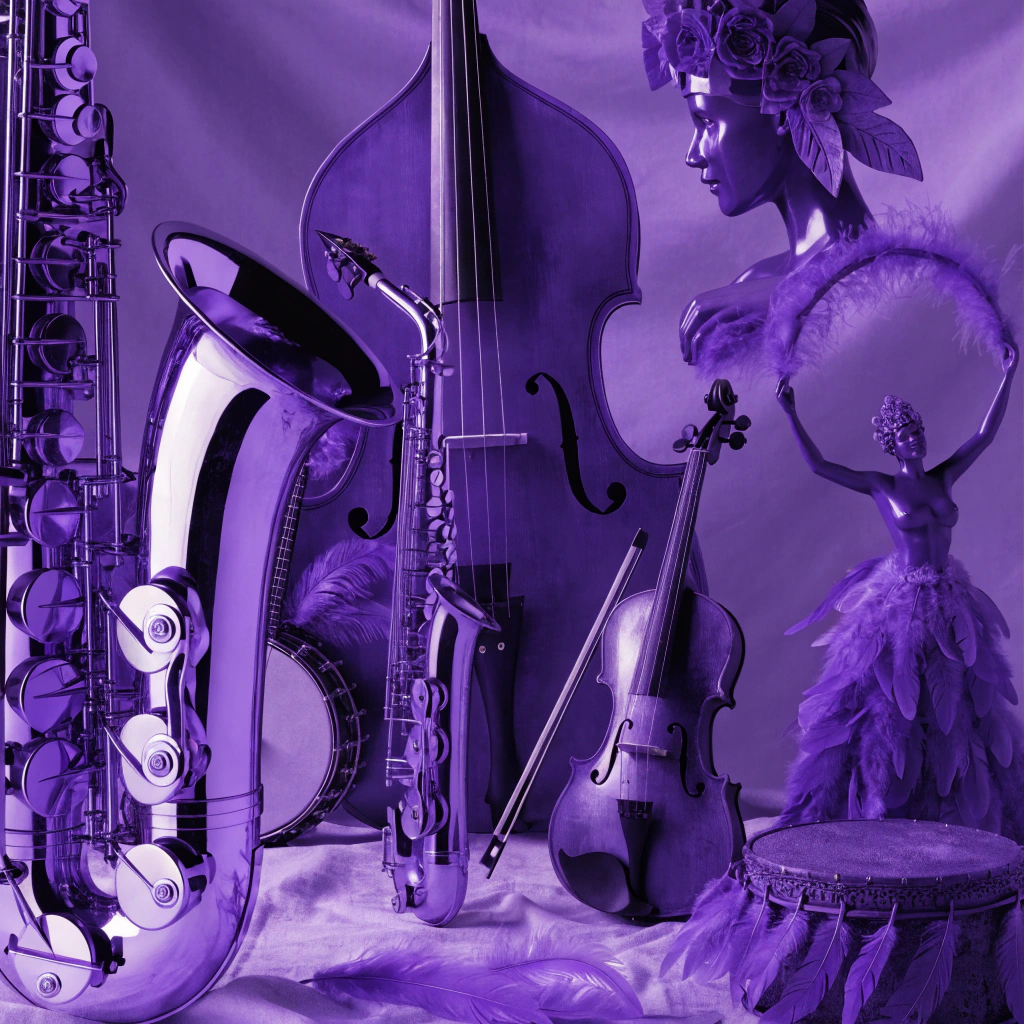
Jazz: Music from America
Jazz is a famous style of music. It is from the United States. Many people love jazz. It started in a city called New Orleans.
Jazz is special. Musicians play instruments like the trumpet and the piano. They often make new music while they play. This is called improvisation.
Jazz has many sounds. Sometimes it is fast. Sometimes it is slow. It is important to American history. You can hear jazz in clubs and at big festivals today.
Gramática em destaque
Padrão: Present Simple: To Be
"Jazz is a famous style of music."
We use 'is' with singular subjects like 'Jazz' to talk about facts. It connects the subject to a description.
Padrão: Present Simple: Regular Verbs
"Musicians play instruments like the trumpet."
For plural subjects like 'Musicians', we use the base form of the verb. This describes a regular action or habit.
Teste sua compreensão
10 perguntas · A1 Iniciante · 1 pré-visualização grátis
Teste o que aprendeu neste artigo. Responda todas as perguntas para ganhar XP!
Where did jazz start?
Quer finalizar o quiz?
9 perguntas a mais estão esperando por você. Cadastre-se grátis para desbloquear o quiz completo e ganhar XP!
Cadastrar grátisJá tem conta? Entrar
Detalhamento das perguntas
Where did jazz start?
Sua resposta:
Resposta correta: New Orleans
Jazz is from the United Kingdom.
Sua resposta:
Resposta correta: Falso
What does 'famous' mean?
Sua resposta:
Resposta correta: Known by many people
Jazz is a _____ style of music.
Sua resposta:
Resposta correta: famous
Jazz: America's Special Music
Jazz is a very special type of music from the United States. Many people call it "America's Classical Music" because it is a very important part of American history. Jazz started more than one hundred years ago in a city called New Orleans. This city was a big "melting pot" where many different cultures lived together.
Jazz was born when African American music met European music. It used rhythms from Africa and instruments like trumpets and pianos from Europe. Jazz is different from other music because it is more free. In a jazz band, musicians often play "improvisation." This means they make up the music while they are playing it.
Today, jazz is more popular than it was in the past. People all over the world listen to it because it is exciting and creative. Many famous musicians, like Louis Armstrong, became stars because they played jazz. It is a beautiful way to express feelings without using many words.
Gramática em destaque
Padrão: Past Simple
"Jazz started more than one hundred years ago in a city called New Orleans."
We use the Past Simple to talk about finished actions in the past. To form it for regular verbs, we usually add '-ed' to the base verb.
Padrão: Comparatives
"Today, jazz is more popular than it was in the past."
We use comparatives to compare two things. For long adjectives like 'popular', we use 'more' + adjective + 'than'.
Teste sua compreensão
11 perguntas · A2 Elementar · 1 pré-visualização grátis
Teste o que aprendeu neste artigo. Responda todas as perguntas para ganhar XP!
Where did jazz music start?
Quer finalizar o quiz?
10 perguntas a mais estão esperando por você. Cadastre-se grátis para desbloquear o quiz completo e ganhar XP!
Cadastrar grátisJá tem conta? Entrar
Detalhamento das perguntas
Where did jazz music start?
Sua resposta:
Resposta correta: New Orleans
Jazz only uses music from Europe.
Sua resposta:
Resposta correta: Falso
What does 'improvisation' mean?
Sua resposta:
Resposta correta: Making up music while playing
Jazz started more than one _____ years ago.
Sua resposta:
Resposta correta: hundred
Who was a famous jazz star mentioned in the text?
Sua resposta:
Resposta correta: Louis Armstrong
Jazz: The Soul of American Music
Jazz is often called 'America’s Classical Music' because it is a unique style that was born in the United States. It started in the late 19th century in New Orleans, which is a city with a very diverse history. At that time, many different cultures lived together, including people with African, Caribbean, and European backgrounds. This cultural mix created a new type of music that combined African rhythms with European instruments.
Since its beginning, jazz has changed many times, but its heart is always the same. The most important part of jazz is improvisation. This means that musicians often make up the music while they are playing it. Instead of reading every note from a page, they listen to each other and create something new in the moment. This makes every jazz performance special because it can never be played exactly the same way twice.
Many famous musicians have contributed to this genre. For example, Louis Armstrong and Duke Ellington helped make jazz popular around the world. Today, jazz is studied in universities and performed in big concert halls. It is no longer just 'street music'; it has become a respected art form that represents freedom and creativity.
Over the years, jazz has influenced many other types of music, such as rock and hip-hop. Even though it is over a hundred years old, jazz is still evolving. New artists are constantly finding ways to mix traditional jazz with modern sounds, ensuring that this American treasure will be enjoyed for many years to come.
Gramática em destaque
Padrão: Passive Voice (Present and Past)
"Jazz is often called 'America’s Classical Music' because it is a unique style that was born in the United States."
The passive voice is used when the action is more important than the person doing it. It is formed using 'be' + the past participle (e.g., 'is called', 'was born').
Padrão: Relative Clauses
"It started in the late 19th century in New Orleans, which is a city with a very diverse history."
Relative clauses give extra information about a noun. We use 'which' for things or places and 'who' for people.
Teste sua compreensão
11 perguntas · B1 Intermediário · 1 pré-visualização grátis
Teste o que aprendeu neste artigo. Responda todas as perguntas para ganhar XP!
Where did jazz music first start?
Quer finalizar o quiz?
10 perguntas a mais estão esperando por você. Cadastre-se grátis para desbloquear o quiz completo e ganhar XP!
Cadastrar grátisJá tem conta? Entrar
Detalhamento das perguntas
Where did jazz music first start?
Sua resposta:
Resposta correta: New Orleans
Jazz performances are exactly the same every time they are played.
Sua resposta:
Resposta correta: Falso
What is the definition of 'improvisation'?
Sua resposta:
Resposta correta: Making up music while playing it
Jazz has _____ many other types of music, such as rock and hip-hop.
Sua resposta:
Resposta correta: influenced
Which two cultures were combined to create jazz?
Sua resposta:
Resposta correta: African and European
The Evolution of Jazz: America’s Unique Musical Legacy
Often hailed as 'America’s Classical Music,' jazz represents a sophisticated synthesis of African American musical expression and European harmonic theory. This genre emerged during the late 19th and early 20th centuries in the vibrant city of New Orleans, Louisiana. It was born from a unique cultural melting pot where Caribbean rhythms, African communal music, and European brass band traditions collided to create something entirely new.
The heart of jazz lies in improvisation—the ability of a musician to compose music spontaneously while performing. Unlike classical music, where performers typically adhere strictly to a written score, jazz musicians are expected to interpret a melody in their own unique way. This requires not only a high level of technical skill but also a deep understanding of music theory. While one soloist takes the lead, the other members of the ensemble must maintain a delicate balance of group cohesion, reacting to every subtle shift in rhythm or tone.
As the 20th century progressed, jazz underwent several significant transformations. During the 1930s, the 'Swing Era' saw the rise of big bands, making jazz the most popular dance music in the United States. However, by the 1940s, a more complex style known as 'Bebop' had emerged. This style was characterized by fast tempos and intricate harmonies, shifting jazz from the dance floor to the concert hall. Consequently, jazz began to be viewed as an intellectual pursuit rather than mere entertainment.
Throughout its history, jazz has served as a powerful tool for social change. It has been used to break down racial barriers, as integrated bands became more common long before the Civil Rights Movement gained national momentum. Furthermore, jazz has had a profound influence on other genres, including rock, R&B, and hip-hop.
In conclusion, the legacy of jazz continues to thrive in the modern era. Although it may no longer dominate the popular music charts, its principles of freedom and creativity remain essential. Jazz is a testament to the resilience of the human spirit and the power of cultural exchange. As long as musicians continue to experiment with new sounds, the evolution of jazz will never truly be finished.
Gramática em destaque
Padrão: Passive Voice (Present Perfect)
"It has been used to break down racial barriers."
The passive voice is used here because the focus is on the action (breaking barriers) rather than the specific person doing it. It is formed using 'has/have been' + the past participle.
Padrão: Defining and Non-Defining Relative Clauses
"It was born from a unique cultural melting pot where Caribbean rhythms, African communal music, and European brass band traditions collided..."
The relative adverb 'where' introduces a clause that provides essential information about the 'melting pot'. This adds complexity and detail to the description of the setting.
Padrão: Passive with Infinitives
"...jazz began to be viewed as an intellectual pursuit rather than mere entertainment."
This structure (began + to be + past participle) describes a change in perception over time. It shifts the focus to the subject being perceived.
Teste sua compreensão
11 perguntas · B2 Intermediário superior · 1 pré-visualização grátis
Teste o que aprendeu neste artigo. Responda todas as perguntas para ganhar XP!
What is considered the core element of jazz music according to the article?
Quer finalizar o quiz?
10 perguntas a mais estão esperando por você. Cadastre-se grátis para desbloquear o quiz completo e ganhar XP!
Cadastrar grátisJá tem conta? Entrar
Detalhamento das perguntas
What is considered the core element of jazz music according to the article?
Sua resposta:
Resposta correta: Improvisation and spontaneous composition
Jazz first emerged in New York City during the late 20th century.
Sua resposta:
Resposta correta: Falso
What does the word 'sophisticated' mean in the context of the text?
Sua resposta:
Resposta correta: Highly complex and refined
Jazz musicians are expected to interpret a _____ in their own unique way.
Sua resposta:
Resposta correta: melody
How did Bebop differ from the Swing Era style?
Sua resposta:
Resposta correta: It featured fast tempos and intricate harmonies
The Existential Rhythms of America: A Critical Analysis of Jazz
Rarely has a musical genre encapsulated the convoluted history of a nation as profoundly as jazz. Often heralded as 'America’s Classical Music,' jazz represents a sophisticated synthesis of African rhythmic sensibilities and European harmonic structures. It was in the cultural crucible of late 19th-century New Orleans that this art form first germinated, emerging from an unprecedented convergence of Caribbean influences, spirituals, and brass band traditions. This unique melting pot allowed for the cross-pollination of ideas that would eventually redefine the global musical landscape.
Central to the ethos of jazz is the concept of improvisation. Unlike the rigid adherence to a score found in traditional Western classical music, jazz prioritizes the spontaneity and creative agency of the performer. What the musician achieves through 'comping' and soloing is not merely a display of technical prowess, but an existential dialogue between the individual and the collective. This subversion of traditional hierarchies within the ensemble reflects a broader democratic ideal, albeit one born from the crucible of racial segregation and systemic oppression. The interplay between musicians requires a level of active listening and mutual respect that mirrors the complexities of social integration.
The institutionalization and subsequent global dissemination of jazz have not been without controversy. Critics often point to the commodification of the genre during the Swing Era as a potential dilution of its radical roots. As jazz moved from the smoky clubs of Storyville to the grand ballrooms of New York, the tension between commercial viability and artistic integrity became increasingly palpable. However, the emergence of Bebop in the 1940s served as a defiant reclamation of jazz as a high art form, demanding intellectual engagement rather than mere passive consumption. Not only did these musicians push the boundaries of tonality and rhythm, but they also challenged the prevailing social order, asserting their identity in a society that frequently sought to marginalize them.
Furthermore, the globalization of jazz has facilitated a dialogue between disparate cultures, leading to the birth of Afro-Cuban jazz, Bossa Nova, and European avant-garde movements. This adaptability is perhaps the genre's greatest strength. The legacy of jazz continues to resonate in contemporary discourse, influencing modern hip-hop, R&B, and even electronic music. It proves that its foundational principles—innovation, resilience, and fusion—are timeless. The role of jazz as a catalyst for social change cannot be overstated. During the Civil Rights Movement, jazz served as a soundtrack for resistance, providing a voice to the voiceless. The complexities of its harmonic language and the freedom inherent in its structure offered a symbolic counter-narrative to the rigid constraints of Jim Crow laws. Ultimately, the ongoing evolution of jazz serves as a testament to the enduring power of creative expression to transcend cultural and linguistic barriers, remaining a vital force in the 21st century.
Gramática em destaque
Padrão: Negative Inversion
"Rarely has a musical genre encapsulated the convoluted history of a nation as profoundly as jazz."
When we start a sentence with a negative or limiting adverb like 'rarely', the subject and auxiliary verb are inverted. This is used for emphasis and to create a more formal or dramatic tone.
Padrão: It-Cleft Sentence
"It was in the cultural crucible of late 19th-century New Orleans that this art form first germinated..."
A cleft sentence divides a single clause into two parts to focus on specific information (in this case, the location). It follows the structure 'It + is/was + focus + that/who clause'.
Padrão: Nominalization
"The institutionalization and subsequent global dissemination of jazz have not been without controversy."
Nominalization involves turning verbs (institutionalize, disseminate) into nouns. This makes the text more dense, abstract, and academic, which is typical of C1 level writing.
Teste sua compreensão
12 perguntas · C1 Avançado · 1 pré-visualização grátis
Teste o que aprendeu neste artigo. Responda todas as perguntas para ganhar XP!
According to the article, what distinguishes jazz from traditional Western classical music?
Quer finalizar o quiz?
11 perguntas a mais estão esperando por você. Cadastre-se grátis para desbloquear o quiz completo e ganhar XP!
Cadastrar grátisJá tem conta? Entrar
Detalhamento das perguntas
According to the article, what distinguishes jazz from traditional Western classical music?
Sua resposta:
Resposta correta: The prioritization of spontaneity and improvisation
The author suggests that jazz serves as a reflection of democratic ideals through the interplay between musicians.
Sua resposta:
Resposta correta: Verdadeiro
Which word describes the process of turning an art form into a commercial product?
Sua resposta:
Resposta correta: Commodification
Bebop is described as a defiant _____ of jazz as a high art form.
Sua resposta:
Resposta correta: reclamation
What was the significance of jazz during the Civil Rights Movement?
Sua resposta:
Resposta correta: It served as a soundtrack for resistance and a voice for the voiceless
Bebop was characterized by its demand for passive consumption and simple tonality.
Sua resposta:
Resposta correta: Falso
O Jazz nos Estados Unidos: Uma Síntese Cultural e Expressiva de Profunda Complexidade
No vasto panorama da expressão artística norte-americana, poucas manifestações culturais ostentam a profundidade e a intrincada tapeçaria histórica que o jazz invariavelmente apresenta. Frequentemente alcunhado de "música clássica da América", o jazz transcende a mera categoria de gênero musical; ele se configura como um vernáculo singular, nascido da confluência de tradições musicais africanas e europeias, forjado no cadinho efervescente de Nova Orleans no final do século XIX e início do século XX. Sua gênese, portanto, não pode ser desassociada de um contexto socio-histórico de inegável relevância, onde a ressonância das experiências afro-americanas se imbricou indissociavelmente com a sofisticação harmônica europeia.
É plausível que a essência mais pura do jazz resida na improvisação. Esta não é uma mera ornamentação ou variação incidental; antes, é o cerne pulsante que confere à música uma vitalidade orgânica e uma imprevisibilidade cativante. A capacidade de um músico compor em tempo real, dialogando espontaneamente com os demais instrumentistas e com a estrutura harmônica subjacente, é o que distingue o jazz e o eleva a um patamar de diálogo estético quase metafísico. Sem dúvida, este aspecto exige não apenas virtuosismo técnico, mas também uma escuta ativa e uma sensibilidade interativa apuradas, sem as quais a magia da síncope e do "swing" dificilmente se manifestaria plenamente.
Ao longo de sua evolução multifacetada, o jazz demonstrou uma adaptabilidade notável, absorvendo e reinterpretando influências diversas, desde o ragtime e o blues até as vanguardas atonais do século XX. Essa plasticidade permitiu que ele se metamorfoseasse em inúmeras subcategorias – do Dixieland ao Bebop, do Cool Jazz ao Free Jazz e à Fusion – cada qual refletindo as idiossincrasias de sua época e dos artistas que a moldaram. Contudo, apesar de todas as suas transformações, certos elementos perenes, como a primazia do ritmo, a expressividade melódica e a harmonia inovadora, persistiram como pilares inabaláveis de sua identidade.
Ademais, a dimensão social e política do jazz é inalienável. Nascido entre comunidades marginalizadas, ele serviu como um veículo potente para a expressão de dor, alegria, resistência e esperança. Em um período de segregação racial, o jazz foi um dos primeiros espaços onde a colaboração inter-racial se tornou não apenas possível, mas intrínseca à sua prática. Sua universalidade, que o levou dos clubes enfumaçados de Harlem aos palcos mais prestigiados do mundo, atesta sua capacidade de transcender barreiras culturais e linguísticas, tornando-se um embaixador cultural dos Estados Unidos, embora sua gênese seja frequentemente negligenciada ou simplificada.
Para que se compreenda a verdadeira magnitude do jazz, é imperativo reconhecer que ele não é um artefato estático, mas sim um organismo vivo, em constante mutação e diálogo com o presente. Sua complexidade reside não apenas na sofisticação de suas estruturas musicais, mas também na sua profunda conexão com a experiência humana, refletindo as tensões e triunfos de uma nação em perpétua redefinição. Que se continue a explorar suas nuances, pois é nesse aprofundamento que reside a chave para desvendar um dos tesouros mais preciosos e, paradoxalmente, menos compreendidos da cultura global.
Gramática em destaque
Padrão: Uso do Subjuntivo em Orações Subordinadas Adverbiais Finais
"Para que se compreenda a verdadeira magnitude do jazz, é imperativo reconhecer que ele não é um artefato estático..."
O subjuntivo é empregado aqui para expressar uma finalidade ou objetivo ('para que'). Ele indica uma ação desejada ou esperada que serve como propósito para a ação principal. A estrutura comum é 'para que' + verbo no subjuntivo.
Padrão: Futuro do Subjuntivo para Ações Futuras Incertas ou Hipotéticas
"Sem as quais a magia da síncope e do "swing" dificilmente se manifestaria plenamente."
Embora o exemplo utilize um condicional, o futuro do subjuntivo é frequentemente usado em contextos semelhantes para expressar uma condição ou possibilidade futura. Ele indica uma ação que poderá ocorrer no futuro, mas cuja realização é incerta ou depende de uma condição. É comum em orações subordinadas que começam com 'quando', 'se', 'enquanto', 'caso'.
Padrão: Infinitivo Pessoal Flexionado
"A capacidade de um músico compor em tempo real, dialogando espontaneamente com os demais instrumentistas..."
O infinitivo pessoal flexionado ('compor') é usado quando o sujeito do infinitivo é diferente do sujeito da oração principal e está explícito ou subentendido. Ele atribui a ação do infinitivo a um agente específico, conferindo clareza e precisão à frase, especialmente após preposições como 'de', 'para', 'ao'.
Teste sua compreensão
12 perguntas · C2 Domínio · 1 pré-visualização grátis
Teste o que aprendeu neste artigo. Responda todas as perguntas para ganhar XP!
Qual das seguintes afirmações melhor descreve a essência da improvisação no jazz, de acordo com o texto?
Quer finalizar o quiz?
11 perguntas a mais estão esperando por você. Cadastre-se grátis para desbloquear o quiz completo e ganhar XP!
Cadastrar grátisJá tem conta? Entrar
Detalhamento das perguntas
Qual das seguintes afirmações melhor descreve a essência da improvisação no jazz, de acordo com o texto?
Sua resposta:
Resposta correta: É o cerne pulsante que confere vitalidade orgânica e imprevisibilidade à música.
O jazz é considerado um organismo estático, cujas estruturas musicais não sofrem alterações ao longo do tempo.
Sua resposta:
Resposta correta: Falso
O que significa a palavra "efervescente" no contexto do texto?
Sua resposta:
Resposta correta: Em plena atividade, agitado e vibrante
O jazz serviu como um veículo potente para a expressão de dor, alegria, resistência e _____ entre comunidades marginalizadas.
Sua resposta:
Resposta correta: esperança
Onde o jazz emergiu, de acordo com o artigo?
Sua resposta:
Resposta correta: Nova Orleans
A dimensão social e política do jazz é inalienável, tendo servido como um espaço para a colaboração inter-racial.
Sua resposta:
Resposta correta: Verdadeiro

