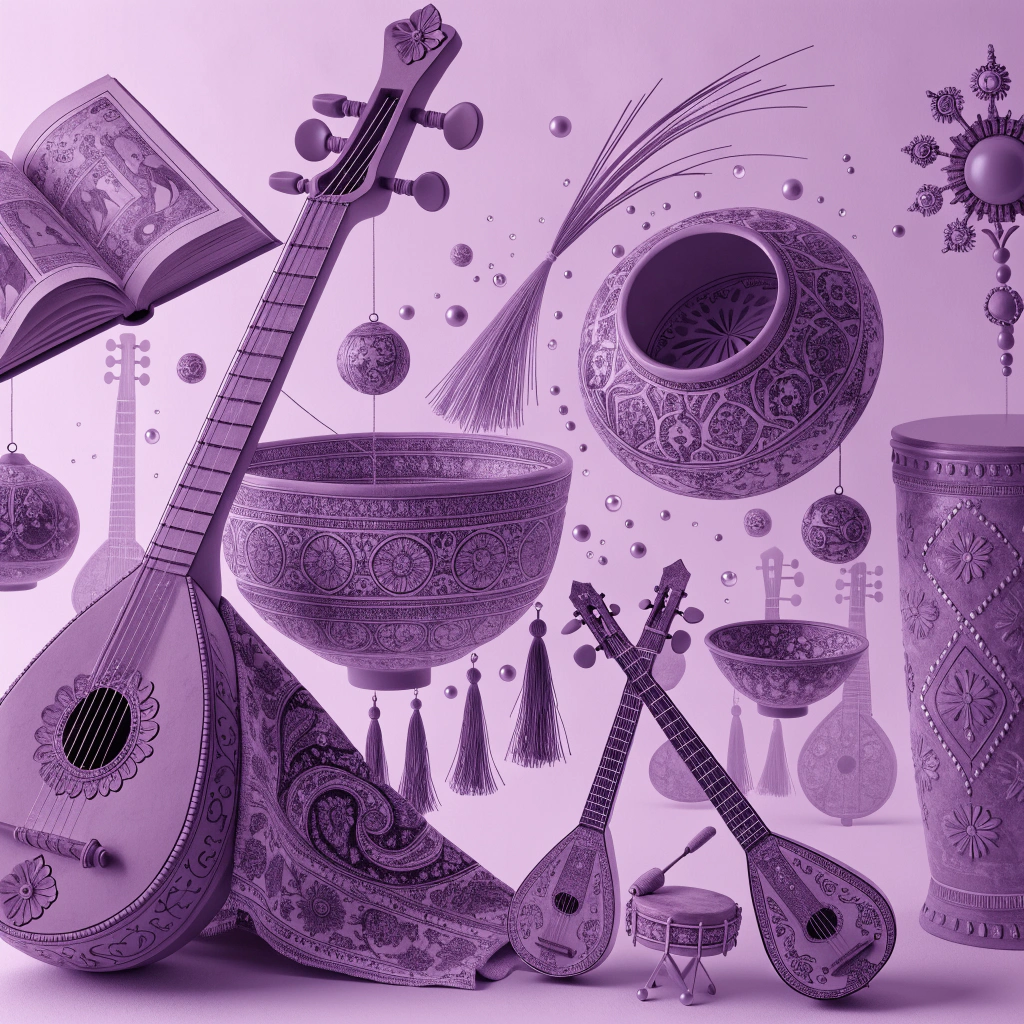
The Two Strings of Khorasan
The Dotar is a special musical instrument from Iran. It comes from the Khorasan region. The word 'Dotar' means 'two strings.' It is a long lute. People make it from wood.
Musicians play the Dotar at weddings and parties. These musicians are called Bakhshis. They are very important people in the community. They tell old stories and sing songs for everyone.
The Dotar is very old. Children learn the music from their parents. It is a beautiful part of Iranian culture. Many people love the sound of the Dotar.
语法聚焦
句型: Present Simple (to be)
"The Dotar is a special musical instrument from Iran."
We use 'is' with singular subjects like 'The Dotar' to describe what something is. This is the most common way to state facts in English.
句型: Present Simple (Action Verbs)
"They tell old stories and sing songs for everyone."
For plural subjects like 'They', we use the base form of the verb (tell, sing). We use this pattern for things that happen regularly.
测试你的理解
10 个问题 · A1 初学 · 1 次免费预览
测试你从这篇文章中学到的知识。回答所有问题即可获得经验值!
题目详情
Where is the Dotar from?
你的回答:
正确答案: Iran
The Dotar has two strings.
你的回答:
正确答案: 正确
What is 'wood'?
你的回答:
正确答案: Material from trees
People make the Dotar from _____.
你的回答:
正确答案: wood
The Beautiful Music of the Dotar
The Dotar is a special musical instrument from the Khorasan region in Iran. The name "Dotar" means "two strings" because it only has two strings. People make this instrument from mulberry and apricot wood. It is older than many other instruments and has a very beautiful sound.
In the past, master musicians called "Bakhshis" played the Dotar. These people were more than just musicians. They were also poets and storytellers. They traveled to different villages and told long stories about history and heroes. They played at weddings and festivals because everyone loved their music.
Today, the Dotar is still very important in Iranian culture. Younger people are learning to play it because they want to keep their history alive. The music is more famous now than before, and people from all over the world listen to it. It is a simple instrument, but it tells many great stories.
语法聚焦
句型: Comparatives
"The music is more famous now than before."
We use 'more + adjective + than' to compare two things. For long adjectives like 'famous', we do not add -er.
句型: Past Simple
"They traveled to different villages and told long stories."
The past simple is used for finished actions. Regular verbs like 'travel' add -ed, while irregular verbs like 'tell' change to 'told'.
测试你的理解
11 个问题 · A2 基础 · 1 次免费预览
测试你从这篇文章中学到的知识。回答所有问题即可获得经验值!
题目详情
What does the word 'Dotar' mean?
你的回答:
正确答案: Two strings
The Bakhshis were only musicians and did not do anything else.
你的回答:
正确答案: 错误
What is an 'instrument'?
你的回答:
正确答案: An object used to make music
People make the Dotar from mulberry and apricot _____.
你的回答:
正确答案: wood
Where is the Dotar from?
你的回答:
正确答案: The Khorasan region
The Art of the Dotar: A Musical Soul from Iran
The Dotar is a traditional musical instrument that has been played in the Khorasan region of Iran for many centuries. Its name literally means "two strings," which refers to its simple but beautiful design. This long-necked lute is usually carved from the seasoned wood of mulberry and apricot trees. For a long time, the music of the Dotar has been used to share historical stories and express deep emotions.
The people who play this instrument are known as "Bakhshis." These master musicians are highly respected members of the community because they are not just performers; they are also poets and oral historians. A Bakhshi is a person who transmits epic narratives and spiritual lessons to the younger generation through music. They are often invited to perform at weddings and local festivals, where they help to keep the local culture alive.
In recent years, the art of the Dotar has been recognized by UNESCO as an important part of the world’s cultural heritage. This recognition shows that the music is valuable to everyone, not just people in Iran. Although the modern world is changing quickly, this ancient tradition has been kept alive by dedicated teachers and students. The music is often described as mystical because it has a spiritual quality that touches the soul of the listener.
The Bakhshis believe that the Dotar is more than just an instrument; it is a tool for peace and reflection. By listening to its unique sound, people can learn about the history and the values of the Khorasan region. Today, the Dotar continues to be a symbol of identity and pride for the people who live there.
语法聚焦
句型: Passive Voice
"This long-necked lute is usually carved from the seasoned wood of mulberry and apricot trees."
We use the passive voice (be + past participle) when the action is more important than who did it. In this case, the focus is on how the lute is made.
句型: Relative Clauses
"A Bakhshi is a person who transmits epic narratives and spiritual lessons to the younger generation."
Relative clauses start with 'who' or 'which' to give more information about a person or thing. Here, 'who' defines the specific role of a Bakhshi.
测试你的理解
11 个问题 · B1 中级 · 1 次免费预览
测试你从这篇文章中学到的知识。回答所有问题即可获得经验值!
What does the name 'Dotar' mean in English?
题目详情
What does the name 'Dotar' mean in English?
你的回答:
正确答案: Two strings
Bakhshis are only musicians and do not have other roles in the community.
你的回答:
正确答案: 错误
What does 'heritage' mean?
你的回答:
正确答案: Traditions from the past
The Dotar is carved from the _____ of mulberry trees.
你的回答:
正确答案: wood
Which organization recognized the Dotar as cultural heritage?
你的回答:
正确答案: UNESCO
The Soul of Khorasan: The Spiritual Art of the Dotar
In the vast, windswept landscapes of northeastern Iran lies the Khorasan region, a territory where music is not merely a form of entertainment but a profound spiritual language. At the heart of this tradition is the Dotar, a long-necked lute whose name literally translates to 'two strings.' Despite its seemingly simple construction, the Dotar serves as the primary vessel for the region’s rich oral history and mystical heritage.
The instrument is typically crafted from the wood of mulberry and apricot trees, which have been seasoned for years to ensure the perfect resonance. The two silk or steel strings are plucked with a specific technique that produces a rhythmic, hypnotic sound. However, the true soul of the Dotar is found in the hands of the Bakhshis. These master musicians are much more than performers; they are regarded as the intellectual custodians of their community. Traditionally, a Bakhshi must not only master the technical complexities of the instrument but also possess an extensive repertoire of epic poems and historical narratives.
For centuries, Bakhshis have played a pivotal role in social gatherings, ranging from lively weddings to solemn spiritual ceremonies. Their music often incorporates Sufi teachings, aiming to bridge the gap between the earthly and the divine. Historically, these musicians have been responsible for transmitting the collective memory of the Khorasan people from one generation to the next. Had it not been for their dedication, many of these ancient stories might have been lost to the passage of time.
In the contemporary era, the art of the Dotar faces challenges from modern globalized culture. Nevertheless, there has been a renewed interest in preserving this intangible heritage. Educational initiatives have been established to ensure that younger musicians can acquire the skills necessary to maintain the tradition. By analyzing the Dotar’s influence, one can appreciate how a simple two-stringed instrument can encapsulate the identity of an entire civilization. It remains a testament to the power of music as a tool for storytelling and spiritual exploration.
语法聚焦
句型: Passive Voice
"The instrument is typically crafted from the wood of mulberry and apricot trees..."
The passive voice is used here to focus on the object (the instrument) and the process of creation rather than who specifically is making it, which is common in formal descriptions.
句型: Third Conditional (Inverted)
"Had it not been for their dedication, many of these ancient stories might have been lost to the passage of time."
This is a formal version of 'If it had not been for...'. It describes a hypothetical past situation and its probable result, emphasizing the importance of the Bakhshis' efforts.
句型: Modal Verbs for Ability and Deduction
"By analyzing the Dotar’s influence, one can appreciate how a simple two-stringed instrument can encapsulate the identity..."
The modal 'can' is used here to express possibility and ability based on evidence, which is typical in academic analysis and evaluation.
测试你的理解
11 个问题 · B2 中高级 · 1 次免费预览
测试你从这篇文章中学到的知识。回答所有问题即可获得经验值!
What is the primary role of the Bakhshis in Khorasan?
题目详情
What is the primary role of the Bakhshis in Khorasan?
你的回答:
正确答案: They act as oral historians and spiritual guides.
The Dotar is a complex instrument with at least six strings.
你的回答:
正确答案: 错误
What does the word 'custodian' mean in the context of the article?
你的回答:
正确答案: A person who protects and preserves cultural knowledge.
The instrument is typically _____ from the wood of mulberry and apricot trees.
你的回答:
正确答案: crafted
Why is the wood for the Dotar seasoned for several years?
你的回答:
正确答案: To ensure the instrument has the perfect resonance.
Resonance and Ritual: The Metaphysical Tapestry of the Khorasani Dotar
In the arid expanses of northeastern Iran, the Khorasan region serves as the cradle for one of the most intellectually and spiritually demanding musical traditions in the Middle East. At the heart of this cultural landscape lies the Dotar, a long-necked lute whose name—literally 'two strings'—belies the staggering complexity of its sonic and social significance. Rarely has an instrument so humble in construction commanded such profound spiritual authority over a populace. Carved from the seasoned wood of mulberry and apricot trees, the Dotar is not merely an object of craftsmanship; it is a vessel for the collective consciousness of a people.
Central to the perpetuation of this tradition are the Bakhshis, master musicians who transcend the role of mere performers. It is through the seasoned wood of the mulberry tree that the collective memories of the Khorasani people find their voice. These individuals function as oral historians, poets, and spiritual conduits, bridging the gap between the mundane and the divine. The Bakhshi’s repertoire is an intricate weave of epic narratives, mystical Sufi teachings, and historical chronicles, often delivered with an evocative intensity that demands absolute attention from the listener. The transition of knowledge within this lineage is an arduous process, requiring years of apprenticeship to master the nuanced finger-tapping techniques and the philosophical depth required for authentic interpretation.
The preservation of this auditory heritage relies not merely on technical proficiency but on the spiritual lineage of the Bakhshi. In a contemporary era characterized by the rapid homogenization of culture, the Dotar stands as a resilient bulwark against the ephemeral nature of modern entertainment. The instrument’s resonance is deeply intertwined with the social fabric of the region, appearing at weddings, seasonal festivals, and private mystical gatherings. Each performance is a unique negotiation between the artist and the environment, where the Bakhshi must gauge the spiritual 'readiness' of the audience before embarking on more esoteric compositions.
Critical analysis of the Dotar tradition reveals a sophisticated interplay between material craftsmanship and metaphysical aspiration. The construction of the instrument itself is a ritualized act; the choice of wood and the drying process are seen as vital to the eventual 'soul' of the sound produced. Furthermore, the two strings are often conceptualized as representing dualities: man and God, the earth and the heavens, or the physical and the spiritual realms. To play the Dotar is to engage in a form of meditation, where the rhythmic patterns serve to elevate both the performer and the listener to a higher state of awareness. Consequently, the UNESCO recognition of the Dotar in 2019 was not merely a celebratory gesture for a musical style, but an acknowledgment of a complex living system of ethics, history, and spirituality that continues to thrive despite the pressures of globalization.
语法聚焦
句型: Inversion with negative/restrictive adverbs
"Rarely has an instrument so humble in construction commanded such profound spiritual authority over a populace."
When using restrictive words like 'rarely' or 'seldom' at the beginning of a sentence for emphasis, the auxiliary verb is placed before the subject. This creates a more formal and dramatic tone suitable for academic or literary analysis.
句型: Cleft Sentences for Emphasis
"It is through the seasoned wood of the mulberry tree that the collective memories of the Khorasani people find their voice."
A cleft sentence (It + is/was + [emphasized part] + that/who...) is used to focus on a specific piece of information. Here, it emphasizes the material (mulberry wood) as the primary medium of cultural expression.
句型: Nominalization
"The preservation of this auditory heritage relies not merely on technical proficiency but on the spiritual lineage of the Bakhshi."
Nominalization involves turning verbs or adjectives into nouns (e.g., 'preservation' from 'preserve'). This allows for more abstract, concise, and formal sentence structures, common in high-level academic writing.
测试你的理解
12 个问题 · C1 高级 · 1 次免费预览
测试你从这篇文章中学到的知识。回答所有问题即可获得经验值!
What does the author suggest about the relationship between the Bakhshi and their audience?
题目详情
What does the author suggest about the relationship between the Bakhshi and their audience?
你的回答:
正确答案: The Bakhshi evaluates the spiritual state of the audience before choosing complex material.
The name 'Dotar' refers to the four strings used to play the instrument.
你的回答:
正确答案: 错误
What does 'ephemeral' mean in the context of the article?
你的回答:
正确答案: Something that is short-lived or transitory.
The transition of knowledge within the Bakhshi tradition is described as an _____ process requiring years of training.
你的回答:
正确答案: arduous
Which trees are primarily used to construct the Dotar?
你的回答:
正确答案: Mulberry and Apricot
The Dotar was recognized by UNESCO in 2019.
你的回答:
正确答案: 正确
Resonance and Reciprocity: The Ontological Significance of the Khorasani Dotar
The Dotar of Khorasan, a two-stringed long-necked lute, represents far more than a mere artifact of ethnomusicology; it is a profound vessel for the ontological and sociological transmission of Persianate culture. To appreciate the Dotar is to engage with a complex tapestry of history, mysticism, and communal identity that has flourished in the northeastern reaches of Iran for centuries. Were the Dotar to be stripped of its spiritual context, it would remain but a skeletal frame of wood and wire, devoid of the vital breath that transforms it into a medium of the divine. The craftsmanship itself is a testament to patience, with the resonator typically carved from the seasoned wood of a mulberry tree, while the neck is fashioned from apricot or walnut. This selection of materials is not arbitrary; rather, it is dictated by a centuries-old understanding of acoustic resonance and durability, ensuring that the instrument may endure the rigors of both time and performance.
Central to this tradition are the Bakhshis, master musicians whose role transcends simple entertainment. Not only does the Bakhshi serve as a musician, but he also acts as a repository for the collective memory and oral historiography of the region. Through the medium of the Dotar, these individuals transmit epic narratives, moral parables, and the intricate subtleties of Sufi mysticism. The performance is characterized by a unique heterophony, where the interplay between the two strings—one providing a rhythmic and melodic drone, the other weaving complex melodic patterns—mirrors the philosophical duality of the mundane and the transcendent. It might be posited that the instrument’s resonance is as much a product of the player’s intention as it is of the seasoned mulberry wood. The Bakhshis are traditionally respected figures who serve as spiritual guides, often performing at weddings and village gatherings, where their music facilitates a communal state of reflection and catharsis.
The pedagogical transmission of the Dotar is equally rigorous, traditionally occurring through a master-disciple relationship that emphasizes not only technical virtuosity but also the cultivation of a specific ethical and spiritual disposition. This ensures that the art form remains a living tradition, resistant to the homogenizing pressures of modernity. However, the ephemeral nature of oral traditions poses a significant challenge. While the UNESCO recognition of the Dotar as Intangible Cultural Heritage has provided a necessary impetus for preservation, the true survival of the art form depends on the continued relevance of its narratives in the contemporary socio-cultural landscape. Rarely has an instrument been so inextricably linked to the spiritual health of its community. The Dotar does not merely play music; it articulates the very soul of Khorasan, bridging the gap between historical epic and the lived experience of the present. To ignore the Dotar is to overlook a quintessential element of the Iranian cultural identity, one that continues to resonate with a haunting, timeless beauty.
语法聚焦
句型: Inverted Conditional (Second Conditional)
"Were the Dotar to be stripped of its spiritual context, it would remain but a skeletal frame of wood and wire."
In formal English, 'were' can be placed at the beginning of a conditional sentence to replace 'if'. This structure adds a scholarly or hypothetical tone to the writing.
句型: Negative Inversion
"Not only does the Bakhshi serve as a musician, but he also acts as a repository for the collective memory."
When a sentence starts with a negative or restrictive phrase like 'Not only', the auxiliary verb comes before the subject. This is used for emphasis in academic or formal contexts.
句型: Academic Hedging with Modals
"It might be posited that the instrument’s resonance is as much a product of the player’s intention as it is of the seasoned mulberry wood."
Using 'might be posited' or 'it could be argued' allows the writer to present a theory or interpretation without making an absolute, unproven claim, which is a hallmark of C2-level analytical prose.
测试你的理解
12 个问题 · C2 精通 · 1 次免费预览
测试你从这篇文章中学到的知识。回答所有问题即可获得经验值!
What is the primary function of the Bakhshis according to the text?
题目详情
What is the primary function of the Bakhshis according to the text?
你的回答:
正确答案: To serve as moral and historical guardians through music
The choice of mulberry and apricot wood for the Dotar is based solely on aesthetic preference.
你的回答:
正确答案: 错误
Which word describes something that is transitory and short-lived?
你的回答:
正确答案: Ephemeral
The Dotar's music is characterized by _____, where variations of a single melody are played simultaneously.
你的回答:
正确答案: heterophony
What does the author suggest about the survival of the Dotar tradition?
你的回答:
正确答案: It requires the stories to remain relevant to modern society.
The pedagogical process of learning the Dotar involves both technical skill and spiritual development.
你的回答:
正确答案: 正确

