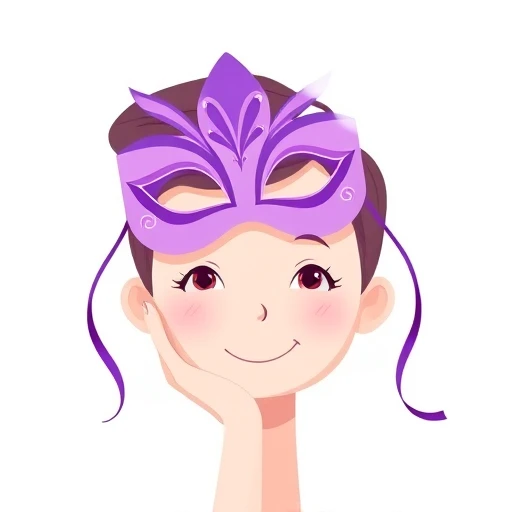
mask 30秒了解
- A mask is a facial covering used for protection, disguise, or performance in various settings.
- Metaphorically, a mask represents a false outward appearance used to hide true emotions or character.
- Common types include surgical masks, gas masks, carnival masks, and sports masks like goalie masks.
- Grammatically, it is a countable noun that often appears with verbs like 'wear' and 'remove'.
The word mask is a versatile noun that primarily refers to an object worn over the face. At its most basic level, a mask serves to protect, hide, or transform the wearer. In modern contexts, we often think of medical masks used to prevent the spread of germs, but the history of the mask spans thousands of years, covering everything from ancient Greek theater to Venetian carnivals. When you use this word, you are usually talking about something physical, but it is equally common to use it in a psychological sense. For example, a person might wear a 'mask of happiness' to hide their true sadness. This metaphorical usage is essential for reaching higher levels of English proficiency, as it allows you to describe complex human emotions and social behaviors where the external appearance does not match the internal reality.
- Physical Utility
- A physical mask is used for protection in sports, such as a catcher's mask in baseball, or for safety in hazardous environments, like a gas mask or a welder's mask. These objects are designed to shield the face from impact, chemicals, or intense light.
- Cultural Significance
- In many cultures, masks are used in rituals and performances. They allow the wearer to take on a new identity, often representing a deity, an animal, or a specific character in a story. This transformation is a key element of traditional storytelling and religious ceremonies across the globe.
- Metaphorical Concealment
- In literature and psychology, a mask refers to a false front. It is the persona we present to the world to hide our vulnerabilities or true intentions. This usage is common when discussing social dynamics and character development in novels.
The superhero adjusted his mask before jumping into the fray to protect his secret identity.
She wore a mask of calm, even though she was terrified inside.
The surgeon reached for a sterile mask before entering the operating room.
During the festival, everyone wore a colorful mask made of papier-mâché.
The scuba diver cleared the water from his mask so he could see the coral reef clearly.
In summary, whether you are discussing health, safety, theater, or human psychology, the word 'mask' is an indispensable part of the English vocabulary. It describes the boundary between what is seen and what is hidden, making it a powerful tool for both literal and figurative expression. Understanding its various forms allows you to navigate diverse conversations, from medical advice to literary analysis, with confidence and precision.
Using the word mask correctly requires an understanding of its grammatical role as a countable noun. Because it is countable, you must use an article (a, an, the) or a possessive pronoun (my, your, his) when referring to a single mask. In the plural form, 'masks' is used to refer to multiple items. The word often appears in specific collocations that clarify its purpose. For instance, we 'wear' a mask, 'put on' a mask, or 'take off' a mask. When discussing protection, we use modifiers like 'protective,' 'surgical,' or 'oxygen.' When discussing disguise, we might use 'elaborate,' 'scary,' or 'decorative.'
- As a Direct Object
- The most common grammatical structure is [Subject] + [Verb] + [Article/Possessive] + mask. Example: 'The thief wore a mask to hide his face.' Here, 'mask' is the object receiving the action of the verb 'wore.'
- In Prepositional Phrases
- 'Mask' frequently appears in phrases starting with 'behind' or 'under.' Example: 'He hid his true feelings behind a mask of professionalism.' This structure emphasizes the layer of concealment.
- With Compound Nouns
- 'Mask' often combines with other nouns to create specific terms like 'gas mask,' 'face mask,' 'sleep mask,' or 'ski mask.' In these cases, the first word acts as an adjective describing the type or function of the mask.
Please ensure your mask covers both your nose and mouth for maximum protection.
The museum displayed an ancient golden mask from the Aztec civilization.
He struggled to keep his mask of indifference when he heard the shocking news.
When writing, consider the tone of your sentence. 'Face mask' is neutral and common in health contexts. 'Disguise' might be a more descriptive synonym if the intent is criminal. 'Persona' is a sophisticated alternative for the metaphorical mask used in social settings. By choosing the right modifiers and prepositions, you can make your use of 'mask' more evocative and precise.
In daily life, the word mask is ubiquitous across several domains. You will hear it most frequently in medical settings, where doctors and nurses discuss PPE (Personal Protective Equipment). In the wake of global health events, 'mask mandates' and 'wearing a mask' became standard phrases in news broadcasts and public service announcements. Beyond health, the word is a staple of the entertainment industry. Actors discuss 'mask work' in physical theater, and superhero movies are entirely built around the concept of the 'masked hero.' In the world of sports, commentators mention 'goalie masks' in hockey or 'face masks' in American football, referring to the protective cages on helmets.
- Medical and Public Health
- 'Don't forget to wear your mask in the clinic.' 'The N95 mask provides a high level of filtration.' In these contexts, the word is associated with safety and hygiene.
- Crime and Security
- 'The suspect was described as wearing a black ski mask.' Security footage often shows individuals using masks to avoid identification, making the word common in police reports and true crime podcasts.
- Beauty and Skincare
- 'I'm going to put on a clay mask tonight.' In the beauty industry, a mask is a substance applied to the face for a period of time to improve the skin's condition.
The flight attendant demonstrated how to use the oxygen mask in case of an emergency.
You might also encounter the word in technical fields. In photo editing software like Photoshop, a 'layer mask' is a tool used to hide or reveal parts of an image. In computing, a 'subnet mask' is used in networking. These specialized uses demonstrate how the core concept of 'covering' or 'filtering' translates into abstract digital processes. Whether you are at the doctor, the movies, or working on your computer, 'mask' is a word that describes the essential action of controlling what is visible.
One of the most frequent mistakes learners make with the word mask is confusing its noun and verb forms. While they look identical, their grammatical placement is different. Another common error involves the pluralization; some learners forget the 's' when talking about multiple people wearing masks. Additionally, there is often confusion between 'mask' and 'mascara.' While both are applied to the face, 'mascara' is a specific type of makeup for eyelashes, whereas a 'mask' covers a larger area or the whole face. Spelling can also be tricky for those familiar with French, as they might try to spell it 'masque,' which is only used in very specific historical or artistic contexts in English.
- Noun vs. Verb Confusion
- Incorrect: 'He mask his face.' Correct: 'He wears a mask' (noun) or 'He masks his face' (verb). Ensure you have the correct subject-verb agreement if using the verb form.
- Preposition Errors
- Incorrect: 'He hid his anger in a mask.' Correct: 'He hid his anger behind a mask.' The preposition 'behind' is the standard choice for describing the relationship between the hidden emotion and the mask.
- Confusing with 'Veil'
- While both cover the face, a 'veil' is usually made of thin, transparent fabric and is often associated with weddings or mourning. A 'mask' is typically more solid and used for protection or disguise.
Incorrect: The doctor wore a masque during the surgery. (Unless it's a 17th-century play!)
Finally, be careful with the pronunciation of the plural 'masks.' The 's-k-s' cluster can be difficult for non-native speakers. It requires a clear 'k' sound followed by a sharp 's.' Practicing this cluster will help you sound more natural when discussing multiple masks in a conversation. Avoiding these common pitfalls will ensure your communication is clear and professional.
Depending on the context, you might want to use a word more specific than mask. If you are talking about a disguise used to deceive others, 'disguise' or 'facade' might be better. If you are referring to something that covers the face for religious or wedding purposes, 'veil' is the correct term. In a psychological context, 'persona' is a powerful alternative that refers to the social face an individual presents to the world. Understanding these nuances allows you to choose the word that perfectly fits your intended meaning.
- Mask vs. Disguise
- A 'mask' is a specific object for the face. A 'disguise' can include a mask, but it also includes clothes, wigs, and makeup used to change one's entire appearance.
- Mask vs. Facade
- A 'facade' usually refers to the front of a building, but metaphorically, it refers to a deceptive outward appearance. While a 'mask' hides an emotion, a 'facade' often hides a whole situation or a person's true character.
- Mask vs. Visor
- A 'visor' is a part of a helmet that can be pulled down to cover the eyes or face, or a brim on a cap to shade the eyes. It is more about visibility and protection than disguise.
His polite behavior was merely a facade to hide his true intentions.
By mastering these alternatives, you can avoid repeating the word 'mask' too often in your writing. Use 'respirator' in technical safety contexts, 'blindfold' if the eyes are covered to prevent sight, and 'shield' if the mask is part of a larger protective gear. Each of these words adds a layer of detail that 'mask' alone might lack.
How Formal Is It?
趣味小知识
In the Middle Ages, the word 'masca' was actually used to describe a witch or a specter, which gives the modern word a slightly spooky historical background.
发音指南
- Pronouncing the 'k' and 's' too softly in the plural 'masks'.
- Confusing the vowel sound with 'mesh'.
- Adding an extra vowel sound between 'k' and 's'.
- Pronouncing it like 'mash'.
- Over-emphasizing the 'e' sound in some accents.
难度评级
The literal meaning is very easy, but metaphorical uses require B1-B2 level reading skills.
Using the 'mask of [emotion]' structure correctly takes practice.
The plural 'masks' can be a pronunciation challenge for many learners.
Usually clear in context, though technical uses like 'subnet mask' might be confusing.
接下来学什么
前置知识
接下来学习
高级
需要掌握的语法
Countable Nouns
I have a mask. (Not: I have mask.)
Adjective Placement
A protective mask. (Adjective before noun.)
Prepositional Phrases
Behind the mask. (Use 'behind' for location/metaphor.)
Compound Nouns
Gas mask. (Two nouns acting as one unit.)
Pluralization
They wore masks. (Add 's' for plural.)
按水平分级的例句
I wear a cat mask for the party.
Je porte un masque de chat pour la fête.
Use 'a' before 'cat mask' because it is a singular countable noun.
The doctor has a white mask.
Le docteur a un masque blanc.
The adjective 'white' comes before the noun 'mask'.
Do you like my scary mask?
Aimes-tu mon masque effrayant ?
This is a question using the auxiliary verb 'do'.
Put on your mask now.
Mets ton masque maintenant.
This is an imperative sentence used for giving a command.
The mask is on the table.
Le masque est sur la table.
Use 'the' to refer to a specific mask.
He has two masks.
Il a deux masques.
Add 's' to make the noun plural.
I cannot see your face behind the mask.
Je ne peux pas voir ton visage derrière le masque.
'Behind' is a preposition of place.
This mask is very big.
Ce masque est très grand.
'This' is a demonstrative adjective.
The hockey goalie wears a strong mask for protection.
Le gardien de hockey porte un masque solide pour se protéger.
'For protection' explains the purpose of the mask.
You must wear a face mask in the hospital.
Vous devez porter un masque facial à l'hôpital.
'Must' is a modal verb indicating obligation.
The diver's mask helps him see underwater.
Le masque du plongeur l'aide à voir sous l'eau.
The possessive 's' shows that the mask belongs to the diver.
She bought a beautiful silk mask in Venice.
Elle a acheté un beau masque en soie à Venise.
The adjectives 'beautiful' and 'silk' describe the mask.
The superhero never takes off his mask.
Le super-héros n'enlève jamais son masque.
'Takes off' is a phrasal verb meaning to remove.
I need a new sleep mask because the light wakes me up.
J'ai besoin d'un nouveau masque de sommeil parce que la lumière me réveille.
'Sleep mask' is a compound noun.
The bank robber wore a black ski mask.
Le braqueur de banque portait un passe-montagne noir.
'Ski mask' specifies the type of mask.
They are making masks in the art class.
Ils fabriquent des masques en cours d'art.
The present continuous 'are making' shows an ongoing action.
He wore a mask of calm to hide his anxiety during the interview.
Il portait un masque de calme pour cacher son anxiété pendant l'entretien.
This is a metaphorical use of 'mask'.
The museum has a collection of ancient tribal masks.
Le musée possède une collection de masques tribaux anciens.
'Collection of' is followed by a plural noun.
The oxygen mask dropped from the ceiling of the airplane.
Le masque à oxygène est tombé du plafond de l'avion.
'Oxygen mask' is a specific technical term.
She applied a mud mask to her face to clean her skin.
Elle a appliqué un masque de boue sur son visage pour nettoyer sa peau.
'Applied... to' is the standard verb-preposition pair for skincare.
The actor's mask was so realistic that no one recognized him.
Le masque de l'acteur était si réaliste que personne ne l'a reconnu.
'So... that' is used to show result.
Behind his mask of wealth, he was actually quite poor.
Derrière son masque de richesse, il était en fait assez pauvre.
'Behind' is used here in a figurative sense.
The gas mask is essential for soldiers in certain environments.
Le masque à gaz est essentiel pour les soldats dans certains environnements.
'Essential for' indicates necessity.
The festival ended with a grand parade of masked dancers.
Le festival s'est terminé par une grande parade de danseurs masqués.
'Masked' is the adjective form derived from the noun.
The politician's public persona is merely a mask for his private ambitions.
Le personnage public du politicien n'est qu'un masque pour ses ambitions privées.
'Persona' and 'mask' are used synonymously here.
The welder lowered his mask before starting the torch.
Le soudeur a abaissé son masque avant d'allumer le chalumeau.
'Lowered' is the specific action for a hinged mask.
In the play, the characters use masks to represent different social classes.
Dans la pièce, les personnages utilisent des masques pour représenter différentes classes sociales.
'To represent' shows the symbolic purpose.
The suspect's mask was found discarded in a nearby alleyway.
Le masque du suspect a été retrouvé jeté dans une ruelle voisine.
The passive voice 'was found' focuses on the object.
She struggled to maintain her mask of indifference when he spoke.
Elle luttait pour maintenir son masque d'indifférence quand il parlait.
'Struggled to maintain' implies internal effort.
The ancient death mask was crafted from pure gold.
Le masque mortuaire antique était fabriqué en or pur.
'Death mask' is a historical term.
A subnet mask is used to divide an IP address into two parts.
Un masque de sous-réseau est utilisé pour diviser une adresse IP en deux parties.
This is a technical, non-physical use of the word.
The surgeon adjusted her mask, ensuring a tight seal against her skin.
La chirurgienne a ajusté son masque, assurant une étanchéité parfaite contre sa peau.
The participial phrase 'ensuring...' adds detail to the action.
The novel explores the theme of the social mask and the loss of authentic self.
Le roman explore le thème du masque social et de la perte du soi authentique.
'Social mask' is a sociological concept.
He wore a mask of joviality that few people ever saw past.
Il portait un masque de jovialité que peu de gens parvenaient à percer.
'Saw past' is a phrasal verb meaning to see the truth.
The ritual required the high priest to don a ceremonial mask made of obsidian.
Le rituel exigeait que le grand prêtre revête un masque cérémoniel en obsidienne.
'Don' is a formal verb meaning 'to put on'.
The layer mask in the software allowed for non-destructive editing of the image.
Le masque de fusion dans le logiciel permettait une édition non destructive de l'image.
'Non-destructive' is a technical adjective.
Her mask of composure finally slipped when the verdict was read.
Son masque de calme a finalement glissé à la lecture du verdict.
'Slipped' is a common verb used with metaphorical masks.
The intricate carvings on the ivory mask indicated its royal origins.
Les sculptures complexes sur le masque en ivoire indiquaient ses origines royales.
'Indicated' is a formal synonym for 'showed'.
Masking is a common coping mechanism for individuals on the autism spectrum.
Le camouflage (masking) est un mécanisme d'adaptation courant pour les personnes autistes.
Here 'masking' is used as a gerund (noun from a verb).
The gas mask's filter must be replaced after eight hours of continuous use.
Le filtre du masque à gaz doit être remplacé après huit heures d'utilisation continue.
'Continuous use' is a formal collocation.
The protagonist's tragic flaw was his inability to reconcile his public mask with his private desires.
Le défaut tragique du protagoniste était son incapacité à concilier son masque public avec ses désirs privés.
'Reconcile... with' is a sophisticated verb construction.
The exhibition showcased the evolution of the death mask from ancient Egypt to the Victorian era.
L'exposition présentait l'évolution du masque mortuaire de l'Égypte ancienne à l'époque victorienne.
'Showcased' is a high-level verb for 'displayed'.
The use of the mask in Greek tragedy served to amplify the actor's voice and emotions.
L'utilisation du masque dans la tragédie grecque servait à amplifier la voix et les émotions de l'acteur.
'Served to' indicates a specific function.
His entire existence was a carefully constructed mask designed to deceive his enemies.
Toute son existence était un masque soigneusement construit conçu pour tromper ses ennemis.
'Carefully constructed' is a complex modifier.
The semiconductor industry relies on photolithographic masks to etch circuits onto silicon wafers.
L'industrie des semi-conducteurs s'appuie sur des masques photolithographiques pour graver des circuits sur des galettes de silicium.
This is a highly specialized technical usage.
The poet speaks of the 'mask of the world,' suggesting that reality is but a veil over a deeper truth.
Le poète parle du « masque du monde », suggérant que la réalité n'est qu'un voile sur une vérité plus profonde.
'Suggesting that' introduces a subordinate clause.
The masquerade ball provided a rare opportunity for the nobility to shed their social masks.
Le bal masqué offrait une rare occasion à la noblesse de se défaire de ses masques sociaux.
'Shed' is a poetic verb for 'remove'.
The sheer variety of masks across human cultures attests to our universal desire for transformation.
La grande variété de masques à travers les cultures humaines atteste de notre désir universel de transformation.
'Attests to' is a formal way to say 'proves'.
常见搭配
常用短语
— Referring to the true person or reality hidden by an outward appearance.
No one knew the real man behind the mask.
— To accidentally reveal one's true feelings or identity.
For a moment, his mask slipped and I saw his anger.
— To stop pretending and show one's true self intentionally.
She finally dropped the mask and told us the truth.
— A false expression of a specific feeling.
He wore a mask of politeness throughout the dinner.
— A person whose identity is hidden by a mask, often a hero or villain.
The masked man rode away into the night.
— A formal dance where guests wear masks.
We were invited to a grand masquerade ball at the palace.
— A legal requirement to wear masks in public places.
The city lifted the face mask mandate last week.
— A cast taken of a person's face after they have died.
The museum has the death mask of Napoleon.
容易混淆的词
Mascara is makeup for eyelashes; a mask covers the face.
A masque is a historical play; a mask is the object worn.
Mesh is a material with holes; a mask is a specific object.
习语与表达
— To act differently in various social situations or to have many different roles.
As a spy, he had to wear many masks to survive.
literary— The truth is finally revealed; there is no more deception.
Now that the mask is off, we can see his true intentions.
neutral— To avoid showing one's true self or feelings out of fear or social pressure.
Stop hiding behind a mask and tell me what you really think.
neutral— An outward appearance of being normal or rational that hides a disturbed mind.
The serial killer maintained a mask of sanity for years.
formal/psychological— To suddenly reveal one's true character or plans.
The enemy threw off the mask and attacked the city.
literary— Concealed by a deceptive appearance.
Behind a mask of friendship, he was planning to betray her.
neutral— Though 'mask' is a verb here, it relates to the noun's concept of hiding evidence of one's path.
The fugitives used the river to mask their trail.
neutral— Covering up a symptom without fixing the underlying cause.
Taking painkillers is just masking the problem; you need surgery.
neutral— Using a specific appearance as a cover for something else.
Under the mask of charity, the organization was actually a scam.
formal— To expose someone's true, often negative, nature publicly.
The journalist vowed to tear the mask from the corrupt official.
literary容易混淆
Both cover the face.
A veil is usually thin fabric for modesty; a mask is solid for disguise or protection.
The bride wore a veil, but the diver wore a mask.
Both mean a false appearance.
Facade is more about the whole situation or building; mask is specifically about the face or persona.
The building's facade was grand, but his mask of happiness was failing.
Both are parts of headgear.
A visor is a brim or a movable shield for the eyes; a mask usually covers more of the face.
He flipped down his visor to see better, while the doctor put on a mask.
A mask is often part of a disguise.
Disguise is the total change of appearance; mask is just the face covering.
His disguise included a wig, a fake beard, and a rubber mask.
Both protect the head/face.
A helmet protects the whole head from impact; a mask protects the face or filters air.
The astronaut wore a helmet with a built-in oxygen mask.
句型
I have a [adjective] mask.
I have a red mask.
He wears a mask to [verb].
He wears a mask to protect his face.
She hid her [emotion] behind a mask of [emotion].
She hid her fear behind a mask of confidence.
The [type] mask is essential for [activity].
The oxygen mask is essential for high-altitude flight.
The [noun] serves as a mask for [noun].
His wealth serves as a mask for his lack of character.
To [verb] is to shed the social mask that [clause].
To meditate is to shed the social mask that we wear every day.
Don't forget to [verb] your mask.
Don't forget to wash your mask.
There is a mask on the [noun].
There is a mask on the shelf.
词族
名词
动词
形容词
相关
如何使用
Very high, especially in medical and social contexts.
-
He wear a mask.
→
He wears a mask.
In the third person singular (he/she/it), you must add 's' to the verb 'wear'.
-
I applied mascara on my face.
→
I applied a mask to my face.
Mascara is only for eyelashes. A mask is for the whole face.
-
He hid his pain in a mask.
→
He hid his pain behind a mask.
The correct preposition for a metaphorical mask is 'behind'.
-
The doctor wore a masque.
→
The doctor wore a mask.
'Masque' is a historical play, not a medical face covering.
-
I have many mask.
→
I have many masks.
After 'many', you must use the plural form of the noun.
小贴士
Countable Noun Rule
Always use an article like 'a' or 'the' when talking about one mask. For example, 'I bought a mask' is correct, but 'I bought mask' is not.
Metaphorical Usage
Use 'mask' to describe emotions. 'A mask of sorrow' sounds more poetic and advanced than just saying 'he looked sad'.
The Plural Challenge
The 's-k-s' sound in 'masks' is hard. Try saying 'mask' then a sharp 's' right after. Don't skip the 'k'!
Mask vs. Masque
Stick to 'mask' for 99% of situations. 'Masque' is very rare and only for old theater history.
Technical Terms
If you are in IT, learn 'subnet mask'. If you are in design, learn 'layer mask'. The word changes meaning in different jobs.
Collocations
Pair 'mask' with 'wear', 'put on', or 'remove' for natural-sounding English.
Theatrical Roots
Remember that masks come from theater. This helps you understand why we talk about 'playing a role' and 'wearing a mask'.
Protection Types
Distinguish between 'surgical', 'N95', and 'cloth' masks when discussing health for better precision.
Beauty Context
In beauty, a mask is a cream or gel. You 'apply' a mask and then 'wash it off'.
Mask Slipped
Use the phrase 'his mask slipped' to describe when someone accidentally shows their true, often bad, side.
记住它
记忆技巧
Think of a 'Mask' as a 'Make-up Ask'—it asks people to believe you are someone else.
视觉联想
Imagine a theater stage with two masks: one smiling and one crying. This represents the duality of the word.
Word Web
挑战
Try to write a paragraph about a person at a party using the word 'mask' three times: once for a physical mask, once for a metaphorical mask, and once for a skincare mask.
词源
The word 'mask' entered English in the 1530s, likely from Middle French 'masque'. Its ultimate origin is debated, but it may come from Italian 'maschera' or Medieval Latin 'masca', meaning 'ghost' or 'nightmare'. Some scholars suggest an Arabic root 'maskhara', meaning 'buffoon' or 'mockery'.
原始含义: Originally, it referred to a covering for the face used by a person to disguise themselves, often for entertainment or ritual.
Indo-European (via Romance languages).文化背景
Be aware that in some cultures, certain masks are sacred and should not be worn as costumes.
In the US and UK, masks are most commonly associated with Halloween and medical professionals.
在生活中练习
真实语境
Medical
- sterile mask
- mask fit test
- change your mask
- double masking
Halloween/Parties
- scary mask
- costume mask
- mask party
- homemade mask
Sports
- catcher's mask
- protective mask
- diving mask
- fencing mask
Psychology
- social mask
- emotional mask
- hiding behind a mask
- shedding the mask
Technology
- layer mask
- subnet mask
- bitmask
- clipping mask
对话开场白
"Do you think people wear a 'mask' when they are at work compared to when they are at home?"
"Have you ever been to a masquerade ball or a party where everyone wore masks?"
"What kind of mask do you think is the most important for safety in the world today?"
"If you had to design a mask for a superhero, what would it look like and why?"
"Do you find it difficult to communicate with people when they are wearing a face mask?"
日记主题
Describe a time when you felt like you were wearing a 'mask' to hide your true feelings from others.
Write about the history and significance of traditional masks in your own culture or a culture you admire.
If you could wear a mask that gave you a different personality for one day, what would that personality be?
Discuss the pros and cons of face mask mandates in public spaces from your personal perspective.
Imagine a world where everyone is born with a permanent mask. How would society be different?
常见问题
10 个问题It is both! As a noun, it is the object you wear (e.g., 'a surgical mask'). As a verb, it means to hide something (e.g., 'to mask a smell').
It is pronounced /mæsks/ (US) or /mɑːsks/ (UK). Make sure to sound the 'k' before the final 's'.
A face mask (like a surgical mask) is loose-fitting and protects others from your germs. A respirator (like an N95) is tight-fitting and protects you from breathing in small particles.
Only if you are referring to a 16th or 17th-century courtly performance. For the object you wear, always use 'mask'.
It is a metaphorical phrase referring to a person's true character or feelings that they are hiding from the world.
Yes, it is a countable noun. You can have one mask or many masks.
In computer networking, it is a number that defines the range of IP addresses in a local network. It is a technical, non-physical use of the word.
Historically, masks helped actors portray different characters and amplified their voices in large theaters.
It is a plaster or wax cast made of a person's face shortly after their death, often used as a memento or for creating portraits.
It refers to the process where an individual changes or 'masks' their natural personality to conform to social pressures.
自我测试 200 个问题
Write a sentence using 'mask' as a physical object.
Well written! Good try! Check the sample answer below.
Write a sentence using 'mask' metaphorically to describe an emotion.
Well written! Good try! Check the sample answer below.
Describe the difference between a surgical mask and a gas mask.
Well written! Good try! Check the sample answer below.
Write a short story (50 words) about a person at a masquerade ball.
Well written! Good try! Check the sample answer below.
Explain why a goalie in hockey needs a mask.
Well written! Good try! Check the sample answer below.
Write a dialogue between two people discussing a 'mask mandate'.
Well written! Good try! Check the sample answer below.
Describe a 'death mask' and its historical use.
Well written! Good try! Check the sample answer below.
Use the phrase 'behind the mask' in a complex sentence.
Well written! Good try! Check the sample answer below.
Write a product description for a new type of skincare mask.
Well written! Good try! Check the sample answer below.
Explain the concept of 'social masking' in your own words.
Well written! Good try! Check the sample answer below.
Write a sentence using the plural form 'masks' correctly.
Well written! Good try! Check the sample answer below.
Describe a superhero's mask and what it represents.
Well written! Good try! Check the sample answer below.
Write a formal letter requesting masks for a workplace.
Well written! Good try! Check the sample answer below.
Explain how a 'layer mask' works in digital art.
Well written! Good try! Check the sample answer below.
Write a poem about a mask that hides a secret.
Well written! Good try! Check the sample answer below.
Compare a 'mask' and a 'veil'.
Well written! Good try! Check the sample answer below.
Write a sentence using 'mask' as a verb.
Well written! Good try! Check the sample answer below.
Describe a traditional mask from a culture you know.
Well written! Good try! Check the sample answer below.
Explain the phrase 'his mask slipped'.
Well written! Good try! Check the sample answer below.
Write a journal entry about a day you felt you had to wear a 'mask'.
Well written! Good try! Check the sample answer below.
Describe a mask you have worn in the past.
Read this aloud:
你说的:
Speech recognition is not supported in your browser. Try Chrome or Edge.
Explain why people might wear a 'mask' of happiness.
Read this aloud:
你说的:
Speech recognition is not supported in your browser. Try Chrome or Edge.
Pronounce the words: 'mask', 'masks', 'masked'.
Read this aloud:
你说的:
Speech recognition is not supported in your browser. Try Chrome or Edge.
Discuss the importance of masks in medical settings.
Read this aloud:
你说的:
Speech recognition is not supported in your browser. Try Chrome or Edge.
Tell a story about a superhero and their mask.
Read this aloud:
你说的:
Speech recognition is not supported in your browser. Try Chrome or Edge.
What are the benefits of using a skincare mask?
Read this aloud:
你说的:
Speech recognition is not supported in your browser. Try Chrome or Edge.
How do masks change the way we communicate?
Read this aloud:
你说的:
Speech recognition is not supported in your browser. Try Chrome or Edge.
Describe a traditional mask from your country.
Read this aloud:
你说的:
Speech recognition is not supported in your browser. Try Chrome or Edge.
Explain the phrase 'to hide behind a mask'.
Read this aloud:
你说的:
Speech recognition is not supported in your browser. Try Chrome or Edge.
What is your opinion on mask mandates?
Read this aloud:
你说的:
Speech recognition is not supported in your browser. Try Chrome or Edge.
Describe a masquerade ball you have seen in a movie.
Read this aloud:
你说的:
Speech recognition is not supported in your browser. Try Chrome or Edge.
Why do some athletes wear masks?
Read this aloud:
你说的:
Speech recognition is not supported in your browser. Try Chrome or Edge.
Explain the difference between a mask and a disguise.
Read this aloud:
你说的:
Speech recognition is not supported in your browser. Try Chrome or Edge.
How does a mask help a diver?
Read this aloud:
你说的:
Speech recognition is not supported in your browser. Try Chrome or Edge.
Discuss the use of masks in ancient theater.
Read this aloud:
你说的:
Speech recognition is not supported in your browser. Try Chrome or Edge.
What does 'the mask slipped' mean in a social context?
Read this aloud:
你说的:
Speech recognition is not supported in your browser. Try Chrome or Edge.
Describe the most beautiful mask you have ever seen.
Read this aloud:
你说的:
Speech recognition is not supported in your browser. Try Chrome or Edge.
Why do people wear masks on Halloween?
Read this aloud:
你说的:
Speech recognition is not supported in your browser. Try Chrome or Edge.
Explain 'masking' in the context of personality.
Read this aloud:
你说的:
Speech recognition is not supported in your browser. Try Chrome or Edge.
What would a world without masks be like?
Read this aloud:
你说的:
Speech recognition is not supported in your browser. Try Chrome or Edge.
Listen and write the type of mask mentioned: 'The pilot put on his oxygen mask.'
Listen and identify the emotion: 'He wore a mask of sadness.'
Listen and write the plural form: 'The children wore masks.'
Listen for the verb: 'She took off her mask.'
Listen and identify the setting: 'The doctor adjusted his surgical mask.'
Listen for the adjective: 'It was a scary mask.'
Listen and write the phrase: 'Behind the mask of calm.'
Listen for the material: 'The mask was made of gold.'
Listen and identify the sport: 'The goalie's mask was hit by the puck.'
Listen for the action: 'He is masking his true feelings.'
Listen and write the compound noun: 'I need a new sleep mask.'
Listen for the location: 'The mask is on the table.'
Listen and identify the person: 'The masked man ran away.'
Listen for the technical term: 'Check the subnet mask.'
Listen and write the sentence: 'Wear a mask to stay safe.'
/ 200 correct
Perfect score!
Summary
The word 'mask' describes any covering for the face, whether for safety, art, or deception. Example: 'The surgeon wore a sterile mask to prevent infection, while the actor wore a dramatic mask to portray a villain.'
- A mask is a facial covering used for protection, disguise, or performance in various settings.
- Metaphorically, a mask represents a false outward appearance used to hide true emotions or character.
- Common types include surgical masks, gas masks, carnival masks, and sports masks like goalie masks.
- Grammatically, it is a countable noun that often appears with verbs like 'wear' and 'remove'.
Countable Noun Rule
Always use an article like 'a' or 'the' when talking about one mask. For example, 'I bought a mask' is correct, but 'I bought mask' is not.
Metaphorical Usage
Use 'mask' to describe emotions. 'A mask of sorrow' sounds more poetic and advanced than just saying 'he looked sad'.
The Plural Challenge
The 's-k-s' sound in 'masks' is hard. Try saying 'mask' then a sharp 's' right after. Don't skip the 'k'!
Mask vs. Masque
Stick to 'mask' for 99% of situations. 'Masque' is very rare and only for old theater history.