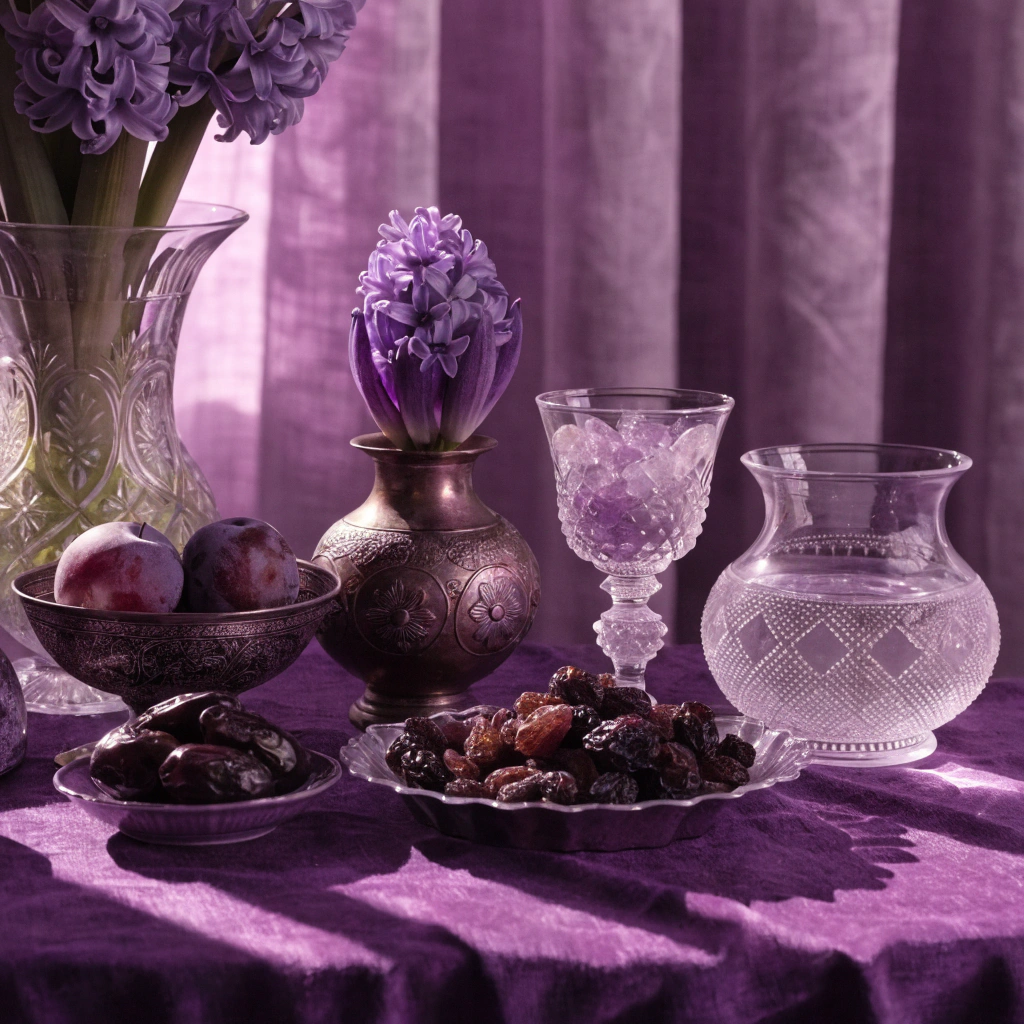
A Special Table for the New Year
Nowruz is the Iranian New Year. It starts in spring. People celebrate the new year with a special table. They call it the Sofreh-e Haft-Seen.
The table has seven special things. All the names start with the letter 'S' in Persian. For example, there is an apple for health. There is also garlic for medicine. Families put a mirror and candles on the table too.
The table is very beautiful. It shows life and light. Families sit together at the table. They are happy and eat sweet food. It is a time for a new start.
Grammar Spotlight
Pattern: Present Simple for Facts
"Nowruz is the Iranian New Year."
We use the present simple to talk about things that are always true. For the verb 'to be', use 'is' for singular subjects.
Pattern: There is / There are
"There is also garlic for medicine."
We use 'There is' to say that one thing exists. It is followed by a singular noun like 'garlic' or 'an apple'.
Test Your Understanding
10 questions · A1 Beginner · 1 free preview
Test what you learned from this article. Answer all questions to earn XP!
When does Nowruz start?
Want to finish the quiz?
9 more questions are waiting for you. Sign up free to unlock the full quiz and earn XP!
Sign Up FreeAlready have an account? Sign In
Question Breakdown
When does Nowruz start?
Your answer:
Correct answer: In spring
The special table has ten items that start with the letter 'S'.
Your answer:
Correct answer: False
What does the word 'health' mean?
Your answer:
Correct answer: The state of being well
Families sit _____ at the table.
Your answer:
Correct answer: together
The Special Table of the Iranian New Year
Nowruz is the famous Iranian New Year. It starts on the first day of spring because people celebrate the rebirth of nature. The most important tradition is the Sofreh-e Haft-Seen. This is a special table with seven symbolic items. Each item starts with the Persian letter 'Seen'.
Families prepare the table together. They put 'Sabzeh' (wheat grass) for rebirth and 'Seeb' (apple) for health and beauty. They also use 'Serkeh' (vinegar) for patience because waiting for spring is sometimes difficult. This tradition is older than many other modern holidays. It is more than 3,000 years old!
In the past, families sat around the table and waited for the exact moment of the spring equinox. Today, people still celebrate this way. They are happy because the light is stronger than the darkness. It is a beautiful time to visit friends and eat delicious food. Everyone feels excited because the new year brings hope.
Grammar Spotlight
Pattern: Comparatives (adjective + -er + than)
"This tradition is older than many other modern holidays."
We use comparatives to compare two things. For short adjectives, we add '-er' and use 'than' before the second object.
Pattern: Past Simple
"In the past, families sat around the table and waited for the exact moment."
We use the Past Simple to talk about finished actions in the past. 'Sat' is the irregular past of 'sit', and 'waited' is the regular past of 'wait'.
Test Your Understanding
11 questions · A2 Elementary · 1 free preview
Test what you learned from this article. Answer all questions to earn XP!
When does Nowruz begin?
Want to finish the quiz?
10 more questions are waiting for you. Sign up free to unlock the full quiz and earn XP!
Sign Up FreeAlready have an account? Sign In
Question Breakdown
When does Nowruz begin?
Your answer:
Correct answer: On the first day of spring
The tradition of Haft-Seen is less than 500 years old.
Your answer:
Correct answer: False
What does 'delicious' mean?
Your answer:
Correct answer: Tasting very good
Each item on the table starts with the Persian _____ 'Seen'.
Your answer:
Correct answer: letter
Why do people use vinegar (Serkeh) on the table?
Your answer:
Correct answer: For patience
Sofreh-e Haft-Seen: The Symbolic Table of Nowruz
Nowruz is the traditional Iranian New Year, which has been celebrated for over 3,000 years. It marks the spring equinox, the exact moment when nature is reborn after the cold winter. The most famous part of this festival is the Sofreh-e Haft-Seen, a decorative table that is prepared by families to welcome the new year with hope and joy.
The name 'Haft-Seen' literally means 'Seven S’s.' On the table, seven specific items are placed, and each of their names begins with the Persian letter 'Seen.' These items, which represent different hopes for the future, are chosen carefully to bring good luck. For example, 'Sabzeh' (wheat or lentil sprouts) represents rebirth and the greening of nature. Another item is 'Seer' (garlic), which symbolizes medicine and maintaining good health throughout the year.
In addition to the seven 'S' items, many other symbolic objects are also included. A mirror is often used to represent self-reflection, and beautifully colored eggs are placed on the cloth to symbolize fertility. Traditionally, a bowl of goldfish is kept on the table to represent life, although this practice has changed in some modern homes.
These customs have their roots in Zoroastrianism, an ancient religion that emphasizes the victory of light over darkness. This theme of renewal is very important to Iranians. Before the equinox arrives, every corner of the house is cleaned thoroughly, a process called 'Khoune-Tekouni.'
When the new year finally begins, family members gather around the Sofreh to pray and exchange gifts. It is a special time when old arguments are forgotten and new goals are set. This beautiful tradition, which has survived for centuries, continues to bring families together to celebrate the beauty of nature and the start of a fresh chapter.
Grammar Spotlight
Pattern: Passive Voice
"The most famous part of this festival is the Sofreh-e Haft-Seen, a decorative table that is prepared by families."
The passive voice (is + past participle) is used here to focus on the table rather than who is preparing it. It is common in B1 English when describing traditions or processes.
Pattern: Relative Clauses
"These items, which represent different hopes for the future, are chosen carefully to bring good luck."
A relative clause starting with 'which' provides extra information about the subject. It helps create more complex and descriptive sentences.
Test Your Understanding
11 questions · B1 Intermediate · 1 free preview
Test what you learned from this article. Answer all questions to earn XP!
How long has the tradition of Nowruz been celebrated?
Want to finish the quiz?
10 more questions are waiting for you. Sign up free to unlock the full quiz and earn XP!
Sign Up FreeAlready have an account? Sign In
Question Breakdown
How long has the tradition of Nowruz been celebrated?
Your answer:
Correct answer: For over 3,000 years
The name 'Haft-Seen' refers to seven items that begin with the Persian letter 'Seen'.
Your answer:
Correct answer: True
What does 'Sabzeh' (wheat sprouts) represent on the table?
Your answer:
Correct answer: Rebirth and nature
On the Sofreh, a mirror is often used to represent self-_____.
Your answer:
Correct answer: reflection
What is 'Khoune-Tekouni'?
Your answer:
Correct answer: The process of cleaning the house thoroughly
The Cultural Significance and Symbolism of Sofreh-e Haft-Seen
For over three millennia, the arrival of spring has been celebrated across the Iranian plateau through the vibrant and deeply symbolic festival of Nowruz. Marking the precise astronomical moment of the vernal equinox, this ancient tradition signifies the triumph of light over darkness and the seasonal rebirth of the natural world. At the absolute heart of these festivities lies the Sofreh-e Haft-Seen, an elaborate and visually striking table setting that reflects the collective hopes, historical values, and spiritual aspirations of the Iranian people.
The term 'Haft-Seen' translates literally to 'Seven S’s,' referring to seven specific items that must begin with the Persian letter 'Seen' (س). Each component is meticulously chosen for its metaphorical weight and historical significance. For instance, Sabzeh—wheat, barley, or lentil sprouts growing in a dish—represents rejuvenation and the lush greening of nature. Similarly, Samanu, a sophisticated sweet pudding made from wheat germ, symbolizes affluence and the rewards that come from patience and hard work. Other essential items include Senjed (dried oleaster fruit) for love, Seeb (apple) for beauty and health, Seer (garlic) for medicinal protection, Somāq (sumac berries) representing the color of sunrise, and Serkeh (vinegar) symbolizing age and the wisdom it brings.
Beyond the primary seven items, the arrangement often incorporates various secondary elements that enrich its meaning. A mirror is typically placed at the head of the table to encourage self-reflection and honesty, while lit candles signify enlightenment and the fire of life. Painted eggs are frequently included to represent fertility, and a bowl of goldfish symbolizes life within life. While the origins of these customs are deeply rooted in ancient Zoroastrianism, they have evolved over centuries into a secular cultural cornerstone that unites diverse ethnic and religious communities. It is widely believed by many families that if the table is not prepared with sufficient care and aesthetic harmony, the coming year might lack the balance and prosperity that these symbols are intended to invite.
In contemporary society, the setting of the sofreh remains a profound act of cultural preservation and national identity. As the clock strikes the exact second of the New Year, families gather around the table in their finest clothes, reinforcing social bonds and ancestral ties through shared prayers or poetry. Despite the rapid modernization of Iranian life, the core essence of the Haft-Seen persists, serving as a poignant reminder that the cycles of nature and the fundamental virtues of humanity are eternally intertwined.
Grammar Spotlight
Pattern: Present Perfect Passive
"For over three millennia, the arrival of spring has been celebrated across the Iranian plateau."
This pattern is used to describe an action that started in the past and continues to the present, focusing on the receiver of the action. It is formed using 'has/have been' plus the past participle.
Pattern: First Conditional with Modals
"If the table is not prepared with sufficient care and aesthetic harmony, the coming year might lack the balance and prosperity."
This structure expresses a real possibility in the future. The 'if' clause uses the present simple, while the main clause uses 'might' to show a possible consequence.
Pattern: Defining Relative Clauses
"referring to seven specific items that must begin with the Persian letter 'Seen'."
The relative pronoun 'that' introduces a clause that provides essential information about the 'seven specific items'. This helps to define exactly which items are being discussed.
Test Your Understanding
11 questions · B2 Upper Intermediate · 1 free preview
Test what you learned from this article. Answer all questions to earn XP!
What does the festival of Nowruz specifically mark?
Want to finish the quiz?
10 more questions are waiting for you. Sign up free to unlock the full quiz and earn XP!
Sign Up FreeAlready have an account? Sign In
Question Breakdown
What does the festival of Nowruz specifically mark?
Your answer:
Correct answer: The exact moment of the spring equinox
The Haft-Seen tradition is strictly a religious Zoroastrian practice in modern Iran.
Your answer:
Correct answer: False
What does 'metaphorical' mean in the context of the article?
Your answer:
Correct answer: Representing something symbolic
Each item on the table is _____ chosen for its historical significance.
Your answer:
Correct answer: meticulously
Which item is used to symbolize the wisdom that comes with age?
Your answer:
Correct answer: Serkeh (Vinegar)
Vernal Resurgence: Deciphering the Semiotics of the Sofreh-e Haft-Seen
It is at the precise moment of the vernal equinox that millions across the Iranian plateau and beyond celebrate Nowruz, the Persian New Year. Central to this celebration is the Sofreh-e Haft-Seen, a meticulously curated table that serves as a profound manifestation of cultural identity and ancient cosmology. The setting of the table is not merely a ritualistic performance; rather, it represents a sophisticated synthesis of Zoroastrian heritage and the perennial human desire for renewal. This tradition, which has weathered the sands of time for over three millennia, offers a window into the philosophical psyche of a civilization that prizes the triumph of light over darkness.
The term 'Haft-Seen' refers to seven specific items beginning with the Persian letter 'Seen,' each imbued with deep semiotic significance. Not only does the Sabzeh (sprouted wheat or lentils) symbolize the rebirth of nature, but it also serves as a poignant reminder of the cyclicality of life. Similarly, Samanu, a sweet pudding made from wheat germ, represents the resilience and strength required to navigate the complexities of existence. The inclusion of Senjed (dried oleaster) points towards love and wisdom, while Seer (garlic) is traditionally associated with medicinal protection and the maintenance of health. Furthermore, Seeb (apple) is placed to evoke beauty and vitality, while Serkeh (vinegar) symbolizes the patience and wisdom that come with age. Completing the primary seven is Somaq (sumac), whose crimson hue represents the sunrise and the spice of life.
The historical underpinnings of this tradition are deeply rooted in the dualistic philosophy of ancient Persia, where the struggle between light and darkness was a central theme. The Sofreh acts as a microcosm of a harmonious universe. The presence of a mirror reflects the light of the soul and the clarity of self-reflection, while goldfish in a bowl denote life and the end of the astral year. The ephemeral nature of the spring season is captured in the delicate balance of these items, suggesting that while beauty may be fleeting, the spirit of renewal is eternal. The critical analysis of these symbols reveals a culture that finds divinity in the natural world.
The meticulous arrangement of the table involves significant nominalisation in its description: the preservation of heritage, the cultivation of hope, and the sanctification of the domestic space. It is through these symbolic gestures that families propitiate the forces of nature and welcome a prosperous year. The precursor to the modern Sofreh can be traced back to the Achaemenid era, surviving countless political and social upheavals. This metamorphosis of the tradition across centuries demonstrates the adaptive capacity of Persian culture, allowing it to remain relevant in an increasingly globalized world.
In contemporary times, the Sofreh-e Haft-Seen remains an indispensable element of Nowruz. It transcends religious boundaries, acting as a secular bond that unites diverse communities across the globe. By critically analyzing the semiotics of the Haft-Seen, one uncovers a narrative of human perseverance against the backdrop of seasonal change. It is this profound connection to the natural world and the ancestral past that ensures Nowruz remains a vibrant, living tradition in the twenty-first century, inviting us all to reflect on the possibilities of a fresh start.
Grammar Spotlight
Pattern: Cleft Sentences
"It is at the precise moment of the vernal equinox that millions across the Iranian plateau and beyond celebrate Nowruz."
Cleft sentences are used to focus on a specific part of the sentence. They follow the structure 'It + is/was + [focused part] + that/who...'
Pattern: Negative Inversion
"Not only does the Sabzeh symbolize the rebirth of nature, but it also serves as a poignant reminder of the cyclicality of life."
When a sentence starts with a negative adverbial like 'Not only,' the subject and auxiliary verb are inverted to create emphasis and a more formal tone.
Pattern: Nominalisation
"The meticulous arrangement of the table involves significant nominalisation in its description: the preservation of heritage, the cultivation of hope, and the sanctification of the domestic space."
Nominalisation involves turning verbs or adjectives into nouns. This is common in academic and formal English to make the text sound more objective and concise.
Test Your Understanding
12 questions · C1 Advanced · 1 free preview
Test what you learned from this article. Answer all questions to earn XP!
What is the primary symbolic meaning of the Sabzeh on the Haft-Seen table?
Want to finish the quiz?
11 more questions are waiting for you. Sign up free to unlock the full quiz and earn XP!
Sign Up FreeAlready have an account? Sign In
Question Breakdown
What is the primary symbolic meaning of the Sabzeh on the Haft-Seen table?
Your answer:
Correct answer: The rebirth of nature
The tradition of the Sofreh-e Haft-Seen has its origins in Zoroastrian heritage dating back over 3,000 years.
Your answer:
Correct answer: True
What does the word 'ephemeral' mean in the context of the article?
Your answer:
Correct answer: Lasting for a very short time
The _____ of the tradition across centuries demonstrates the adaptive capacity of Persian culture.
Your answer:
Correct answer: metamorphosis
What does the mirror represent on the Sofreh?
Your answer:
Correct answer: The light of the soul
The article suggests that Nowruz is exclusively a religious holiday and does not unite diverse communities.
Your answer:
Correct answer: False
The Semiotics of the Sofreh-e Haft-Seen: An Ontological Exploration of Nowruz
The vernal equinox, a celestial juncture marking the precise moment nature recalibrates itself, is nowhere more profoundly observed than in the Iranian tradition of Nowruz. Central to this antiquity-steeped celebration is the Sofreh-e Haft-Seen, a meticulously curated tableau that transcends mere aesthetic ornamentation. It serves as a semiotic anchor, grounding the observer in a complex matrix of Zoroastrian cosmology and syncretic cultural evolution. Should one scrutinize the arrangement, one would find that it is not merely a collection of flora and artifacts, but rather an axiological statement on the triumph of light over the primordial abyss of darkness.
The 'Haft-Seen', or the Seven S’s, consists of seven specific items, each commencing with the Persian letter 'Seen'. These items are not chosen arbitrarily; rather, they are imbued with allegorical depth. Sabzeh (wheat or lentil sprouts) symbolizes rebirth, yet its inherent transience serves as a poignant reminder of the ephemeral nature of life itself. Samanu, a sweet pudding derived from germinated wheat, represents affluence and the sophisticated alchemy of patience. Senjed (dried oleaster fruit) is said to evoke love and wisdom, while Seer (garlic) functions as a medicinal talisman against the encroaching malaise of ill health. Seeb (apple) represents beauty and health, Somāq (sumac) the crimson dawn of a new beginning, and Serkeh (vinegar) the stoic resilience and wisdom found in the process of aging.
Seldom has a cultural practice maintained such verisimilitude to its ancient roots while simultaneously absorbing the shifting theological tides of the region. The inclusion of a mirror, or Aayeneh, reflects the light of truth and self-contemplation, while the presence of goldfish in a vessel of water signifies life within life and the end of the astral year. Furthermore, the juxtaposition of the Quran alongside the Diwan of Hafez—the pinnacle of Persian lyrical poetry—exemplifies the syncretic harmony that characterizes the modern Iranian identity. It is imperative that the setting of the table be completed before the exact second of the 'Tahvil', the transition into the new year, as if the cosmic order itself depended on this domestic ritual. This liminality, the threshold between the old and the new, is a moment of profound psychological and spiritual significance.
Beyond the physical components, the Sofreh-e Haft-Seen functions as a locus of domestic conviviality. Families gather around the table, waiting for the cannon's roar or the radio's announcement of the equinox. In this moment, the domestic sphere is transformed into a sacred space. The olfactory experience—the scent of Sonbol (hyacinth) mingling with the aroma of Samanu—creates a sensory memory that binds generations together. This is not merely a performance of heritage but an ontological reassertion of the self within the cycle of the seasons. By engaging with these symbols, the practitioner participates in a temporal continuity that stretches back over three millennia, defying the erosive forces of time.
In an era defined by the rapid homogenization of global culture, the Sofreh-e Haft-Seen remains a bastion of particularity. It represents a sophisticated interplay between the material and the metaphysical. The coins (Sekkeh) represent future prosperity, yet they sit alongside the Sabzeh, which will eventually be cast into running water, illustrating the duality of human aspirations: the desire for material security and the recognition of life’s unavoidable transience. Thus, the Sofreh is not a static display but a living, breathing testament to the enduring human desire to find meaning in the rhythmic pulses of the cosmos. It is a scholarly endeavor in itself to unpack the layers of meaning embedded in this tradition, a tradition that continues to flourish as a vibrant expression of Iranian soul and resilience.
Grammar Spotlight
Pattern: Inversion after negative or restrictive adverbs
"Seldom has a cultural practice maintained such verisimilitude to its ancient roots while simultaneously absorbing the shifting theological tides of the region."
When using restrictive adverbs like 'seldom', 'never', or 'hardly' at the start of a sentence for emphasis, the auxiliary verb is placed before the subject. This structure is common in formal, C2-level academic prose.
Pattern: The Subjunctive Mood in noun clauses
"It is imperative that the setting of the table be completed before the exact second of the 'Tahvil'..."
The subjunctive 'be completed' is used after adjectives of necessity (imperative, essential, vital). Note the base form of the verb is used regardless of the subject.
Pattern: Inverted Conditional (Should)
"Should one scrutinize the arrangement, one would find that it is not merely a collection of flora and artifacts..."
This is a formal alternative to 'If one should scrutinize'. It creates a more scholarly and hypothetical tone, typical of analytical writing.
Test Your Understanding
12 questions · C2 Mastery · 1 free preview
Test what you learned from this article. Answer all questions to earn XP!
What does the author suggest about the relationship between the items on the Sofreh and their meanings?
Want to finish the quiz?
11 more questions are waiting for you. Sign up free to unlock the full quiz and earn XP!
Sign Up FreeAlready have an account? Sign In
Question Breakdown
What does the author suggest about the relationship between the items on the Sofreh and their meanings?
Your answer:
Correct answer: The items serve as a complex system of symbolic and value-based statements.
The article claims that Nowruz has completely discarded its Zoroastrian origins in favor of modern secularism.
Your answer:
Correct answer: False
Which word describes the quality of appearing real or authentic?
Your answer:
Correct answer: Verisimilitude
The author describes the transition into the new year as a moment of _____, or a threshold between two states.
Your answer:
Correct answer: liminality
According to the text, what does the juxtaposition of the Quran and the Diwan of Hafez represent?
Your answer:
Correct answer: The syncretic nature of contemporary Iranian identity.
The Sabzeh (sprouts) serves as a reminder of both rebirth and the temporary nature of existence.
Your answer:
Correct answer: True
