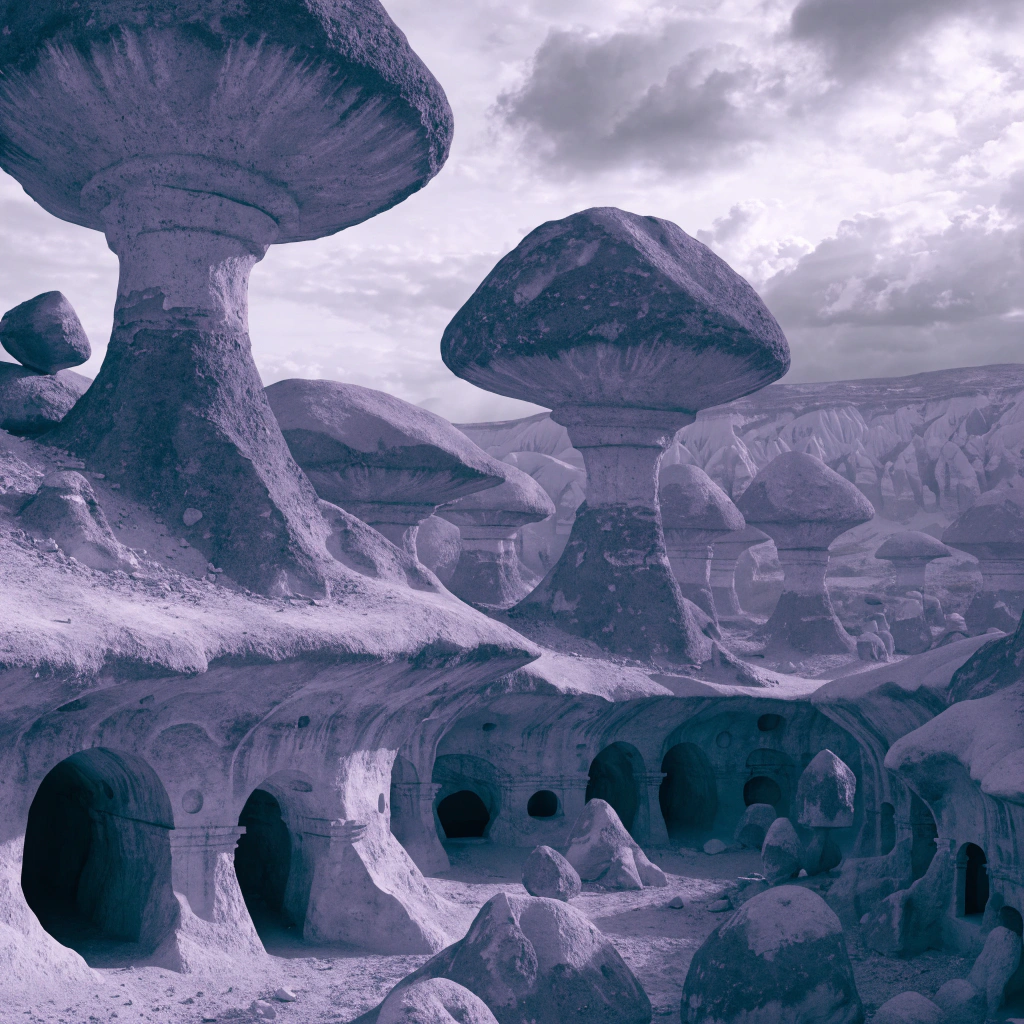
A Beautiful Place in Turkey
Cappadocia is a beautiful place in Turkey. It is in the center of the country. The rocks have strange shapes. People call them fairy chimneys. They look like tall mushrooms.
Long ago, people lived in these rocks. They carved houses and churches inside the soft stone. Today, many people visit Cappadocia. They like to see the valleys.
Many people fly in hot air balloons. They see the mountains from the sky. It is very quiet and peaceful. Cappadocia is a magic place.
Grammar Spotlight
Pattern: Present Simple of 'to be'
"Cappadocia is a beautiful place in Turkey."
We use 'is' for singular subjects like 'Cappadocia' or 'it'. This pattern helps us describe people, places, and things.
Pattern: Present Simple (Plural)
"Many people visit Cappadocia."
With plural subjects like 'people' or 'they', we use the base form of the verb. We do not add an -s at the end.
Test Your Understanding
10 questions · A1 Beginner · 1 free preview
Test what you learned from this article. Answer all questions to earn XP!
Where is Cappadocia?
Want to finish the quiz?
9 more questions are waiting for you. Sign up free to unlock the full quiz and earn XP!
Sign Up FreeAlready have an account? Sign In
Question Breakdown
Where is Cappadocia?
Your answer:
Correct answer: In Turkey
People live in the sky in Cappadocia.
Your answer:
Correct answer: False
What is a 'valley'?
Your answer:
Correct answer: Low land between mountains
Cappadocia is a _____ place.
Your answer:
Correct answer: magic
Cappadocia: The Land of Fairy Chimneys
Cappadocia is a special region in central Turkey. It is a very famous place because it looks like another planet. The land is unique and beautiful.
Millions of years ago, volcanoes covered the area with ash. This ash became soft rock. Later, the wind and rain changed the rocks into tall shapes. People call these rocks 'fairy chimneys.' They are taller than normal trees and look very strange.
In the past, people lived inside these rocks. They carved houses, churches, and even cities under the ground because the rock was soft. It was easier to build homes there than in other places. Today, some people still live in cave houses, but many are now hotels for tourists.
The most popular activity is flying in a hot air balloon. Every morning, hundreds of balloons fly in the sky. The view is more amazing than any photo. Cappadocia is more quiet than a big city, but it is very exciting to visit.
Grammar Spotlight
Pattern: Past Simple
"Millions of years ago, volcanoes covered the area with ash."
We use the past simple to talk about things that happened and finished in the past. To form regular verbs, we usually add '-ed' to the end of the word.
Pattern: Comparatives
"The view is more amazing than any photo."
We use comparatives to compare two things or places. For long adjectives like 'amazing', we use 'more' before the adjective and 'than' after it.
Test Your Understanding
11 questions · A2 Elementary · 1 free preview
Test what you learned from this article. Answer all questions to earn XP!
Where is Cappadocia located?
Want to finish the quiz?
10 more questions are waiting for you. Sign up free to unlock the full quiz and earn XP!
Sign Up FreeAlready have an account? Sign In
Question Breakdown
Where is Cappadocia located?
Your answer:
Correct answer: Turkey
People built cities under the ground in Cappadocia.
Your answer:
Correct answer: True
What does 'unique' mean?
Your answer:
Correct answer: Special and different
The wind and rain _____ the rocks into tall shapes.
Your answer:
Correct answer: changed
What do people call the tall rocks in Cappadocia?
Your answer:
Correct answer: Fairy chimneys
The Magic of Cappadocia: A World Carved in Stone
Cappadocia is a magical region in central Turkey which has been shaped by nature over millions of years. This incredible area is famous for its unique landscape, which often looks like it belongs on another planet. The strange rock formations, which are called 'fairy chimneys', were created by volcanic eruptions a long time ago. Thick layers of ash from these volcanoes eventually became a soft rock known as tuff. Over many centuries, the wind and rain have carved this tuff into the tall, thin spires that we see today.
However, the true wonder of Cappadocia is how humans have adapted to this environment. Because the rock is soft and easy to cut, people have carved homes, churches, and even entire underground cities into the mountains. In the past, these hidden cities were used by thousands of people to protect themselves from enemies during times of war. Today, many of these ancient caves have been turned into unique hotels where modern tourists can experience life inside the rock.
One of the most popular activities in Cappadocia is taking a hot air balloon flight at sunrise. Every morning, hundreds of colorful balloons are seen floating in the sky, providing a spectacular view of the valleys below. This experience has become a bucket-list dream for many travelers who visit Turkey. Although the region has changed because of tourism, it still keeps its mysterious and peaceful atmosphere. Visitors often spend several days exploring the deep valleys and hiking through the historical sites. It is truly a destination that has been admired by people for generations.
Grammar Spotlight
Pattern: Passive Voice
"Every morning, hundreds of colorful balloons are seen floating in the sky."
The passive voice is used when the action is more important than who is doing it. It is formed using 'be' + the past participle.
Pattern: Relative Clauses with 'Which'
"Cappadocia is a magical region in central Turkey which has been shaped by nature."
Relative clauses give more information about a noun. We use 'which' for things or places to connect ideas smoothly in one sentence.
Test Your Understanding
11 questions · B1 Intermediate · 1 free preview
Test what you learned from this article. Answer all questions to earn XP!
What caused the formation of the 'fairy chimneys' initially?
Want to finish the quiz?
10 more questions are waiting for you. Sign up free to unlock the full quiz and earn XP!
Sign Up FreeAlready have an account? Sign In
Question Breakdown
What caused the formation of the 'fairy chimneys' initially?
Your answer:
Correct answer: Volcanic eruptions and erosion
The underground cities were originally built to host modern tourists.
Your answer:
Correct answer: False
What does 'ancient' mean?
Your answer:
Correct answer: From a very long time ago
The soft rock created from volcanic ash is known as _____.
Your answer:
Correct answer: tuff
Why did people carve their homes into the rock in Cappadocia?
Your answer:
Correct answer: Because the rock was soft and easy to cut
Cappadocia: A Masterpiece of Nature and Human Ingenuity
Situated in the heart of Anatolia, Cappadocia presents a landscape so surreal that it seems to belong to a different realm. Millions of years ago, violent volcanic eruptions deposited layers of thick ash across the region, which subsequently solidified into a porous, soft rock known as tuff. Over millennia, the relentless forces of wind and water erosion have meticulously sculpted this material into the world-renowned 'fairy chimneys'—tapering rock spires that dominate the horizon. This unique topography serves as a testament to the transformative power of natural processes over geological time.
While the geological formations are undoubtedly spectacular, the historical human intervention is what truly distinguishes Cappadocia. For centuries, inhabitants have exploited the pliable nature of the tuff rock, carving out elaborate subterranean cities and cliffside dwellings. These structures were not merely primitive shelters; they were sophisticated urban centers capable of housing thousands of people, featuring ventilation systems, storage rooms, and places of worship. Consequently, these underground labyrinths provided essential protection against both extreme weather and invading forces. The thermal properties of the rock also ensured a stable temperature, offering a cool retreat during scorching summers and warmth during the bitter winters.
Beyond its architectural marvels, the region holds significant cultural weight. As a vital stop along the ancient Silk Road, Cappadocia became a melting pot of diverse civilizations. This cultural exchange is most evident in the numerous rock-cut churches, many of which are adorned with intricate frescoes that have survived the passage of time. These artworks provide a window into the spiritual life of the Byzantine era, reflecting a period where art and faith were inextricably linked. Today, the preservation of these sites is a subject of ongoing debate, as the influx of international tourism brings both economic prosperity and environmental challenges.
In contemporary times, the region is perhaps most famous for the kaleidoscopic display of hot air balloons that drift over the valleys at dawn. This spectacle offers a unique perspective on the intricate topography below. However, observers must consider the delicate balance required to maintain such a heritage site. While tourism provides the necessary funds for conservation, the sheer volume of visitors could potentially threaten the structural integrity of the soft rock formations. Therefore, sustainable management remains paramount for the future of this Anatolian treasure.
Grammar Spotlight
Pattern: Relative Clauses
"Millions of years ago, violent volcanic eruptions deposited layers of thick ash across the region, which subsequently solidified into a porous, soft rock known as tuff."
Non-defining relative clauses provide extra information about a noun. They are separated by commas and use 'which' for things or 'who' for people.
Pattern: Present Perfect Passive
"Over millennia, the relentless forces of wind and water erosion have meticulously sculpted this material..."
The present perfect (have/has + past participle) is used here to describe an action that started in the past and has continuing relevance or results in the present.
Pattern: Passive Voice with 'be' + Past Participle
"...many of which are adorned with intricate frescoes that have survived the passage of time."
The passive voice is used when the focus is on the action or the object receiving the action rather than the person performing it. Here, it emphasizes the state of the churches.
Test Your Understanding
11 questions · B2 Upper Intermediate · 1 free preview
Test what you learned from this article. Answer all questions to earn XP!
What was the primary cause of the unique geological formations in Cappadocia?
Want to finish the quiz?
10 more questions are waiting for you. Sign up free to unlock the full quiz and earn XP!
Sign Up FreeAlready have an account? Sign In
Question Breakdown
What was the primary cause of the unique geological formations in Cappadocia?
Your answer:
Correct answer: Volcanic eruptions followed by erosion
The subterranean cities were only used as temporary shelters during wars.
Your answer:
Correct answer: False
What does 'pliable' mean in the context of the tuff rock?
Your answer:
Correct answer: Easy to shape or carve
The article suggests that sustainable management is _____ for the future of the region.
Your answer:
Correct answer: paramount
Why does the author mention hot air balloons?
Your answer:
Correct answer: To describe a popular way to view the landscape
The Stratigraphy of Human Ingenuity: Unearthing the Cultural Palimpsest of Cappadocia
Seldom does a landscape evoke such a profound sense of temporal displacement as the central Anatolian plateau of Cappadocia. This region, characterized by its surreal 'fairy chimneys' and undulating valleys, is not merely a geological anomaly but a testament to human resilience. The stratigraphy of the land reveals a history of volcanic upheaval, where layers of ash solidified into tuff—a soft rock that would eventually become the canvas for an entire civilization.
It was the peculiar geological composition of this tuff that facilitated an unprecedented architectural phenomenon. Rather than building upward, the inhabitants of Cappadocia carved downward, creating vast subterranean cities such as Derinkuyu and Kaymakli. These monolithic structures, descending several stories beneath the surface, provided sanctuary for thousands during periods of invasion. The sheer ingenuity required to engineer ventilation shafts and rolling stone doors in such a precarious environment remains a subject of intense academic scrutiny.
Beyond its defensive utility, the rock also served as an ecclesiastical refuge. The Goreme Open Air Museum showcases a multitude of churches hewn directly into the rock face. Inside, the preservation of Byzantine frescoes is remarkable, offering a glimpse into the spiritual life of early Christian communities. This cultural palimpsest—where layers of history are superimposed upon one another—illustrates how the region transitioned from a pagan landscape to a bastion of Christian monasticism.
However, the modern era brings a different set of challenges. The ephemeral nature of the tuff, while beneficial for carvers, makes the structures susceptible to erosion. Furthermore, the burgeoning tourism industry presents a double-edged sword. While it brings economic prosperity, the risk of 'Disneyfication' threatens the authenticity of these ancient sites. Conservationists argue that the delicate balance between accessibility and preservation must be maintained to prevent the irreversible degradation of this UNESCO World Heritage site.
Ultimately, Cappadocia represents a unique synthesis of nature and culture. The landscape is a living record of how humans can adapt to and thrive in even the most alien environments. As we gaze upon the sunset reflecting off the honey-colored spires, we are reminded that our history is not just written in books, but etched into the very earth itself.
Grammar Spotlight
Pattern: Negative Inversion
"Seldom does a landscape evoke such a profound sense of temporal displacement as the central Anatolian plateau of Cappadocia."
When a negative adverbial like 'seldom' starts a sentence, the auxiliary verb and subject are inverted. This is used in formal writing to emphasize the rarity or intensity of the statement.
Pattern: Cleft Sentence (It-cleft)
"It was the peculiar geological composition of this tuff that facilitated an unprecedented architectural phenomenon."
Cleft sentences use the structure 'It is/was + [focused part] + that/who' to emphasize a specific piece of information. Here, it highlights the rock's composition as the primary cause.
Pattern: Nominalisation
"The preservation of Byzantine frescoes is remarkable, offering a glimpse into the spiritual life of early Christian communities."
Nominalisation involves turning verbs (preserve) into nouns (preservation). This makes the writing more concise, formal, and objective, which is a hallmark of C1-level academic and descriptive prose.
Test Your Understanding
12 questions · C1 Advanced · 1 free preview
Test what you learned from this article. Answer all questions to earn XP!
What is the primary message regarding the human history of Cappadocia?
Want to finish the quiz?
11 more questions are waiting for you. Sign up free to unlock the full quiz and earn XP!
Sign Up FreeAlready have an account? Sign In
Question Breakdown
What is the primary message regarding the human history of Cappadocia?
Your answer:
Correct answer: It demonstrates how humans adapted architecture to unique geological conditions.
The 'tuff' rock in Cappadocia is described as a hard, impenetrable material.
Your answer:
Correct answer: False
Which word best describes the 'cleverness and inventiveness' shown by the inhabitants?
Your answer:
Correct answer: Ingenuity
The inhabitants built _____ cities to protect themselves from invasion.
Your answer:
Correct answer: subterranean
What does the term 'cultural palimpsest' refer to in the text?
Your answer:
Correct answer: The overlapping layers of history and religious transition in the region.
The author suggests that tourism is entirely beneficial for the preservation of Cappadocia.
Your answer:
Correct answer: False
The Palimpsest of Anatolia: Lithic Architecture and the Anthropogenic Subterranean of Cappadocia
The Anatolian plateau, specifically the region of Cappadocia, presents a geomorphological tableau so surrealist that it appears to defy the very laws of terrestrial physics. This landscape, a product of cataclysmic volcanic eruptions millions of years ago, was forged when thick layers of ash solidified into tuff—a porous, malleable rock. Over eons, the relentless forces of wind and water erosion have sculpted this lithic canvas into the iconic ‘fairy chimneys,’ yet to focus solely on the exterior would be to overlook the profound anthropogenic interventions that define the region's historical narrative. It might be posited that the landscape is not merely a geological curiosity, but a living record of human resilience and architectural ingenuity.
Were one to traverse the undulating valleys of Göreme or Ihlara, one would encounter a palimpsest of human endeavor etched directly into the earth. The soft nature of the tuff allowed ancient civilizations to bypass traditional masonry, opting instead for a subtractive architecture. This resulted in the creation of vast subterranean complexes, such as Derinkuyu and Kaymakli, which served as multi-level refuges capable of housing thousands. These troglodyte dwellings were not merely utilitarian bunkers but sophisticated urban environments, complete with ventilation shafts, oil presses, and chapels. The sheer scale of these excavations suggests a level of social organization and engineering prowess that challenges our contemporary understanding of pre-modern societies.
The cultural significance of Cappadocia is arguably most poignant in its role as a sanctuary for early Christian communities. During the Byzantine era, the region became a bastion of monasticism. The rock-cut churches, adorned with vibrant frescoes, offer a rare glimpse into the theological shifts of the first millennium. One might observe that the preservation of these artworks is nothing short of miraculous, considering the periods of iconoclasm that swept through the empire. The frescoes, though occasionally defaced by the passage of time or human hands, remain a testament to the spiritual fervor that once permeated these stone halls. The interplay between the natural rock and the sacred art creates an ethereal atmosphere that transcends the mundane.
It is often posited by scholars that the subterranean nature of these settlements was a strategic response to the perennial threat of invasion. By retreating beneath the surface, the inhabitants could remain undetected by marauding armies crossing the Anatolian heartland. This defensive mechanism, while effective, necessitated a highly organized social structure, the remnants of which are still being analyzed by contemporary archaeologists. The complexity of these hidden cities is thought to have been a direct consequence of the region's geopolitical vulnerability, serving as a silent witness to centuries of conflict and cultural exchange.
In the modern era, the ethereal beauty of Cappadocia has been commodified through the lens of global tourism. The image of hundreds of hot-air balloons drifting over the calcified spires at dawn has become an international symbol of Turkey’s natural heritage. However, this influx of visitors brings with it the challenge of balancing preservation with accessibility. Seldom has a site faced such a delicate tightrope walk between maintaining its structural integrity and welcoming the masses. The porous nature of the tuff makes it susceptible to both natural weathering and anthropogenic wear, necessitating rigorous conservation efforts to ensure that this monolithic heritage survives for future generations.
Ultimately, Cappadocia remains an enigma—a place where the boundaries between the natural world and human artifice are irrevocably blurred. Whether viewed as a geological anomaly or a masterpiece of human resilience, it continues to evoke a sense of profound wonder. It is imperative that future generations continue to safeguard this monolithic heritage, lest the whispers of the past be silenced by the encroaching sands of time. The region stands as a monumental reminder of how humanity can adapt to, and thrive within, even the most alien of environments.
Grammar Spotlight
Pattern: Inversion after Negative/Restrictive Adverbs
"Seldom has a site faced such a delicate tightrope walk between maintaining its structural integrity and welcoming the masses."
When using restrictive adverbs like 'seldom', 'rarely', or 'never' at the beginning of a sentence for emphasis, the auxiliary verb is placed before the subject.
Pattern: The Subjunctive Mood
"Were one to traverse the undulating valleys of Göreme or Ihlara, one would encounter a palimpsest of human endeavor etched directly into the earth."
The 'were' subjunctive is used to express hypothetical or counterfactual conditions in the present or future, lending a formal, academic tone.
Pattern: Academic Hedging
"It might be posited that the landscape is not merely a geological curiosity, but a living record of human resilience."
Hedging involves using modal verbs and specific phrasing to soften claims, indicating that an idea is a possibility rather than an absolute, undisputed fact.
Test Your Understanding
12 questions · C2 Mastery · 1 free preview
Test what you learned from this article. Answer all questions to earn XP!
What primary geological material allowed for the creation of subterranean cities in Cappadocia?
Want to finish the quiz?
11 more questions are waiting for you. Sign up free to unlock the full quiz and earn XP!
Sign Up FreeAlready have an account? Sign In
Question Breakdown
What primary geological material allowed for the creation of subterranean cities in Cappadocia?
Your answer:
Correct answer: Tuff
The frescoes in the rock-cut churches were completely preserved without any damage during the iconoclasm period.
Your answer:
Correct answer: False
What does the term 'Anthropogenic' refer to in the context of the article?
Your answer:
Correct answer: Changes caused by human impact
The region's history is described as a _____ of human endeavor, showing layers of different historical eras.
Your answer:
Correct answer: palimpsest
According to the text, why were subterranean cities likely constructed?
Your answer:
Correct answer: As a strategic defense against frequent invasions
The article suggests that Cappadocia's current popularity in tourism poses no threat to its structural integrity.
Your answer:
Correct answer: False

