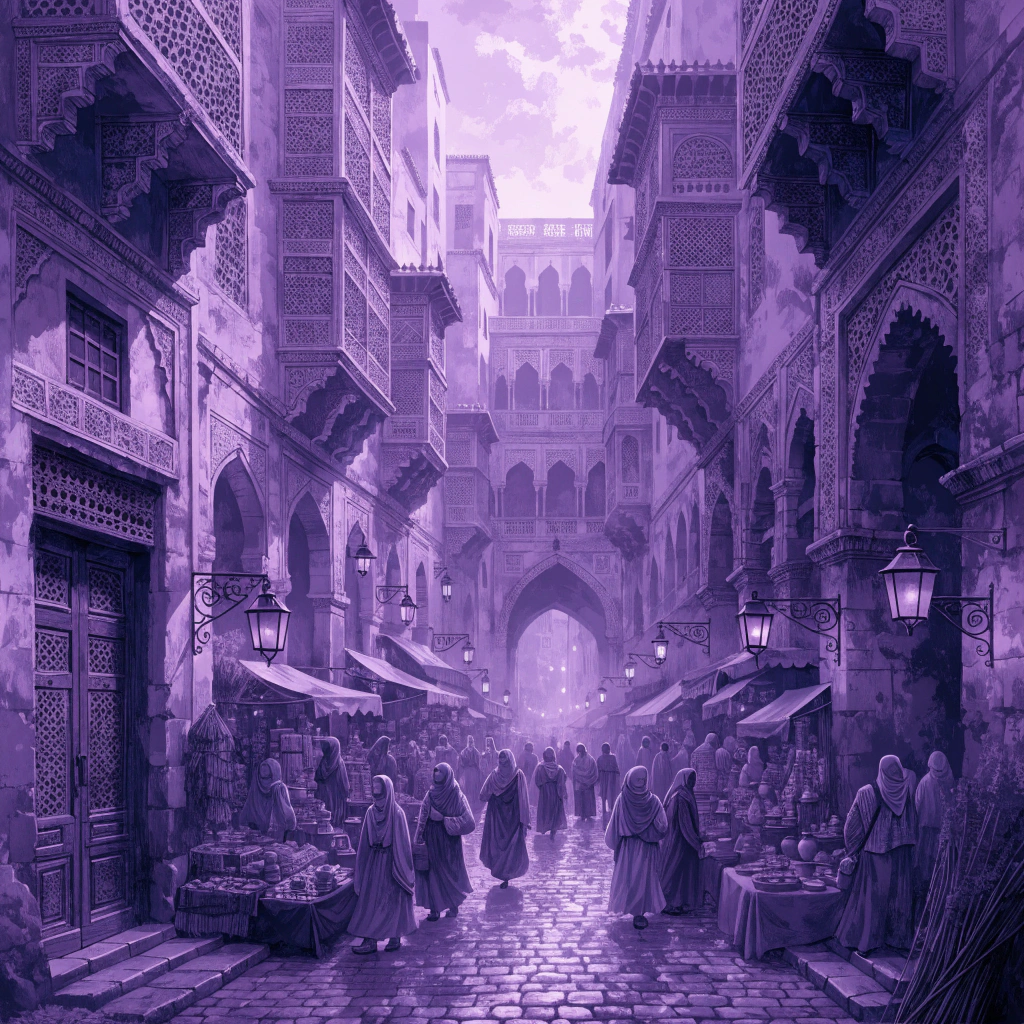
エジプトの古い市場:ハン・ハリーリ
エジプトに有名な市場があります。名前は「ハン・ハリーリ」です。これはとても古い市場です。 たくさんの店があります。人々はここで色々な物を見ます。きれいな物やお土産を買うことができます。 市場はとてもにぎやかです。多くの人が歩いています。食べ物や飲み物も売っています。 ここはエジプトの歴史がある場所です。とても楽しいです。
文法スポットライト
パターン: 〜があります
"エジプトに有名な市場があります。"
これは、何かがあることを言いたいときに使います。物や場所の存在を表します。「に」は場所を示します。
パターン: 〜ことができます
"きれいな物やお土産を買うことができます。"
これは、何かを「できる」という意味を表します。動詞の辞書形の後ろにつけて使います。
理解度をチェック
10 問 · A1 初級 · 無料プレビュー 1回
この記事で学んだことをテストしよう。全問正解してXPを獲得!
問題の内訳
「ハン・ハリーリ」は何ですか?
あなたの回答:
正解: 市場
ハン・ハリーリ市場は新しいです。
あなたの回答:
正解: 間違い
「お土産」の意味は何ですか?
あなたの回答:
正解: 旅行先で買う物
人々はここで色々な物を___。
あなたの回答:
正解: 見ます
A Visit to Khan el-Khalili Bazaar
Khan el-Khalili is a very old market in the heart of Cairo, Egypt. It started more than 600 years ago in the 14th century. In the past, it was a place where merchants could rest and trade their goods. Today, it is one of the most famous markets in the Middle East.
The bazaar is like a large maze with many narrow streets and stone archways. When you walk through the market, you can see many beautiful things. There are colorful lanterns, gold jewelry, and traditional clothes. The smells of spices and perfumes are everywhere because there are many shops.
Many people visit the bazaar because it is more interesting than a modern shopping mall. You can buy gifts for your family or sit in a famous café. The Fishawy Café is the oldest one in the market. People go there to drink mint tea and talk with friends. It is a busy and exciting place to visit.
文法スポットライト
パターン: Past Simple
"It started more than 600 years ago in the 14th century."
We use the past simple for actions that finished in the past. For regular verbs, we add '-ed' to the base verb.
パターン: Comparatives
"Many people visit the bazaar because it is more interesting than a modern shopping mall."
We use comparatives to compare two different things. For long adjectives, we use 'more' + adjective + 'than'.
理解度をチェック
11 問 · A2 初級 · 無料プレビュー 1回
この記事で学んだことをテストしよう。全問正解してXPを獲得!
Where is Khan el-Khalili located?
問題の内訳
Where is Khan el-Khalili located?
あなたの回答:
正解: Cairo
Khan el-Khalili is a very new market.
あなたの回答:
正解: 間違い
What is a 'merchant'?
あなたの回答:
正解: A person who buys and sells things
The bazaar is like a large _____ with many narrow streets.
あなたの回答:
正解: maze
What is the name of the oldest café in the market?
あなたの回答:
正解: Fishawy Café
カイロの歴史と活気:ハン・ハリーリ市場
エジプトの首都カイロの中心には、古くから存在する有名な市場があります。それが「ハン・ハリーリ市場」です。この市場は、14世紀の終わり頃、マムルーク朝の時代にキャラバンサライとして建てられました。キャラバンサライというのは、昔の商人が旅の途中で休んだり、商品を交換したりするための宿でした。商人たちはここで旅の疲れを癒し、様々な国の品物を売り買いしていました。
何世紀もの間、ハン・ハリーリ市場は少しずつ大きくなっていきました。今では、細い道や石造りのアーチがたくさんある、まるで迷路のような場所になっています。ここには、香辛料、宝石、手作りの工芸品、お土産など、様々なものが売られています。多くの店が並んでいて、色々な商品を見ることができます。観光客だけでなく、地元の人々も毎日ここを訪れ、買い物を楽しんでいます。
市場の中に入ると、活気ある声や香辛料の匂いがして、五感でエジプトの文化を感じることができます。店の人とお客さんが値段交渉をしている様子も、この市場の日常的な風景です。ここでは、歴史的な建物の美しさに触れることができ、エジプトの伝統的な生活が今も息づいているのが分かります。ハン・ハリーリ市場は、ただの買い物をする場所ではなく、カイロの歴史と文化が生き続けている特別な場所だと言えるでしょう。
文法スポットライト
パターン: 受身形(~れる/られる)
"この市場は、14世紀の終わり頃、マムルーク朝の時代にキャラバンサライとして建てられました。"
この形は、誰がその行動をしたかではなく、何がされたかに注目する時に使います。動詞の形を変えることで「~される」という意味になります。
パターン: 名詞を修飾する文(~する/した名詞)
"古くから存在する有名な市場"
動詞や文が名詞の前に来て、その名詞について詳しく説明する時に使います。日本語では「~する名詞」や「~した名詞」という形になります。
理解度をチェック
11 問 · B1 中級 · 無料プレビュー 1回
この記事で学んだことをテストしよう。全問正解してXPを獲得!
ハン・ハリーリ市場は、カイロのどこにありますか。
問題の内訳
ハン・ハリーリ市場は、カイロのどこにありますか。
あなたの回答:
正解: カイロの中心
ハン・ハリーリ市場は、もともと商人が休むための宿でした。
あなたの回答:
正解: 正しい
「工芸品」とはどういう意味ですか。
あなたの回答:
正解: 手で作られた美しい物
市場の中では、店の人とお客さんが(______)をしている様子が見られます。
あなたの回答:
正解: 値段交渉
記事によると、ハン・ハリーリ市場で売られているものではないものは何ですか。
あなたの回答:
正解: 最新の電化製品
The Khan el-Khalili Bazaar: A Timeless Intersection of History and Commerce
Nestled in the heart of Islamic Cairo, the Khan el-Khalili is not merely a marketplace; it is a historical monument that encapsulates the essence of Egyptian heritage. Established in the late 14th century during the Mamluk era by Emir Gerkes al-Khalili, it originally served as a caravanserai—a roadside inn where merchants could rest and trade their goods. Over the centuries, this labyrinthine souk has survived numerous political and social transformations, expanding into a sprawling maze of narrow alleys and vaulted stone archways. Had the merchants of the Mamluk era not recognized the strategic value of this location, Cairo might never have developed into such a significant commercial hub between the East and the West.
Walking through the narrow alleys today, visitors are immediately struck by the juxtaposition of ancient architecture and modern commerce. While many tourists flock to the bazaar to purchase intricate souvenirs, the site remains an essential part of the local economy. Local artisans continue to practice crafts that have been passed down through generations, ensuring that traditional techniques in metalwork and textile production are preserved despite the pressures of globalization. Furthermore, the bazaar offers a unique sensory experience; the air is thick with the aroma of exotic spices, while the rhythmic sound of copper being hammered echoes through the stone corridors. This vibrant atmosphere is particularly evident in the evening, when the golden glow of traditional lamps illuminates the storefronts.
However, the bazaar is not without its challenges. Critics argue that the increasing focus on tourism has led to a degree of commercialization that threatens its authenticity. Some shops have replaced traditional hand-crafted goods with mass-produced items to satisfy the demands of casual visitors. Nevertheless, the enduring popularity of the Khan el-Khalili suggests that its cultural value remains intact. It serves as a bridge between the past and the present, offering a glimpse into the rich tapestry of history. Consequently, it is imperative that efforts are made to balance commercial interests with the preservation of its historical integrity. For many, a visit to Cairo is incomplete without experiencing the timeless charm of this historic marketplace, which continues to be a symbol of resilience and tradition.
文法スポットライト
パターン: Third Conditional
"Had the merchants of the Mamluk era not recognized the strategic value of this location, Cairo might never have developed into such a significant commercial hub."
This pattern is used to talk about an imaginary past situation and its hypothetical result. 'Had the merchants not recognized' is an inverted form of 'If the merchants had not recognized'.
パターン: Present Perfect Passive
"Local artisans continue to practice crafts that have been passed down through generations."
This structure (have/has + been + past participle) focuses on the action being performed on the subject over time, emphasizing the continuity of the tradition.
パターン: Non-defining Relative Clause
"...the timeless charm of this historic marketplace, which continues to be a symbol of resilience and tradition."
This clause provides extra information about the 'historic marketplace'. It is separated by a comma and uses 'which' because the sentence would still make sense without it.
理解度をチェック
11 問 · B2 中上級 · 無料プレビュー 1回
この記事で学んだことをテストしよう。全問正解してXPを獲得!
What was the original function of the Khan el-Khalili in the 14th century?
問題の内訳
What was the original function of the Khan el-Khalili in the 14th century?
あなたの回答:
正解: A caravanserai for traveling merchants
The author suggests that globalization has completely destroyed all traditional metalwork techniques in the bazaar.
あなたの回答:
正解: 間違い
What does the word 'authenticity' refer to in the context of the article?
あなたの回答:
正解: The quality of being real and traditional
The bazaar is described as a _____ maze of narrow alleys and vaulted stone archways.
あなたの回答:
正解: labyrinthine
According to the text, why do some critics worry about the bazaar?
あなたの回答:
正解: Because commercialization might threaten its historical truth
The Palimpsest of Commerce: Navigating the Historical Labyrinth of Khan el-Khalili
Nestled within the dense urban fabric of Islamic Cairo, the Khan el-Khalili bazaar stands as a testament to the enduring legacy of Mamluk architecture and the historical resilience of Middle Eastern trade. Established in the late 14th century, what began as a modest caravanserai under the auspices of Emir Gerkes al-Khalili has metamorphosed into a sprawling labyrinthine network of narrow alleys and vaulted stone archways. Seldom do contemporary visitors encounter such a visceral convergence of antiquity and modernity, where the rhythmic clinking of copper-smiths competes with the digital hum of modern commerce. This juxtaposition is not merely aesthetic; it represents the survival of a traditional economic model in a globalized world.
It is the sheer sensory overload that first strikes the uninitiated traveler. The air is thick with the scent of frankincense and the pungent aroma of freshly ground spices, creating an olfactory palimpsest that hints at centuries of transcontinental exchange. However, beyond the aesthetic allure lies a more nuanced narrative concerning the preservation of cultural authenticity. The proliferation of mass-produced souvenirs often threatens to overshadow the artisanal vestiges that have defined the bazaar for generations. This tension between the demands of mass tourism and the integrity of local craftsmanship is central to the bazaar's contemporary identity.
The architectural integrity of the site, characterized by its intricately carved mashrabiya screens and limestone facades, invites a critical analysis of urban conservation. While some argue that the commercialization of the bazaar is a necessary evil for its economic survival, others contend that the commodification of Cairo’s heritage risks eroding its intrinsic value. Not only does the bazaar serve as a commercial hub, but it also functions as a social microcosm where the traditional 'ahwa' (coffeehouse) culture persists, providing a space for intellectual and social discourse that transcends the mere exchange of goods.
What remains most compelling about Khan el-Khalili is its ability to adapt without losing its historical soul. The transition from a medieval trade depot to a global tourist landmark has been fraught with challenges, yet the bazaar remains a cornerstone of Cairene identity. Through the strategic implementation of restoration projects, there is hope that the delicate balance between historical reverence and modern functionality can be maintained. By fostering an environment where traditional skills are valued alongside modern tourism, the bazaar can continue to serve as a living chronicle of Egypt’s illustrious past, rather than becoming a static museum piece. Ultimately, the Khan is a reflection of Cairo itself: chaotic, resilient, and deeply rooted in history.
文法スポットライト
パターン: Negative Inversion
"Seldom do contemporary visitors encounter such a visceral convergence of antiquity and modernity."
This pattern places a negative or restrictive adverbial at the beginning of the sentence for emphasis. It requires the inversion of the subject and the auxiliary verb (do/does/did).
パターン: Pseudo-cleft Sentence
"What remains most compelling about Khan el-Khalili is its ability to adapt without losing its historical soul."
Cleft sentences are used to focus on specific information. A pseudo-cleft uses a 'Wh-' clause as the subject to emphasize the noun phrase following the verb 'be'.
パターン: Nominalisation
"Through the strategic implementation of restoration projects, there is hope..."
Nominalisation involves turning verbs or adjectives into nouns (implement -> implementation). It is a hallmark of C1 writing, making the text more formal and concise.
理解度をチェック
12 問 · C1 上級 · 無料プレビュー 1回
この記事で学んだことをテストしよう。全問正解してXPを獲得!
What is the primary concern mentioned regarding the impact of globalization on the bazaar?
問題の内訳
What is the primary concern mentioned regarding the impact of globalization on the bazaar?
あなたの回答:
正解: The erosion of artisanal vestiges by mass-produced items
The Khan el-Khalili was originally established as a religious temple during the Mamluk era.
あなたの回答:
正解: 間違い
What does 'palimpsest' refer to in the context of the bazaar's atmosphere?
あなたの回答:
正解: A layer of history where traces of the past are still visible
The _____ of mass-produced souvenirs often threatens to overshadow traditional crafts.
あなたの回答:
正解: proliferation
The bazaar is described as a 'social microcosm' because:
あなたの回答:
正解: It encapsulates the broader characteristics of Cairene society and culture
The author suggests that commercialization is viewed by some as necessary for the bazaar's survival.
あなたの回答:
正解: 正しい
カーン・ハリーリ市場:時を超越するカイロの脈動
イスラム・カイロの心臓部に脈打つカーン・ハリーリ市場は、中東における最古にして最も著名なスークの一つとして、その存在感を際立たせています。14世紀後半、マムルーク朝時代にアミール・ジェルケス・アル=ハリーリによって創設されたこの市場は、当初、商人たちが休息し、商品を取引する隊商宿(キャラバンサライ)として機能していました。当時の物流の要衝として、この地は東西を結ぶ交易路の重要な礎となり、斯くして多様な文化と経済活動が交錯する場が形成されたのです。往時を偲ばせる石畳の小道やアーチ状の通路は、数世紀にわたる変遷を経て、今日に至るまでその歴史的奥行きを遍く示唆しています。
時代が下るにつれて、カーン・ハリーリは単なる宿泊施設としての枠を超え、次第に広大な商業複合体へと変貌を遂げていきました。狭隘な路地は迷宮のように絡み合い、ヴォールト天井の石造りのアーチが連なる景観は、訪れる者をあたかも過去へと誘うかのようです。そこかしこに軒を連ねる無数の店舗は、香辛料の芳醇な香り、色鮮やかな織物、精緻な金属細工、そして煌びやかな宝飾品に至るまで、多種多様な品々で溢れかえっています。これらの商品は、遠くはインド、近くは地中海沿岸諸国からもたらされたものであり、その交易の歴史が市場の活気を醸成してきたことは疑うべくもありません。職人たちの手仕事が息づく工房からは、槌音や研磨の音が絶えず聞こえ、古くからの伝統が今なお生き続けていることを如実に物語っています。
現代においても、カーン・ハリーリ市場は単なる観光名所であるに留まらず、カイロ市民の日常生活に深く根差した活気あふれる商業拠点であり続けています。観光客がカメラを片手に歴史的な雰囲気を満喫する一方で、地元の人々は日用品の買い出しや友人との語らいに興じる姿が至る所で見受けられます。喧騒と静寂、伝統と現代が織りなす独特のハーモニーは、この市場が持つ尽きることのない魅力に他なりません。交渉術が試される場面も少なくなく、売り手と買い手の間の丁々発止のやり取りは、市場の活気を一層高める要素となっています。こうした人間模様こそが、カーン・ハリーリの魅力の一端を担っていると言えましょう。
蓋し、この市場の真価は、単に物品の売買が行われる場であるという点に尽きるものではありません。それは、過去の栄光と現在の息吹が凝縮された、生きた歴史の証人であり、カイロという都市のアイデンティティを形成する上で不可欠な要素であると言っても過言ではないでしょう。香気、色彩、音、そして人々の熱気――五感を刺激するあらゆる要素が渾然一体となり、訪れる者の心に深く刻み込まれる体験を提供します。カーン・ハリーリは、エジプトの豊かな文化と歴史を肌で感じ、その奥深さに触れることのできる、まさに時を超越した空間なのです。この不朽の魅力を湛える市場は、今後もカイロの文化を涵養し続けるに相違ありません。
文法スポットライト
パターン: ~に他ならない
"喧騒と静寂、伝統と現代が織りなす独特のハーモニーは、この市場が持つ尽きることのない魅力に他なりません。"
「~に他ならない」は、「~であることは間違いない」「~以外の何物でもない」という意味で、断定的な結論や強調を表す際に用いられます。名詞や動詞の終止形に接続し、書き言葉や硬い表現で使われることが多いです。
パターン: ~であるにもかかわらず
"現代においても、カーン・ハリーリ市場は単なる観光名所であるに留まらず、カイロ市民の日常生活に深く根差した活気あふれる商業拠点であり続けています。"
「~であるにもかかわらず」は、「~であるのに、それにもかかわらず」という意味で、予想に反する状況や結果が起こることを表します。逆接の接続表現であり、フォーマルな文脈で用いられ、原因や理由とは異なる結果が生じた際に使われます。
パターン: ~んがため
"商人たちが休息し、商品を取引する隊商宿(キャラバンサライ)として機能していました。"
「~んがため」は、「~するために」「~を目的として」という意味で、改まった目的や意図を表す際に使われる非常に古風な表現です。動詞の未然形に接続し、現代日本語ではあまり日常的に使われず、文学的または歴史的な文脈で目にすることが多いです。
理解度をチェック
12 問 · C2 マスター · 無料プレビュー 1回
この記事で学んだことをテストしよう。全問正解してXPを獲得!
カーン・ハリーリ市場が最初に創設されたのは、何という王朝の時代でしたか?
問題の内訳
カーン・ハリーリ市場が最初に創設されたのは、何という王朝の時代でしたか?
あなたの回答:
正解: マムルーク朝
カーン・ハリーリ市場は、当初から広大な商業複合体として建設されました。
あなたの回答:
正解: 間違い
「脈打つ」の最も適切な意味は何ですか?
あなたの回答:
正解: 心臓のように鼓動し、活気に満ちていること
カーン・ハリーリ市場は、当初、商人たちが休息し、商品を取引する______として機能していました。
あなたの回答:
正解: 隊商宿
記事によれば、カーン・ハリーリ市場で見られる商品として言及されていないものはどれですか?
あなたの回答:
正解: 精密な電子機器
カーン・ハリーリ市場は、観光客のためだけに存在する場所であり、地元住民の日常生活にはほとんど関わりがありません。
あなたの回答:
正解: 間違い
ハンハリーリ いちば
エジプト。 ここは ハンハリーリ いちば です。 とても ふるい いちば です。 おおきい いちば です。 たくさんの みせ が あります。 みせ は きれい です。 いろ が たくさん あります。 ひと は みます。 ひと は かいます。 おみやげ も あります。 これは たのしい ばしょ です。 また きます。
文法スポットライト
パターン: 〜は 〜です
"ここは ハンハリーリ いちば です。"
「〜は 〜です」は、もの や ばしょ を しょうかい するとき に つかいます。「〜は」で トピック を しめして、「〜です」で それ が なに か を いいます。
理解度をチェック
9 問 · A0 プレビギナー · 無料プレビュー 1回
この記事で学んだことをテストしよう。全問正解してXPを獲得!
ハンハリーリ いちば は どこ ですか。
問題の内訳
ハンハリーリ いちば は どこ ですか。
あなたの回答:
正解: エジプト
ハンハリーリ いちば は あたらしい いちば です。
あなたの回答:
正解: 間違い
ひと は もの を ____ ます。
あなたの回答:
正解: かい

