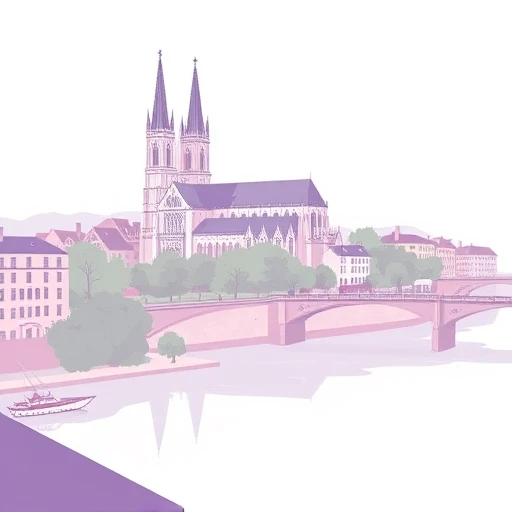
metz في 30 ثانية
- Metz is a historic French city located in the Grand Est region, near Germany and Luxembourg.
- It is famous for its Gothic cathedral, yellow limestone buildings, and the Centre Pompidou-Metz art museum.
- The city has a unique dual heritage, having been part of both France and Germany throughout history.
- Metz is a major center for technology, education, and sustainable urban living in northeastern France.
Metz is a city of profound historical significance and architectural beauty located in the northeastern part of France. When people use the word 'Metz,' they are usually referring to the capital of the Moselle department, a place where the Moselle and Seille rivers meet. It is a city that has transitioned through various identities: from a powerful Roman center to the capital of the Austrasian kingdom under the Merovingians, and later a bone of contention between France and Germany. In modern conversation, Metz is frequently mentioned in the context of European history, urban ecology, and contemporary art. It is a city that embodies the 'Yellow City' aesthetic due to the widespread use of Jaumont limestone in its construction, which gives the buildings a warm, honey-colored glow. People use the name Metz when discussing the 'Lanterne du Bon Dieu' (the Cathedral of Saint-Étienne), which features the largest surface area of stained glass in the world. It is also a key term in the world of modern art thanks to the Centre Pompidou-Metz, a satellite of the famous Parisian museum. Whether you are a historian studying the Franco-Prussian War or a tourist planning a trip through the Grand Est region, Metz is a central point of reference. The city is also a pioneer in urban planning, often cited for its extensive pedestrian zones and green spaces, making it a frequent topic in discussions about sustainable city living.
- Geographical Context
- Metz is situated at a strategic crossroads in Europe, near the borders of Luxembourg and Germany, making it a vital hub for international travel and trade.
I spent the weekend exploring the medieval streets of Metz and was stunned by the cathedral's glass.
Historically, the name Metz is synonymous with resilience. The city has survived numerous sieges and annexations, most notably being part of the German Empire from 1871 to 1918. This period left a unique architectural mark on the city, specifically in the 'Quartier Impérial' (Imperial Quarter), which was designed to showcase German power and style. When discussing European history, Metz is often used as a case study for shifting borders and cultural synthesis. The city's name is also associated with the 'Mirabelle plum,' a small, sweet yellow fruit that is the pride of the Lorraine region. During the annual Mirabelle Festival, the word Metz is on everyone's lips as the city celebrates its culinary heritage. In academic circles, Metz is discussed in relation to its Gallo-Roman roots, as it was once one of the most important cities in Roman Gaul, known as Divodurum. The city's name carries a weight of antiquity and modernity combined, representing a place that has successfully integrated its complex past into a vibrant, forward-looking present.
- Cultural Identity
- Metz is often referred to as the 'Green City' (Ville Verte) because of its commitment to parks and gardens along its riverbanks.
The train from Paris to Metz takes only about eighty-five minutes on the TGV.
In the context of modern governance, Metz serves as a regional administrative center. It was the capital of the former Lorraine region before the administrative reforms that created the Grand Est region. Despite this change, it remains the capital of the Moselle department. When people talk about the economy of northeastern France, Metz is a central figure, particularly in the sectors of logistics, digital technology, and higher education. The presence of Georgia Tech Lorraine and various French engineering schools makes it a hub for innovation. Furthermore, the city is a significant site for religious history, being one of the oldest episcopal sees in France. The name Metz evokes images of the Temple Neuf sitting on the Île du Petit-Saulcy, surrounded by water and greenery, a scene that is one of the most photographed in the country. It is a word that suggests a blend of French elegance and Germanic order, a unique cultural cocktail that defines the Moselle identity.
Many students choose Metz for its high quality of life and affordable cost of living compared to Paris.
- Architectural Landmark
- The Saint-Étienne Cathedral in Metz is nicknamed the 'God's Lantern' because of its vast stained-glass windows.
The Christmas market in Metz is considered one of the most beautiful in all of France.
During the Roman period, Metz was a major crossroads for trade routes across Europe.
Using the word 'Metz' in a sentence requires an understanding that it is a proper noun representing a specific location. Most commonly, it functions as the object of a preposition in travel-related sentences. For example, 'I am going to Metz' or 'The train arrives in Metz.' Because it is a city name, it does not take an article in English, though in French, the name itself is used without 'le' or 'la.' When describing the city, you might use it as an adjective in a compound noun, such as 'the Metz cathedral' or 'the Metz city council.' It is important to remember that 'Metz' is both the name of the city and often used to refer to the metropolitan area, known as Metz Métropole. In historical writing, you might see sentences like, 'The Siege of Metz in 1870 was a turning point in the Franco-Prussian War.' Here, Metz is the focal point of a historical event. In culinary contexts, you might say, 'This recipe for Quiche Lorraine is authentic to the traditions of Metz.' The word is also used in sports, specifically referring to the local football club, FC Metz. A fan might say, 'I am going to watch Metz play at the Stade Saint-Symphorien.'
- Travel Usage
- 'We decided to stop in Metz on our way from Paris to Strasbourg to see the Pompidou Center.'
The high-speed TGV line has made Metz a popular destination for day-trippers from the capital.
In more formal or academic sentences, Metz might be used to discuss urban development or European integration. For instance, 'Metz serves as a prime example of a city that has successfully navigated the transition from an industrial past to a culture-based economy.' Or, 'The cross-border cooperation between Metz, Luxembourg, and Saarbrücken is a model for the European Union.' In these cases, Metz represents a political and economic entity. When speaking about the people of the city, the term 'Messins' is used, but the city name itself remains the primary descriptor for the location. You might also use the word in the context of weather or climate: 'The winters in Metz can be quite cold, often seeing snow due to its continental influence.' In artistic discussions, one might say, 'The architecture of Metz is a dialogue between the French limestone tradition and the German imperial style.' This highlights the city's dual heritage. Whether used in a simple travel plan or a complex historical analysis, 'Metz' remains a versatile and essential proper noun in the lexicon of European geography.
- Historical Usage
- 'During the Middle Ages, Metz was a Free Imperial City within the Holy Roman Empire.'
The Treaty of Metz is often cited in legal history regarding regional boundaries.
Furthermore, the word 'Metz' appears frequently in logistical and transportation contexts. 'The Metz-Nancy-Lorraine airport serves the wider region.' In this sentence, Metz is part of a compound name for an infrastructure project. In literary contexts, authors might use Metz to evoke a specific atmosphere of northeastern France. 'The grey skies of Metz reflected the somber mood of the post-war era.' Here, the city name is used to set a scene. In the digital age, 'Metz' is also a common tag for social media posts featuring the city's picturesque river views or its futuristic museum. 'Just posted my photos from Metz on Instagram!' In every instance, the word functions to anchor the conversation to a specific point on the map, carrying with it all the cultural and historical baggage of that location. Whether you are discussing the 'Metz Christmas Market' or the 'Metz Technopôle,' the word is indispensable for anyone engaging with the geography and culture of France.
The local government in Metz has invested heavily in bicycle lanes over the last decade.
- Artistic Usage
- 'The stained glass by Marc Chagall in the Metz Cathedral is a masterpiece of 20th-century religious art.'
If you love history, Metz offers a unique look at how different empires shaped a single city.
The culinary scene in Metz is famous for its use of local plums and high-quality pork products.
The word 'Metz' is a staple in several specific environments, most notably in European transportation hubs. If you are at the Gare de l'Est in Paris, you will frequently hear the overhead announcements for the TGV trains departing for Metz. The name is also common in French news broadcasts, especially when discussing regional politics of the Grand Est or news from the Moselle department. In the world of sports, particularly French football (Ligue 1 and Ligue 2), Metz is heard constantly as commentators discuss the performance of FC Metz. During the winter season, travel programs and lifestyle segments on television often feature the Metz Christmas market, which is renowned for its traditional crafts and Ferris wheel. In academic settings, particularly those focusing on European history or architecture, professors and students use the word Metz to refer to the city's unique position as a cultural crossroads. You will also hear it in weather reports for northeastern France, where the city's name is used as a reference point for the Moselle valley's climate.
- Transportation Hubs
- Train stations and airports across France and neighboring countries frequently announce departures and arrivals for Metz.
'The next train to Metz Ville will depart from platform four,' the announcer said.
In the tourism industry, the word Metz is a key marketing term. Travel agents and tour guides use it when promoting the 'Route du Vin' (Wine Route) or historical tours of the Maginot Line, which is located nearby. In the art world, the word is synonymous with the Centre Pompidou-Metz. Curators and art critics frequently mention Metz when discussing major contemporary art exhibitions in Europe. If you are a fan of French radio, such as France Bleu Sud Lorraine, you will hear the word Metz multiple times an hour in local news and traffic updates. The city's name also appears in culinary circles, particularly when chefs discuss the origin of the Mirabelle plum or the specific style of Lorraine charcuterie. In international business, especially in the logistics and tech sectors, Metz is mentioned as a strategic location within the 'Blue Banana' (the corridor of urbanization in Western Europe). It is a word that resonates in many different professional and social spheres.
- Sports Media
- Football commentators often use the city's name to refer to the local team, FC Metz, during match broadcasts.
'It's a tough away game for the team today in Metz,' the sports reporter noted.
Furthermore, the word Metz is frequently heard in the context of European politics. Because of its proximity to Luxembourg and its role in the 'QuattroPole' (a cross-border network of four cities including Luxembourg, Saarbrücken, and Trier), it is often mentioned in discussions about regional cooperation and the Schengen Agreement. In documentary films about World War II or the Franco-Prussian War, the name Metz is used to describe critical battles and territorial shifts. You might also hear it in the context of music and festivals, such as the 'Festival Constellations de Metz,' a digital arts festival that transforms the city with light installations in the summer. Whether it's a casual mention in a travel vlog or a formal reference in a historical documentary, the word Metz is an integral part of the linguistic landscape of Western Europe, signifying a place of deep history and modern cultural energy.
The documentary highlighted how Metz changed hands between France and Germany multiple times.
- Artistic Circles
- The Centre Pompidou-Metz is a frequent topic of conversation among architects and art historians worldwide.
'Have you seen the new exhibition in Metz?' asked the art gallery owner.
The annual Mirabelle festival in Metz attracts thousands of visitors every August.
The most frequent mistake people make with the word 'Metz' is its pronunciation. In English, there is a strong tendency to pronounce the 'z' at the end, making it sound like 'mets' or 'metts.' However, in French, the 'z' is silent, and the word is pronounced like 'mess' (/mɛs/). This can lead to confusion when English speakers are trying to buy train tickets or ask for directions in France. Another common error is confusing Metz with other similarly named places or misidentifying its location. People often confuse it with Nancy, another major city in the Lorraine region, or assume it is in Germany because of its historical ties and German-style architecture in certain districts. Spelling can also be an issue; although it is a short word, some people mistakenly add an 'e' at the end (Metze) or confuse it with the German word 'Metzger' (butcher). Understanding the cultural and linguistic context is key to avoiding these pitfalls.
- Pronunciation Error
- Pronouncing the 'z' in Metz is a common mistake for non-French speakers; it should sound like 'mess'.
He asked for a ticket to 'Metz' (pronouncing the z), and the clerk had to correct him.
In terms of geography, a common mistake is placing Metz in the wrong region. While it was the capital of Lorraine, it is now part of the larger Grand Est region. Some people still refer to it exclusively as a 'Lorraine city' without acknowledging the modern administrative structure. Additionally, tourists often mistake the 'Quartier Impérial' for a purely French creation, when it was actually built by the Germans during the annexation. This misunderstanding can lead to a misinterpretation of the city's historical narrative. Another mistake is assuming that Metz is a small, quiet town. In reality, it is a bustling metropolitan area with a significant student population and a major industrial and technological base. Misjudging the size and importance of Metz can lead to poor travel planning, such as not allocating enough time to see the cathedral and the Pompidou Center in a single day.
- Geographical Confusion
- Many people mistakenly think Metz is in Germany because of its proximity to the border and its history.
Is Metz in France or Germany? It's a question often asked by history students.
Linguistically, some people use the word 'Metz' when they should be using the adjective 'Messin' to describe the people or culture of the city. For example, saying 'the Metz people' is less accurate than saying 'the Messins.' Furthermore, in written English, some might forget to capitalize the word, which is a basic grammatical error for a proper noun. There is also a tendency to overlook the importance of the rivers in Metz. People might say 'Metz is on the river,' but it is more accurate to say it is at the 'confluence of the Moselle and Seille.' Finally, a common mistake in travel planning is underestimating the distance between Metz and Paris. While the TGV is fast, it is still over 300 kilometers away, so it's not a 'suburb' of Paris by any means. Being aware of these common errors helps in using the word correctly and understanding the city's true identity.
The student's essay on Metz failed to mention its Roman origins.
- Historical Misconception
- Assuming Metz has always been French ignores its long history as a Free Imperial City and its periods under German rule.
The tour guide explained that Metz has a dual cultural heritage that is visible in its streets.
It's a mistake to think Metz is only about old buildings; it's a very modern tech hub.
When discussing Metz, it is helpful to compare it to other cities in the region to understand its unique position. The most obvious comparison is with Nancy. While Metz is the capital of Moselle, Nancy is the capital of Meurthe-et-Moselle. Historically, they have been rivals. Metz is often seen as the more 'ancient' and 'ecclesiastical' city with its Roman roots and massive cathedral, while Nancy is viewed as the 'Art Nouveau' and 'ducal' city, famous for the Place Stanislas. Another similar city is Strasbourg, the capital of the Grand Est region. Strasbourg is larger and more internationally recognized as the seat of the European Parliament, but both cities share a history of being annexed by Germany and have a distinct Rhine-Moselle cultural blend. Comparing Metz to these cities helps travelers and students of history understand the regional dynamics of northeastern France.
- Metz vs. Nancy
- Metz is known for its Gothic architecture and Roman history, whereas Nancy is famous for its 18th-century Enlightenment architecture and Art Nouveau.
While Metz has the Pompidou Center, Nancy boasts the stunning Place Stanislas.
In terms of alternatives for travelers, one might consider Reims or Luxembourg City. Reims, like Metz, has a world-famous cathedral and a deep historical connection to the French monarchy. Luxembourg City, located just an hour north of Metz, shares the multi-layered history of fortifications and a blend of French and German linguistic influences. In the context of art and culture, the word 'Metz' might be swapped with 'Bilbao' in discussions about the 'Guggenheim effect'—how a major museum (like the Pompidou-Metz) can revitalize a post-industrial city. However, Metz remains unique because of its specific 'Jaumont' stone and its status as one of the oldest cities in Europe. Using these comparisons allows for a richer description of what Metz offers compared to its neighbors.
- Metz vs. Strasbourg
- Strasbourg is the political heart of Europe, while Metz is a major cultural and technological hub of the Moselle valley.
Travelers often debate whether to visit Metz or Strasbourg first when touring eastern France.
Furthermore, in the context of urban ecology, Metz is often compared to Nantes or Angers, cities that are also leaders in green space management. When people talk about 'green cities' in France, Metz is always in the top tier. In historical discussions, Metz is often grouped with the 'Three Bishoprics' (Trois-Évêchés), which included Toul and Verdun. These three cities were seized by France from the Holy Roman Empire in 1552. Understanding these historical groupings provides a better alternative to just seeing Metz as an isolated city. Whether you are looking for architectural parallels in Trier, Germany, or cultural rivals in Nancy, the word Metz exists within a network of similar and contrasting European cities that define its character.
The 'Three Bishoprics' of Metz, Toul, and Verdun were crucial to French expansion eastward.
- Metz vs. Trier
- Both Metz and Trier have significant Roman ruins and were major administrative centers of the Roman Empire.
Comparing the Roman baths in Metz to those in Trier reveals much about ancient urban life.
The choice between Metz and Nancy often depends on whether you prefer Gothic or Baroque art.
How Formal Is It?
حقيقة ممتعة
Despite being a French city, Metz was the birthplace of several famous Germans during the periods of annexation, including the composer Gabriel Pierné and the general Heinz Guderian.
دليل النطق
- Pronouncing the 'z' as in 'pizza'.
- Pronouncing it like 'met-zuh'.
- Confusing it with the word 'mates'.
- Using a hard 't' sound at the end.
- Adding an 's' sound that isn't there.
مستوى الصعوبة
Easy to recognize as a city name in text.
Short and easy to spell.
Difficult due to the silent 'z' which is counter-intuitive for English speakers.
Can be confused with 'mess' or 'mace' if context is not clear.
ماذا تتعلّم بعد ذلك
المتطلبات الأساسية
تعلّم لاحقاً
متقدم
قواعد يجب معرفتها
Proper Nouns
Metz is always capitalized.
Prepositions of Place
Use 'in' for Metz (In Metz).
Silent Letters
The 'z' in Metz is silent in French.
Zero Article with Cities
We say 'Metz is old', not 'The Metz is old'.
Possessive Proper Nouns
Metz's cathedral is famous.
أمثلة حسب المستوى
Metz is a city in France.
Metz est une ville en France.
Proper noun, always capitalized.
I want to visit Metz.
Je veux visiter Metz.
Direct object of the verb visit.
Metz has a big cathedral.
Metz a une grande cathédrale.
Third person singular 'has'.
The train goes to Metz.
Le train va à Metz.
Preposition 'to' indicates direction.
Metz is very green.
Metz est très verte.
Adjective 'green' describes the city.
Is Metz near Paris?
Est-ce que Metz est près de Paris ?
Interrogative sentence structure.
My friend lives in Metz.
Mon ami habite à Metz.
Preposition 'in' for location.
Metz is a beautiful place.
Metz est un bel endroit.
Predicate nominative.
Metz is the capital of the Moselle department.
Metz est la capitale du département de la Moselle.
Use of 'the' with 'capital'.
You can see the river in Metz.
On peut voir la rivière à Metz.
Modal verb 'can' for possibility.
The cathedral in Metz is very old.
La cathédrale de Metz est très ancienne.
Adjective 'old' modified by 'very'.
Metz is famous for its yellow stone.
Metz est célèbre pour sa pierre jaune.
Adjective phrase 'famous for'.
We walked through the parks in Metz.
Nous avons marché dans les parcs de Metz.
Past tense 'walked'.
Metz has a famous art museum.
Metz a un célèbre musée d'art.
Compound noun 'art museum'.
The food in Metz is delicious.
La nourriture à Metz est délicieuse.
Subject-verb-adjective agreement.
Metz is located in northeastern France.
Metz est située dans le nord-est de la France.
Passive voice 'is located'.
Metz is situated at the confluence of the Moselle and Seille rivers.
Metz est située au confluent de la Moselle et de la Seille.
Use of 'confluence' as a technical geographic term.
The city of Metz was once the capital of the Lorraine region.
La ville de Metz était autrefois la capitale de la région Lorraine.
Past tense 'was once' for historical facts.
Metz is known for its unique blend of French and German architecture.
Metz est connue pour son mélange unique d'architecture française et allemande.
Noun phrase 'unique blend'.
The Centre Pompidou-Metz attracts many tourists every year.
Le Centre Pompidou-Metz attire de nombreux touristes chaque année.
Present simple for habitual actions.
Metz played a strategic role during the Franco-Prussian War.
Metz a joué un rôle stratégique pendant la guerre franco-prussienne.
Adjective 'strategic' modifying 'role'.
The 'Lanterne du Bon Dieu' is a nickname for the cathedral in Metz.
La 'Lanterne du Bon Dieu' est un surnom pour la cathédrale de Metz.
Appositive phrase for a nickname.
Metz is a leader in urban ecology and green spaces.
Metz est un leader en écologie urbaine et en espaces verts.
Prepositional phrase 'in urban ecology'.
Many international students study at the universities in Metz.
De nombreux étudiants internationaux étudient dans les universités de Metz.
Quantifier 'many' with plural noun.
The architectural diversity of Metz reflects its complex historical narrative.
La diversité architecturale de Metz reflète son récit historique complexe.
Subject-verb agreement with 'diversity'.
Metz has successfully transitioned from an industrial center to a cultural hub.
Metz a réussi sa transition d'un centre industriel à un pôle culturel.
Present perfect 'has transitioned'.
The German Imperial Quarter in Metz is a UNESCO World Heritage candidate.
Le quartier impérial allemand de Metz est candidat au patrimoine mondial de l'UNESCO.
Proper noun 'UNESCO World Heritage'.
Metz is part of the QuattroPole, a network of four cross-border cities.
Metz fait partie de QuattroPole, un réseau de quatre villes transfrontalières.
Appositive explaining 'QuattroPole'.
The annual Mirabelle Festival in Metz celebrates the local harvest.
Le festival annuel de la Mirabelle à Metz célèbre la récolte locale.
Adjective 'annual' modifying 'festival'.
Metz's pedestrian-friendly city center encourages sustainable tourism.
Le centre-ville de Metz, propice aux piétons, encourage le tourisme durable.
Possessive 'Metz's'.
The city council of Metz has implemented several green initiatives.
Le conseil municipal de Metz a mis en œuvre plusieurs initiatives vertes.
Present perfect 'has implemented'.
Metz serves as a vital link between France and the Benelux countries.
Metz sert de lien vital entre la France et les pays du Benelux.
Verb 'serves as' for function.
The palimpsest of urban styles in Metz offers a visual history of European conflict.
Le palimpseste des styles urbains à Metz offre une histoire visuelle des conflits européens.
Metaphorical use of 'palimpsest'.
Metz's identity is defined by its liminal status between French and German cultures.
L'identité de Metz est définie par son statut liminaire entre les cultures française et allemande.
Adjective 'liminal' for threshold status.
The stained glass by Marc Chagall in Metz Cathedral is a testament to modern religious art.
Les vitraux de Marc Chagall dans la cathédrale de Metz sont un témoignage de l'art religieux moderne.
Noun phrase 'testament to'.
Metz has leveraged its historical heritage to foster a vibrant tourism industry.
Metz a tiré parti de son héritage historique pour favoriser une industrie touristique dynamique.
Verb 'leveraged' for strategic use.
The socio-economic landscape of Metz has been reshaped by the TGV Est connection.
Le paysage socio-économique de Metz a été remodelé par la liaison TGV Est.
Passive voice 'has been reshaped'.
Metz exemplifies the integration of contemporary architecture within a medieval fabric.
Metz illustre l'intégration de l'architecture contemporaine dans un tissu médiéval.
Verb 'exemplifies' for providing an example.
The 'Yellow City' moniker of Metz stems from the use of Jaumont limestone.
Le surnom de 'Ville Jaune' de Metz provient de l'utilisation de la pierre de Jaumont.
Phrasal verb 'stems from'.
Metz's strategic importance as a fortress city is evident in its surviving ramparts.
L'importance stratégique de Metz en tant que ville fortifiée est évidente dans ses remparts subsistants.
Adjective 'evident' with prepositional phrase.
The annexation of Metz in 1871 catalyzed a profound shift in the city's demographic and architectural profile.
L'annexion de Metz en 1871 a catalysé un changement profond dans le profil démographique et architectural de la ville.
Verb 'catalyzed' for starting a process.
Metz's urban planning meticulously balances historical preservation with the exigencies of modern life.
L'urbanisme de Metz équilibre méticuleusement la préservation historique avec les exigences de la vie moderne.
Noun 'exigencies' for urgent needs.
The ecclesiastical hegemony of Metz during the Middle Ages is reflected in its numerous monastic ruins.
L'hégémonie ecclésiastique de Metz au Moyen Âge se reflète dans ses nombreuses ruines monastiques.
Noun 'hegemony' for dominant influence.
Metz serves as a crucible for Franco-German reconciliation within the broader European project.
Metz sert de creuset pour la réconciliation franco-allemande au sein du projet européen plus large.
Metaphorical use of 'crucible'.
The juxtaposition of the Gothic cathedral and the Imperial Quarter in Metz creates a striking architectural dialogue.
La juxtaposition de la cathédrale gothique et du quartier impérial à Metz crée un dialogue architectural saisissant.
Noun 'juxtaposition' for side-by-side comparison.
Metz's resilience throughout centuries of conflict underscores its enduring regional importance.
La résilience de Metz à travers des siècles de conflit souligne son importance régionale durable.
Verb 'underscores' for emphasis.
The cultural vitality of Metz is bolstered by its prestigious academic and research institutions.
La vitalité culturelle de Metz est soutenue par ses prestigieuses institutions universitaires et de recherche.
Passive voice 'is bolstered by'.
To study Metz is to trace the very contours of Western European history and identity.
Étudier Metz, c'est retracer les contours mêmes de l'histoire et de l'identité de l'Europe occidentale.
Infinitive phrase as subject.
تلازمات شائعة
العبارات الشائعة
— Referring to the two major cities of Lorraine.
The rivalry between Metz and Nancy is well-known.
— The local higher education institution.
He studies engineering at the Metz university.
يُخلط عادةً مع
The New York baseball team; pronounced with a 'ts' sound.
The rival city in Lorraine; often confused by tourists.
The German word for butcher; sounds similar but unrelated.
تعبيرات اصطلاحية
— A variation of 'all roads lead to Rome,' used locally to emphasize the city's central location.
In this part of Lorraine, all roads lead to Metz.
informal— Refers to the resilience and dual culture of the city.
The spirit of Metz is visible in its architecture.
literary— A local way to say something will happen quickly (humorous).
I'll be there in a Metz minute!
slang— Refers to Metz's limestone and its central role.
Metz is the yellow heart of Lorraine.
poetic— Being in a state of indecision or being in the middle of two things.
I'm stuck between Metz and Nancy on this decision.
informal— Refers to something very strong or reliable.
Our agreement is as solid as the Metz walls.
informal— A local expression for being happy or bright-eyed (regional).
He's so happy today, he has a Mirabelle in the eye.
informal— Refers to the unique way the sun hits the Jaumont stone.
Artists come here just for the light of Metz.
artistic— Refers to the city's beautiful evening illumination.
You haven't seen the city until you've seen Metz by night.
informalسهل الخلط
Pronunciation
Metz (French city) is pronounced 'mess'.
I live in Metz.
Spelling
Mets is a sports team or the plural of 'met' (food).
The Mets won the game.
Sound
A mess is a state of untidiness.
Your room is a mess.
Sound
Mace is a spice or a weapon.
She used mace for protection.
Sound
A maze is a puzzle of paths.
We got lost in the maze.
أنماط الجُمل
Metz is [adjective].
Metz is beautiful.
I am going to [City].
I am going to Metz.
Metz is known for [Noun].
Metz is known for its cathedral.
Located in [Region], Metz is [Description].
Located in Grand Est, Metz is a historic hub.
The [Noun] of Metz reflects [Concept].
The architecture of Metz reflects its dual heritage.
Metz serves as a [Metaphor] for [Concept].
Metz serves as a crucible for European reconciliation.
Have you been to Metz?
Have you been to Metz?
Metz is a city in France.
Metz is a city in France.
عائلة الكلمة
الأسماء
الصفات
مرتبط
كيفية الاستخدام
Common in travel, history, and regional French contexts.
-
Pronouncing the Z.
→
Pronounce it like 'mess'.
The 'z' is a historical spelling but is not sounded in modern French.
-
Thinking it's a small town.
→
Recognize it as a major city.
Metz is a significant regional capital with over 100,000 residents.
-
Confusing it with Nancy.
→
Metz is Moselle; Nancy is Meurthe-et-Moselle.
They are two distinct cities with a long-standing rivalry.
-
Spelling it 'Mets'.
→
Spell it 'Metz'.
Metz is the city; Mets is a sports team or food.
-
Assuming it's only German.
→
It is a French city with German history.
While it has German architecture, its culture and language are French.
نصائح
Silent Z
Always remember the 'z' is silent. Think of 'Mess' in France.
TGV Connection
Take the TGV from Paris Gare de l'Est; it's the fastest way to get there.
Pompidou
Don't miss the Centre Pompidou-Metz; the building itself is a work of art.
Cathedral
Visit the cathedral at sunset to see the yellow stone glow.
Mirabelle
Try anything made with Mirabelle plums if you visit in August.
Pedestrian Zones
The city center is very walkable; wear comfortable shoes.
Temple Neuf
The best photo spot is the Temple Neuf from the bridge.
Christmas Market
If you are there in winter, visit the multiple market squares.
Riverside
Take a walk along the Moselle river for a peaceful break.
Messin
Impress locals by using the word 'Messin' for things from Metz.
احفظها
وسيلة تذكّر
Think of a 'mess' of history all in one place: that's Metz (pronounced 'mess').
ربط بصري
Imagine a giant yellow lantern (the cathedral) glowing by a river.
Word Web
تحدٍّ
Try to explain the history of Metz to a friend using the words 'cathedral', 'limestone', and 'silent z'.
أصل الكلمة
The name Metz is derived from the Mediomatrici, a Celtic tribe that inhabited the area before the Roman conquest. The Romans called the city Divodurum Mediomatricorum, which meant 'Holy Fortress of the Mediomatrici.' Over time, the name was shortened to Mettis, which eventually evolved into the modern French name Metz.
المعنى الأصلي: Holy Fortress or Place of the Mediomatrici.
Celtic/Latinالسياق الثقافي
Be mindful of the city's complex history with Germany; while the German heritage is celebrated architecturally, the periods of annexation were historically difficult.
In the English-speaking world, Metz is best known for its football team and the Centre Pompidou-Metz.
تدرّب في الحياة الواقعية
سياقات واقعية
Tourism
- Where is the cathedral?
- When does the museum open?
- How do I get to Metz?
- Is there a city tour?
History
- The siege of the city.
- The German annexation.
- Roman ruins in the area.
- Medieval fortifications.
Geography
- Located on the Moselle.
- Capital of the department.
- Near the border.
- The confluence of two rivers.
Sports
- The Metz match is tonight.
- Who is the Metz coach?
- The stadium is full.
- Metz won the game.
Education
- Studying at Metz University.
- The campus is in the city.
- Research in Metz.
- Student life in Lorraine.
بدايات محادثة
"Have you ever visited the city of Metz in France?"
"What do you know about the history of Metz?"
"I heard the cathedral in Metz has amazing stained glass."
"Would you rather visit Metz or Nancy for a weekend trip?"
"Did you know the 'z' in Metz is silent?"
مواضيع للكتابة اليومية
Describe what you would like to see most in Metz and why.
Write about a time you visited a historic city like Metz.
If you lived in Metz, how would you spend your Sunday afternoon?
Compare the architecture of Metz to your own hometown.
Imagine you are a tour guide in Metz; what stories would you tell?
الأسئلة الشائعة
10 أسئلةIn French, it is pronounced 'mess' (/mɛs/). The 'z' is silent. English speakers often say 'mets', but 'mess' is the local way.
Metz is in northeastern France, in the Grand Est region, near the borders of Luxembourg and Germany.
It is famous for its Gothic cathedral with stunning stained glass, the Centre Pompidou-Metz art museum, and its yellow limestone architecture.
Yes, it is a beautiful, walkable city with a rich history, great food, and many green spaces.
Metz is located at the confluence of the Moselle and Seille rivers.
No, it is in France, although it was part of Germany from 1871 to 1918 and again during WWII.
Summer is great for the parks and festivals, while December is perfect for the famous Christmas market.
It is about 330 kilometers from Paris, or 85 minutes by high-speed TGV train.
Local specialties include Quiche Lorraine, Mirabelle plums, and various pork dishes.
It is a nickname for Metz because many of its buildings are made from yellow Jaumont limestone.
اختبر نفسك 180 أسئلة
Describe the city of Metz in three sentences.
Well written! Good try! Check the sample answer below.
Why is Metz called the 'Yellow City'?
Well written! Good try! Check the sample answer below.
Write a short email to a friend about your trip to Metz.
Well written! Good try! Check the sample answer below.
Explain the importance of the Metz Cathedral.
Well written! Good try! Check the sample answer below.
Discuss the dual French and German heritage of Metz.
Well written! Good try! Check the sample answer below.
What are the main attractions in Metz for a tourist?
Well written! Good try! Check the sample answer below.
Describe the Centre Pompidou-Metz and its impact on the city.
Well written! Good try! Check the sample answer below.
How does the Moselle river influence life in Metz?
Well written! Good try! Check the sample answer below.
Write a review of the Metz Christmas market.
Well written! Good try! Check the sample answer below.
Explain the origin of the name 'Metz'.
Well written! Good try! Check the sample answer below.
Compare Metz and Nancy as regional capitals.
Well written! Good try! Check the sample answer below.
What is the significance of the Mirabelle plum to Metz?
Well written! Good try! Check the sample answer below.
Describe the architecture of the Imperial Quarter.
Well written! Good try! Check the sample answer below.
How has the TGV changed the economy of Metz?
Well written! Good try! Check the sample answer below.
Write a short story set in the streets of Metz.
Well written! Good try! Check the sample answer below.
What makes Metz a 'Green City'?
Well written! Good try! Check the sample answer below.
Discuss the role of Metz in the QuattroPole network.
Well written! Good try! Check the sample answer below.
Describe the stained glass of Marc Chagall in Metz.
Well written! Good try! Check the sample answer below.
Why is the pronunciation of Metz often a mistake for foreigners?
Well written! Good try! Check the sample answer below.
Summarize the historical shifts of Metz between France and Germany.
Well written! Good try! Check the sample answer below.
Pronounce the word 'Metz' correctly.
Read this aloud:
قلت:
Speech recognition is not supported in your browser. Try Chrome or Edge.
Tell a partner three facts about Metz.
Read this aloud:
قلت:
Speech recognition is not supported in your browser. Try Chrome or Edge.
Describe a photo of the Metz Cathedral.
Read this aloud:
قلت:
Speech recognition is not supported in your browser. Try Chrome or Edge.
Explain why you would like to visit Metz.
Read this aloud:
قلت:
Speech recognition is not supported in your browser. Try Chrome or Edge.
Discuss the pros and cons of living in a city like Metz.
Read this aloud:
قلت:
Speech recognition is not supported in your browser. Try Chrome or Edge.
Roleplay: You are at the train station buying a ticket to Metz.
Read this aloud:
قلت:
Speech recognition is not supported in your browser. Try Chrome or Edge.
Give a short presentation on the history of Metz.
Read this aloud:
قلت:
Speech recognition is not supported in your browser. Try Chrome or Edge.
Discuss the importance of modern art in historic cities.
Read this aloud:
قلت:
Speech recognition is not supported in your browser. Try Chrome or Edge.
Debate: Is Metz more French or more German?
Read this aloud:
قلت:
Speech recognition is not supported in your browser. Try Chrome or Edge.
Describe the taste of a Mirabelle plum (imaginary).
Read this aloud:
قلت:
Speech recognition is not supported in your browser. Try Chrome or Edge.
Talk about the 'Green City' concept in relation to Metz.
Read this aloud:
قلت:
Speech recognition is not supported in your browser. Try Chrome or Edge.
Explain the silent 'z' rule to a beginner.
Read this aloud:
قلت:
Speech recognition is not supported in your browser. Try Chrome or Edge.
Discuss the rivalry between Metz and Nancy.
Read this aloud:
قلت:
Speech recognition is not supported in your browser. Try Chrome or Edge.
Describe the atmosphere of a Christmas market.
Read this aloud:
قلت:
Speech recognition is not supported in your browser. Try Chrome or Edge.
Talk about the impact of the TGV on travel in France.
Read this aloud:
قلت:
Speech recognition is not supported in your browser. Try Chrome or Edge.
Describe the architecture of the Centre Pompidou-Metz.
Read this aloud:
قلت:
Speech recognition is not supported in your browser. Try Chrome or Edge.
Discuss the role of rivers in urban development.
Read this aloud:
قلت:
Speech recognition is not supported in your browser. Try Chrome or Edge.
Tell a story about a traveler getting lost in Metz.
Read this aloud:
قلت:
Speech recognition is not supported in your browser. Try Chrome or Edge.
Explain the term 'Yellow City'.
Read this aloud:
قلت:
Speech recognition is not supported in your browser. Try Chrome or Edge.
Summarize the cultural significance of Metz in Europe.
Read this aloud:
قلت:
Speech recognition is not supported in your browser. Try Chrome or Edge.
Listen to a description of a city and identify if it is Metz.
Listen to a train announcement and write down the destination.
Listen to a tour guide and list two landmarks mentioned.
Listen to a weather report for Metz and note the temperature.
Listen to a local person talking about the Mirabelle festival.
Listen to a historical lecture about the 1870 siege.
Listen to an interview with an architect about the Pompidou-Metz.
Listen to a sports commentary of an FC Metz game.
Listen to a podcast about the 'Three Bishoprics'.
Listen to a conversation about travel plans to northeastern France.
Listen to the pronunciation of 'Metz' and repeat it.
Listen to a news segment about the Grand Est region.
Listen to a description of the 'Lanterne du Bon Dieu'.
Listen to a student talking about their university in Metz.
Listen to a radio ad for the Metz Christmas market.
/ 180 correct
Perfect score!
Summary
Metz is a culturally rich city in northeastern France that offers a unique blend of Roman history, Gothic architecture, and modern art, serving as a vital bridge between French and German cultural influences. Example: Visiting Metz allows you to see both a medieval cathedral and a futuristic art museum in one day.
- Metz is a historic French city located in the Grand Est region, near Germany and Luxembourg.
- It is famous for its Gothic cathedral, yellow limestone buildings, and the Centre Pompidou-Metz art museum.
- The city has a unique dual heritage, having been part of both France and Germany throughout history.
- Metz is a major center for technology, education, and sustainable urban living in northeastern France.
Silent Z
Always remember the 'z' is silent. Think of 'Mess' in France.
TGV Connection
Take the TGV from Paris Gare de l'Est; it's the fastest way to get there.
Pompidou
Don't miss the Centre Pompidou-Metz; the building itself is a work of art.
Cathedral
Visit the cathedral at sunset to see the yellow stone glow.