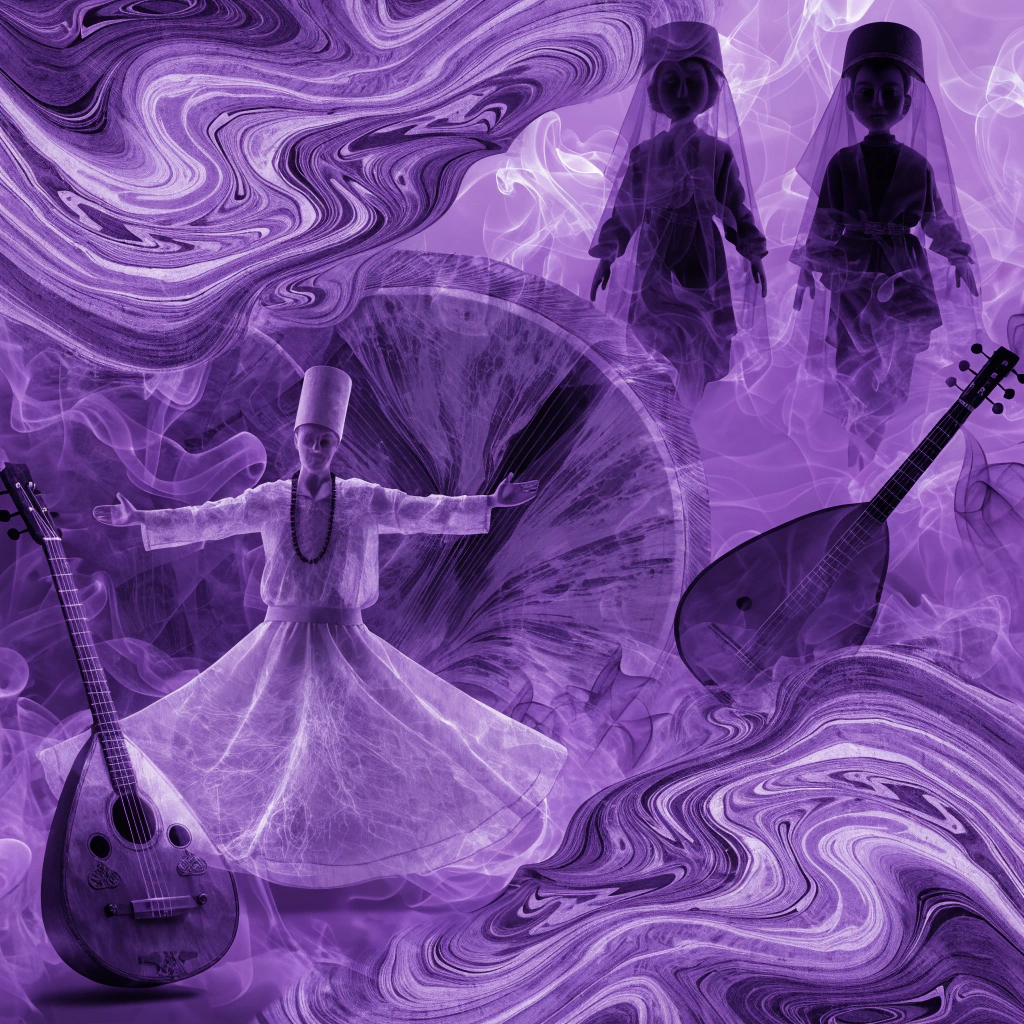
La danse des derviches tourneurs en Turquie
En Turquie, il y a une cérémonie très spéciale. C'est la cérémonie Mevlevi. Les hommes s'appellent des derviches tourneurs. Ils portent de longs vêtements blancs et de grands chapeaux marron.
Les derviches tournent en rond sur de la musique traditionnelle. C'est une danse spirituelle et calme. Ils tournent pour trouver la paix et l'amour.
Beaucoup de touristes vont à Konya pour voir ce spectacle. C'est un moment magique et important de la culture turque. Tout le monde regarde la danse en silence.
Point grammaire
Structure: Le présent de l'indicatif (verbes en -er)
"Les derviches tournent en rond."
On utilise le présent pour une action actuelle. Pour les verbes en -er comme 'tourner', la terminaison avec 'ils' est toujours -ent.
Structure: L'accord des adjectifs au pluriel
"Ils portent de longs vêtements blancs."
En français, l'adjectif s'accorde avec le nom. Comme 'vêtements' est masculin pluriel, on ajoute un 's' à 'longs' et 'blancs'.
Teste ta compréhension
10 questions · A1 Débutant · 1 aperçu gratuit
Teste ce que tu as appris dans cet article. Réponds à toutes les questions pour gagner des XP !
Où se passe cette cérémonie ?
Tu veux terminer le quiz ?
9 questions supplémentaires t'attendent. Inscris-toi gratuitement pour débloquer le quiz complet et gagner des XP !
S'inscrire gratuitementTu as dj un compte ? Connexion
Bien joué !
Continue à pratiquer !
Déjà terminé — pas de XP supplémentaire
Inscris-toi pour gagner des XPDétail des questions
Où se passe cette cérémonie ?
Ta réponse:
Bonne réponse: En Turquie
Les derviches portent des vêtements noirs.
Ta réponse:
Bonne réponse: Faux
Que signifie le mot 'calme' ?
Ta réponse:
Bonne réponse: Tranquille et sans agitation
Les derviches _____ en rond sur de la musique.
Ta réponse:
Bonne réponse: tournent
The Whirling Dervishes of Turkey
The Mevlevi Sema Ceremony is a very old tradition in Turkey. It started in the 13th century because of a famous poet named Rumi. He lived in Konya and taught people about love and peace. Today, many people call the dancers "Whirling Dervishes."
The ceremony is more beautiful than a normal dance. The dervishes wear tall brown hats and long white dresses. The hats represent tombstones and the dresses represent a shroud. During the ceremony, they turn around and around. They move their arms in a special way. One hand points to the sky and the other hand points to the earth.
This ceremony is important because it shows a spiritual journey. The dervishes want to find truth and love. They believe that everything in the universe turns, like the planets and the stars. Visitors come from many countries to watch this ceremony. It is a peaceful experience for everyone.
Point grammaire
Structure: Past Simple
"He lived in Konya and taught people about love and peace."
We use the past simple to talk about finished actions in the past. For regular verbs, we add -ed, but 'taught' is the irregular past of 'teach'.
Structure: Comparatives
"The ceremony is more beautiful than a normal dance."
To compare two things with long adjectives, we use 'more' + adjective + 'than'. It shows that one thing has more of a quality than another.
Teste ta compréhension
11 questions · A2 mentaire · 1 aperçu gratuit
Teste ce que tu as appris dans cet article. Réponds à toutes les questions pour gagner des XP !
Who was the famous poet that started the tradition?
Tu veux terminer le quiz ?
10 questions supplémentaires t'attendent. Inscris-toi gratuitement pour débloquer le quiz complet et gagner des XP !
S'inscrire gratuitementTu as dj un compte ? Connexion
Bien joué !
Continue à pratiquer !
Déjà terminé — pas de XP supplémentaire
Inscris-toi pour gagner des XPDétail des questions
Who was the famous poet that started the tradition?
Ta réponse:
Bonne réponse: Rumi
The dervishes wear long white dresses.
Ta réponse:
Bonne réponse: Vrai
What does 'famous' mean?
Ta réponse:
Bonne réponse: Known by many people
One hand points to the _____, and the other points to the earth.
Ta réponse:
Bonne réponse: sky
Where did Rumi live?
Ta réponse:
Bonne réponse: Konya
La Cérémonie de la Sema : Un Voyage Spirituel au Cœur de la Turquie
La cérémonie de la Sema mevlevie est l'une des traditions les plus emblématiques de la Turquie. Ce rituel fascinant a été inspiré par les enseignements de Jalaluddin Rumi, un célèbre mystique soufi du treizième siècle. Aujourd'hui, les derviches tourneurs continuent de pratiquer cette danse spirituelle à Konya, une ville qui est devenue le centre de cet ordre religieux.
Pour les participants, la Sema n'est pas une simple performance artistique, c'est un voyage mystique. Les derviches portent des tenues chargées de symboles. Le grand chapeau marron représente la pierre tombale de l'ego, alors que la longue robe blanche symbolise le linceul de l'homme qui abandonne ses désirs terrestres. Au début de la cérémonie, ils enlèvent leur manteau noir, ce qui montre qu'ils sont prêts à s'élever vers la vérité spirituelle.
Pendant qu'ils tournent sur eux-mêmes, les derviches placent leurs mains d'une manière très précise. La main droite est levée vers le ciel pour capter la bénédiction divine, et la main gauche est abaissée vers le sol pour transmettre cette énergie au monde entier. Ce mouvement circulaire, accompagné par le son mélancolique du ney, une flûte en roseau, crée une atmosphère de méditation profonde.
En 2008, la cérémonie de la Sema a été inscrite sur la liste du patrimoine culturel immatériel de l'humanité par l'UNESCO. Elle est considérée comme un symbole de tolérance et d'amour universel. Les spectateurs qui assistent à cet événement sont souvent touchés par la beauté et le calme de cette quête de perfection. C'est une expérience unique qui permet de mieux comprendre la richesse spirituelle de la culture turque.
Point grammaire
Structure: La voix passive
"Ce rituel fascinant a été inspiré par les enseignements de Jalaluddin Rumi."
On utilise la voix passive pour mettre l'accent sur l'action ou l'objet plutôt que sur le sujet. Elle se forme avec l'auxiliaire 'être' conjugué suivi du participe passé.
Structure: Les pronoms relatifs
"Konya, une ville qui est devenue le centre de cet ordre religieux."
Le pronom relatif 'qui' remplace un sujet pour relier deux phrases. Il permet d'ajouter des informations supplémentaires sans répéter le nom.
Teste ta compréhension
11 questions · B1 Intermédiaire · 1 aperçu gratuit
Teste ce que tu as appris dans cet article. Réponds à toutes les questions pour gagner des XP !
Qui a inspiré la tradition de la Sema ?
Tu veux terminer le quiz ?
10 questions supplémentaires t'attendent. Inscris-toi gratuitement pour débloquer le quiz complet et gagner des XP !
S'inscrire gratuitementTu as dj un compte ? Connexion
Bien joué !
Continue à pratiquer !
Déjà terminé — pas de XP supplémentaire
Inscris-toi pour gagner des XPDétail des questions
Qui a inspiré la tradition de la Sema ?
Ta réponse:
Bonne réponse: Jalaluddin Rumi
La Sema est uniquement une performance pour les touristes sans signification religieuse.
Ta réponse:
Bonne réponse: Faux
Que signifie le mot 'ney' dans l'article ?
Ta réponse:
Bonne réponse: Une flûte en roseau
La main droite est levée vers le _____ pour capter la bénédiction.
Ta réponse:
Bonne réponse: ciel
Que représente la robe blanche portée par les derviches ?
Ta réponse:
Bonne réponse: Le linceul de l'homme
The Spiritual Ascent: Understanding the Mevlevi Sema Ceremony
The Mevlevi Sema Ceremony, widely recognized as the ritual of the Whirling Dervishes, represents one of Turkey’s most profound cultural and spiritual heritages. Rooted in the 13th-century teachings of the Sufi mystic Jalaluddin Rumi, this ceremony is not merely a performance but a symbolic journey reflecting the soul's ascent toward truth and love. Having been formalized by Rumi’s followers in Konya, the Sema has survived centuries, maintaining its status as a sacred practice of the Mevlevi Order. Consequently, it offers a unique window into the mystical dimensions of Islam.
Participants, known as semazens, undergo rigorous training to master the physical and mental discipline required for the ceremony. Every element of their attire carries deep significance. For instance, the tall camel-hair hat represents a tombstone for the ego, while the white skirt symbolizes the ego's shroud. When the dervish removes his black cloak, it signifies a spiritual rebirth to the truth. Furthermore, the act of whirling is interpreted as an imitation of the planets revolving around the sun, as well as a movement toward divine perfection.
The ceremony itself is divided into several distinct parts, each accompanied by traditional Sufi music. Throughout the ritual, the semazen keeps his arms open; the right hand is directed toward the sky to receive God’s beneficence, while the left hand is turned toward the earth to convey these blessings to humanity. This posture illustrates the dervish's role as a bridge between the divine and the physical world. Moreover, the rhythmic chanting and the haunting sound of the 'ney' flute create an atmosphere that encourages meditation and inner peace.
In 2008, the Mevlevi Sema Ceremony was confirmed as a Masterpiece of the Oral and Intangible Heritage of Humanity by UNESCO. This designation highlights the importance of preserving such traditions in an increasingly globalized world. Although modern audiences often view it as a tourist attraction, it is essential to remember that for the practitioners, it remains a deeply personal and religious experience. By analyzing the intricate details of the Sema, one can appreciate how it successfully blends art, philosophy, and spirituality into a unified expression of human devotion. Ultimately, the ceremony serves as a reminder of the universal search for harmony and spiritual enlightenment.
Point grammaire
Structure: Perfect Participle Clause
"Having been formalized by Rumi’s followers in Konya, the Sema has survived centuries."
This structure is used to indicate that one action was completed before another. It provides a concise way to show cause or chronological sequence in formal writing.
Structure: Passive Voice with 'Signify'
"The act of whirling is interpreted as an imitation of the planets revolving around the sun."
The passive voice is used here to focus on the action (the interpretation) rather than the person doing the interpreting, which is common in academic and analytical texts.
Structure: Relative Clauses for Elaboration
"Participants, known as semazens, undergo rigorous training to master the physical and mental discipline required for the ceremony."
The phrase 'known as semazens' is a reduced relative clause providing extra information about the subject. It helps maintain a smooth flow in descriptive writing.
Teste ta compréhension
11 questions · B2 Intermédiaire supérieur · 1 aperçu gratuit
Teste ce que tu as appris dans cet article. Réponds à toutes les questions pour gagner des XP !
What does the tall camel-hair hat worn by the dervishes symbolize?
Tu veux terminer le quiz ?
10 questions supplémentaires t'attendent. Inscris-toi gratuitement pour débloquer le quiz complet et gagner des XP !
S'inscrire gratuitementTu as dj un compte ? Connexion
Bien joué !
Continue à pratiquer !
Déjà terminé — pas de XP supplémentaire
Inscris-toi pour gagner des XPDétail des questions
What does the tall camel-hair hat worn by the dervishes symbolize?
Ta réponse:
Bonne réponse: A tombstone for the ego
The Sema ceremony was created in the 21st century for tourists.
Ta réponse:
Bonne réponse: Faux
What does 'intangible' mean in the context of UNESCO heritage?
Ta réponse:
Bonne réponse: Cultural practices that are not physical objects
When the dervish removes his black cloak, it signifies a spiritual _____ to the truth.
Ta réponse:
Bonne réponse: rebirth
Which instrument is specifically mentioned as creating a meditative atmosphere?
Ta réponse:
Bonne réponse: The ney flute
L'Ascèse Circulaire : La Métaphysique de la Cérémonie du Sema
Au cœur de l'Anatolie, là où les vents de l'histoire ont sculpté les paysages de Konya, subsiste une tradition dont la profondeur métaphysique défie le simple spectacle : la cérémonie du Sema. Issue de la pensée de Jalaluddin Rumi, mystique persan du XIIIe siècle, cette pratique n'est point une chorégraphie profane, mais une véritable ascèse spirituelle. C’est par le biais de cette rotation incessante que le derviche tourneur, ou « mevlevi », cherche à s'affranchir de sa condition charnelle pour atteindre une union mystique avec le Divin. Rarement a-t-on vu une telle symbiose entre le mouvement physique et l'aspiration ontologique.
Le rituel est empreint d'un symbolisme rigoureux où chaque élément vestimentaire narre le dépouillement de l'ego. Le chapeau de feutre brun, le « sikke », représente la pierre tombale de l'ego, tandis que la large robe blanche, la « tennure », symbolise son suaire. Lorsque le derviche ôte sa cape noire au début de la cérémonie, il manifeste sa renaissance spirituelle, se libérant des attaches terrestres. L'inclination initiale devant le cheikh, représentant de Rumi, marque l'acceptation de la voie de la Vérité. Nonobstant la complexité technique de la rotation, l'esprit du pratiquant doit demeurer immuable, ancré dans une concentration absolue.
La cérémonie se décline en plusieurs étapes, nommées « selams ». C'est au son mélancolique du ney, cette flûte de roseau dont le souffle évoque l'âme humaine séparée de sa source divine, que s'ouvre la méditation. S’ensuit le mouvement giratoire : la main droite levée vers le ciel pour recevoir la grâce divine, et la main gauche tournée vers la terre pour la transmettre à l'humanité. Ce geste souligne l'absence de thésaurisation spirituelle ; le derviche n'est qu'un canal, un médiateur entre l'immanence et la transcendance.
L'apogée de la cérémonie réside dans cette extase contenue, où le temps semble se suspendre. Bien que l'observateur non averti puisse y voir une forme de transe, il s'agit en réalité d'une vigilance extrême. Chaque tour est une émanation de l'amour universel. L'abandon de soi ne conduit pas à l'annihilation, mais à une plénitude retrouvée. En fin de compte, la cérémonie du Sema nous rappelle que le voyage le plus long est celui qui mène de l'ego vers le cœur. Cette tradition, classée au patrimoine immatériel de l'UNESCO, demeure un témoignage vibrant de la quête de perfection de l'homme, une invitation à la contemplation dans un monde dominé par l'immédiateté.
Point grammaire
Structure: L'inversion du sujet après certains adverbes
"Rarement a-t-on vu une telle symbiose entre le mouvement physique et l'aspiration ontologique."
En français soutenu, l'inversion du sujet (ici 'on') est requise après des adverbes de fréquence ou de restriction placés en début de phrase pour accentuer l'effet stylistique.
Structure: La phrase clivée (mise en relief)
"C’est par le biais de cette rotation incessante que le derviche tourneur cherche à s'affranchir..."
Utilisée pour mettre l'accent sur un complément de moyen. La structure 'C'est... que' permet d'isoler l'élément essentiel de la proposition.
Structure: La proposition participiale
"Issue de la pensée de Jalaluddin Rumi, cette pratique n'est point une chorégraphie profane."
L'adjectif ou le participe passé en tête de phrase fonctionne comme une proposition subordonnée relative ou de cause, apportant une précision élégante sur le sujet.
Teste ta compréhension
12 questions · C1 Avancé · 1 aperçu gratuit
Teste ce que tu as appris dans cet article. Réponds à toutes les questions pour gagner des XP !
Quelle est la signification symbolique du chapeau de feutre (sikke) ?
Tu veux terminer le quiz ?
11 questions supplémentaires t'attendent. Inscris-toi gratuitement pour débloquer le quiz complet et gagner des XP !
S'inscrire gratuitementTu as dj un compte ? Connexion
Bien joué !
Continue à pratiquer !
Déjà terminé — pas de XP supplémentaire
Inscris-toi pour gagner des XPDétail des questions
Quelle est la signification symbolique du chapeau de feutre (sikke) ?
Ta réponse:
Bonne réponse: La pierre tombale de l'ego
Le derviche conserve sa cape noire pendant toute la durée de la rotation.
Ta réponse:
Bonne réponse: Faux
Que signifie le terme 'immuable' dans ce contexte ?
Ta réponse:
Bonne réponse: Qui ne peut pas être changé
Le _____ est la flûte de roseau dont le son ouvre la cérémonie.
Ta réponse:
Bonne réponse: ney
Que représente la position des mains du derviche pendant la danse ?
Ta réponse:
Bonne réponse: Le lien entre le divin et l'humanité
La cérémonie du Sema est reconnue par l'UNESCO.
Ta réponse:
Bonne réponse: Vrai
Transcending the Terrestrial: An Analytical Inquiry into the Mevlevi Sema Ceremony
To characterize the Mevlevi Sema Ceremony merely as a folkloric display would be to commit a category error of the highest order. Rather, it is a sophisticated ontological apparatus designed to facilitate a spiritual ascent. Rooted in the 13th-century teachings of Jalaluddin Rumi, the ceremony represents a synthesis of poetry, music, and movement that transcends the mundane. Should one scrutinize the attire of the Semazen, the symbolic weight becomes immediately apparent. The sikke, a conical hat of camel's hair, represents the tombstone of the ego, while the white tennure serves as its shroud. By casting off the black cloak at the commencement of the ritual, the dervish is metaphorically reborn into truth. It is imperative that the dervish renounce the ego to enter the presence of the Divine.
The structure of the Sema is governed by rigorous esoteric principles. It consists of four distinct 'salams', or musical movements, each corresponding to a stage in the spiritual journey. The first salam is the realization of God's existence; the second is the awe felt before God's power; the third is the transformation of awe into love; and the fourth is the return to a state of service. Throughout these movements, the circumambulation of the dervishes mirrors the celestial mechanics of the solar system, with the Sheikh at the center representing the sun. This celestial paradigm suggests that the individual is not an isolated entity but a participant in a universal harmony. Seldom does a tradition encapsulate such a synthesis of music and movement with such precision.
Musicality provides the ephemeral backbone of this experience. The ney, a reed flute, is often described as the 'breath of the divine,' its plaintive melodies evoking the soul's yearning to return to its source. It is through this auditory medium that the dervish enters a state of dhikr, or remembrance. Academic hedging is necessary here: while some might argue that the Sema is a form of trance, Mevlevi practitioners insist it is a state of heightened consciousness rather than a loss of self. This distinction is crucial for understanding the asceticism inherent in the practice; it is not a reckless abandonment but a disciplined refinement of the spirit. One might even posit that the ceremony serves as a bridge between the finite and the infinite.
In the contemporary era, the Sema has faced the challenges of commodification. Having been designated a UNESCO Masterpiece of the Oral and Intangible Heritage of Humanity, it attracts global audiences. However, the tension between its sacred origins and its presentation as a cultural spectacle remains palpable. Seldom has a ritual survived the pressures of modernity without losing its core essence, yet the Sema persists. The vestige of Rumi’s universal message—one of radical inclusion and divine love—continues to permeate the ceremony, ensuring that it remains more than a mere historical relic. It is as if the ceremony itself were an anchor against the tides of secularization.
Ultimately, the Mevlevi Sema Ceremony is a quintessential expression of the human desire for the transcendent. It posits that through the abandonment of the individual ego and the embrace of a collective spiritual rhythm, one may attain a state of perfection. Whether viewed through a theological or a sociological lens, the ceremony remains a profound testament to the enduring power of mystical thought. Should the observer venture beyond the aesthetic veneer, they would encounter a profound ontological framework that challenges our modern understanding of the self. It is imperative that we approach such rituals with a sense of intellectual humility, recognizing that their true meaning may lie beyond the reach of empirical analysis.
Point grammaire
Structure: Inverted Conditionals (Should)
"Should the observer venture beyond the aesthetic veneer, they would encounter a profound ontological framework."
In formal English, 'should' can be used at the beginning of a sentence to replace 'if'. It creates a more scholarly or hypothetical tone, common in C2 level academic writing.
Structure: Negative Inversion with 'Seldom'
"Seldom does a tradition encapsulate such a synthesis of music and movement with such precision."
When a sentence begins with a negative or restrictive adverb like 'seldom', the subject and auxiliary verb are inverted. This is used for emphasis and stylistic variety in formal prose.
Structure: Mandative Subjunctive
"It is imperative that the dervish renounce the ego to enter the presence of the Divine."
After adjectives expressing necessity or importance (imperative, crucial, essential), the base form of the verb ('renounce' instead of 'renounces') is used in the 'that' clause.
Teste ta compréhension
12 questions · C2 Maîtrise · 1 aperçu gratuit
Teste ce que tu as appris dans cet article. Réponds à toutes les questions pour gagner des XP !
According to the article, what does the 'sikke' represent?
Tu veux terminer le quiz ?
11 questions supplémentaires t'attendent. Inscris-toi gratuitement pour débloquer le quiz complet et gagner des XP !
S'inscrire gratuitementTu as dj un compte ? Connexion
Bien joué !
Continue à pratiquer !
Déjà terminé — pas de XP supplémentaire
Inscris-toi pour gagner des XPDétail des questions
According to the article, what does the 'sikke' represent?
Ta réponse:
Bonne réponse: The tombstone of the ego
The author argues that the Sema ceremony is a form of trance where the participant loses their self-awareness.
Ta réponse:
Bonne réponse: Faux
Which word best describes something that is 'fleeting' or 'short-lived'?
Ta réponse:
Bonne réponse: Ephemeral
The dervish's white garment, known as the _____, serves as a symbolic shroud.
Ta réponse:
Bonne réponse: tennure
What is the primary function of the fourth 'salam' in the ceremony?
Ta réponse:
Bonne réponse: A return to a state of service
The Sheikh at the center of the ceremony symbolizes the sun within a celestial paradigm.
Ta réponse:
Bonne réponse: Vrai

