









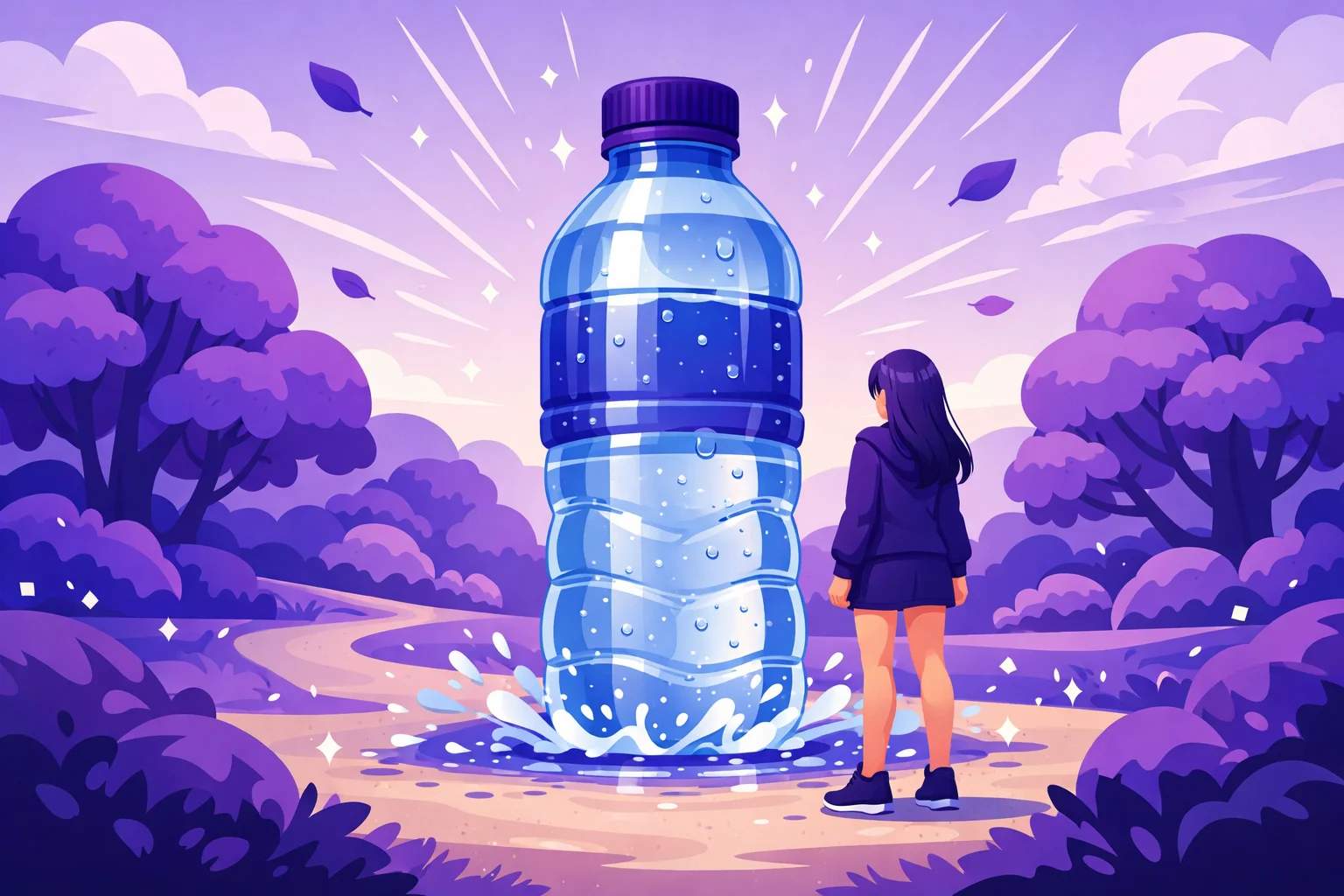
water 30초 만에
- Water is a clear, tasteless liquid essential for all life on Earth, found in oceans, rivers, and used daily for drinking and washing.
- Grammatically, it is an uncountable noun that takes a singular verb and is often used in compound terms like 'water bottle.'
- It has many metaphorical uses, such as 'in deep water' for trouble or 'water under the bridge' for past events.
- Pronunciation varies by dialect, with American English often using a flap 'T' and British English often using a glottal stop or clear 'T'.
The word water is perhaps one of the most fundamental nouns in the English language, representing the transparent, tasteless, odorless, and nearly colorless chemical substance that is the main constituent of Earth's hydrosphere and the fluids of all known living organisms. In its most basic sense, it refers to the liquid state of H2O. Humans use this word in almost every facet of daily life, from discussing basic survival needs to describing complex meteorological phenomena. When you wake up and feel thirsty, you ask for water. When you look at the ocean, you are looking at a vast body of water. The word is ubiquitous because the substance itself is the foundation of life on our planet.
- Physical State
- While 'water' technically refers to the liquid form, in common parlance, it is the umbrella term for the substance that can also exist as ice or steam. However, when someone says 'I want water,' they almost exclusively mean the liquid form at a drinkable temperature.
The hikers were relieved to find a source of fresh water after three hours in the sun.
Beyond the physical substance, 'water' is used to describe bodies of liquid such as lakes, rivers, and oceans. In these contexts, it often takes a plural form 'waters' to denote specific territorial areas or a vast expanse, though 'water' remains the standard singular noun for the substance itself. We use it to describe weather (rain is falling water), culinary processes (boiling water for pasta), and hygiene (washing with soap and water). It is a word that transcends social class, geography, and age, making it one of the first words learned by both native speakers and English language learners alike.
- Biological Necessity
- Biologically, water acts as a solvent, transporting nutrients and oxygen to cells and removing waste products. This vital role is reflected in how we talk about health, where 'drinking enough water' is a constant refrain in medical and wellness circles.
Plants need sunlight and water to grow through the process of photosynthesis.
In a metaphorical sense, water represents clarity, flow, and change. We speak of 'uncharted waters' when entering a new situation, or 'being in deep water' when we are in trouble. These metaphorical extensions rely on our physical understanding of water's properties—its depth, its movement, and its power. Whether we are discussing the 'water cycle' in a science class or 'watering the plants' in the garden, the word remains a pillar of the English lexicon. It is a word that carries weight, from the simplicity of a teardrop to the overwhelming force of a flood.
- Environmental Context
- In modern discourse, water is often discussed in the context of conservation and ecology. Terms like 'water scarcity,' 'water footprint,' and 'water purification' are increasingly common as global populations grapple with resource management.
The city implemented strict water restrictions during the peak of the summer drought.
Could you please bring me a glass of water with ice?
The reflection of the moon on the water was absolutely breathtaking.
Using the word water correctly involves understanding its grammatical role as an uncountable noun and its versatility as a modifier. In most sentences, 'water' functions as the object of a verb or the subject of a sentence describing a state or action. Because it is uncountable, we do not use 'a' or 'an' directly before it unless we are implying a container or a specific type. Instead, we use quantifiers like 'some,' 'much,' 'a lot of,' or 'a glass of.' For example, 'I need some water' is more natural than 'I need water,' although both are grammatically acceptable in different contexts.
- Subject-Verb Agreement
- As an uncountable noun, 'water' always takes a singular verb. You would say 'The water is cold,' never 'The water are cold.' This remains true even if you are referring to a large amount of water, such as the water in a swimming pool.
Still water runs deep, suggesting that a quiet person may have a complex personality.
In more complex sentence structures, 'water' often acts as a noun adjunct, modifying another noun to create compound terms. Common examples include 'water bottle,' 'water heater,' 'water park,' and 'water level.' In these cases, 'water' describes the purpose or nature of the second noun. This is a very productive pattern in English, allowing for the creation of specific vocabulary without needing entirely new words. When you say 'water damage,' the listener immediately understands that the damage was caused by the liquid substance.
- Prepositional Phrases
- We often use 'water' with prepositions to indicate location or movement. 'Under water,' 'above water,' 'in the water,' and 'by the water' are standard phrases. Note that 'underwater' can also be an adjective or adverb (one word).
The boat was floating peacefully on the calm water of the bay.
Advanced usage involves the plural 'waters.' This is typically reserved for literary, formal, or geographical contexts. For instance, 'international waters' refers to sea areas not belonging to any one nation. In a metaphorical sense, one might say 'navigating troubled waters' to describe managing a difficult situation. However, for 99% of daily communication, the singular 'water' is the correct choice. It is also important to distinguish between 'water' as a noun and its related forms like 'watery' (adjective), which describes something that contains too much water or resembles water in a negative way, like 'watery soup.'
- The Passive Voice
- 'Water' often appears in passive constructions in scientific or technical writing. 'The sample was diluted with water' or 'The fields are irrigated with water from the nearby river.'
You should drink plenty of water after exercising to stay hydrated.
The plumber found a leak in the water pipe behind the kitchen wall.
The sound of running water is often used in meditation to promote relaxation.
You will encounter the word water in almost every environment where English is spoken. In a domestic setting, it is part of the morning routine: 'Is the water hot yet?' or 'Don't forget to water the plants.' In restaurants, it is the first question a server might ask: 'Would you like some water for the table?' or 'Sparkling or still water?' These interactions are so common that the word becomes a background element of our linguistic landscape, yet it remains essential for clear communication.
- At the Gym or Outdoors
- In fitness contexts, you'll hear 'water break' or 'hydration' frequently. Coaches and trainers emphasize 'drinking water' to maintain performance. Outdoors, you'll hear it in descriptions of nature: 'The water is quite choppy today' or 'The water level in the lake is dropping.'
'Can I get a bottle of water from the vending machine?'
In professional and scientific settings, 'water' is used with more precision. You might hear a scientist talk about 'distilled water,' 'saline water,' or 'water vapor.' In the news, 'water' is a frequent topic in stories about climate change, natural disasters like floods, or infrastructure issues like 'water main breaks.' It is also a key term in political discussions regarding 'water rights' and 'clean water access.' These contexts elevate the word from a simple household item to a critical global resource, reflecting its multifaceted importance.
- In the Kitchen
- Cooking shows and recipes are filled with the word. 'Bring a large pot of salted water to a boil' or 'Rinse the vegetables under cold running water.' It is the most basic ingredient in the culinary world.
The weather report warned of rising water levels along the coast due to the storm surge.
Pop culture also heavily utilizes 'water.' From song lyrics ('Bridge Over Troubled Water') to movie titles ('The Shape of Water'), the word is used to evoke emotion and imagery. In sports, particularly swimming, diving, and sailing, 'water' is the primary medium. You'll hear commentators talk about the 'entry into the water' or 'water temperature.' Even in office environments, the 'water cooler' is a metaphorical and sometimes literal place where colleagues gather to chat, giving rise to the term 'water cooler talk' for informal office gossip.
- Emergency Situations
- In emergencies, 'water' is a top priority. You might hear instructions to 'boil water' before use or see signs for 'potable water' (water safe for drinking) in relief camps.
The lifeguard blew the whistle and told everyone to get out of the water.
'Do you prefer tap water or bottled water?' the waiter asked politely.
The sound of the water crashing against the rocks was incredibly loud.
One of the most frequent errors learners make with the word water is treating it as a countable noun. Because many languages use a countable form for 'water' or have different rules for liquids, students often say 'I want a water' or 'I have two waters.' While this is acceptable in a restaurant context (meaning 'a glass/bottle of water'), in general English, it is incorrect. You should say 'some water' or 'a glass of water.' Understanding the distinction between the substance and the container is key to sounding natural.
- The 'Waters' Confusion
- Learners sometimes see the word 'waters' in literature or news and assume it is the standard plural. However, 'waters' is a specific term used for large bodies of water or territorial seas. Using it to describe the water in your cup is a mistake.
Incorrect: I drank three waters today. Correct: I drank three glasses of water today.
Another common mistake involves the use of articles. Since 'water' is uncountable, we generally do not use 'the' when talking about water in a general sense. For example, 'Water is necessary for life' is correct, whereas 'The water is necessary for life' sounds like you are talking about a specific puddle or glass of water. However, you *must* use 'the' when referring to a specific body of water that has already been mentioned or is known to the listener, such as 'The water in this lake is very clean.'
- Pronunciation Pitfalls
- The pronunciation of the 't' in 'water' varies significantly between dialects. Non-native speakers often over-enunciate the 't' in American English contexts, which can sound stiff. Conversely, swallowing the 't' too much in British English can make the word unrecognizable to some.
Incorrect: The plants need a water. Correct: The plants need some water.
Confusion also arises with the verb form. Some learners use 'make water' or 'put water' when they mean 'water the plants.' In English, 'water' is its own verb. You don't 'put water' on a garden; you simply 'water' the garden. Additionally, 'make water' is an archaic or very formal way to say 'urinate,' so using it in the wrong context can lead to significant embarrassment. Always stick to 'water' as a verb for plants and animals, and 'drink water' for consumption.
- Adjective vs. Noun Adjunct
- Learners often try to use 'watery' as a general adjective for things related to water. However, 'water' itself usually acts as the modifier. It's a 'water bottle,' not a 'watery bottle.'
Incorrect: I need a watery heater. Correct: I need a water heater.
Incorrect: How many water do you want? Correct: How much water do you want?
Incorrect: I'm going to the water for a swim. Correct: I'm going into the water for a swim.
While water is the most common term, English offers several alternatives depending on the context, formality, and state of the liquid. Understanding these synonyms helps in achieving precision in writing and speaking. For instance, in a scientific context, one might use 'H2O' or 'dihydrogen monoxide' (though the latter is often used in jokes). In a culinary or beverage context, 'liquid' or 'fluid' might be used, though they are much broader terms that include things like oil or juice.
- Liquid vs. Fluid
- 'Liquid' is a state of matter. All water is liquid (unless frozen or boiled), but not all liquids are water. 'Fluid' is even broader, including both liquids and gases in physics. Use 'water' when you mean the specific substance.
The doctor told him to drink plenty of fluids, which includes water, juice, and tea.
When describing bodies of water, words like 'aqua' (Latin for water) are often used in branding or color descriptions. 'Brine' refers specifically to very salty water, like that in the ocean or used for pickling. 'Freshwater' and 'saltwater' are essential distinctions in biology and ecology. If you are talking about water that is safe to drink, the formal term is 'potable water.' In poetic or literary contexts, you might see 'the deep,' 'the main,' or 'the waves' used as metonyms for the ocean's water.
- Beverage vs. Drink
- 'Beverage' is a formal word for any drink. While water is a beverage, it is often listed separately on menus. 'Drink' is the more common, neutral term.
The aqua blue of the Caribbean sea is world-famous.
There are also verbs that can replace 'water' in specific situations. Instead of 'watering' a field, a farmer might 'irrigate' it. Instead of 'putting water' on a fire, a firefighter will 'extinguish' or 'douse' it. If you are adding water to a concentrated liquid, you are 'diluting' it. These verbs provide more specific information about the action being performed. Similarly, 'soak,' 'drench,' and 'saturate' describe different degrees of something being covered in or filled with water. Choosing the right word depends on the intensity you wish to convey.
- Hydration
- This is the biological term for the absorption of water. We use 'hydrate' as a verb and 'dehydration' for the dangerous state of lacking water.
The heavy rain drenched the spectators at the outdoor concert.
The scientist used distilled water to ensure the experiment was not contaminated.
The moisture in the air made the humid day feel even hotter.
How Formal Is It?
재미있는 사실
The chemical formula H2O was only discovered in the late 18th century, but the word 'water' has been used for thousands of years. It is one of the few words that has remained relatively stable in meaning throughout history.
발음 가이드
- Pronouncing the 't' too harshly in American English.
- Using a short 'a' sound like in 'cat'.
- Failing to pronounce the 'r' in rhotic dialects (like US).
- Confusing the vowel sound with 'waiter'.
- Over-emphasizing the second syllable.
난이도
The word is very short and common, making it easy to recognize in text.
Spelling is straightforward, though the 'er' ending is a common pattern.
Pronunciation of the 't' can be tricky depending on the desired dialect.
It is a high-frequency word that is usually clear in most contexts.
다음에 무엇을 배울까
선수 학습
다음에 배울 것
고급
알아야 할 문법
Uncountable Nouns
Water is (not are) essential.
Noun Adjuncts
Water bottle, water heater, water park.
Zero Article
I like drinking water (general).
Definite Article
The water in this glass is dirty (specific).
Quantifiers
A little water, much water, some water.
수준별 예문
I drink water every day.
Je bois de l'eau chaque jour.
Simple present tense with an uncountable noun.
The water is cold.
L'eau est froide.
Subject-verb agreement with a singular verb 'is'.
Can I have some water?
Puis-je avoir de l'eau ?
Using 'some' with an uncountable noun in a request.
The cat drinks water.
Le chat boit de l'eau.
Third person singular verb 'drinks'.
I need water for the plants.
J'ai besoin d'eau pour les plantes.
Noun used as an object of the verb 'need'.
Is the water hot?
L'eau est-elle chaude ?
Question form with the verb 'to be'.
There is water on the floor.
Il y a de l'eau sur le sol.
Using 'there is' with an uncountable noun.
Wash your hands with water.
Lavez-vous les mains avec de l'eau.
Imperative sentence with a prepositional phrase.
He filled his water bottle before the game.
Il a rempli sa gourde avant le match.
Compound noun 'water bottle'.
The sea water is very salty.
L'eau de mer est très salée.
Noun adjunct 'sea' modifying 'water'.
We went to a big water park yesterday.
Nous sommes allés dans un grand parc aquatique hier.
Compound noun 'water park'.
She is watering the flowers in the garden.
Elle arrose les fleurs dans le jardin.
'Water' used as a verb in the present continuous.
Don't forget to drink plenty of water.
N'oubliez pas de boire beaucoup d'eau.
Using 'plenty of' as a quantifier.
The water in the lake is very clear.
L'eau du lac est très claire.
Definite article 'the' used for specific water.
I like to swim in cold water.
J'aime nager dans l'eau froide.
Infinitive phrase followed by a prepositional phrase.
The recipe says to add two cups of water.
La recette dit d'ajouter deux tasses d'eau.
Using a unit of measurement 'cups of' for an uncountable noun.
The city is facing a serious water shortage.
La ville est confrontée à une grave pénurie d'eau.
Compound noun 'water shortage' as a direct object.
You should always carry water when you go hiking.
Vous devriez toujours porter de l'eau quand vous faites de la randonnée.
Modal verb 'should' followed by the base form of the verb.
The water pollution is affecting the local fish.
La pollution de l'eau affecte les poissons locaux.
Compound noun 'water pollution' as the subject.
I prefer tap water to bottled water because it's cheaper.
Je préfère l'eau du robinet à l'eau en bouteille parce que c'est moins cher.
Comparison using 'prefer... to...'.
The plumber came to fix the water leak.
Le plombier est venu réparer la fuite d'eau.
Compound noun 'water leak'.
The sound of running water helps me sleep.
Le bruit de l'eau qui coule m'aide à dormir.
Participle 'running' used as an adjective modifying 'water'.
We need to conserve water during the summer months.
Nous devons économiser l'eau pendant les mois d'été.
Infinitive 'to conserve' with 'water' as the object.
The water level in the reservoir is quite low.
Le niveau d'eau dans le réservoir est assez bas.
Compound noun 'water level'.
The company was accused of dumping chemicals into the water.
L'entreprise a été accusée de rejeter des produits chimiques dans l'eau.
Passive voice 'was accused of' followed by a gerund.
The boat entered international waters early this morning.
Le bateau est entré dans les eaux internationales tôt ce matin.
Plural 'waters' used in a geographical/legal context.
His explanation was a bit watered down to make it easier to understand.
Son explication a été un peu édulcorée pour la rendre plus facile à comprendre.
Phrasal verb 'water down' in the passive voice.
She felt like she was treading water in her current job.
Elle avait l'impression de faire du surplace dans son travail actuel.
Idiomatic use of 'treading water'.
The water's surface was like a mirror in the morning light.
La surface de l'eau était comme un miroir dans la lumière du matin.
Possessive form 'water's' modifying 'surface'.
They are in deep water after failing to pay their taxes.
Ils sont dans de beaux draps après avoir omis de payer leurs impôts.
Idiomatic expression 'in deep water'.
The project was designed to improve water accessibility in rural areas.
Le projet a été conçu pour améliorer l'accessibilité à l'eau dans les zones rurales.
Compound noun 'water accessibility'.
The ice began to melt, turning back into water.
La glace a commencé à fondre, redevenant de l'eau.
Present participle 'turning' describing a change of state.
The negotiations were like navigating uncharted waters.
Les négociations étaient comme naviguer en eaux inconnues.
Metaphorical use of 'uncharted waters'.
That's all water under the bridge now, so let's move on.
C'est de l'histoire ancienne maintenant, alors passons à autre chose.
Idiom 'water under the bridge'.
The government's proposal was criticized for being too watered down.
La proposition du gouvernement a été critiquée pour être trop édulcorée.
Phrasal verb 'watered down' as an adjective.
The sheer volume of water cascading over the falls was breathtaking.
Le volume impressionnant d'eau s'écoulant en cascades sur les chutes était à couper le souffle.
Complex noun phrase 'sheer volume of water'.
The company is trying to keep its head above water during the recession.
L'entreprise essaie de garder la tête hors de l'eau pendant la récession.
Idiom 'keep one's head above water'.
The book explores the symbolic significance of water in various cultures.
Le livre explore la signification symbolique de l'eau dans diverses cultures.
Academic tone with 'symbolic significance'.
The water table has dropped significantly due to over-extraction.
La nappe phréatique a baissé de manière significative en raison d'une surextraction.
Technical term 'water table'.
His eyes began to water as he chopped the onions.
Ses yeux ont commencé à larmoyer alors qu'il coupait les oignons.
'Water' used as an intransitive verb.
The poet used water as a motif for the fluidity of time.
Le poète a utilisé l'eau comme motif pour la fluidité du temps.
Literary analysis terminology.
The legal dispute over water rights lasted for over a decade.
Le litige juridique sur les droits d'eau a duré plus d'une décennie.
Formal legal context.
The intricate plumbing system ensures the efficient distribution of water.
Le système de plomberie complexe assure la distribution efficace de l'eau.
Technical and precise vocabulary.
She has a way of pouring cold water on every new idea I have.
Elle a l'art de doucher tous mes nouveaux projets.
Idiom 'pour cold water on'.
The hydro-geological survey revealed a vast aquifer beneath the desert.
L'étude hydrogéologique a révélé un vaste aquifère sous le désert.
Highly technical scientific language.
The film's cinematography captures the ethereal quality of light on water.
La cinématographie du film capture la qualité éthérée de la lumière sur l'eau.
Sophisticated artistic description.
The treaty governs the use of the trans-boundary waters between the two nations.
Le traité régit l'utilisation des eaux transfrontalières entre les deux nations.
Formal diplomatic language.
His arguments simply don't hold water when you look at the facts.
Ses arguments ne tiennent tout simplement pas la route quand on regarde les faits.
Idiom 'hold water' meaning to be valid.
동의어
반의어
자주 쓰는 조합
자주 쓰는 구문
— A standard serving of water. Used when ordering or offering a drink.
Could I have a glass of water, please?
— Water contained in a plastic or glass bottle. Common for travel.
I always keep a bottle of water in my bag.
— Water at a high temperature. Also used idiomatically for trouble.
The shower has no hot water this morning.
— Water at a low temperature. Used for drinking or cooling down.
I love a glass of cold water on a hot day.
— Water with carbonation (bubbles). A popular alternative to still water.
Do you prefer sparkling water or still water?
— Water without carbonation. The most common form of drinking water.
I'll just have some still water, thank you.
— Water from a natural spring containing minerals. Often bottled.
This mineral water comes from the French Alps.
— Water that has been used and is now dirty. Usually goes into sewers.
The factory needs a better way to treat its waste water.
— Water that is safe for human consumption. Often used in signs.
Is this tap providing drinking water?
— Water that is not deep. Safe for children to play in.
The children stayed in the shallow water near the shore.
자주 혼동되는 단어
Similar sound, but a waiter is a person who serves food in a restaurant.
Similar sound, but weather refers to the state of the atmosphere (rain, sun, etc.).
A common male name that sounds similar to 'water' in some accents.
관용어 및 표현
— Problems or events from the past that are no longer important or worth worrying about.
We had our disagreements, but that's all water under the bridge now.
informal— To be in serious trouble or in a difficult situation.
He found himself in deep water when he couldn't explain the missing money.
neutral— To just manage to survive a difficult situation, especially a financial one.
With the rising costs, the small business is struggling to keep its head above water.
neutral— To feel very uncomfortable or out of place in a particular situation.
At the formal gala, the shy student felt like a fish out of water.
informal— To be negative about someone's ideas or plans; to discourage someone.
I don't want to pour cold water on your plans, but I don't think they will work.
informal— If an argument or theory holds water, it seems to be true or reasonable.
His excuse for being late just doesn't hold water.
neutral— To be active but not making any progress; to stay in the same position.
I feel like I'm just treading water in this job; I need a new challenge.
neutral— Family relationships are stronger and more important than other types of relationships.
He chose to help his brother instead of his friend, proving that blood is thicker than water.
informal— No matter what happens; determined to do something despite any difficulties.
I'll be there for your graduation, come hell or high water.
informal— To make something weaker or less effective, often by removing the strongest parts.
The committee watered down the proposal to make it more acceptable to the board.
neutral혼동하기 쉬운
Both relate to water.
'Water' is the noun; 'watery' is an adjective meaning containing too much water or resembling water.
The soup was very watery.
Plural form of water.
'Water' is the general substance; 'waters' refers to specific bodies of water or territorial seas.
They sailed into international waters.
Water is a liquid.
'Liquid' is a state of matter; 'water' is a specific chemical substance.
Mercury is a liquid metal.
Water is a fluid.
'Fluid' includes both liquids and gases; 'water' is specifically H2O.
Air is a fluid in the study of aerodynamics.
Rain is water.
'Rain' is specifically water falling from the sky; 'water' is the substance itself.
The rain filled the water barrels.
문장 패턴
I drink [water].
I drink water.
The [water] is [adjective].
The water is hot.
Can I have a [container] of [water]?
Can I have a glass of water?
I am [verb-ing] the [water].
I am boiling the water.
There is a [noun] of [water].
There is a shortage of water.
The [noun] was [verb-ed] with [water].
The fire was extinguished with water.
It's all [idiom] now.
It's all water under the bridge now.
The [noun] doesn't [idiom].
His theory doesn't hold water.
어휘 가족
명사
동사
형용사
관련
사용법
Extremely high; among the top 500 words in English.
-
I drank two waters.
→
I drank two glasses of water.
Water is uncountable; you must use a container or quantifier to count it.
-
The water are cold.
→
The water is cold.
Uncountable nouns always take a singular verb.
-
I'm going to water the garden with a water.
→
I'm going to water the garden with some water.
Don't use 'a' before 'water' unless referring to a specific container.
-
He is in deep waters.
→
He is in deep water.
The idiom for being in trouble uses the singular 'water'.
-
The soup is very water.
→
The soup is very watery.
Use the adjective 'watery' to describe something that has too much water.
팁
Uncountable Rule
Always remember that water is uncountable. Avoid saying 'I want a water' in formal writing. Instead, use 'a glass of water' or just 'water'.
The Flap T
If you want to sound more American, try pronouncing the 't' in water as a soft 'd'. It makes your speech sound more fluid and natural.
Compound Words
Learn compound words like 'waterfall' and 'waterfront' together. It helps you see how 'water' acts as a building block for other words.
Deep Water
Use the idiom 'in deep water' when you want to describe someone who is in a lot of trouble. It's a very common and evocative expression.
Tap vs. Bottled
In many English-speaking countries, 'tap water' is the default. If you want bottled water, you usually have to specify 'bottled' or a brand name.
Action Verbs
Instead of saying 'put water on', use specific verbs like 'irrigate', 'douse', or 'dilute' to make your writing more professional.
Context Clues
When you hear 'water', look at the surroundings. Is the person in a garden? They probably mean the verb. In a restaurant? They mean the drink.
Hospitality
In many cultures, offering a glass of water is the first thing you do for a guest. It's a universal sign of welcome and care.
H2O
Knowing that water is H2O can help you understand scientific texts, but avoid using it in casual conversation unless you're being funny.
Visual Link
Link the word 'water' to the color blue in your mind. Whenever you see blue, say the word 'water' to yourself to reinforce the memory.
암기하기
기억법
Think of the 'W' as waves in the ocean. The word 'water' starts with a wave!
시각적 연상
Imagine a clear glass of refreshing water with ice cubes clinking against the side on a hot summer day.
Word Web
챌린지
Try to use the word 'water' in five different sentences today, including one idiom like 'water under the bridge.'
어원
The word 'water' comes from the Old English 'wæter,' which is derived from the Proto-Germanic '*watar.' It has cognates in many other Germanic languages, such as the German 'Wasser' and the Dutch 'water.'
원래 의미: The original meaning has always referred to the liquid substance H2O, reflecting its fundamental importance to human life since the earliest times.
Indo-European > Germanic > West Germanic > English.문화적 맥락
Be mindful that in some parts of the world, clean water is a luxury. Using the word 'water' in the context of waste can be sensitive in those regions.
In the US and UK, tap water is generally safe and expected to be free in restaurants. Asking for 'water' is the most common request in any social setting.
실생활에서 연습하기
실제 사용 상황
Restaurant
- A glass of tap water, please.
- Still or sparkling?
- No ice, thank you.
- Could we get some water for the table?
Gardening
- Did you water the plants?
- The soil needs more water.
- Over-watering can kill the flowers.
- Use a watering can.
Science Class
- Water boils at 100 degrees Celsius.
- The water cycle involves evaporation.
- H2O is the chemical formula for water.
- Water is a universal solvent.
Health/Fitness
- Stay hydrated by drinking water.
- I need a water break.
- How much water should I drink daily?
- Water helps flush out toxins.
Weather/Nature
- The water level is rising.
- The water is very calm today.
- Watch out for the deep water.
- The rain turned into a flood of water.
대화 시작하기
"Do you prefer drinking tap water or bottled water when you are at home?"
"How many glasses of water do you think a person should drink every day?"
"Have you ever been to a famous body of water, like a Great Lake or the ocean?"
"Do you enjoy water sports like swimming, surfing, or perhaps sailing on a boat?"
"Is the tap water in your city safe to drink, or do people usually filter it?"
일기 주제
Describe a time when you were very thirsty and finally had a drink of cold water. How did it feel?
Write about your favorite place that is near water, such as a beach, a riverbank, or a quiet lake.
Reflect on the importance of water conservation. What are some small ways you can save water in your daily life?
Imagine a world where water was a very rare and expensive resource. How would your life change?
Describe the sound and feeling of rain. Do you find the sound of water to be relaxing or annoying?
자주 묻는 질문
10 질문In 99% of cases, 'water' is uncountable. You say 'some water' or 'much water.' You only use it as a countable noun ('a water') when ordering a specific container like a bottle or glass in a restaurant.
Use 'waters' when referring to large, specific bodies of water (e.g., 'the coastal waters') or in legal/geographical terms like 'international waters.' It is also used in the idiom 'troubled waters.'
Tap water comes from the faucet and is provided by the city. Mineral water comes from a natural spring and contains minerals; it is usually sold in bottles.
Americans usually pronounce the 't' as a flap 'T', which sounds like a soft 'd'. The 'a' is open like in 'father', and the 'r' at the end is clearly heard.
Yes, 'water' is a verb meaning to give water to plants or animals. For example, 'I need to water the garden.' It can also mean eyes filling with tears.
It is an idiom meaning that past problems or events are no longer important and should be forgotten. It's like saying 'let's move on.'
Not exactly. Sparkling water is just water with carbonation. Soda usually contains sugar, flavorings, and other ingredients, though some people use the terms interchangeably for carbonated water.
Potable water is a formal and technical term for water that is safe for humans to drink without risk of health problems.
This means that a tap or faucet is turned on and water is flowing out of it. It doesn't mean the water is actually 'running' like a person!
It means to add water to a drink (like juice or alcohol) to make it weaker or less strong in flavor.
셀프 테스트 190 질문
Write a sentence about drinking water.
Well written! Good try! Check the sample answer below.
Write a sentence about the color of water.
Well written! Good try! Check the sample answer below.
Write a sentence about watering a plant.
Well written! Good try! Check the sample answer below.
Write a sentence about a water bottle.
Well written! Good try! Check the sample answer below.
Write a paragraph about why we should save water.
Well written! Good try! Check the sample answer below.
Write a sentence about tap water vs bottled water.
Well written! Good try! Check the sample answer below.
Explain what 'in deep water' means in your own words.
Well written! Good try! Check the sample answer below.
Write a sentence using the word 'waters' correctly.
Well written! Good try! Check the sample answer below.
Use the idiom 'water under the bridge' in a short dialogue.
Well written! Good try! Check the sample answer below.
Describe a beautiful scene involving water.
Well written! Good try! Check the sample answer below.
Write a formal email about a water rights dispute.
Well written! Good try! Check the sample answer below.
Argue for or against the privatization of water resources.
Well written! Good try! Check the sample answer below.
What do you use water for in the morning?
Well written! Good try! Check the sample answer below.
Describe a water park you have visited or seen.
Well written! Good try! Check the sample answer below.
How does water pollution affect your community?
Well written! Good try! Check the sample answer below.
Write a story about someone who is 'treading water' in life.
Well written! Good try! Check the sample answer below.
Analyze the symbolism of water in a movie you like.
Well written! Good try! Check the sample answer below.
Use the phrase 'hold water' in a complex sentence about a theory.
Well written! Good try! Check the sample answer below.
Write a set of instructions for boiling water safely.
Well written! Good try! Check the sample answer below.
Describe the physical properties of water in scientific terms.
Well written! Good try! Check the sample answer below.
Say: 'I would like a glass of water, please.'
Read this aloud:
당신의 답변:
Speech recognition is not supported in your browser. Try Chrome or Edge.
Say: 'The water is very cold.'
Read this aloud:
당신의 답변:
Speech recognition is not supported in your browser. Try Chrome or Edge.
Describe your favorite water-related activity (e.g., swimming).
Read this aloud:
당신의 답변:
Speech recognition is not supported in your browser. Try Chrome or Edge.
Tell someone how to water a plant.
Read this aloud:
당신의 답변:
Speech recognition is not supported in your browser. Try Chrome or Edge.
Talk for one minute about why water is important for health.
Read this aloud:
당신의 답변:
Speech recognition is not supported in your browser. Try Chrome or Edge.
Discuss the pros and cons of tap water vs bottled water.
Read this aloud:
당신의 답변:
Speech recognition is not supported in your browser. Try Chrome or Edge.
Explain the idiom 'in deep water' to a friend.
Read this aloud:
당신의 답변:
Speech recognition is not supported in your browser. Try Chrome or Edge.
Describe a time you saw a beautiful body of water.
Read this aloud:
당신의 답변:
Speech recognition is not supported in your browser. Try Chrome or Edge.
Give a short presentation on the global water crisis.
Read this aloud:
당신의 답변:
Speech recognition is not supported in your browser. Try Chrome or Edge.
Debate the importance of water conservation in modern cities.
Read this aloud:
당신의 답변:
Speech recognition is not supported in your browser. Try Chrome or Edge.
Discuss the philosophical implications of water as a symbol of life.
Read this aloud:
당신의 답변:
Speech recognition is not supported in your browser. Try Chrome or Edge.
Analyze the use of water imagery in a famous poem or song.
Read this aloud:
당신의 답변:
Speech recognition is not supported in your browser. Try Chrome or Edge.
Roleplay ordering water in a fancy restaurant.
Read this aloud:
당신의 답변:
Speech recognition is not supported in your browser. Try Chrome or Edge.
Tell a story about a flood or a heavy rainstorm you experienced.
Read this aloud:
당신의 답변:
Speech recognition is not supported in your browser. Try Chrome or Edge.
Practice the American pronunciation of 'water'.
Read this aloud:
당신의 답변:
Speech recognition is not supported in your browser. Try Chrome or Edge.
Practice the British pronunciation of 'water'.
Read this aloud:
당신의 답변:
Speech recognition is not supported in your browser. Try Chrome or Edge.
Ask three questions about water to a partner.
Read this aloud:
당신의 답변:
Speech recognition is not supported in your browser. Try Chrome or Edge.
Explain how a water filter works in simple terms.
Read this aloud:
당신의 답변:
Speech recognition is not supported in your browser. Try Chrome or Edge.
Discuss the impact of rising sea levels on coastal cities.
Read this aloud:
당신의 답변:
Speech recognition is not supported in your browser. Try Chrome or Edge.
Summarize a news story you heard about water pollution.
Read this aloud:
당신의 답변:
Speech recognition is not supported in your browser. Try Chrome or Edge.
Listen to the sentence: 'I want water.' What does the speaker want?
Listen to the sound of a tap. Is the water running or off?
Listen to a weather report. Is it going to rain?
Listen to a conversation about a plumbing problem. What is leaking?
Listen to a lecture on environmental science. What is a watershed?
Listen to a debate about water rights. What are the two main arguments?
Identify the word 'water' in a list of spoken words.
Listen to a waiter's question. Does he offer still or sparkling water?
Listen to a person describing their garden. How often do they water it?
Listen to an idiom. What does the speaker mean by 'treading water'?
Listen to a song. What does water symbolize in the lyrics?
Listen to a scientific podcast. How is the aquifer being replenished?
Listen to a travel guide. What is special about the local water?
Listen to a news clip about a drought. What restrictions are in place?
Does the speaker say 'water' or 'waiter'?
/ 190 correct
Perfect score!
Summary
Water is a fundamental noun representing the liquid H2O. It is essential for survival, ubiquitous in daily life, and versatile in both literal and metaphorical contexts. Example: 'Always carry a water bottle to ensure you stay hydrated throughout the day.'
- Water is a clear, tasteless liquid essential for all life on Earth, found in oceans, rivers, and used daily for drinking and washing.
- Grammatically, it is an uncountable noun that takes a singular verb and is often used in compound terms like 'water bottle.'
- It has many metaphorical uses, such as 'in deep water' for trouble or 'water under the bridge' for past events.
- Pronunciation varies by dialect, with American English often using a flap 'T' and British English often using a glottal stop or clear 'T'.
Uncountable Rule
Always remember that water is uncountable. Avoid saying 'I want a water' in formal writing. Instead, use 'a glass of water' or just 'water'.
The Flap T
If you want to sound more American, try pronouncing the 't' in water as a soft 'd'. It makes your speech sound more fluid and natural.
Compound Words
Learn compound words like 'waterfall' and 'waterfront' together. It helps you see how 'water' acts as a building block for other words.
Deep Water
Use the idiom 'in deep water' when you want to describe someone who is in a lot of trouble. It's a very common and evocative expression.
예시
Drink water daily.
관련 콘텐츠


맥락에서 배우기
food 관련 단어
barbecue
A2바비큐는 야외에서 요리하는 식사로, 종종 파티에서 열립니다.
bean
A2콩은 식물의 식용 씨앗으로, 종종 꼬투리 안에 들어 있습니다.
breakfast
A1아침 식사는 하루의 첫 번째 식사입니다.
food
A1음식은 생물에게 영양을 공급하기 위해 섭취하는 물질입니다. 나는 매운 음식을 좋아한다.
eat lunch
A2점심을 먹는 것은 하루 중 에너지를 보충하는 중요한 시간입니다.
cafe
A2카페는 커피, 가벼운 식사, 간식을 제공하는 작은 레스토랑입니다. 친구를 만나거나 휴식을 취하기에 인기 있는 장소입니다.
fruit
A1과일은 씨앗을 포함하고 있는 식물의 식용 부분입니다. 보통 달콤하고 건강에 좋습니다.
chop
A2수프를 위해 채소를 썰다.
lunch
A1점심은 낮 중간에 먹는 식사입니다.
beer
A2발효된 곡물로 만든 알코올 음료. 그는 바에서 맥주를 주문했다.

