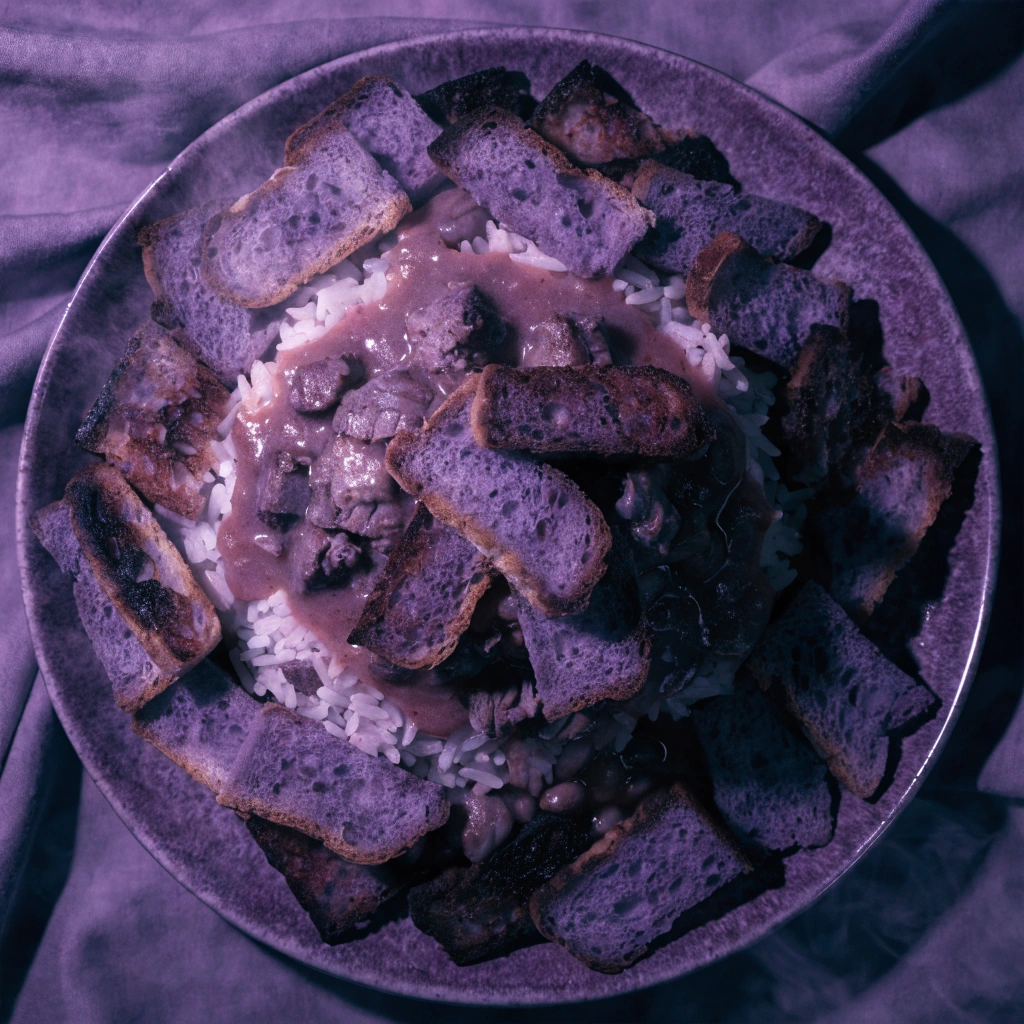
A Special Meal in Egypt
Fatteh is a special food from Egypt. People eat this dish on big holidays. It is very popular and delicious.
Fatteh has many layers. At the bottom, there is toasted bread. Next, there is white rice. On top, there is meat. Usually, it is lamb or beef.
There is a special sauce on the food. The sauce has garlic and vinegar. It smells very good. Families sit together and eat Fatteh from a big plate. It is a happy time for everyone.
نکته دستوری
الگو: Present Simple (to be)
"Fatteh is a special food from Egypt."
We use 'is' with singular subjects like 'Fatteh' to describe facts. It follows the pattern Subject + am/is/are + Adjective/Noun.
الگو: There is / There are
"There is white rice."
We use 'There is' to say that something exists. Use 'There is' for one thing and 'There are' for many things.
درک خود را بسنجید
10 سوال · A1 مبتدی · 1 پیشنمایش رایگان
آنچه از این مقاله آموختید را بسنجید. به همه سؤالات پاسخ دهید و XP کسب کنید!
Where is Fatteh from?
آیا میخواهید آزمون را تمام کنید؟
9 سؤال دیگر منتظر شماست. ثبتنام رایگان کنید تا آزمون کامل را باز کنید و XP کسب کنید!
ثبتنام رایگانقبلاً ثبتنام کردی؟ ورود
جزئیات سؤالات
Where is Fatteh from?
پاسخ شما:
پاسخ درست: Egypt
Fatteh has bread at the bottom.
پاسخ شما:
پاسخ درست: درست
What is 'meat'?
پاسخ شما:
پاسخ درست: Food from an animal
Families sit _____ and eat Fatteh.
پاسخ شما:
پاسخ درست: together
Fatteh: The Special Dish of Egypt
Fatteh is a very famous dish in Egypt. It is a special meal for big celebrations, like Eid al-Adha. The name comes from the word 'fatta'. This means 'to break into pieces' because the cook breaks dry bread for the base.
Making Fatteh is like building a house. First, people put toasted bread in a large bowl. Then, they add a layer of white rice. On top, they put pieces of boiled meat, usually lamb or beef. The most important part is the sauce. It is made with garlic and vinegar. This sauce gives the dish a strong and delicious taste.
In the past, Egyptian families only ate Fatteh on special days because meat was expensive. Today, it is more common, but it is still the king of the table. People usually eat it together from one big plate. It is better than many other dishes because it brings the family together. Everyone loves the smell of the garlic sauce in the kitchen.
نکته دستوری
الگو: Comparatives
"It is better than many other dishes because it brings the family together."
We use comparatives to compare two things. For the adjective 'good', we use the irregular form 'better than' to show that one thing is of a higher quality than another.
الگو: Past Simple (was/were)
"In the past, Egyptian families only ate Fatteh on special days because meat was expensive."
The past simple of the verb 'to be' is used to describe states in the past. We use 'was' for singular subjects like 'meat' to show a condition that existed before now.
درک خود را بسنجید
11 سوال · A2 مقدماتی · 1 پیشنمایش رایگان
آنچه از این مقاله آموختید را بسنجید. به همه سؤالات پاسخ دهید و XP کسب کنید!
What does the Arabic word 'fatta' mean?
آیا میخواهید آزمون را تمام کنید؟
10 سؤال دیگر منتظر شماست. ثبتنام رایگان کنید تا آزمون کامل را باز کنید و XP کسب کنید!
ثبتنام رایگانقبلاً ثبتنام کردی؟ ورود
جزئیات سؤالات
What does the Arabic word 'fatta' mean?
پاسخ شما:
پاسخ درست: To break into pieces
Fatteh is usually eaten alone from many small plates.
پاسخ شما:
پاسخ درست: نادرست
What does the word 'layer' mean in the article?
پاسخ شما:
پاسخ درست: A level of material
On top of the rice, they put pieces of boiled _____.
پاسخ شما:
پاسخ درست: meat
What gives Fatteh its strong and delicious taste?
پاسخ شما:
پاسخ درست: The garlic and vinegar sauce
Fatteh: The Heart of Egyptian Celebrations
Fatteh is a famous dish that has been loved by Egyptians for centuries. It is the quintessential meal during Eid al-Adha, which is a major religious festival. The name comes from the Arabic word 'fatta,' meaning to break into pieces. This refers to the crispy bread that forms the foundation of the dish. While variations of this dish are found across the Middle East, the Egyptian version is distinct because of its specific ingredients.
The preparation of Fatteh is like building a delicious monument. First, pieces of flatbread are toasted or fried until they are golden. These are placed at the bottom of a large bowl. Next, a layer of white rice is added. On top of the rice, pieces of boiled lamb or beef are served. However, the most special part is the sauce. A hot mixture of garlic and vinegar is poured over the top, which gives the dish its unique, sharp flavor.
In Egypt, Fatteh is often cooked for weddings and to celebrate the birth of a new baby. It is a meal that is shared with family and friends to show happiness and generosity. Because it is quite a heavy meal, it is usually eaten as a main lunch. Many people believe that a celebration is not complete without a large tray of Fatteh in the middle of the table.
The Egyptian style is different from other countries because it focuses on the strong taste of garlic rather than yogurt. It has become a symbol of hospitality and tradition. If you are invited to an Egyptian home during a holiday, you will likely be served this wonderful meal. It is a tradition that has been passed down through many generations and remains a favorite today.
نکته دستوری
الگو: Present Perfect Passive
"Fatteh is a famous dish that has been loved by Egyptians for centuries."
This pattern is used to talk about an action that started in the past and continues to the present, where the focus is on the object. It is formed using 'has/have + been + past participle'.
الگو: Present Simple Passive
"A hot mixture of garlic and vinegar is poured over the top."
We use the passive voice when the action is more important than who is doing it. It is formed with 'am/is/are + past participle'.
درک خود را بسنجید
11 سوال · B1 متوسط · 1 پیشنمایش رایگان
آنچه از این مقاله آموختید را بسنجید. به همه سؤالات پاسخ دهید و XP کسب کنید!
What does the Arabic word 'fatta' mean?
آیا میخواهید آزمون را تمام کنید؟
10 سؤال دیگر منتظر شماست. ثبتنام رایگان کنید تا آزمون کامل را باز کنید و XP کسب کنید!
ثبتنام رایگانقبلاً ثبتنام کردی؟ ورود
جزئیات سؤالات
What does the Arabic word 'fatta' mean?
پاسخ شما:
پاسخ درست: To break into pieces
The Egyptian version of Fatteh is famous for using a lot of yogurt.
پاسخ شما:
پاسخ درست: نادرست
What is the meaning of 'hospitality'?
پاسخ شما:
پاسخ درست: The act of being generous to guests
The crispy bread forms the _____ of the dish.
پاسخ شما:
پاسخ درست: foundation
Which festival is most closely associated with Fatteh?
پاسخ شما:
پاسخ درست: Eid al-Adha
Fatteh: The Culinary Heart of Egyptian Celebrations
In the rich tapestry of Egyptian gastronomy, few dishes command as much reverence as Fatteh. Widely regarded as the quintessential celebratory meal, Fatteh is an architectural assembly of textures and flavors that signals a significant occasion. The etymology of the dish is rooted in the Arabic word 'fatta,' which translates to 'breaking into pieces.' This refers specifically to the toasted or fried bread that serves as the foundation of the entire structure. While various versions of this dish are prevalent across the Levant, the Egyptian iteration is remarkably distinct, primarily due to its signature heavy garlic and vinegar sauce.
Historically, Fatteh has been most famously associated with 'Eid al-Adha,' also known as the Festival of Sacrifice. During this period, families gather to share the abundance of the season, and Fatteh takes center stage as the primary culinary highlight. The construction of the dish is a meticulous process that requires precision. It begins with a layer of crispy, broken bread, which is then soaked in a rich meat broth. This is followed by a substantial layer of fluffy white rice. Finally, pieces of slow-cooked beef or lamb are placed on top, and the entire assembly is drenched in a sharp, aromatic sauce made from sautéed garlic and white vinegar.
The importance of Fatteh extends beyond its nutritional value; it is a profound symbol of Egyptian hospitality. In Egyptian culture, the act of preparing such a labor-intensive meal is a gesture of respect and generosity toward one's guests. Furthermore, the communal nature of the dish, often served in a large circular tray, encourages a shared dining experience that reinforces familial and social bonds. Consequently, the presence of Fatteh on a dining table is an immediate indicator of a festive atmosphere.
Despite the rapid globalization of food trends, Fatteh has remained a sophisticated staple in Egyptian households. It has successfully withstood the test of time, evolving from a simple peasant meal into a complex dish that reflects the country's historical narrative. The balance of the acidic vinegar against the savory richness of the meat creates a palate that is uniquely Egyptian. Ultimately, Fatteh is more than just a combination of ingredients; it is a cultural landmark. It represents the enduring spirit of a nation that finds joy in the ritual of sharing a meal, ensuring that this tradition will be passed down to future generations with the same pride and devotion.
نکته دستوری
الگو: Passive Voice
"Fatteh is widely regarded as the quintessential celebratory meal..."
The passive voice is used here to focus on the dish rather than the people who regard it. It is formed using 'to be' + past participle.
الگو: Relative Clauses
"...toasted or fried bread that serves as the foundation of the entire structure."
The relative pronoun 'that' introduces a clause that provides essential information about the bread. This helps create complex sentences typical of B2 level writing.
الگو: Present Perfect
"It has successfully withstood the test of time..."
The present perfect is used to describe an action that started in the past and continues to have relevance in the present.
درک خود را بسنجید
11 سوال · B2 بالاتر از متوسط · 1 پیشنمایش رایگان
آنچه از این مقاله آموختید را بسنجید. به همه سؤالات پاسخ دهید و XP کسب کنید!
What is the linguistic origin of the word 'Fatteh'?
آیا میخواهید آزمون را تمام کنید؟
10 سؤال دیگر منتظر شماست. ثبتنام رایگان کنید تا آزمون کامل را باز کنید و XP کسب کنید!
ثبتنام رایگانقبلاً ثبتنام کردی؟ ورود
جزئیات سؤالات
What is the linguistic origin of the word 'Fatteh'?
پاسخ شما:
پاسخ درست: To break into pieces
The Egyptian version of Fatteh is identical to the versions found in other Levantine countries.
پاسخ شما:
پاسخ درست: نادرست
What does 'architectural' mean in the context of this article?
پاسخ شما:
پاسخ درست: A complex assembly of different layers
The presence of Fatteh on a dining table is an immediate indicator of a _____ atmosphere.
پاسخ شما:
پاسخ درست: festive
Which specific sauce makes the Egyptian version of Fatteh unique?
پاسخ شما:
پاسخ درست: Garlic and vinegar sauce
The Architectural Gastronomy of Fatteh: A Cultural Anchor in Modern Egypt
Seldom does a dish so perfectly encapsulate the intersection of religious observance and culinary heritage as Fatteh. In the grand tapestry of Egyptian gastronomy, this layered masterpiece stands as the quintessential celebratory offering, particularly during the momentous festival of Eid al-Adha. Its name, derived from the Arabic verb 'fatta,' meaning to break into pieces, refers to the foundational layer of toasted or fried bread shards. However, the meticulous assembly of bread, rice, and meat represents far more than mere sustenance; it is a culinary manifestation of communal solidarity and historical continuity.
The architectural complexity of Fatteh is deceptive. At its core, the dish relies on the harmonious interplay of textures. The crispness of the bread, softened just enough by a ladle of rich meat broth, provides a structural base for a fluffy mound of white rice. Crowning this edifice are succulent chunks of slow-cooked lamb or beef. Yet, it is the assertive infusion of garlic and vinegar—the 'da’ah'—that distinguishes the Egyptian iteration from its Levantine counterparts. This pungent dressing acts as a vital counterpoint, its sharp acidity slicing through the unctuous richness of the meat and fat.
The ubiquity of Fatteh during Eid al-Adha is intrinsically linked to the ritual of the sacrifice. Following the distribution of meat to the less fortunate—an act of profound altruism—families gather to partake in the year’s most significant meal. It is during these moments that the dish transcends its physical ingredients. The preparation becomes a shared ritual, a temporal anchor that connects modern Egyptians to generations past. To observe the serving of Fatteh is to witness a performance of hospitality; the platter is often vast, designed for collective consumption, reinforcing the social fabric of the household.
From a critical perspective, the endurance of Fatteh in the contemporary Egyptian diet is a testament to its cultural resilience. In an era where globalized fast food threatens traditional culinary practices, the steadfast presence of Fatteh suggests a deep-seated desire for authenticity. While modern chefs may experiment with deconstructed versions or alternative proteins, the core components remain inviolable. The dish’s ability to adapt while maintaining its soul is what allows it to remain a poignant symbol of national identity in an increasingly fragmented world.
Ultimately, Fatteh is not merely a meal; it is a narrative of Egyptian life. It tells a story of scarcity transformed into abundance, of simple grains and bread elevated to a status of reverence through the alchemy of heat and spice. Whether served in a humble rural dwelling or an opulent urban residence, the dish commands the same respect. It remains the undeniable centerpiece of the Egyptian table, a pungent, vinegar-soaked reminder of the ties that bind a community together through the shared experience of breaking bread.
نکته دستوری
الگو: Inversion with Negative/Restrictive Adverbs
"Seldom does a dish so perfectly encapsulate the intersection of religious observance and culinary heritage as Fatteh."
When using restrictive adverbs like 'seldom' or 'rarely' at the beginning of a sentence, the auxiliary verb moves before the subject. This creates a more formal and emphatic tone suitable for academic or analytical writing.
الگو: It-Cleft Sentences
"It is the assertive infusion of garlic and vinegar—the 'da’ah'—that distinguishes the Egyptian iteration from its Levantine counterparts."
A cleft sentence is used to focus on a specific part of the information. By starting with 'It is...', the writer emphasizes the garlic and vinegar as the primary distinguishing factor.
الگو: Nominalisation
"the meticulous assembly of bread, rice, and meat represents far more than mere sustenance"
Nominalisation involves turning verbs (to assemble) into nouns (assembly). This allows the writer to pack more information into the subject and discuss abstract concepts with greater complexity.
درک خود را بسنجید
12 سوال · C1 پیشرفته · 1 پیشنمایش رایگان
آنچه از این مقاله آموختید را بسنجید. به همه سؤالات پاسخ دهید و XP کسب کنید!
What is the primary factor that distinguishes Egyptian Fatteh from other regional versions?
آیا میخواهید آزمون را تمام کنید؟
11 سؤال دیگر منتظر شماست. ثبتنام رایگان کنید تا آزمون کامل را باز کنید و XP کسب کنید!
ثبتنام رایگانقبلاً ثبتنام کردی؟ ورود
جزئیات سؤالات
What is the primary factor that distinguishes Egyptian Fatteh from other regional versions?
پاسخ شما:
پاسخ درست: The specific garlic and vinegar dressing
The article suggests that Fatteh is only found in Egypt.
پاسخ شما:
پاسخ درست: نادرست
What does 'ubiquity' mean in the context of the article?
پاسخ شما:
پاسخ درست: The state of being everywhere
Fatteh is most famously associated with the festival of Eid al-_____.
پاسخ شما:
پاسخ درست: Adha
What does the name 'Fatteh' literally refer to?
پاسخ شما:
پاسخ درست: Breaking into pieces
The bread in Fatteh is intended to be completely crisp when served.
پاسخ شما:
پاسخ درست: نادرست
The Gastronomic Architecture of the Egyptian Fatteh: A Socio-Cultural Deconstruction
In the multifaceted tapestry of Egyptian culinary heritage, few constructs command as much reverential awe as the Fatteh. Far from being a mere amalgamation of disparate ingredients, Fatteh serves as a profound semiotic marker of celebration, particularly during the hallowed and sacrosanct period of Eid al-Adha. To understand Fatteh is to engage with a dish that is inherently architectural, built upon a foundation of parched, toasted bread—an elemental substrate that undergoes a transformative baptism when doused in a potent meat broth. Seldom does a dish so elegantly balance the duality of humble origins and ritualistic grandeur.
The etymological roots of the term, derived from the Arabic 'fatta' (meaning to break into pieces), underscore a fundamental philosophy of fragmentation and reconstruction. This is not a dish characterized by homogeneity; rather, it is a nuanced palimpsest where each stratum retains its distinct identity while contributing to a symphonic whole. The Egyptian iteration distinguishes itself from its Levantine cousins through a sharp, almost aggressive, garlic and vinegar reduction—the 'da’ah'—which provides a necessary acidic counterpoint to the richness of the slow-cooked lamb. Were one to remove this pungent element, the dish would lose its quintessential Egyptian character, descending into a mere stew.
Within the socio-historical landscape of the Nile Valley, Fatteh occupies a position that transcends simple nutrition; it provides communal sustenance and reinforces collective memory. Its preparation is an exercise in patience and precision. The bread must be sufficiently resilient to withstand the saturation of the broth without descending into a mere pap, while the rice must be fluffy enough to act as a porous insulator for the heat of the meat. This juxtaposition of textures—the ephemeral crunch of the bread against the succulent, yielding fibers of the mutton—creates a visceral sensory experience that has been venerated for generations.
Furthermore, the dish functions as a vessel for national identity. During the Festival of Sacrifice, the ritual slaughter of livestock provides the requisite protein, yet it is the Fatteh that provides the liturgical structure for the subsequent feast. It is a dish that demands to be shared, its large communal platters reflecting a collective ethos that has persisted through millennia. The aroma of searing garlic, should it emanate from a household, acts as a public declaration of festivity. Analytical scrutiny reveals that the Egyptian proclivity for this specific flavor profile—the marriage of the pungent and the sour—is a testament to a sophisticated palate that values contrast. The vinegar does not merely season; it dissects the fat of the meat, rendering the meal surprisingly dynamic.
It is imperative that the balance of these elements be maintained with rigorous care; an excess of acidity might overwhelm the delicate notes of the cardamom-infused broth, while a deficiency would leave the dish feeling ponderously heavy. In conclusion, Fatteh is more than an epicurean delight; it is a cultural monument. It encapsulates the Egyptian capacity for taking humble, fragmented components and elevating them through ritual into something truly majestic. As a staple of the national identity, it continues to provide a tangible connection to the ancestral rhythms of the land, proving that even the most fragmented pieces can be reconstructed into a masterpiece of culinary art.
نکته دستوری
الگو: Negative Inversion
"Seldom does a dish so elegantly balance the duality of humble origins and ritualistic grandeur."
When using negative or restrictive adverbs like 'seldom' at the beginning of a sentence for emphasis, the auxiliary verb and subject are inverted.
الگو: Second Conditional with Inversion
"Were one to remove this pungent element, the dish would lose its quintessential Egyptian character."
In formal English, the 'if' can be omitted by inverting the verb 'were' and the subject, creating a more sophisticated hypothetical structure.
الگو: Subjunctive Mood
"It is imperative that the balance of these elements be maintained with rigorous care."
The subjunctive 'be maintained' is used after adjectives expressing necessity or urgency (imperative, vital, crucial) to indicate a required action.
درک خود را بسنجید
12 سوال · C2 تسلط · 1 پیشنمایش رایگان
آنچه از این مقاله آموختید را بسنجید. به همه سؤالات پاسخ دهید و XP کسب کنید!
What does the author suggest is the primary function of the vinegar and garlic in Egyptian Fatteh?
آیا میخواهید آزمون را تمام کنید؟
11 سؤال دیگر منتظر شماست. ثبتنام رایگان کنید تا آزمون کامل را باز کنید و XP کسب کنید!
ثبتنام رایگانقبلاً ثبتنام کردی؟ ورود
جزئیات سؤالات
What does the author suggest is the primary function of the vinegar and garlic in Egyptian Fatteh?
پاسخ شما:
پاسخ درست: To provide a sharp contrast to the meat's richness
The term 'Fatteh' etymologically refers to the architectural layering of the rice.
پاسخ شما:
پاسخ درست: نادرست
Which word describes something that is regarded as too important to be changed or disrespected?
پاسخ شما:
پاسخ درست: Sacrosanct
The author describes the dish as a _____ because its layers retain their identity while forming a new whole.
پاسخ شما:
پاسخ درست: palimpsest
According to the text, what is the 'elemental substrate' of the dish?
پاسخ شما:
پاسخ درست: The toasted bread
The author argues that Fatteh is a purely nutritional dish with little cultural significance.
پاسخ شما:
پاسخ درست: نادرست

