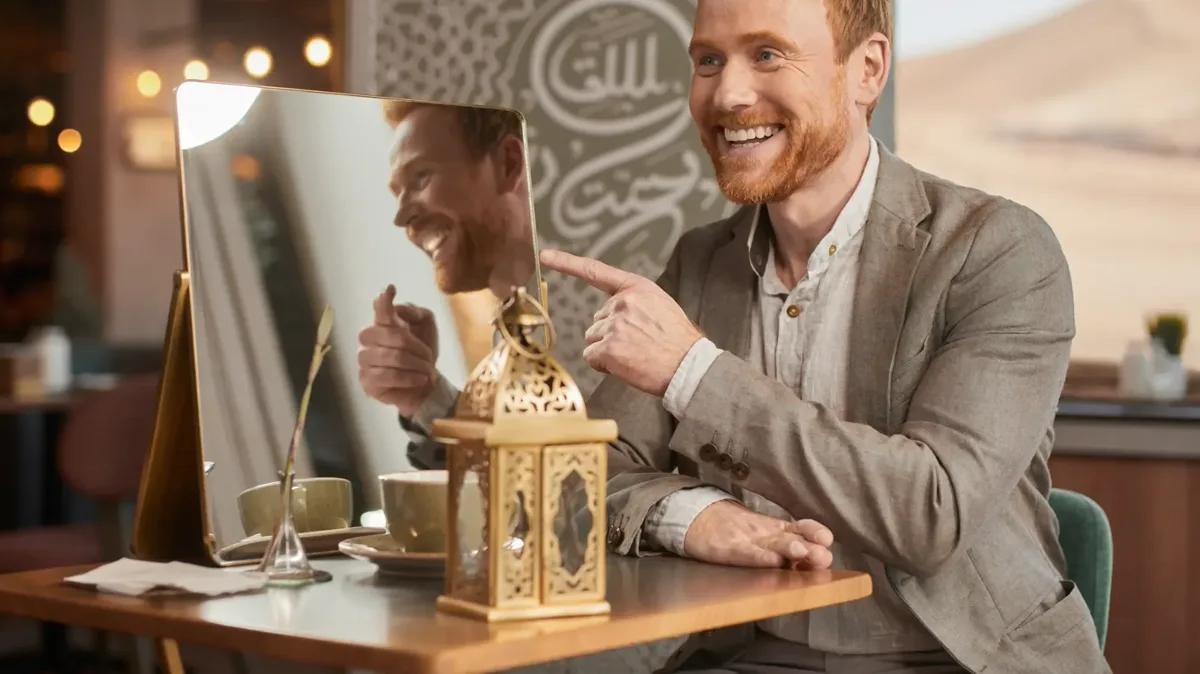
Chapter in 30 Seconds
Master the art of pointing at your world and claiming what belongs to you.
- Identify objects near and far using demonstrative pronouns.
- Attach suffix pronouns to verbs for smoother communication.
- Construct possessive relationships using the classic Idafa grammar structure.
学べること
Hey there, future Arabic speaker! You've built a solid foundation, and now it's time to supercharge your ability to interact with the world around you. This chapter is all about mastering how to point to things, near and far, and how to express who owns what.
First, you'll learn the secrets of this in Arabic, using «هذا» (hādha) for masculine and «هذه» (hādhihi) for feminine nouns. A cool trick: for all non-human plurals, you'll always use the feminine singular «هذه»! Next, we'll venture into pointing at things further away with «ذلك» (dhālika) and «تلك» (tilka) for that and those. Another neat shortcut: for *all* plural objects, animals, and concepts, you'll use «تلك,» simplifying references to multiple items.
Then, we'll dive into Lego Suffixes. Just like saying he saw *me* in English, Arabic uses clever little endings attached directly to verbs to show who is receiving the action. You'll learn to add suffixes like -ni (me), -ka (you), and -hu (him) to verbs. This makes your sentences concise and natural, avoiding separate, clunky pronouns.
Finally, we'll unlock the Idafa structure (الإضافة), the bedrock of expressing possession. Think of it like building with Lego bricks: you'll learn to link two nouns to form phrases like "Ahmed's car or my book.
This powerful structure lets you clearly state ownership, whether askingIs this car yours?
or explaining That phone is mine."
By the end, you'll confidently point out objects, discuss their location, and express possession with ease. Imagine asking «كم سعر هذا؟» (How much is this?) in a souk or telling a friend, «هذه حقيبتي» (This is my bag). You'll have the tools to describe your surroundings and belongings with clarity. Get ready to expand your Arabic world!
-
アラビア語の「これ」:(هذا と هذه) の使い方指示代名詞は名詞の性別に合わせるのが大切です。特に、人間ではない複数のものには「女性単数形」の「هَذِهِ」を使いますよ。
-
遠くを指す言葉:あれ・それ (Dhālika, Tilka)単数形は名詞の性別に合わせるけど、物や動物、抽象的なことの複数形は全部「
tilka」を使うんだよ。これがアラビア語の面白いところ! -
アラビア語の「レゴ」接尾辞:私を、あなたを、彼を (-nī, -ka, -hu)独立した代名詞(anaやhuwa)を目的語に使わず、動詞の最後にピタッとくっつけるのがコツです。«ـني» «ـكَ» «ـهُ» を使いこなしましょう!
-
アラビア語の所有表現:イダーファ構造 (الإضافة)イダーファは、二つの名詞をくっつけて「~の」という所有関係を作る魔法のルールです。最初の名詞から「アル」を取って、二番目の名詞を属格にするだけ!「所有」「関係」「属格」がキーワードですね。
Learning Objectives
By the end of this chapter, you will be able to:
-
1
By the end you will be able to: Use 'هذا' and 'هذه' to correctly identify objects in your immediate environment.
-
2
By the end you will be able to: Build possessive phrases like 'my car' or 'Ahmed's book' using the Idafa structure.
チャプターガイド

Overview
Pointing and Belonging, will empower you to interact more dynamically with your surroundings, making your Arabic conversations richer and more natural.this (هذا and هذه), that and those (ذلك and تلك), adding direct object suffixes (our Lego suffixes) to verbs like -ني (me) and -ك (you), and the powerful Idafa structure (الإضافة) for showing possession. By the end, you'll feel much more confident pointing to things, describing them, and stating who owns what – core elements of A2 Arabic communication.How This Grammar Works
this and that. For something nearby, we use هذا (hādha) for masculine singular nouns, like هذا قلم (hādha qalam) – *this is a pen*. For feminine singular nouns, you'll use هذه (hādhihi), as in هذه حقيبة (hādhihi ḥaqībah) – *this is a bag*.that, for example, ذلك بيت (dhālika bayt) – *that is a house*. For feminine singular that, we use تلك (tilka), as in تلك شجرة (tilka shajarah) – *that is a tree*. Similar to هذه, تلك simplifies things for plurals: for *all plural objects, animals, and concepts*, you will use تلك for those. So, تلك بيوت (tilka buyūt) – *those are houses*, and تلك أشجار (tilka ashjār) – *those are trees*.Lego Suffixes, which are direct object pronouns that attach directly to verbs. Instead of separate words for me, you, or him, Arabic uses these clever endings. For me, you add -ني (-nī) to the verb, as in ساعدني (sā'adanī) – *he helped me*.you (masculine singular), it's -ك (-ka), so رآك (ra'āka) – *he saw you*. For him, you add -ه (-hu), as in أعطه (a'ṭihu) – *give him*. These suffixes make your sentences concise and fluent.the) and *tanween* (nunnation), and its ending reflects its grammatical role in the sentence. The second noun (the *mudaf ilayhi*) is always in the genitive case (often ending in a *kasra* or i sound).
Common Mistakes
- 1✗ Wrong: هذا كتب (hādha kutub)
this) for non-human plural nouns. Remember the golden rule for A2 Arabic: for *all* non-human plurals, whether masculine or feminine, you *must* use هذه (this / these).- 1✗ Wrong: السيارة أحمد (as-sayyārah Aḥmad)
- 1✗ Wrong: هو ساعد أنا (huwa sā'ada anā)
me, you, him), it attaches directly to the verb as a Lego suffix rather than being a separate word. Using a standalone subject pronoun like أنا (anā) as an object is incorrect.
Real Conversations
A
B
A
B
A
B
Quick FAQ
How do I know when to use هذا or هذه in A2 Arabic?
Use هذا for singular masculine nouns and هذه for singular feminine nouns. Crucially, use هذه for *all non-human plural nouns*, regardless of their original gender.
What's the easiest way to express my book or your car in Arabic grammar?
The easiest way for Arabic possession at the A2 level is to attach a possessive suffix directly to the noun: كتابي (kitābī) for my book, and سيارتك (sayyāratuk) for your car.
Can I use the Lego suffixes (object pronouns) with prepositions in Arabic?
Yes! These suffixes also attach to prepositions. For example, لي (lī) means to me or for me, and معك (ma'ak) means with you.
Is the Idafa structure (الإضافة) only used for possession in Arabic grammar?
While primarily for possession, Idafa also forms descriptive phrases, like غرفة نوم (ghurfat nawm) – *bedroom* (literally room of sleep), or طالب علم (ṭālib 'ilm) – *student* (literally seeker of knowledge).

Cultural Context
重要な例文 (6)
ヒントとコツ (4)
隠れたアリフ
「L」で遠さを感じよう
Dhālika al-rajul」(あの男性)「私」のトラップ
أحب ي とは言いません。動詞の場合は ن を入れて أحبني (uḥibbunī) - 「彼は私を愛している」と言います。この ن が動詞を守ってくれるんです。見えない「~の」
重要な語彙 (6)
Real-World Preview
At the Market
Review Summary
- hādha/hādhihi + noun
- Possessed + Possessor
よくある間違い
You used the masculine pointer for a feminine noun. Remember, 'حقيبة' ends in a ta-marbuta, so it needs the feminine pointer.
You must remove the definite article 'al-' from the first noun in an Idafa construction.
Lego suffixes must be attached directly to the verb, not written as separate words.
このチャプターのルール (4)
Next Steps
You are doing fantastic! Every word you learn brings you closer to fluency. See you in the next chapter!
Label items in your room with sticky notes using demonstratives.
クイック練習 (9)
Choose the correct phrase:
frontend.learn_grammar.from_rule: アラビア語の所有表現:イダーファ構造 (الإضافة)
Find and fix the mistake:
Ulā'ika al-sayyārāt jamīla (Those cars are beautiful).
frontend.learn_grammar.from_rule: 遠くを指す言葉:あれ・それ (Dhālika, Tilka)
Find and fix the mistake:
هَذَا طَالِبَةٌ جَدِيدَةٌ.
هَذِهِ طَالِبَة)か、名詞を男性代名詞に合わせる(هَذَا طَالِب)かのどちらかで修正できます。frontend.learn_grammar.from_rule: アラビア語の「これ」:(هذا と هذه) の使い方
___ سَيَّارَةٌ جَمِيلَةٌ. (これは美しい車です。)
سَيَّارَةは「ة」で終わる女性名詞なので、「هَذِهِ」が必要です。frontend.learn_grammar.from_rule: アラビア語の「これ」:(هذا と هذه) の使い方
Find and fix the mistake:
السيارة المعلم سريعة.
frontend.learn_grammar.from_rule: アラビア語の所有表現:イダーファ構造 (الإضافة)
How do you say 'Those books'?
frontend.learn_grammar.from_rule: 遠くを指す言葉:あれ・それ (Dhālika, Tilka)
___ الطالب (Book)
frontend.learn_grammar.from_rule: アラビア語の所有表現:イダーファ構造 (الإضافة)
___ (That) is a beautiful house (bayt - masculine).
frontend.learn_grammar.from_rule: 遠くを指す言葉:あれ・それ (Dhālika, Tilka)
文法的に正しい文を選んでください:
frontend.learn_grammar.from_rule: アラビア語の「これ」:(هذا と هذه) の使い方
Score: /9
よくある質問 (6)
Dhālika al-kitāb」(あの本)
Ana はあくまで主語(〜は)として使います。目的語に使うと「彼は見た、私(は)」のように聞こえて不自然です。«رآني» と言いましょう。رأى (ra'ā) のように母音で終わる動詞に ـه をつけると、رآه (ra'āhu) のように音が伸びてスムーズになります。
