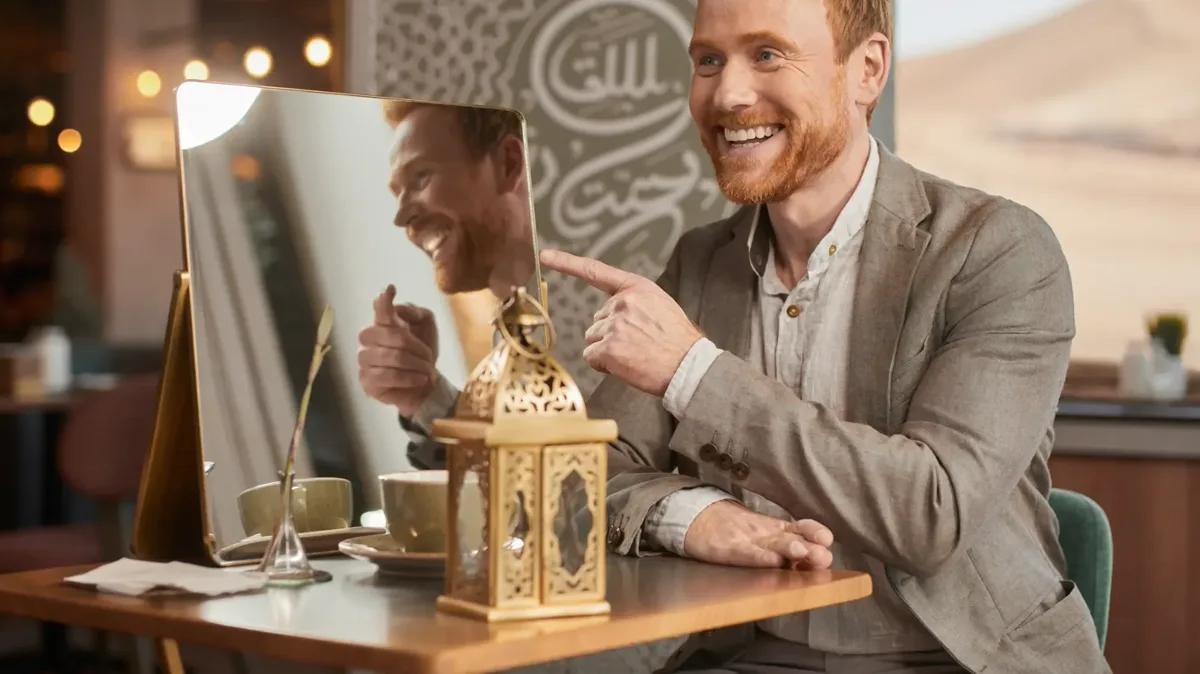
Chapter in 30 Seconds
Master the art of pointing at your world and claiming what belongs to you.
- Identify objects near and far using demonstrative pronouns.
- Attach suffix pronouns to verbs for smoother communication.
- Construct possessive relationships using the classic Idafa grammar structure.
你将学到什么
Hey there, future Arabic speaker! You've built a solid foundation, and now it's time to supercharge your ability to interact with the world around you. This chapter is all about mastering how to point to things, near and far, and how to express who owns what.
First, you'll learn the secrets of this in Arabic, using «هذا» (hādha) for masculine and «هذه» (hādhihi) for feminine nouns. A cool trick: for all non-human plurals, you'll always use the feminine singular «هذه»! Next, we'll venture into pointing at things further away with «ذلك» (dhālika) and «تلك» (tilka) for that and those. Another neat shortcut: for *all* plural objects, animals, and concepts, you'll use «تلك,» simplifying references to multiple items.
Then, we'll dive into Lego Suffixes. Just like saying he saw *me* in English, Arabic uses clever little endings attached directly to verbs to show who is receiving the action. You'll learn to add suffixes like -ni (me), -ka (you), and -hu (him) to verbs. This makes your sentences concise and natural, avoiding separate, clunky pronouns.
Finally, we'll unlock the Idafa structure (الإضافة), the bedrock of expressing possession. Think of it like building with Lego bricks: you'll learn to link two nouns to form phrases like "Ahmed's car or my book.
This powerful structure lets you clearly state ownership, whether askingIs this car yours?
or explaining That phone is mine."
By the end, you'll confidently point out objects, discuss their location, and express possession with ease. Imagine asking «كم سعر هذا؟» (How much is this?) in a souk or telling a friend, «هذه حقيبتي» (This is my bag). You'll have the tools to describe your surroundings and belongings with clarity. Get ready to expand your Arabic world!
-
阿拉伯语的“这个”:(هذا 和 هذه) 的用法“هذا” 和 “هذه” 要和名词的“性”一致,非人类复数就用“هذه”。
-
指代远处:那个和那些 (Dhālika, Tilka)单数要性别匹配,但所有复数物体、动物和抽象概念都用 «تِلْكَ»。
-
像乐高一样的后缀:我、你、他 (-nī, -ka, -hu)别再用独立的
ana或huwa当宾语啦,把它们像乐高一样粘在动词后面吧!比如 «ـني»、«ـكَ»、«ـهُ»。 -
阿拉伯语所有格:Idafa 结构 (الإضافة)Idafa creates a possessive link between two nouns by removing 'al-' from the first and adding genitive to the second.
Learning Objectives
By the end of this chapter, you will be able to:
-
1
By the end you will be able to: Use 'هذا' and 'هذه' to correctly identify objects in your immediate environment.
-
2
By the end you will be able to: Build possessive phrases like 'my car' or 'Ahmed's book' using the Idafa structure.
章节指南

Overview
Pointing and Belonging, will empower you to interact more dynamically with your surroundings, making your Arabic conversations richer and more natural.this (هذا and هذه), that and those (ذلك and تلك), adding direct object suffixes (our Lego suffixes) to verbs like -ني (me) and -ك (you), and the powerful Idafa structure (الإضافة) for showing possession. By the end, you'll feel much more confident pointing to things, describing them, and stating who owns what – core elements of A2 Arabic communication.How This Grammar Works
this and that. For something nearby, we use هذا (hādha) for masculine singular nouns, like هذا قلم (hādha qalam) – *this is a pen*. For feminine singular nouns, you'll use هذه (hādhihi), as in هذه حقيبة (hādhihi ḥaqībah) – *this is a bag*.that, for example, ذلك بيت (dhālika bayt) – *that is a house*. For feminine singular that, we use تلك (tilka), as in تلك شجرة (tilka shajarah) – *that is a tree*. Similar to هذه, تلك simplifies things for plurals: for *all plural objects, animals, and concepts*, you will use تلك for those. So, تلك بيوت (tilka buyūt) – *those are houses*, and تلك أشجار (tilka ashjār) – *those are trees*.Lego Suffixes, which are direct object pronouns that attach directly to verbs. Instead of separate words for me, you, or him, Arabic uses these clever endings. For me, you add -ني (-nī) to the verb, as in ساعدني (sā'adanī) – *he helped me*.you (masculine singular), it's -ك (-ka), so رآك (ra'āka) – *he saw you*. For him, you add -ه (-hu), as in أعطه (a'ṭihu) – *give him*. These suffixes make your sentences concise and fluent.the) and *tanween* (nunnation), and its ending reflects its grammatical role in the sentence. The second noun (the *mudaf ilayhi*) is always in the genitive case (often ending in a *kasra* or i sound).
Common Mistakes
- 1✗ Wrong: هذا كتب (hādha kutub)
this) for non-human plural nouns. Remember the golden rule for A2 Arabic: for *all* non-human plurals, whether masculine or feminine, you *must* use هذه (this / these).- 1✗ Wrong: السيارة أحمد (as-sayyārah Aḥmad)
- 1✗ Wrong: هو ساعد أنا (huwa sā'ada anā)
me, you, him), it attaches directly to the verb as a Lego suffix rather than being a separate word. Using a standalone subject pronoun like أنا (anā) as an object is incorrect.
Real Conversations
A
B
A
B
A
B
Quick FAQ
How do I know when to use هذا or هذه in A2 Arabic?
Use هذا for singular masculine nouns and هذه for singular feminine nouns. Crucially, use هذه for *all non-human plural nouns*, regardless of their original gender.
What's the easiest way to express my book or your car in Arabic grammar?
The easiest way for Arabic possession at the A2 level is to attach a possessive suffix directly to the noun: كتابي (kitābī) for my book, and سيارتك (sayyāratuk) for your car.
Can I use the Lego suffixes (object pronouns) with prepositions in Arabic?
Yes! These suffixes also attach to prepositions. For example, لي (lī) means to me or for me, and معك (ma'ak) means with you.
Is the Idafa structure (الإضافة) only used for possession in Arabic grammar?
While primarily for possession, Idafa also forms descriptive phrases, like غرفة نوم (ghurfat nawm) – *bedroom* (literally room of sleep), or طالب علم (ṭālib 'ilm) – *student* (literally seeker of knowledge).

Cultural Context
关键例句 (8)
技巧与窍门 (4)
隐藏的“艾利夫”
“L”音助记远方
“我”的陷阱
أحب ي。如果是动词,你需要加个字母 NUN 来救场:«أحبني» 表示‘他爱我’。这个 ن 就像个小护卫。The 'Light' Rule
核心词汇 (6)
Real-World Preview
At the Market
Review Summary
- hādha/hādhihi + noun
- Possessed + Possessor
常见错误
You used the masculine pointer for a feminine noun. Remember, 'حقيبة' ends in a ta-marbuta, so it needs the feminine pointer.
You must remove the definite article 'al-' from the first noun in an Idafa construction.
Lego suffixes must be attached directly to the verb, not written as separate words.
本章规则 (4)
Next Steps
You are doing fantastic! Every word you learn brings you closer to fluency. See you in the next chapter!
Label items in your room with sticky notes using demonstratives.
快速练习 (10)
Which is correct?
frontend.learn_grammar.from_rule: 阿拉伯语所有格:Idafa 结构 (الإضافة)
Find and fix the mistake:
Ulā'ika al-sayyārāt jamīla (那些车很漂亮)。
frontend.learn_grammar.from_rule: 指代远处:那个和那些 (Dhālika, Tilka)
为什么 'أحب هي' (uḥibbu hiya) 表示“我爱她”是错的?
frontend.learn_grammar.from_rule: 像乐高一样的后缀:我、你、他 (-nī, -ka, -hu)
Find and fix the mistake:
Al-sayyarat al-rajuli
frontend.learn_grammar.from_rule: 阿拉伯语所有格:Idafa 结构 (الإضافة)
他昨天帮了我。 (ساعد___ أمس)
frontend.learn_grammar.from_rule: 像乐高一样的后缀:我、你、他 (-nī, -ka, -hu)
选择正确形式:
frontend.learn_grammar.from_rule: 像乐高一样的后缀:我、你、他 (-nī, -ka, -hu)
___ سَيَّارَةٌ جَمِيلَةٌ. (This is a beautiful car.)
frontend.learn_grammar.from_rule: 阿拉伯语的“这个”:(هذا 和 هذه) 的用法
选择语法正确的句子:
frontend.learn_grammar.from_rule: 阿拉伯语的“这个”:(هذا 和 هذه) 的用法
你如何说“那些书”?
frontend.learn_grammar.from_rule: 指代远处:那个和那些 (Dhālika, Tilka)
___ (那个) 是一栋漂亮的房子 (bayt - 阳性)。
frontend.learn_grammar.from_rule: 指代远处:那个和那些 (Dhālika, Tilka)
Score: /10
常见问题 (6)
Ana 只能做主语(动作发出者)。把它当宾语用听起来像原始人说话。就像英语里说 He saw I 而不是 He saw me。正确写法是 «رآني»。رأى,加上 ـه 可能会拉长音变成 «رآه»。这样读起来更顺滑。
