









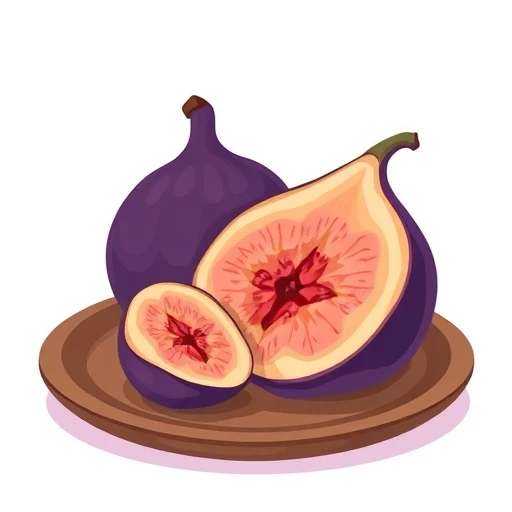
fig in 30 Seconds
- A sweet, pear-shaped fruit with a unique texture.
- Grows on the Ficus carica tree, native to the Mediterranean.
- Can be eaten fresh, dried, or used in various recipes.
- Used metaphorically in idioms like 'fig leaf' and 'not care a fig'.
The word fig refers to the edible fruit of the Ficus carica, a species of small tree in the flowering plant family Moraceae. While we commonly call it a fruit, botanically speaking, a fig is actually a syconium—a fleshy, hollow receptacle that contains hundreds of tiny flowers inside. This unique structure gives the fig its characteristic crunchy texture, as those 'seeds' are actually the individual fruits of the internal flowers. Figs are iconic symbols of the Mediterranean landscape, often associated with warmth, ancient history, and natural sweetness. They have been cultivated for thousands of years, with evidence suggesting they were one of the first crops ever domesticated by humans in the Near East. In modern usage, the word appears in culinary contexts, gardening discussions, and various idiomatic expressions that have evolved over centuries.
- Culinary Identity
- In the kitchen, a fig is prized for its honey-like sweetness and complex flavor profile, which can range from berry-like to nutty. They are eaten fresh when in season, but because they are highly perishable, they are frequently dried, preserved in jams, or used as a filling for pastries.
- Botanical Wonder
- The fig tree is known for its large, deeply lobed leaves and its fascinating pollination process involving specialized wasps. This biological relationship is a classic example of mutualism, though most commercial figs today are self-pollinating varieties.
- Symbolic Weight
- Beyond the physical fruit, 'fig' carries weight in literature and religion. It often represents fertility, peace, and prosperity. Conversely, in certain historical idioms, it has been used to represent something of little value, as seen in the phrase 'not worth a fig'.
The chef drizzled balsamic glaze over the roasted fig and goat cheese salad.
We sat under the shade of the ancient fig tree in the courtyard.
Dried figs are a concentrated source of fiber and potassium.
The artist carefully painted the intricate veins of the fig leaf.
He didn't care a fig for the opinions of the critics.
Historically, the fig has been a staple food for many civilizations. In ancient Greece, figs were so highly valued that their export was sometimes regulated by law. In Rome, they were considered a gift from the gods and were planted in the Forum. This deep-rooted history means that when you use the word 'fig' today, you are participating in a linguistic tradition that spans millennia. Whether you are discussing the nutritional benefits of the fruit, the aesthetic beauty of the tree, or using it in a colorful idiom, the word 'fig' remains a versatile and evocative part of the English vocabulary. Its short, punchy sound belies a rich complexity that mirrors the fruit itself—simple on the outside, but filled with a multitude of layers and history on the inside.
Using the word fig correctly involves understanding its role as a countable noun and its various metaphorical applications. In its primary sense, it refers to the fruit. You can have one fig or many figs. Because figs are often associated with specific culinary pairings, you will frequently see them used alongside words like 'cheese', 'honey', 'prosciutto', or 'walnuts'. When describing the tree, you use the compound noun 'fig tree'. The word is also used to describe a specific shade of dark purple or brownish-green, though this is less common than other color names. In more advanced English, you might encounter 'fig' in idiomatic expressions that require careful handling to ensure the correct tone.
- As a Direct Object
- When the fig is the thing being acted upon: 'She sliced the fig into thin rounds.' Here, the word functions as a standard countable noun receiving the action of the verb.
- In Attributive Usage
- Using 'fig' as an adjective to modify another noun: 'The fig jam was spread thickly on the toast.' This is very common in food descriptions and product labeling.
- Metaphorical Application
- In phrases like 'fig leaf', the word takes on a symbolic meaning: 'The minor policy change was merely a fig leaf to cover the massive budget cuts.' This usage is common in political and social commentary.
Would you like a fresh fig from the garden?
The recipe calls for three ounces of chopped dried figs.
A fig Newton is a popular cookie filled with fruit paste.
The shadow of the fig tree stretched across the patio.
The company's environmental pledge was seen as a fig leaf for its polluting practices.
Grammatically, 'fig' is straightforward. It is a concrete noun that can be quantified. You can say 'a few figs', 'many figs', or 'some fig jam'. In sentence construction, it usually appears in the predicate as an object or within a prepositional phrase. For example, 'I am looking for a recipe with figs.' In this case, 'figs' is the object of the preposition 'with'. When teaching or learning this word, it is helpful to group it with other fruit nouns like 'apple', 'pear', or 'date' to reinforce its category. However, its unique texture and historical associations often set it apart in descriptive writing. Whether you are writing a menu, a botanical report, or a literary analysis, 'fig' provides a specific and evocative image that enhances the clarity and richness of your sentences.
The word fig is most frequently heard in environments where food, nature, or history are the primary topics. If you are at a farmer's market in late summer or early autumn, you will likely hear vendors calling out the price of fresh figs. In upscale restaurants, servers might describe a dish featuring 'caramelized figs' or 'fig reduction'. Cooking shows on television often feature figs because of their visual appeal and sophisticated flavor. Beyond the culinary world, you might hear the word in a garden center or a botanical garden when experts discuss Mediterranean plants. In academic or religious settings, 'fig' appears during discussions of ancient texts, particularly the Bible or Greek mythology, where the fruit and the tree play significant roles.
- Culinary Media
- Chefs and food bloggers use 'fig' constantly. You might hear: 'The sweetness of the fig balances the saltiness of the blue cheese perfectly.' It is a staple of gourmet vocabulary.
- Gardening and Botany
- Horticulturalists might say: 'This variety of fig is particularly hardy and can withstand cooler climates.' They focus on the growth habits and varieties of the Ficus carica.
- Literary and Historical Contexts
- In a literature class, a professor might discuss the 'fig tree' in Sylvia Plath's 'The Bell Jar', where it serves as a powerful metaphor for life's choices.
'Are these figs locally grown?' the customer asked at the market.
'Today we are making a fig and almond tart,' the TV chef announced.
'The fig leaf has been used in art for centuries to provide modesty,' the museum guide explained.
'I don't give a fig about what he thinks,' the character shouted in the movie.
'The fig tree in the backyard provides great shade during the summer,' the neighbor remarked.
In everyday conversation, 'fig' is not as common as 'apple' or 'banana', but it carries a certain level of sophistication. When someone mentions figs, it often suggests an interest in diverse cuisines or gardening. In literature and film, the word is used to ground a setting in a specific geographic location, like the Mediterranean or California. It also appears in news reports about agriculture or climate change, as fig crops are sensitive to weather shifts. Understanding where you hear 'fig' helps you grasp its cultural associations—it's a word that bridges the gap between the ancient past and the modern dinner table, appearing in both the most sacred texts and the most casual grocery lists.
While 'fig' is a short and seemingly simple word, learners and even native speakers can make several common mistakes. These errors usually fall into three categories: pronunciation confusion, misuse of idioms, and botanical misunderstandings. Because 'fig' sounds very similar to other common words, it can be easily misheard or misspelled in fast-paced conversation. Additionally, the idioms involving 'fig' are somewhat dated or specific, leading to incorrect usage in modern contexts. Finally, people often confuse figs with other dried fruits like dates or prunes, which can lead to errors in culinary or descriptive writing.
- Phonetic Confusion
- The most common mistake is confusing 'fig' with 'pig' or 'big'. In noisy environments, 'I want a fig' can sound like 'I want a pig'. Clear articulation of the 'f' sound is essential.
- Idiom Misapplication
- Using 'fig leaf' incorrectly is a frequent error. Some people use it to mean any kind of cover, but it specifically refers to a cover-up that is intended to hide something shameful or embarrassing, often in a way that is transparent or insufficient.
- Category Errors
- Confusing a 'fig' with a 'date'. While both are sweet and often dried, they come from different trees (fig tree vs. date palm) and have very different textures and flavors. Calling a date a fig in a recipe can ruin the intended result.
Incorrect: He gave me a fig of his mind. (Correct: He gave me a piece of his mind.)
Incorrect: I don't give a figs. (Correct: I don't give a fig.)
Incorrect: The fig palm was tall. (Correct: The fig tree was tall / The date palm was tall.)
Incorrect: She wore a fig dress. (Correct: She wore a fig-colored dress.)
Incorrect: I ate a fig from the pine tree. (Correct: I ate a fig from the fig tree.)
Another mistake is assuming all figs are the same. There are hundreds of varieties, such as Mission, Adriatic, and Brown Turkey, each with different flavors and uses. In culinary writing, being specific adds authority. Furthermore, learners sometimes struggle with the countability of 'fig' when it's used as a flavor. You should say 'fig-flavored yogurt' rather than 'figs-flavored yogurt'. By paying attention to these small details—pronunciation, idiomatic accuracy, and botanical precision—you can avoid the most common pitfalls and use the word 'fig' with the confidence of a native speaker. Remember that 'fig' is a specific noun, and using it accurately shows a high level of vocabulary control.
When discussing figs, it is helpful to know related words that can serve as alternatives or points of comparison. Depending on the context—whether culinary, botanical, or metaphorical—different words might be more appropriate. In cooking, figs are often grouped with other dried fruits or 'stone fruits', though they aren't technically stone fruits. In metaphorical language, 'fig' has synonyms that relate to insignificance or concealment. Understanding these nuances allows for more precise communication and helps you avoid repetitive language in your writing and speaking.
- Culinary Alternatives
- Dates are the most common alternative to figs in recipes. While dates are sweeter and stickier, they share a similar dried fruit profile. Prunes (dried plums) and apricots are also used in similar ways in baking and savory dishes.
- Botanical Relatives
- The mulberry is a close relative of the fig. Both belong to the Moraceae family. While the fruits look different, the trees share similar leaf structures and sap. The Banyan tree is also a type of Ficus, making it a 'cousin' to the common fig tree.
- Metaphorical Synonyms
- For 'not worth a fig', you could use 'not worth a dime', 'not worth a cent', or 'not worth a hill of beans'. For 'fig leaf', alternatives include 'facade', 'veneer', 'pretense', or 'smoke screen'.
The recipe suggests using dates if fresh figs are unavailable.
The mulberry tree in the corner of the yard is often mistaken for a fig tree.
His apology was a mere veneer of regret, much like a fig leaf covering his true intentions.
Dried apricots provide a similar tartness to some varieties of figs.
The sycamore fig is a different species but closely related to the common fig.
Choosing the right word depends on your goal. If you want to sound more scientific, you might mention the 'Ficus' genus. If you want to sound more casual, 'fruit' might suffice. However, 'fig' is such a specific and culturally rich word that it is often the best choice. It evokes a particular taste, a particular climate, and a particular history that alternatives like 'date' or 'prune' cannot fully capture. By exploring these similar words, you gain a deeper appreciation for the unique place 'fig' holds in the English language and the natural world. Whether you are substituting ingredients or searching for the perfect metaphor, knowing the landscape of related terms makes you a more versatile and effective communicator.
How Formal Is It?
Fun Fact
The fig is one of the oldest recorded fruits in human history, mentioned in some of the earliest written documents and religious texts. It was so important in ancient Greece that 'sycophant' originally meant someone who informed on people illegally exporting figs.
Pronunciation Guide
- Pronouncing it like 'feeg' (long 'e' sound).
- Confusing it with 'pig' (p instead of f).
- Confusing it with 'big' (b instead of f).
- Dropping the final 'g' sound.
- Over-aspirating the 'f' sound.
Difficulty Rating
The word is short and easy to recognize in text.
Spelling is simple, though pluralization is regular.
Pronunciation is easy, but must be distinguished from 'pig' or 'big'.
Can be easily confused with similar-sounding words in fast speech.
What to Learn Next
Prerequisites
Learn Next
Advanced
Grammar to Know
Countable Nouns
I have three figs.
Attributive Nouns
This is a fig tree.
Irregular Plurals (None)
The plural of fig is always figs.
Compound Nouns
Fig jam is delicious.
Idiomatic Expressions
He doesn't care a fig.
Examples by Level
I have a fig.
I have a [fruit].
Simple subject-verb-object structure.
The fig is sweet.
The [fruit] is [taste].
Using an adjective to describe the noun.
Do you like figs?
Do you like [plural fruit]?
Forming a question with the plural noun.
This is a fig tree.
This is a [fruit] [tree].
Compound noun 'fig tree'.
I see three figs.
I see [number] [plural fruit].
Using a number with a plural noun.
The fig is purple.
The [fruit] is [color].
Identifying color.
Eat the fig.
[Action] the [fruit].
Imperative sentence.
A fig is small.
A [fruit] is [size].
Describing size.
I bought some fresh figs at the market.
I bought [quantity] [adjective] [plural fruit] at the [place].
Using 'some' with a plural countable noun.
Dried figs are a very healthy snack.
[Adjective] [plural fruit] are a [adjective] [noun].
Using an adjective to modify the noun.
My mother makes delicious fig jam.
My [person] makes [adjective] [fruit] [noun].
Using 'fig' as an attributive noun.
The fig tree in our garden is very old.
The [fruit] [tree] in our [place] is [adjective].
Using a prepositional phrase to specify location.
You can eat the skin of a fig.
You can eat the [part] of a [fruit].
Using 'can' for possibility.
Figs grow in warm countries like Italy.
[Plural fruit] grow in [adjective] [places].
Present simple for general facts.
I put a sliced fig on my yogurt.
I put a [adjective] [fruit] on my [food].
Using a past participle as an adjective.
There are many seeds inside a fig.
There are [quantity] [plural noun] inside a [fruit].
Using 'there are' with plural nouns.
The sweetness of the fig pairs perfectly with salty prosciutto.
The [noun] of the [fruit] [verb] with [adjective] [food].
Using 'pairs with' to describe culinary combinations.
We sat in the shade of a large fig tree to escape the heat.
We sat in the [noun] of a [adjective] [fruit] [tree].
Infinitive of purpose: 'to escape the heat'.
I've never tasted a fresh fig before today.
I [present perfect] never [verb] a [adjective] [fruit] before.
Present perfect for life experience.
The recipe calls for dried figs, but you can use dates instead.
The [noun] [verb] for [adjective] [plural fruit].
Using 'instead' to show an alternative.
Figs have been cultivated in the Mediterranean for thousands of years.
[Plural fruit] [present perfect passive] [verb] in the [place].
Present perfect passive voice.
She carefully removed the stem from the fig before eating it.
She [adverb] [verb] the [part] from the [fruit].
Using an adverb to describe the action.
The fig's texture is quite unique because of the tiny seeds.
The [fruit]'s [noun] is [adverb] [adjective].
Possessive form 'fig's'.
I don't really care a fig about what the neighbors think.
I don't [idiom] about [clause].
Using the idiom 'not care a fig'.
The artist used a fig leaf as a symbolic element in the painting.
The [person] used a [noun phrase] as a [adjective] [noun].
Using 'as' to show function.
Despite the drought, the fig trees managed to produce a decent crop.
Despite the [noun], the [fruit] [plural noun] [verb].
Using 'despite' to show contrast.
The company's new policy was criticized as a mere fig leaf for their lack of real action.
The [noun] was [verb] as a [idiom].
Metaphorical use of 'fig leaf'.
Figs are often associated with fertility and prosperity in ancient cultures.
[Plural fruit] are [adverb] [verb] with [noun] and [noun].
Passive voice with 'associated with'.
The intense sweetness of the roasted figs was balanced by the tartness of the balsamic vinegar.
The [adjective] [noun] of the [verb] [plural fruit] was [verb].
Complex sentence with passive voice and balanced structure.
He claimed he didn't give a fig for fame, but his actions suggested otherwise.
He [verb] he [idiom], but [clause].
Using the idiom in a subordinate clause.
The fig's ability to thrive in poor soil makes it a resilient species.
The [fruit]'s [noun] to [verb] in [adjective] [noun].
Possessive noun followed by an infinitive phrase.
Many varieties of figs require a specific type of wasp for pollination.
[Quantity] [noun] of [plural fruit] [verb] a [adjective] [noun].
Subject-verb agreement with 'many varieties'.
The politician's apology was dismissed as a transparent fig leaf designed to appease the public.
The [noun] was [verb] as a [adjective] [idiom].
Using 'designed to' for purpose.
In the poem, the withering fig tree serves as a poignant metaphor for lost opportunities.
In the [noun], the [verb] [fruit] [tree] [verb] as a [adjective] [noun].
Using a present participle as an adjective.
The complex mutualism between the fig and the fig wasp is a marvel of evolutionary biology.
The [adjective] [noun] between the [fruit] and the [insect].
Using 'between' to show a relationship.
The chef's innovative use of fig reduction added an unexpected depth to the savory dish.
The [person]'s [adjective] [noun] of [fruit] [noun].
Possessive subject with a complex object.
Historically, the fig has been a cornerstone of the Mediterranean diet, providing essential nutrients.
[Adverb], the [fruit] [present perfect] been a [noun].
Using a present participle phrase for additional information.
The sheer variety of figs available at the specialty market was overwhelming.
The [adjective] [noun] of [plural fruit] [verb] [adjective].
Subject-verb agreement with 'variety'.
Her disdain for the project was evident; she clearly didn't give a fig whether it succeeded or not.
Her [noun] was [adjective]; she [adverb] [idiom].
Using a semicolon to connect related independent clauses.
The fig's thick, milky sap can be an irritant to sensitive skin.
The [fruit]'s [adjective], [adjective] [noun] [modal] be a [noun].
Using 'can be' to show potential.
The environmental regulations were widely regarded as a mere fig leaf, failing to address the systemic issues of industrial pollution.
The [noun] were [adverb] [verb] as a [idiom].
Using a participial phrase to provide further explanation.
The author masterfully employs the imagery of the fig tree to underscore the protagonist's internal conflict.
The [person] [adverb] [verb] the [noun] of the [fruit] [tree].
Using an adverb to describe the author's skill.
The intricate symbiosis of the Ficus genus offers profound insights into the delicate balance of ecosystems.
The [adjective] [noun] of the [Latin name] [noun].
Using 'genus' in a scientific context.
His philanthropic efforts, while substantial, were seen by some as a fig leaf to obscure the questionable origins of his wealth.
His [adjective] [plural noun], while [adjective], were [verb].
Using a concessive clause ('while substantial').
The culinary discourse surrounding the fig often highlights its transition from a humble staple to a gourmet delicacy.
The [adjective] [noun] [verb] the [fruit] [adverb] [verb].
Using a present participle to modify the subject.
The fig's presence in ancient mythology serves as a testament to its enduring cultural significance.
The [fruit]'s [noun] in [adjective] [noun] [verb] as a [noun].
Using 'serves as' to describe a function.
One might argue that the fig leaf of corporate social responsibility often masks a relentless pursuit of profit.
[Pronoun] [modal] [verb] that the [idiom] of [noun phrase].
Using 'one might argue' for a formal, speculative tone.
The nuanced flavor profile of the Mission fig, with its hints of berry and earth, is highly prized by connoisseurs.
The [adjective] [noun] [noun] of the [variety] [fruit].
Using a prepositional phrase to add descriptive detail.
Synonyms
Antonyms
Common Collocations
Common Phrases
— Something that has no value or is very insignificant.
His promises are not worth a fig.
— To not care at all about something or someone.
I don't care a fig about his opinion.
— Wearing smart or formal clothes for a special occasion (British English).
He arrived at the wedding in full fig.
— Something used to hide an embarrassing or shameful fact.
The new law is a fig leaf for their real intentions.
— A well-known brand of cookie filled with fig paste.
He ate a whole pack of Fig Newtons.
— A traditional English Christmas pudding originally made with figs.
We all want some figgy pudding.
— The standard species of fig (Ficus carica) grown for food.
The common fig is widely grown in California.
— A specific type of wasp that pollinates fig trees.
The life cycle of the fig wasp is fascinating.
— A popular variety of fig with dark purple skin.
Black Mission figs are known for their deep flavor.
Often Confused With
Sounds similar but is an animal.
Sounds similar but is an adjective meaning large.
A different sweet fruit often confused with figs.
Idioms & Expressions
— Completely worthless or of very little importance.
That old car is not worth a fig.
Informal/Dated— To be completely indifferent or unconcerned.
I don't care a fig what they say behind my back.
Informal— A superficial or inadequate cover for something embarrassing.
The minor concession was a fig leaf for the policy reversal.
Formal/Political— Dressed in one's best or most formal clothes.
The officers were in full fig for the parade.
British/Old-fashioned— To have any interest or concern (usually negative).
Does anyone actually give a fig about this issue?
Informal— An expression of contempt or lack of care for something.
A fig for your rules!
Literary/Archaic— A state of peace, security, and independence.
They dreamed of living under their own vine and fig tree.
Literary/Biblical— An insulting gesture made with the hand (common in some cultures).
He made the fig at the driver who cut him off.
Slang/Cultural— A bird or insect that feeds on figs; sometimes used as a nickname.
The fig-eater was busy in the orchard.
Neutral— To take advantage of a good opportunity (rare).
He managed to pluck a fig from the situation.
MetaphoricalEasily Confused
Both are sweet, often dried, and Mediterranean.
Figs have seeds and a crunchy texture; dates are smoother and come from a palm tree.
I prefer the crunch of a fig over the stickiness of a date.
Both are dried fruits used for health benefits.
A prune is a dried plum; a fig is a different species entirely.
Prunes are good for digestion, but I like the taste of figs better.
It is the scientific name for the genus.
Ficus is the broad category; fig is the specific fruit or common name for Ficus carica.
The common fig is just one of many species in the Ficus genus.
They are in the same plant family and have similar leaves.
Mulberries are clusters of small drupes; figs are a single syconium.
The mulberry tree looks like a fig tree, but the fruit is very different.
The 'Sycamore Fig' is a specific species.
A standard sycamore is a different tree; the sycamore fig is a type of Ficus.
The biblical sycamore was actually a type of fig tree.
Sentence Patterns
I like [fruit].
I like figs.
This is a [adjective] [fruit].
This is a sweet fig.
I have never [verb] a [fruit] before.
I have never eaten a fresh fig before.
The [noun] of the [fruit] is [adjective].
The texture of the fig is unique.
The [noun] served as a [idiom] for [noun].
The apology served as a fig leaf for his mistakes.
One might [verb] the [noun] of the [fruit].
One might admire the resilience of the fig tree.
If you don't have [fruit], use [alternative].
If you don't have figs, use dates.
There are [number] [plural fruit] on the [noun].
There are five figs on the plate.
Word Family
Nouns
Verbs
Adjectives
Related
How to Use It
Moderate; common in specific domains like food and gardening.
-
I don't care a figs.
→
I don't care a fig.
The idiom uses the singular form of the noun.
-
The fig palm tree.
→
The fig tree.
Figs grow on deciduous trees, not palm trees (which grow dates).
-
I ate a big.
→
I ate a fig.
Confusion between 'big' (adjective) and 'fig' (noun).
-
The fig leaf of his car.
→
The cover of his car.
'Fig leaf' is a metaphor for hiding shame or embarrassment, not a literal cover for objects.
-
He is in full figs.
→
He is in full fig.
The British idiom for being dressed up is always singular.
Tips
Pairing Figs
Figs go incredibly well with salty foods like goat cheese, blue cheese, or cured meats. The contrast between sweet and salty is a classic culinary technique.
Choosing Fresh Figs
Look for figs that are soft but not leaking. A little bit of 'sugar bleeding' at the bottom is actually a sign of extreme ripeness and sweetness.
Growing Figs
If you grow a fig tree in a pot, it will limit the tree's size and often encourage it to produce more fruit. They are very resilient once established.
Using Idioms
Use 'not care a fig' in casual writing to add a bit of character. It sounds slightly more sophisticated than just saying 'I don't care'.
Fiber Boost
Adding just two or three dried figs to your daily diet can significantly increase your fiber intake, helping with digestion.
Ancient Staples
Remember that figs were a primary source of sugar for ancient civilizations before cane sugar was widely available. This explains their historical importance.
The Fig Leaf in Art
When visiting art museums, notice how fig leaves were added to statues during more conservative periods of history to cover nudity.
Freezing Figs
You can freeze fresh figs by washing them, drying them thoroughly, and placing them on a baking sheet before transferring them to a bag.
Latin Roots
Knowing that 'ficus' is the Latin root helps you recognize related scientific terms and even words in other Romance languages.
Substituting Figs
If a recipe calls for fig paste and you can't find it, you can make your own by simmering dried figs in a little water and blending them.
Memorize It
Mnemonic
Think of a 'Fast, Interesting, Green' fruit to remember F-I-G. Or imagine a 'Funny Individual in a Garden' eating a fig.
Visual Association
Visualize a small, purple, pear-shaped fruit with a tiny hole at the bottom and a very soft, red interior filled with seeds.
Word Web
Challenge
Try to use the word 'fig' in three different sentences today: one about food, one about a tree, and one using an idiom.
Word Origin
The word 'fig' comes from the Old French 'figue', which in turn derived from the Provençal 'figa'. This traces back to the Latin 'ficus', the name for the tree and its fruit. The Latin term is thought to be of Mediterranean origin, possibly related to the Greek 'sykon'.
Original meaning: The fruit of the Ficus carica tree.
Indo-European (via Latin and French).Cultural Context
The 'fig' hand gesture can be offensive in some cultures (e.g., Turkey, Greece, Italy), so be mindful of non-verbal communication.
In English-speaking countries, figs are often associated with gourmet cooking or traditional holiday foods like figgy pudding.
Practice in Real Life
Real-World Contexts
Cooking/Recipes
- slice the figs
- dried figs
- fig reduction
- stuffed figs
Gardening
- plant a fig tree
- fig tree leaves
- pruning a fig
- ripe figs
History/Literature
- ancient fig
- symbol of the fig
- fig tree metaphor
- biblical fig
Health/Nutrition
- high in fiber
- source of potassium
- nutritious figs
- dried fig snack
Idiomatic Speech
- not care a fig
- not worth a fig
- fig leaf cover
- in full fig
Conversation Starters
"Have you ever tried a fresh fig, or do you prefer them dried?"
"Do you have any recipes that use figs as a main ingredient?"
"In your culture, do figs have any special meaning or symbolism?"
"Would you ever consider planting a fig tree in your garden?"
"What do you think of the idiom 'not worth a fig'—is it still useful today?"
Journal Prompts
Describe the taste and texture of a fig to someone who has never eaten one before.
Write about a time you sat under a tree. If it wasn't a fig tree, imagine it was.
Reflect on the phrase 'fig leaf'. Have you ever seen someone use a 'fig leaf' to hide a problem?
Research the history of the fig and write a short summary of its importance to ancient civilizations.
Create a menu for a dinner party where every dish includes figs in some way.
Frequently Asked Questions
10 questionsYes, the skin of a fresh fig is entirely edible and often quite thin. However, some people prefer to peel them if the skin is thick or if they dislike the texture. Always wash fresh figs before eating.
This is a common debate because some figs are pollinated by wasps that die inside the fruit. However, the fig's enzymes completely break down the wasp, and most commercial figs are self-pollinating and do not involve wasps at all. Most vegans consider them acceptable.
Literally, it is a leaf from a fig tree. Metaphorically, a 'fig leaf' is something used to hide something embarrassing or to provide a superficial cover for a problem.
It means to not care at all. It is a way of expressing complete indifference toward something or someone.
Fresh figs are very perishable. They should be kept in the refrigerator and eaten within a few days. Do not wash them until you are ready to eat them.
Dried figs are more concentrated in sugar and calories but also higher in fiber and certain minerals. Both are healthy, but fresh figs have more water and fewer calories per gram.
Fresh figs are delicious on their own, paired with cheese, or sliced into salads. Dried figs are great as a snack or chopped into oatmeal and baked goods.
Figs thrive in warm, dry climates like the Mediterranean, California, and parts of the Middle East. They need plenty of sun and well-drained soil.
Because the flowers of a fig grow inside the fruit-like structure (the syconium) rather than on the outside. You never see a fig tree 'in bloom' in the traditional way.
It is a popular American cookie brand consisting of a soft pastry filled with fig paste. It was one of the first commercially successful manufactured cookies.
Test Yourself 180 questions
Describe a fig using three adjectives.
Well written! Good try! Check the sample answer below.
Write a sentence using the word 'fig tree'.
Well written! Good try! Check the sample answer below.
Explain the meaning of the idiom 'not care a fig'.
Well written! Good try! Check the sample answer below.
Describe a dish you could make with figs.
Well written! Good try! Check the sample answer below.
Use 'fig leaf' in a metaphorical sentence.
Well written! Good try! Check the sample answer below.
Compare fresh figs and dried figs.
Well written! Good try! Check the sample answer below.
Write a short story (3 sentences) about a fig tree.
Well written! Good try! Check the sample answer below.
Explain why figs are important in Mediterranean culture.
Well written! Good try! Check the sample answer below.
What does 'in full fig' mean? Use it in a sentence.
Well written! Good try! Check the sample answer below.
Describe the internal structure of a fig.
Well written! Good try! Check the sample answer below.
Write a dialogue between two people at a market buying figs.
Well written! Good try! Check the sample answer below.
Discuss the nutritional benefits of figs.
Well written! Good try! Check the sample answer below.
Write a poem (4 lines) about a fig.
Well written! Good try! Check the sample answer below.
Explain the relationship between figs and fig wasps.
Well written! Good try! Check the sample answer below.
Use 'not worth a fig' in a sentence about a bad product.
Well written! Good try! Check the sample answer below.
Describe the appearance of a fig leaf.
Well written! Good try! Check the sample answer below.
Write a formal sentence about fig cultivation.
Well written! Good try! Check the sample answer below.
How would you describe the flavor of a fig to someone who has never tried one?
Well written! Good try! Check the sample answer below.
Write a sentence using 'fig' as an adjective.
Well written! Good try! Check the sample answer below.
Reflect on the symbolism of the fig tree in literature.
Well written! Good try! Check the sample answer below.
Pronounce the word 'fig' clearly.
Read this aloud:
You said:
Speech recognition is not supported in your browser. Try Chrome or Edge.
Tell me if you like figs and why.
Read this aloud:
You said:
Speech recognition is not supported in your browser. Try Chrome or Edge.
Use the idiom 'not care a fig' in a sentence about a movie.
Read this aloud:
You said:
Speech recognition is not supported in your browser. Try Chrome or Edge.
Describe a fig tree to a friend.
Read this aloud:
You said:
Speech recognition is not supported in your browser. Try Chrome or Edge.
Explain the difference between fresh and dried figs.
Read this aloud:
You said:
Speech recognition is not supported in your browser. Try Chrome or Edge.
Discuss a time you used a 'fig leaf' to cover a mistake.
Read this aloud:
You said:
Speech recognition is not supported in your browser. Try Chrome or Edge.
Talk about a traditional food in your country that uses fruit.
Read this aloud:
You said:
Speech recognition is not supported in your browser. Try Chrome or Edge.
Describe the taste of a fig using culinary terms.
Read this aloud:
You said:
Speech recognition is not supported in your browser. Try Chrome or Edge.
How do you pick a good fig at the store?
Read this aloud:
You said:
Speech recognition is not supported in your browser. Try Chrome or Edge.
Explain the botanical nature of a fig.
Read this aloud:
You said:
Speech recognition is not supported in your browser. Try Chrome or Edge.
Say: 'The fig tree in the garden is full of ripe figs.'
Read this aloud:
You said:
Speech recognition is not supported in your browser. Try Chrome or Edge.
Say: 'I don't give a fig about the weather.'
Read this aloud:
You said:
Speech recognition is not supported in your browser. Try Chrome or Edge.
Describe the color of a fig.
Read this aloud:
You said:
Speech recognition is not supported in your browser. Try Chrome or Edge.
What are some common pairings for figs in cooking?
Read this aloud:
You said:
Speech recognition is not supported in your browser. Try Chrome or Edge.
Talk about the history of figs in ancient times.
Read this aloud:
You said:
Speech recognition is not supported in your browser. Try Chrome or Edge.
How do you feel about the texture of figs?
Read this aloud:
You said:
Speech recognition is not supported in your browser. Try Chrome or Edge.
Explain the phrase 'in full fig'.
Read this aloud:
You said:
Speech recognition is not supported in your browser. Try Chrome or Edge.
Why are figs often dried?
Read this aloud:
You said:
Speech recognition is not supported in your browser. Try Chrome or Edge.
Describe the shape of a fig leaf.
Read this aloud:
You said:
Speech recognition is not supported in your browser. Try Chrome or Edge.
Would you like to grow a fig tree? Why or why not?
Read this aloud:
You said:
Speech recognition is not supported in your browser. Try Chrome or Edge.
Listen and identify the word: 'I ate a sweet fig.'
Listen and identify the plural: 'There are many figs.'
Listen and identify the idiom: 'He doesn't care a fig.'
Listen and identify the tree: 'The fig tree is tall.'
Listen and identify the adjective: 'This is a figgy pudding.'
Listen and identify the variety: 'I love Black Mission figs.'
Listen and identify the botanical term: 'The fig is a syconium.'
Listen and identify the metaphor: 'It was a mere fig leaf.'
Listen and identify the state: 'The figs are ripe.'
Listen and identify the action: 'She is slicing the fig.'
Listen and identify the location: 'Figs grow in the Mediterranean.'
Listen and identify the nutrient: 'Figs are high in fiber.'
Listen and identify the insect: 'The fig wasp is tiny.'
Listen and identify the phrase: 'Not worth a fig.'
Listen and identify the color: 'The fig is dark purple.'
/ 180 correct
Perfect score!
Summary
The word 'fig' refers to both a nutritious, sweet fruit and its parent tree. It is a versatile noun used in culinary, botanical, and idiomatic contexts. For example: 'The fresh fig was perfectly ripe.'
- A sweet, pear-shaped fruit with a unique texture.
- Grows on the Ficus carica tree, native to the Mediterranean.
- Can be eaten fresh, dried, or used in various recipes.
- Used metaphorically in idioms like 'fig leaf' and 'not care a fig'.
Pairing Figs
Figs go incredibly well with salty foods like goat cheese, blue cheese, or cured meats. The contrast between sweet and salty is a classic culinary technique.
Choosing Fresh Figs
Look for figs that are soft but not leaking. A little bit of 'sugar bleeding' at the bottom is actually a sign of extreme ripeness and sweetness.
Growing Figs
If you grow a fig tree in a pot, it will limit the tree's size and often encourage it to produce more fruit. They are very resilient once established.
Using Idioms
Use 'not care a fig' in casual writing to add a bit of character. It sounds slightly more sophisticated than just saying 'I don't care'.
Related Content

Learn it in Context
This Word in Other Languages
Related Phrases
More Food words
wheat
B1Wheat is a cereal grain that is widely cultivated as a primary food source for humans and animals. It is typically ground into flour to make bread, pasta, pastries, and many other staple food products.
buttermilk
B2Describes food or drink made with or having the characteristics of the sour, fermented liquid remaining after butter has been churned. In modern culinary contexts, it refers to a cultured dairy product used to provide a tangy flavor and tender texture to baked goods and meats.
salt
A2A common white crystalline substance, chemically sodium chloride (NaCl), used widely for seasoning and preserving food. It is an essential nutrient for humans and animals.
pineapple
A1A large, tropical fruit with a tough, scaly skin and a tuft of green leaves on top. It has sweet, juicy yellow flesh inside and is eaten fresh, canned, or as juice.
mushrooms
B1Mushrooms are the fleshy, spore-bearing fruiting bodies of fungi, typically produced above ground on soil or on their food source. While many varieties are edible and popular in cooking, others are highly toxic or even fatal if consumed.
truffles
C1Truffles are rare, edible underground fungi known for their strong aroma and high culinary value, often used as a gourmet delicacy. The term also refers to a type of rich chocolate confection coated in cocoa powder, named for its resemblance to the fungus.
snack
A1A snack is a small amount of food eaten between main meals such as breakfast, lunch, or dinner. It is typically something quick to prepare and easy to consume when you feel a little hungry.
coca
B1A tropical shrub native to the Andes whose leaves contain a stimulant alkaloid. It is widely known for its traditional use by indigenous people and as the botanical source of cocaine.
corn
A1Corn is a tall plant that produces yellow grains on a large cob, which are eaten as a vegetable or ground into flour. It is one of the most popular cereal grains in the world and is a staple food in many cultures.
salmon
B1A large, edible fish with pink or reddish-orange flesh that is known for its ability to swim upstream against strong currents to spawn. It is also the name of a pinkish-orange color that resembles the fish's meat.

