









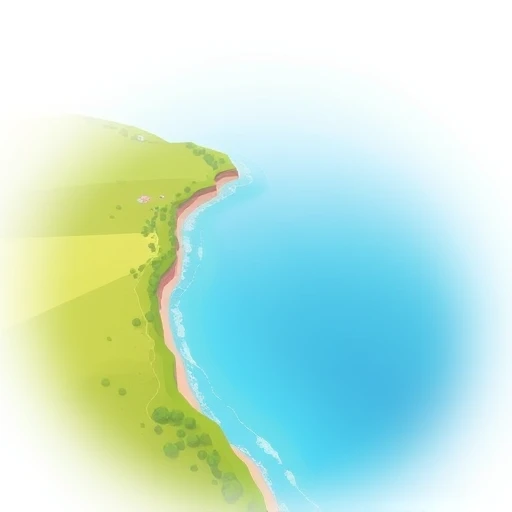
land in 30 Seconds
- A versatile word used as a noun for dry ground and property, and as a verb for arriving on a surface or securing an achievement.
- Commonly heard in travel contexts (planes landing) and professional settings (landing a job), it distinguishes solid earth from water and air.
- Grammatically, it is often uncountable as a noun but can be countable when referring to specific plots of ground or distinct territories.
- Key synonyms include 'ground', 'territory', and 'property' for the noun, and 'touch down' or 'secure' for the verb form.
The word land is a fundamental term in the English language that functions with equal importance as both a noun and a verb. In its primary noun form, it represents the solid part of the Earth's surface, providing a critical distinction from the vast oceans, seas, and the atmosphere. When we speak of land in a geographical sense, we are discussing the physical terrain that supports terrestrial life, agriculture, and human civilization. It is the foundation upon which we build our homes, grow our food, and establish our nations. Beyond the physical, the noun 'land' carries significant legal and economic weight, often referring to property, real estate, or a specific territory owned by an individual or governed by a state. In historical and poetic contexts, 'land' often evokes a sense of belonging or national identity, as seen in phrases like 'the land of my fathers' or 'the promised land'.
- Physical Geography
- The solid surface of the earth that is not covered by water, including mountains, plains, and valleys.
- Property and Ownership
- An area of ground that is owned by someone, often used for building or farming.
After three weeks at sea, the sailors were overjoyed to finally see land on the horizon.
As a verb, 'land' describes the process of arriving on a surface after traveling through the air or over water. This is most commonly associated with aviation, where a pilot must safely land an aircraft on a runway. However, the verb is also used for birds returning to a branch, insects touching down on a flower, or even a person jumping and landing on their feet. In a more metaphorical and informal sense, to 'land' something means to successfully obtain or achieve something that is highly desirable and often difficult to get, such as a prestigious job, a major contract, or a significant role in a play. This usage implies a sense of achievement and the successful conclusion of a pursuit.
The pilot managed to land the plane safely despite the heavy fog and strong crosswinds.
- Aviation and Movement
- To come down to the ground or another surface after a journey through the air.
- Achievement
- To successfully acquire or secure something, like a job or a prize, often through effort.
She was thrilled to land a leading role in the new Broadway musical.
The angler spent twenty minutes fighting the giant marlin before finally being able to land it.
- Impact
- To hit a surface or a person, often used in the context of a punch or a falling object.
The boxer's right hook landed squarely on his opponent's chin.
Using 'land' correctly requires an understanding of its countability and its role in various sentence structures. As a noun referring to the Earth's surface in general, 'land' is uncountable. You would say, 'There is more water than land on Earth.' However, when referring to a specific piece of property or a country, it can be countable or used with specific articles. For example, 'They bought a large piece of land' or 'The lands of the north are cold.' In the context of property, 'land' often appears in formal or legal discussions regarding zoning, taxes, and development. Understanding these nuances helps in selecting the right preposition and article to accompany the word.
- Uncountable Usage
- Refers to the physical substance or the general concept of dry ground.
- Countable Usage
- Refers to specific plots of ground or territories, often in plural form 'lands'.
The government is working to protect public land from industrial development.
When 'land' is used as a verb, it can be either intransitive (it doesn't need an object) or transitive (it takes an object). Intransitively, it describes the action of the subject arriving on the ground: 'The bird landed.' Transitively, it describes the subject bringing something to the ground or securing something: 'The pilot landed the plane' or 'She landed a job.' In the transitive sense of 'landing a job,' the word acts as a more colorful and professional alternative to 'got' or 'obtained.' It is also frequently used with prepositions like 'on,' 'in,' or 'at' to specify the location of the arrival.
The cat jumped from the fence and landed gracefully on the grass.
- Intransitive Verb
- The plane landed ten minutes ahead of schedule.
- Transitive Verb
- The company managed to land a multi-million dollar contract.
Be careful not to land yourself in trouble by breaking the rules.
They traveled across the land to reach the distant mountains.
The word 'land' is ubiquitous across various domains of life, from the highly technical to the completely informal. In the world of travel and aviation, you will hear it constantly. Flight attendants announce, 'We will be landing shortly,' and pilots discuss 'landing gear' and 'landing strips.' In these contexts, the word is literal and functional. Similarly, in maritime environments, 'land' is the ultimate destination for those at sea, and the cry of 'Land ho!' is a classic, if somewhat dated, exclamation of discovery. In the real estate and agricultural sectors, 'land' is a commodity. Real estate agents talk about 'land value,' 'vacant land,' and 'land use regulations,' while farmers discuss 'tilling the land' or 'fertile land.'
- Aviation Announcements
- 'Please fasten your seatbelts as we prepare to land at Heathrow Airport.'
- Real Estate Discussions
- 'The price of land in the city center has skyrocketed over the last decade.'
The environmentalist spoke passionately about the need to preserve our natural land for future generations.
In the corporate and professional world, 'land' takes on its metaphorical meaning of acquisition. You will hear colleagues congratulate each other for 'landing a big client' or 'landing that promotion.' This usage is common in business news and office chatter. Furthermore, in legal and political discourse, 'land' is often at the heart of discussions about sovereignty, borders, and indigenous rights. Terms like 'land claims,' 'territorial land,' and 'land reform' are frequently used in news reports and academic papers. In literature and mythology, 'land' often represents a place of origin or a mystical destination, such as 'Neverland' or 'the land of the living.'
The gymnast stuck the landing perfectly, earning a standing ovation from the crowd.
- Business Success
- 'After months of negotiation, we finally landed the account.'
- Legal and Political Context
- 'The treaty addressed the long-standing land dispute between the two neighboring countries.'
The explorers set foot on the new land, unaware of the challenges that lay ahead.
I left my shoes on the landing before going into the bedroom.
One of the most frequent mistakes learners make is confusing 'land' with 'ground,' 'earth,' or 'soil.' While they are related, they are not always interchangeable. 'Ground' refers to the surface you stand on, regardless of what it is made of. You can stand on the 'ground' inside a building (though we usually say 'floor'), but you wouldn't say you are standing on the 'land' inside a house. 'Earth' usually refers to the planet as a whole or the substance of the soil itself. 'Soil' is specifically the top layer of the earth where plants grow. Using 'land' when you mean 'soil' in a gardening context might sound slightly unnatural, although people will still understand you.
- Land vs. Ground
- Use 'ground' for the immediate surface under your feet; use 'land' for territory or the opposite of sea.
- Land vs. Soil
- Use 'soil' for the dirt used for planting; use 'land' for the area of ground as property.
Incorrect: I dropped my keys on the land.
Correct: I dropped my keys on the ground.
Another common error involves the countability of 'land.' As mentioned before, when referring to the general concept of dry ground, it is uncountable. Learners often incorrectly add an 's' to make it plural in sentences like 'There is many lands on Earth.' The correct way to express this is 'There is a lot of land on Earth.' However, 'lands' is correct when referring to multiple different countries or distinct territories, often in a more formal or literary style. Additionally, when using 'land' as a verb, ensure you don't confuse it with 'arrive.' While landing is a form of arriving, 'arrive' is much broader. You arrive at a destination, but you land on a surface.
Incorrect: The plane landed to the city.
Correct: The plane landed in the city.
- Countability Error
- 'He owns three lands' is usually incorrect. Say 'He owns three pieces of land' or 'He owns three plots of land'.
The farmer decided to sell a portion of his land to a developer.
The spaceship is scheduled to land on Mars next month.
To truly master the word 'land,' it is helpful to compare it with its synonyms and related terms. Each alternative carries a slightly different nuance that can change the tone or precision of your sentence. For instance, 'territory' is often used in political or biological contexts to describe an area defended by a group or animal. 'Property' and 'real estate' are the preferred terms in legal and financial discussions. 'Ground' is the most common everyday word for the surface we walk on. Understanding these distinctions allows you to choose the most appropriate word for your specific context, whether you are writing a formal report or having a casual conversation.
- Territory
- Emphasizes control, ownership, or boundaries. Example: 'The wolves marked their territory.'
- Property
- Focuses on the legal ownership of the land. Example: 'Trespassing on private property is illegal.'
- Ground
- The general surface of the earth. Example: 'The ground was wet after the rain.'
The explorer claimed the new territory in the name of the king.
When using 'land' as a verb, synonyms like 'touch down,' 'arrive,' 'alight,' and 'secure' come into play. 'Touch down' is specifically used for aircraft or spacecraft at the moment of contact with the ground. 'Alight' is a more formal or literary word, often used for birds or people getting off a vehicle. 'Secure' or 'obtain' can replace 'land' when talking about jobs or contracts in a more formal tone. For example, 'She secured a position' sounds more formal than 'She landed a job.' Choosing the right verb helps you match the register of your communication, whether you are aiming for technical accuracy, poetic elegance, or professional directness.
The butterfly alighted on the petal for just a moment before flying away.
- Touch down
- The specific moment an aircraft contacts the ground. Example: 'The flight touched down at 6 PM.'
- Secure
- To successfully get something through effort. Example: 'He secured a loan from the bank.'
The real estate agent showed us several properties in the suburban area.
The plane is expected to arrive at the gate in ten minutes.
How Formal Is It?
Fun Fact
The word 'land' is remarkably stable; its spelling and meaning have changed very little over the last thousand years, showing how fundamental the concept is to human language.
Pronunciation Guide
- Pronouncing it like 'lend' (with an 'e' sound).
- Dropping the final 'd' sound.
- Over-emphasizing the 'a' sound like 'lahnd'.
- Confusing the vowel with the 'u' in 'lund'.
- Making the 'n' sound too soft.
Difficulty Rating
The word is very common and easy to recognize in text.
Requires understanding of countability and metaphorical verb uses.
Pronunciation is straightforward, but idioms can be tricky.
Clearly pronounced and common in many contexts.
What to Learn Next
Prerequisites
Learn Next
Advanced
Grammar to Know
Countability of 'land'
Use 'land' as uncountable for the earth's surface: 'There is a lot of land.' Use 'lands' for multiple countries: 'The lands of Europe.'
Transitive vs. Intransitive Verbs
Intransitive: 'The plane landed.' Transitive: 'The pilot landed the plane.'
Prepositions with 'land'
Use 'on' for surfaces: 'land on the moon.' Use 'in' for areas: 'land in a field.'
Compound Nouns with 'land'
Landlord, landscape, and landmark are common compound nouns.
Using 'piece of' for quantification
Since 'land' is often uncountable, use 'a piece of land' or 'a plot of land' to talk about a single unit.
Examples by Level
The plane will land at five o'clock.
The aircraft arrives on the ground.
Verb, future tense with 'will'.
Cows live on the land.
Animals on the dry ground.
Noun, uncountable, used with preposition 'on'.
Is there land near here?
Is there dry ground close by?
Noun, uncountable, used in a question.
The bird landed on the house.
The bird came down onto the roof.
Verb, past tense.
We saw land from the ship.
We spotted the coast from the boat.
Noun, uncountable.
He wants to buy some land.
He wants to purchase a plot of ground.
Noun, uncountable, used with 'some'.
The ball landed in the garden.
The ball fell into the yard.
Verb, past tense.
This land is very beautiful.
This area of ground is pretty.
Noun, uncountable, used with 'this'.
They traveled by land across Europe.
They went by car or train.
Phrase 'by land' means not by sea or air.
The pilot made a perfect landing.
The act of landing was done well.
Noun form 'landing' used here.
The cat landed on its feet.
The cat arrived on the ground safely.
Common expression for cats.
This is a large piece of land.
A big plot of ground.
Using 'piece of' to make 'land' countable.
The explorers reached a new land.
They arrived at a new country or territory.
Noun, countable, meaning a country.
The helicopter is landing now.
The helicopter is coming down.
Verb, present continuous tense.
Farmers work the land every day.
Farmers farm the ground.
Noun, uncountable, referring to agricultural ground.
The plane had to land early.
The plane arrived before the scheduled time.
Infinitive verb after 'had to'.
She finally landed a job at the bank.
She successfully got a job.
Verb, transitive, metaphorical meaning.
The price of land is very high in the city.
Real estate is expensive.
Noun, uncountable, referring to real estate.
The paraglider landed safely in the field.
The person flying landed without injury.
Verb, intransitive, used with adverb 'safely'.
They are planning to develop the land.
They want to build on the ground.
Noun, uncountable, used with 'develop'.
The punch landed right on his nose.
The hit connected with his face.
Verb, intransitive, meaning to hit.
He owns several plots of land.
He has many pieces of property.
Using 'plots of' to quantify 'land'.
The plane was forced to land due to a storm.
The plane had to come down because of bad weather.
Passive voice 'was forced to land'.
The ship finally sighted land after months.
The crew saw the coast.
Noun, uncountable, used with 'sighted'.
The company managed to land a major contract.
They secured a big business deal.
Verb, transitive, formal business context.
The government is implementing new land reforms.
New laws about owning ground are being made.
Compound noun 'land reforms'.
The gymnast struggled to stick the landing.
The athlete had trouble landing perfectly.
Noun 'landing' used in a sports context.
The spacecraft will land on the moon tomorrow.
The vehicle will arrive on the lunar surface.
Verb, intransitive, scientific context.
He always seems to land on his feet.
He is always successful after problems.
Idiomatic expression.
The dispute is over a small strip of land.
The argument is about a narrow piece of ground.
Noun, uncountable, quantified by 'strip of'.
The storm caused the plane to land at a different airport.
The plane arrived at a non-scheduled location.
Verb, intransitive.
The indigenous people are fighting for their land rights.
They want legal ownership of their territory.
Compound noun 'land rights'.
The treaty defined the territorial land of each nation.
The agreement set the borders.
Noun, uncountable, formal geopolitical context.
The project involves the reclamation of industrial land.
Making old factory ground usable again.
Noun, uncountable, used with 'reclamation'.
The joke didn't quite land with the audience.
The audience didn't find the joke funny.
Verb, intransitive, metaphorical meaning for humor/impact.
The bird alighted on the branch, then took flight again.
The bird landed briefly.
Synonym 'alighted' used for variety.
The economic crisis landed many families in debt.
The crisis put families into a bad situation.
Verb, transitive, meaning to put someone in a situation.
The poem speaks of a mythical land beyond the sea.
A legendary country.
Noun, countable, literary context.
The athlete's jump was disqualified because he didn't land correctly.
The arrival on the ground was improper.
Verb, intransitive.
The acquisition of the land was a complex legal process.
Buying the property was difficult.
Noun, uncountable, used with 'acquisition'.
The sovereign's decree applied to all the lands of the realm.
The king's law applied to all territories.
Noun, plural 'lands' used in a formal, archaic sense.
The probe's successful landing on the asteroid was a milestone.
Arriving on the small space rock was important.
Noun 'landing' in a highly technical context.
He managed to land a blow that effectively ended the debate.
He made a point that won the argument.
Verb, transitive, metaphorical use for 'making a point'.
The ecological impact of land-use changes is profound.
Changing how ground is used affects nature.
Hyphenated compound 'land-use'.
The refugees were seeking a land where they could live in peace.
They wanted a country for safety.
Noun, countable, used in a poignant, human context.
The sheer scale of the land-grab was unprecedented.
The taking of ground was huge.
Compound noun 'land-grab'.
The aircraft's landing gear failed to deploy.
The wheels didn't come out.
Technical compound 'landing gear'.
The philosopher discussed the concept of 'the land' as a living entity.
The earth as a being.
Noun, uncountable, used with 'the' for emphasis.
Synonyms
Antonyms
Common Collocations
Common Phrases
— Traveling using ground transportation like cars or trains. It contrasts with traveling by sea or air.
They decided to travel by land to see the countryside.
— Located on the dry surface of the earth. Used to distinguish from being in the water.
Turtles lay their eggs on land.
— To see the coast or ground from a distance while at sea. A common nautical term.
The crew was relieved to finally sight land.
— A specific plot or area of ground. Used to make 'land' countable.
He bought a small piece of land to build a cabin.
— A poetic way to refer to the world of people who are alive. Often used humorously.
Welcome back to the land of the living! Did you sleep well?
— The country where a person was born. Often used with a sense of patriotism.
He returned to his native land after many years abroad.
— A large continuous area of land, such as a continent. A geographical term.
Eurasia is the largest land mass on Earth.
— A strip of land connecting two larger land masses. Used in history and biology.
The Bering land bridge once connected Asia and North America.
— An area of land between two opposing armies that is not controlled by either. Also used for neglected areas.
The soldiers had to cross no man's land under heavy fire.
— The total size of a piece of land. Used in statistics and geography.
The total land area of the island is fifty square miles.
Often Confused With
Ground is the surface you walk on. Land is the territory or the opposite of water.
Earth is the planet or the soil. Land is the dry surface or property.
Soil is the dirt for plants. Land is the area of ground.
Idioms & Expressions
— To be successful or lucky after a difficult situation or a period of uncertainty.
Even though he lost his job, he landed on his feet and found a better one within a week.
informal— To understand the current situation or the arrangement of things before taking action.
I need to get the lay of the land before I start making any big changes in the office.
neutral— To get into trouble or a difficult situation, often because of something you said or did.
His controversial comments landed him in hot water with the management.
informal— To survive by hunting, fishing, and growing your own food rather than buying it.
They moved to the mountains to try living off the land.
neutral— A place or situation that someone believes will bring them great happiness and success.
For many immigrants, the city was seen as the promised land.
literary/metaphorical— A place of great abundance and wealth where life is very easy.
The brochures described the resort as a land of milk and honey.
literary— Similar to 'the lay of the land'; to know what the current state of affairs is.
Let's wait and see how the land lies before we make our final offer.
neutral— To successfully hit someone with a punch or to make a very effective point in an argument.
She really landed a blow when she pointed out the flaws in his logic.
neutral— To find someone or something after a long and difficult search. (Related to 'land' as ground).
The police finally ran the suspect to ground in a small village.
neutral— To cause someone to be in a difficult or embarrassing situation.
Your mistake has really landed us in it this time.
informal (British)Easily Confused
Both refer to the surface of the earth.
Ground is the immediate surface under your feet, often used for things falling. Land is a broader term for territory, property, or the opposite of sea.
He fell to the ground, but he owns the land.
Both can refer to the solid part of the world.
Earth (capitalized) is the planet. Earth (lowercase) is the substance of the soil. Land is the dry surface as a geographical or legal entity.
The Earth is made of land and water.
Both are related to the earth's surface.
Soil is the specific top layer of the earth that supports plant life. Land is the general area of ground, regardless of the quality of the soil.
The land is large, but the soil is poor.
Both refer to an area of ground.
Territory emphasizes boundaries, control, and political or biological jurisdiction. Land is more general and can refer to the physical substance or property.
The army defended the territory, which consisted of rugged land.
Both can refer to a nation.
Country refers to the political state and its people. Land, in this sense, is more poetic or refers specifically to the physical terrain of that nation.
He loves his country and the land it is built on.
Sentence Patterns
The [noun] lands.
The plane lands.
[Subject] lives on land.
Animals live on land.
[Subject] landed a [job/contract].
He landed a job.
The [noun] is built on [adjective] land.
The house is built on fertile land.
The [noun] involves the [noun] of land.
The project involves the reclamation of land.
The [noun] applies to all the lands of the [noun].
The law applies to all the lands of the realm.
[Subject] landed in [trouble/debt].
He landed in debt.
They traveled by land.
They traveled by land.
Word Family
Nouns
Verbs
Adjectives
Related
How to Use It
Very high in both spoken and written English.
-
I dropped my phone on the land.
→
I dropped my phone on the ground.
'Ground' is the correct word for the immediate surface you are standing on.
-
He owns many lands in this area.
→
He owns a lot of land in this area.
'Land' is uncountable when referring to property in general.
-
The plane landed to the airport.
→
The plane landed at the airport.
Use the preposition 'at' for specific locations like airports.
-
I finally landed to a new job.
→
I finally landed a new job.
When 'land' means to get a job, it is a transitive verb and does not need a preposition.
-
The cat landed on his feet.
→
The cat landed on its feet.
Use the possessive pronoun 'its' for animals unless you are specifically referring to a male cat.
Tips
Use 'piece of land'
To talk about a specific area of ground you own, always use 'a piece of land' or 'a plot of land' rather than 'a land'.
Metaphorical Land
Remember that 'land' can mean 'to get' something difficult, like a job or a contract. This is very common in business.
Preposition Check
You land 'on' a surface (the moon, the runway) but 'in' a general area (the field, the city).
The Short 'A'
Ensure the 'a' in 'land' is short like in 'apple'. If it sounds like 'lend', people might get confused.
Lay of the Land
Use 'the lay of the land' when you want to say you are checking out a situation before acting.
Aviation Context
In technical writing about planes, 'landing' is the noun for the entire process, while 'touchdown' is the specific moment of contact.
Native Land
Use 'native land' to sound more poetic or patriotic when talking about your home country.
Land vs. Country
Use 'country' for political discussions and 'land' for more geographical or emotional descriptions of a nation.
Land on your feet
This is a great idiom to use in a cover letter or interview to describe your resilience.
By Land
Use 'by land' when you want to emphasize that you didn't fly or take a boat.
Memorize It
Mnemonic
Think of 'L-A-N-D' as 'Large Area Not Deep (under water)'. This helps you remember it's the dry part of the earth.
Visual Association
Imagine a plane's wheels touching the solid ground. The moment of contact is 'landing'.
Word Web
Challenge
Try to use 'land' as both a noun and a verb in the same sentence. For example: 'The plane will land on the dry land.'
Word Origin
The word 'land' comes from the Old English word 'land', which meant 'earth, soil, territory, or a specific part of the world'. It has its roots in the Proto-Germanic word '*landą'.
Original meaning: The original meaning was very similar to the modern noun: the solid surface of the earth or a specific region.
GermanicCultural Context
Be aware that 'land' can be a sensitive topic in discussions about colonialism, indigenous rights, and border disputes.
In the United Kingdom and the United States, land ownership is a fundamental part of the legal system and the 'American Dream' often includes owning a piece of land.
Practice in Real Life
Real-World Contexts
Travel and Aviation
- prepare to land
- landing gear
- landing strip
- emergency landing
Real Estate
- buy land
- sell land
- land value
- vacant land
Agriculture
- farm the land
- fertile land
- arable land
- till the land
Professional Success
- land a job
- land a contract
- land a deal
- land a role
Geography and Nature
- on land
- by land
- land mass
- native land
Conversation Starters
"Have you ever thought about buying a piece of land in the countryside?"
"How did you feel when your plane finally landed after a long flight?"
"What was the most difficult job you ever tried to land?"
"Do you prefer traveling by land, sea, or air?"
"Is land very expensive in the city where you live?"
Journal Prompts
Describe a beautiful piece of land you have visited and why it was special.
Write about a time you successfully landed something important, like a job or a prize.
If you could own land anywhere in the world, where would it be and why?
Discuss the importance of protecting natural land from development.
Imagine you are an explorer sighting land for the first time. Describe your feelings.
Frequently Asked Questions
10 questionsIt depends on the meaning. When referring to the earth's surface in general, it is uncountable ('There is a lot of land'). When referring to a specific plot of property, it is also usually uncountable but used with 'piece of' ('a piece of land'). When referring to different countries or distinct territories, it can be countable and plural ('the lands of the East').
Use 'ground' for the surface you are standing on or for things that fall down ('The keys are on the ground'). Use 'land' for territory, property, or to distinguish dry areas from the sea ('We reached land after three days').
Yes, it is a very common and acceptable way to describe successfully getting a position, although 'secured' or 'obtained' might be slightly more formal.
It is an idiom meaning to be successful or to find yourself in a good situation after a period of difficulty or risk. It comes from the way cats always land on their feet.
No, 'landing' can be used for birds, insects, helicopters, spacecraft, or even people jumping. It can also refer to the area at the top of a staircase.
Historically, it was the dangerous area between two opposing trenches in a war. Today, it can also refer to any area that is not clearly owned or controlled by anyone, or a neglected place.
To 'land a fish' means to successfully bring it out of the water and onto the shore or into your boat after catching it on a hook.
Common compounds include landlord (the owner of a property), landmark (a recognizable feature), landscape (the visible features of an area), and landslide (when earth falls down a slope).
While 'land' itself is usually a noun or verb, it is often used as a noun adjunct in phrases like 'land animals', 'land reform', or 'land value', where it functions like an adjective.
The most common opposite for aircraft is 'take off'. For ships, the opposite of reaching land would be 'setting sail' or 'departing'.
Test Yourself 180 questions
Write a sentence using 'land' as a verb for an airplane.
Well written! Good try! Check the sample answer below.
Write a sentence using 'land' as a noun meaning property.
Well written! Good try! Check the sample answer below.
Use the idiom 'land on your feet' in a short paragraph.
Well written! Good try! Check the sample answer below.
Explain the difference between 'land' and 'ground' in two sentences.
Well written! Good try! Check the sample answer below.
Write a formal sentence about 'land development'.
Well written! Good try! Check the sample answer below.
Use 'land' as a verb meaning to get a job.
Well written! Good try! Check the sample answer below.
Describe a 'landscape' you find beautiful.
Well written! Good try! Check the sample answer below.
Write a sentence using the phrase 'by land'.
Well written! Good try! Check the sample answer below.
Use 'land' in a sentence about environmental protection.
Well written! Good try! Check the sample answer below.
Write a short story (3 sentences) about a sailor seeing land.
Well written! Good try! Check the sample answer below.
Use 'land' as a verb for a bird.
Well written! Good try! Check the sample answer below.
Write a sentence about 'land rights'.
Well written! Good try! Check the sample answer below.
Use the phrase 'no man's land' in a sentence.
Well written! Good try! Check the sample answer below.
Write a sentence about a 'moon landing'.
Well written! Good try! Check the sample answer below.
Use 'land' in a sentence about a business contract.
Well written! Good try! Check the sample answer below.
Explain 'landlocked' in your own words.
Well written! Good try! Check the sample answer below.
Write a sentence using 'fertile land'.
Well written! Good try! Check the sample answer below.
Use 'land' as a verb meaning to hit someone.
Well written! Good try! Check the sample answer below.
Write a sentence about 'land use policy'.
Well written! Good try! Check the sample answer below.
Use 'land' in a sentence about a gymnast.
Well written! Good try! Check the sample answer below.
Talk about a time you had to 'land' something important.
Read this aloud:
You said:
Speech recognition is not supported in your browser. Try Chrome or Edge.
Describe the 'landscape' of your hometown.
Read this aloud:
You said:
Speech recognition is not supported in your browser. Try Chrome or Edge.
Do you prefer traveling by land or by air? Why?
Read this aloud:
You said:
Speech recognition is not supported in your browser. Try Chrome or Edge.
Explain what 'landing on your feet' means to a friend.
Read this aloud:
You said:
Speech recognition is not supported in your browser. Try Chrome or Edge.
Discuss the pros and cons of owning a large piece of land.
Read this aloud:
You said:
Speech recognition is not supported in your browser. Try Chrome or Edge.
How would you feel if you were a pilot landing a plane for the first time?
Read this aloud:
You said:
Speech recognition is not supported in your browser. Try Chrome or Edge.
Talk about a famous 'landmark' in your country.
Read this aloud:
You said:
Speech recognition is not supported in your browser. Try Chrome or Edge.
Discuss the importance of land rights for indigenous people.
Read this aloud:
You said:
Speech recognition is not supported in your browser. Try Chrome or Edge.
Tell a story about a bird landing in a strange place.
Read this aloud:
You said:
Speech recognition is not supported in your browser. Try Chrome or Edge.
Explain the difference between 'land' and 'sea' to a child.
Read this aloud:
You said:
Speech recognition is not supported in your browser. Try Chrome or Edge.
What would you do if you 'landed in hot water' at work?
Read this aloud:
You said:
Speech recognition is not supported in your browser. Try Chrome or Edge.
Describe the process of a plane landing.
Read this aloud:
You said:
Speech recognition is not supported in your browser. Try Chrome or Edge.
Talk about a 'landslide' victory in an election you know about.
Read this aloud:
You said:
Speech recognition is not supported in your browser. Try Chrome or Edge.
Do you think we will ever land humans on Mars?
Read this aloud:
You said:
Speech recognition is not supported in your browser. Try Chrome or Edge.
Describe a 'promised land' you would like to visit.
Read this aloud:
You said:
Speech recognition is not supported in your browser. Try Chrome or Edge.
Talk about the challenges of 'living off the land'.
Read this aloud:
You said:
Speech recognition is not supported in your browser. Try Chrome or Edge.
Explain why 'fertile land' is important for a country.
Read this aloud:
You said:
Speech recognition is not supported in your browser. Try Chrome or Edge.
Describe a time a joke you told 'didn't land'.
Read this aloud:
You said:
Speech recognition is not supported in your browser. Try Chrome or Edge.
Talk about a 'land dispute' you have heard about in the news.
Read this aloud:
You said:
Speech recognition is not supported in your browser. Try Chrome or Edge.
What is the most beautiful 'land mass' you have seen?
Read this aloud:
You said:
Speech recognition is not supported in your browser. Try Chrome or Edge.
Listen for the word 'land' in a flight announcement.
Identify if 'land' is used as a noun or verb in this sentence: 'They bought the land.'
Listen for the idiom 'land on your feet' in a conversation about a job loss.
Identify the meaning of 'land' in: 'She landed a major role.'
Listen for the difference between 'land' and 'lend' in a recording.
Identify the context of 'land' in a news report about a storm.
Listen for the phrase 'by land' in a travel documentary.
Identify the speaker's tone when they say 'Welcome back to the land of the living.'
Listen for the word 'landing' in a sports commentary about gymnastics.
Identify the legal term 'land rights' in a political speech.
Listen for the word 'landmark' in a city tour guide.
Identify the metaphorical use of 'land a blow' in a debate.
Listen for the word 'landlocked' in a geography lesson.
Identify the countability of 'land' in: 'There is so much land here.'
Listen for the word 'landlord' in a conversation about renting an apartment.
/ 180 correct
Perfect score!
Summary
The word 'land' is essential for describing the physical world and our movements within it. Whether you are talking about the earth beneath your feet, the property you own, or the successful conclusion of a flight or a job hunt, 'land' provides a precise and evocative way to communicate these concepts. For example: 'After a long flight, we were happy to land on solid land.'
- A versatile word used as a noun for dry ground and property, and as a verb for arriving on a surface or securing an achievement.
- Commonly heard in travel contexts (planes landing) and professional settings (landing a job), it distinguishes solid earth from water and air.
- Grammatically, it is often uncountable as a noun but can be countable when referring to specific plots of ground or distinct territories.
- Key synonyms include 'ground', 'territory', and 'property' for the noun, and 'touch down' or 'secure' for the verb form.
Use 'piece of land'
To talk about a specific area of ground you own, always use 'a piece of land' or 'a plot of land' rather than 'a land'.
Metaphorical Land
Remember that 'land' can mean 'to get' something difficult, like a job or a contract. This is very common in business.
Preposition Check
You land 'on' a surface (the moon, the runway) but 'in' a general area (the field, the city).
The Short 'A'
Ensure the 'a' in 'land' is short like in 'apple'. If it sounds like 'lend', people might get confused.
Example
They bought a small piece of land to build a house on.
Related Content

Learn it in Context
This Word in Other Languages
More Geography words
ridges
B2Ridges are long, narrow, elevated sections of land, such as the crest of a mountain range. The term also refers to raised strips or bands on a flat surface, like the patterns on fingertips or the texture of corduroy fabric.
cities
A1Cities are large and permanent human settlements characterized by high population density, diverse infrastructure, and administrative importance. They serve as primary hubs for commerce, culture, and social interaction within a region.
towns
B1Towns refer to multiple urban areas that are larger than villages but typically smaller and less populated than cities. They function as centers for commerce, local administration, and community life within a specific region.
oklahoma
B1Oklahoma is a landlocked state in the South Central region of the United States. It is characterized by its diverse geography, including prairies and hills, and is well-known for its significant Native American heritage and history.
parks
B1As a noun, 'parks' are public areas of land with grass and trees, often used for recreation and enjoyment. As a verb, 'parks' is the third-person singular present tense of 'park,' meaning to stop and leave a vehicle in a particular place.
pyramid
B1A solid shape with a square or triangular base and triangular sides that meet in a point at the top. It also refers to a hierarchical system or organization where there are many people at the bottom and very few at the top.
coast
B1The land along or near a sea or ocean. As a verb, it means to move easily without using power or to progress with very little effort.
lagos
B1The largest city and former capital of Nigeria, situated on the Atlantic coast. It is a major financial, commercial, and cultural hub for Africa, known for its bustling energy and significant economic influence.
oceans
A2Oceans are vast bodies of salt water that cover approximately 71% of the Earth's surface. They separate the continents and are interconnected, forming a continuous world ocean.
basin
B1A basin is an open, round container used for holding liquids or for washing. In geography, it refers to a depression in the earth's surface, often occupied by a lake or containing a river and its tributaries.

