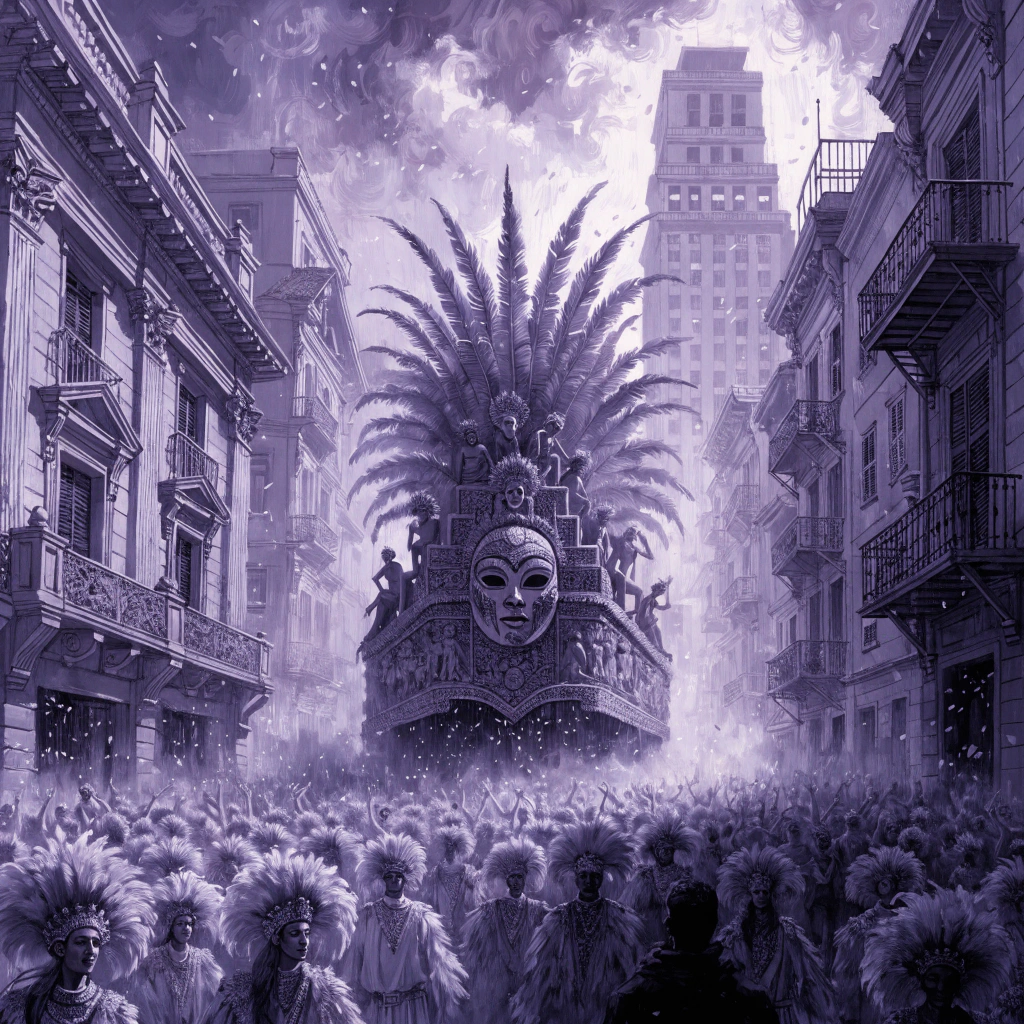
Carnival in Brazil
Carnival is a very big party in Brazil. It happens every year in February or March. The celebration lasts for four days. People wear colorful clothes and masks. They dance in the streets with their friends. There is loud music everywhere.
In the city of Rio de Janeiro, there is a famous parade. Many people watch the dancers. The dancers move to fast samba music. They wear beautiful costumes with many feathers.
Families celebrate together at this time. They eat delicious food and drink juice. Everyone is very happy during Carnival. It is a special and famous holiday for the whole country.
语法聚焦
句型: 'To Be' 的一般现在时
"Carnival is a very big party in Brazil."
我们用 'is' 搭配像 'Carnival' 这样的单数主语来陈述事实。它描述某物是什么或位于哪里。
句型: 复数名词
"People wear colorful clothes and masks."
我们在像 'mask' 这样的名词后加 '-s' 表示不止一个。有些词,如 'people' 和 'clothes',本身就是复数。
测试你的理解
10 个问题 · A1 初学 · 1 次免费预览
Carnival: The Biggest Party in Brazil
Carnival is the most famous festival in Brazil. Every year, millions of people go to the streets to celebrate. It usually happens in February or March, before the Catholic season of Lent. People wear beautiful costumes with many colors.
The history of Carnival is very interesting. A long time ago, Portuguese people brought their traditions to Brazil. Later, African music and dance changed the festival. Today, the samba is the most important part of Carnival. Samba is faster and more energetic than other types of music.
In big cities like Rio de Janeiro, there are huge parades. People dance for many hours and play drums. They are happy because they love their traditions. Last year, more than two million people visited Rio for the party. It was bigger than the year before. Carnival is a special time for everyone in Brazil.
语法聚焦
句型: 形容词最高级
"Carnival is the most famous festival in Brazil."
我们在长形容词前加“the most”来将一个事物与组里的所有其他事物进行比较。这表示狂欢节拥有最高程度的名气。
句型: 形容词比较级
"Samba is faster and more energetic than other types of music."
我们用比较级来看两个事物之间的差异。对于像“fast”这样的短词,我们加“-er”;对于像“energetic”这样的长词,我们用“more”。
测试你的理解
11 个问题 · A2 基础 · 1 次免费预览
测试你从这篇文章中学到的知识。回答所有问题即可获得经验值!
题目详情
狂欢节通常什么时候举行?
你的回答:
正确答案: 在2月或3月
葡萄牙的传统帮助开启了巴西的狂欢节。
你的回答:
正确答案: 正确
单词“huge”是什么意思?
你的回答:
正确答案: 非常非常大
人们在节日期间穿着色彩斑斓的漂亮____。
你的回答:
正确答案: costumes
为什么人们在游行时很开心?
你的回答:
正确答案: 因为他们热爱他们的传统
Carnival: The Heart and Soul of Brazil
Carnival is the most famous celebration in Brazil, which transforms the entire country into a massive party every year. It has been celebrated for centuries and traditionally marks the period before the Catholic season of Lent. While the early roots of the festival come from Portuguese traditions, it has evolved into a unique spectacle that combines African rhythms with indigenous dance.
In famous cities like Rio de Janeiro and Salvador, the streets are filled with "blocos," which are organized street parties. These lively events are enjoyed by millions of people who wear creative costumes and dance to the energetic beat of drums. The music that defines Carnival is Samba, a rhythmic style that was developed by Afro-Brazilian communities in the early 20th century. Samba schools, which are large community organizations, spend the entire year preparing for the grand parades held in the Sambadrome.
During these four days of music and dance, the nation's economy is significantly boosted by tourism. Visitors from every corner of the globe arrive to experience the electric atmosphere. The parades are judged by a panel of experts who carefully evaluate the costumes, the music, and the complex choreography. Consequently, the event is often described as the "greatest show on Earth" because of its incredible scale and artistic creativity.
Even though it is a time of intense celebration, Carnival also represents the diverse and complex history of Brazil. These traditions have been passed down through many generations, ensuring that the spirit of the festival remains vibrant. For most Brazilians, Carnival is not simply a public holiday; it is a powerful expression of their shared cultural identity and a celebration of life itself.
语法聚焦
句型: Present Perfect
"It has been celebrated for centuries and traditionally marks the period before the Catholic season of Lent."
The present perfect (has + been) is used here to describe an action that started in the past and continues to be true today. It emphasizes the long-standing tradition of Carnival.
句型: Passive Voice
"The parades are judged by a panel of experts who carefully evaluate the costumes, the music, and the complex choreography."
The passive voice (are + judged) is used to focus on the action being performed on the parades. It is common in B1 writing to describe formal processes where the actors (the panel) are less important than the activity.
测试你的理解
11 个问题 · B1 中级 · 1 次免费预览
测试你从这篇文章中学到的知识。回答所有问题即可获得经验值!
Which music style is primarily associated with the Brazilian Carnival?
题目详情
Which music style is primarily associated with the Brazilian Carnival?
你的回答:
正确答案: Samba
Carnival began as a celebration created solely by indigenous Brazilian tribes.
你的回答:
正确答案: 错误
What does the word 'boosted' mean in the context of the article?
你的回答:
正确答案: Increased or improved
These lively events are enjoyed by millions of people who wear creative _____.
你的回答:
正确答案: costumes
Why is the Brazilian Carnival often called the 'greatest show on Earth'?
你的回答:
正确答案: Because of its incredible scale and creativity
Brazil’s Carnival: A Tapestry of History, Rhythm, and Social Identity
Brazil's Carnival is far more than a mere celebration; it is a profound sociological phenomenon that encapsulates the nation's complex history. Originating from the Portuguese 'entrudo', the festivities were initially characterized by rowdy street plays where participants threw water and flour at one another. This primitive form of revelry was often seen as chaotic and socially disruptive. However, throughout the 19th and 20th centuries, this tradition underwent a radical transformation as it moved from the margins of society to the center of national pride. By successfully incorporating African percussion and indigenous elements, it evolved into the vibrant spectacle we witness today, blending European roots with deep-seated local traditions.
Central to this evolution is the samba, a rhythmic genre that emerged from the Afro-Brazilian communities in Rio de Janeiro. Samba schools are not merely performing groups; they function as essential social hubs that provide a sense of belonging and support to their members throughout the year. The meticulous preparation for the annual parade at the Sambadrome involves thousands of participants, showcasing elaborate costumes and allegorical floats that often convey poignant social messages about politics, environment, or history. While the Rio parade captures global attention with its sheer scale, the street parties, or 'blocos', in cities like Salvador and Recife offer a more participatory experience. In these northern regions, the barriers between performers and spectators are dismantled, fostering a collective euphoria that lasts for days and permeates every street corner.
Nevertheless, the commercialization of Carnival has sparked significant debate among scholars and locals alike. Some critics argue that the increasing focus on international tourism might dilute the event's authentic cultural roots, turning a sacred tradition into a mere commodity. Conversely, others maintain that the global exposure ensures the survival of these traditions in a rapidly modernizing world. Regardless of these conflicting perspectives, it remains undeniable that Carnival serves as a powerful catalyst for national unity. It is a period where social hierarchies are momentarily suspended, allowing for a unique, uninhibited expression of Brazilian identity.
Furthermore, the economic implications of the festival are staggering. Millions of international visitors flock to the country annually, generating substantial revenue and creating numerous employment opportunities in the hospitality and arts sectors. Despite the logistical challenges and the inevitable exhaustion that follows such a massive undertaking, the spirit of Carnival continues to thrive. It has become an indispensable part of Brazil's cultural fabric, reflecting both the struggles of the past and the exuberant hope of the future. Through its fusion of diverse influences, Carnival remains a testament to the resilience and creativity of the Brazilian people.
语法聚焦
句型: Cleft Sentences
"It is a period where social hierarchies are momentarily suspended, allowing for a unique, uninhibited expression of Brazilian identity."
Cleft sentences are used to focus on a specific part of a sentence. This structure (It + is + noun phrase + relative clause) emphasizes the importance of the time period.
句型: Modal Verbs of Possibility
"Some critics argue that the increasing focus on international tourism might dilute the event's authentic cultural roots."
The modal 'might' is used here to express a future possibility or a tentative prediction. It is common in academic or formal analysis to show that an outcome is not certain.
句型: Participle Clauses
"By successfully incorporating African percussion and indigenous elements, it evolved into the vibrant spectacle we witness today."
This structure uses a present participle (-ing) following a preposition to describe the method or means by which an action was achieved, making the writing more concise.
测试你的理解
11 个问题 · B2 中高级 · 1 次免费预览
测试你从这篇文章中学到的知识。回答所有问题即可获得经验值!
What was the main characteristic of the early Portuguese 'entrudo'?
题目详情
What was the main characteristic of the early Portuguese 'entrudo'?
你的回答:
正确答案: Rowdy street plays with water and flour
Samba schools in Rio de Janeiro only exist to perform during the four days of Carnival.
你的回答:
正确答案: 错误
What does the word 'euphoria' mean in the context of the article?
你的回答:
正确答案: A feeling of intense happiness
Furthermore, the economic implications of the festival are _____.
你的回答:
正确答案: staggering
How do street parties (blocos) in northern cities differ from the Rio parade?
你的回答:
正确答案: The barriers between performers and spectators are dismantled
The Kaleidoscope of Carnaval: Brazil’s Syncretic Symphony of Rhythms and Resistance
Seldom has a national celebration managed to capture the global imagination quite as viscerally as Brazil’s Carnival. While the untrained eye might perceive merely a cacophony of sound and a riot of color, the event represents a profound synthesis of disparate historical narratives. Its genesis lies in the Portuguese 'entrudo', a raucous street play characterized by water fights and practical jokes that often bordered on the chaotic. However, what started as a colonial import underwent a radical transformation through the osmosis of African rhythmic structures and indigenous aesthetic traditions. The resulting amalgam is not merely a festive interlude before Lent but a testament to the resilient spirit of a multi-ethnic populace striving for cultural expression.
At the heart of Rio de Janeiro’s iteration lies the Samba School—a misnomer for what are effectively massive community organizations. These institutions serve as the bedrock of local identity, often emerging from the most disenfranchised neighborhoods. The culmination of a year’s labor is the parade in the Sambadrome, where precision is paramount. It is the meticulous choreography and the conceptual depth of the 'enredo' (theme) that determine the victor. Such is the prestige of the competition that it often functions as a vehicle for biting social commentary, critiquing everything from environmental degradation to political corruption.
To view Carnival solely through the lens of Rio, however, would be a gross oversimplification. In Salvador da Bahia, the celebration takes a distinctively Afro-centric turn. Here, the 'Trio Elétrico'—colossal trucks laden with sound systems—navigates through surging throngs of revelers. Meanwhile, in the historic streets of Olinda and Recife, the air is thick with the frantic energy of Frevo, a dance characterized by acrobatic agility and tiny umbrellas. The ubiquity of the 'Bonecos de Olinda'—giant papier-mâché puppets—adds a touch of surrealism to the festivities, highlighting the regional idiosyncrasies that preclude a singular definition of the event.
Underlying the glitz and glamour is a complex socio-economic reality that warrants critical examination. The increasing commercialization of the event has led to growing concerns regarding the exclusion of the very communities that birthed it. What was once an organic street party is now, in some sectors, a high-priced commodity marketed primarily to international tourists and the domestic elite. Yet, despite these encroaching market forces, the grassroots 'blocos' (street bands) continue to reclaim public spaces with defiance, ensuring that the democratization of joy remains central to the experience. It is this tension between institutional spectacle and communal spontaneity that keeps the tradition in a state of constant, vibrant flux.
Ultimately, Carnival is far more than a hedonistic escape. It is a period of 'liminality', where social hierarchies are temporarily inverted and the marginalized take center stage. Through the sophisticated interplay of percussion, pageantry, and political satire, Brazil narrates its own story to itself and the world. As the last echoes of the drums fade on Ash Wednesday, what remains is the enduring power of cultural syncretism to foster a sense of collective belonging in an increasingly fragmented world.
语法聚焦
句型: 否定/限制性副词的倒装 (Inversion)
"Seldom has a national celebration managed to capture the global imagination quite as viscerally as Brazil’s Carnival."
倒装用于强调。当句子以“seldom”(很少)、“hardly”(几乎不)或“never”(从不)等限制性副词开头时,助动词要放在主语之前。
句型: 分裂句 (Cleft Sentences - It-Cleft)
"It is the meticulous choreography and the conceptual depth of the 'enredo' that determine the victor."
分裂句用于聚焦特定信息。“It is” + [强调部分] + “that” 帮助作者在复杂的句子中突出确切的原因或理由。
句型: 名词化 (Nominalisation)
"The increasing commercialization of the event has led to growing concerns..."
名词化涉及将动词或形容词转化为名词(例如,将“commercialize”转化为“commercialization”)。这是 C1 级写作的一个标志,因为它使文本更加正式和简洁。
测试你的理解
12 个问题 · C1 高级 · 1 次免费预览
测试你从这篇文章中学到的知识。回答所有问题即可获得经验值!
题目详情
作者对里约桑巴学校有什么看法?
你的回答:
正确答案: 它们是植根于被剥夺权利地区的社区组织。
作者认为里约嘉年华是定义这一全国性庆祝活动的唯一版本。
你的回答:
正确答案: 错误
文章中“amalgam”是什么意思?
你的回答:
正确答案: 不同文化元素的混合。
曾经有机的街头派对,现在在某些领域已变成主要向国际游客推销的高价 _____
你的回答:
正确答案: commodity
根据文章,萨尔瓦多的庆祝活动与里约有何不同?
你的回答:
正确答案: 它更偏向非洲中心主义,以“Trio Elétrico”卡车为特色。
术语“entrudo”指的是嘉年华最初的葡萄牙根源。
你的回答:
正确答案: 正确
The Brazilian Carnival: A Dionysian Synthesis of Sacred Rites and Secular Revelry
To approach the Brazilian Carnival merely as a sequence of boisterous parades would be to do a profound disservice to its intricate socio-cultural architecture. Occurring at the temporal threshold between the indulgence of the secular year and the asceticism of Lent, Carnival operates as a liminal space where the conventional hierarchies of Brazilian society are—at least ostensibly—inverted. This annual explosion of pageantry is not merely a modern iteration of the Portuguese 'entrudo,' but rather a sophisticated syncretism that reflects the nation's arduous history of colonization, resistance, and cultural fusion. Throughout the streets of Rio de Janeiro and Salvador, the event manifests as a bacchanalian celebration that nonetheless retains a deeply structured set of traditions.
Historically, the evolution of Carnival mirrors the shifting paradigms of Brazilian identity. The 'entrudo,' a rowdy and often violent street play introduced by Portuguese settlers in the 17th century, eventually met the visceral rhythms and spiritual motifs brought by enslaved Africans. It was within this crucible that the Samba schools emerged in the early 20th century, providing a marginalized population with a platform for collective expression and artistic legitimacy. Were one to scrutinize the meticulous craftsmanship of the 'barracões'—the workshops where colossal floats are constructed—one would discover a level of technical precision and narrative complexity that rivals any traditional academic discipline. These schools do not merely dance; they articulate a 'pedagogy of the streets,' teaching history and social commentary through polyrhythmic percussion.
Furthermore, the Sambadrome, designed by the modernist architect Oscar Niemeyer, functions as a modern-day amphitheater where the aesthetics of excess are institutionalized. It is through the rhythmic pulse of the 'bateria' (drum section) that the 'escolas de samba' narrate stories of national myth, historical grievance, and utopian futures. This 'total work of art' demands that the viewer acknowledge the profound dedication of the 'passistas' and 'ritmistas' who labor throughout the year for a performance that is inherently ephemeral. The paradox of Carnival lies in this very transience: months of painstaking labor culminate in a fleeting moment of transcendence that vanishes with the first light of Ash Wednesday.
Sociologically, Carnival is often theorized as a 'safety valve'—a mechanism for social catharsis that allows for a temporary suspension of class stratification. Influenced by Mikhail Bakhtin’s theory of the 'carnivalesque,' scholars suggest that the mask allows the subaltern to mock the powerful, if only for four days. While some critics argue that the increasing commercialization of the event has reinforced the hegemony of the elite, others maintain that the spontaneous street 'blocos' represent a reclaimed egalitarianism. In these interstices of the urban landscape, the rigid boundaries of the everyday are dissolved, and the city becomes a playground of polyphonic voices. Scarcely had the first drum sounded when the streets are transformed into a kaleidoscope of bodies, challenging the notions of public and private space.
In the northeastern city of Salvador, the celebration takes a different form, focusing on the 'Trio Elétrico'—massive mobile sound systems that navigate through crowds of millions. Here, the African heritage is even more pronounced, with 'afoxé' groups bringing Yoruba-inspired spirituality to the pavement. This regional diversity underscores that there is no singular 'Brazilian Carnival,' but rather a mosaic of local interpretations that share a common primordial energy. Whether in the choreographed precision of Rio or the chaotic fervor of Bahia, the event remains a visceral display of national pride that navigates the tension between the sacred and the profane.
In conclusion, the Brazilian Carnival remains an enigma, a sophisticated cultural performance that defies simple categorization. It is imperative that the observer look beyond the superficial glitter and recognize the profound cultural synthesis at play. As the last echoes of the parade fade into the Ash Wednesday morning, what remains is not merely a vestigial memory of revelry, but a reinforced sense of collective identity that continues to define the Brazilian spirit. Complex as the event may be, it remains the quintessential expression of a nation that finds its soul in the dance, perpetually regenerating itself through the ritual of the mask.
语法聚焦
句型: 倒装条件句
"Were one to scrutinize the meticulous craftsmanship of the 'barracões', one would discover a level of technical precision..."
这种正式结构去掉了单词 'if',并将主语和助动词 (were/had/should) 倒装。它用于 C2 级散文中,为讨论增添学术或假设的语气。
句型: 虚拟语气
"It is imperative that the observer look beyond the superficial glitter..."
虚拟语气用于表示必要性或紧急性的动词或形容词之后。请注意,即使主语 'observer' 是第三人称单数,'look' 仍保持原形。
句型: 否定倒装(表示强调)
"Scarcely had the first drum sounded when the streets are transformed into a kaleidoscope of bodies..."
当句子以否定或限制性副词 (scarcely, hardly, never) 开头时,主语和助动词会倒装,以创造更具戏剧性、文学性的效果。
测试你的理解
12 个问题 · C2 精通 · 1 次免费预览
测试你从这篇文章中学到的知识。回答所有问题即可获得经验值!
题目详情
作者对巴西狂欢节的主要观点是什么?
你的回答:
正确答案: 这是一个反映历史和身份的复杂社会文化综合体。
'entrudo' 是葡萄牙人引入的一种和平且安静的宗教游行。
你的回答:
正确答案: 错误
哪个词描述了强烈社会情感的暂时中止或释放?
你的回答:
正确答案: Catharsis
作者将狂欢节称为社会紧张局势的“安全____”。
你的回答:
正确答案: valve
在桑巴学校游行的背景下,“短暂 (ephemeral)”一词指的是什么?
你的回答:
正确答案: 实际表演的短命、瞬逝的性质。
作者暗示萨尔瓦多的狂欢节在形式上与里约热内卢的狂欢节完全相同。
你的回答:
正确答案: 错误

