barbie في 30 ثانية
- An informal Australian noun meaning 'barbecue', used for the grill and the party.
- A central part of Australian culture, emphasizing casual outdoor social gatherings.
- Commonly paired with verbs like 'throw', 'host', or 'fire up' in everyday speech.
- Distinct from the 'Barbie' doll; it is a key example of Australian hypocorism.
The term barbie is a quintessential example of Australian English hypocorism—the linguistic practice of shortening words and adding a suffix, usually '-ie' or '-o'. In this context, 'barbie' is the informal, highly common noun used to describe a barbecue. It refers simultaneously to the physical apparatus used for grilling food outdoors and the social event itself. To understand the word 'barbie' is to understand a core pillar of Australian social life. It is not merely a method of cooking; it is a cultural ritual that signifies relaxation, community, and the egalitarian spirit of the 'Great Outdoors'. While the rest of the English-speaking world might use 'BBQ' or 'cookout', an Australian will almost exclusively invite you to a 'barbie'. This usage is deeply embedded in the national identity, popularized globally by tourism campaigns in the 1980s, though often misunderstood by those outside the continent. In Australia, a barbie is where friendships are forged over sizzling sausages and where the heat of the sun is matched only by the heat of the grill plate.
- The Social Context
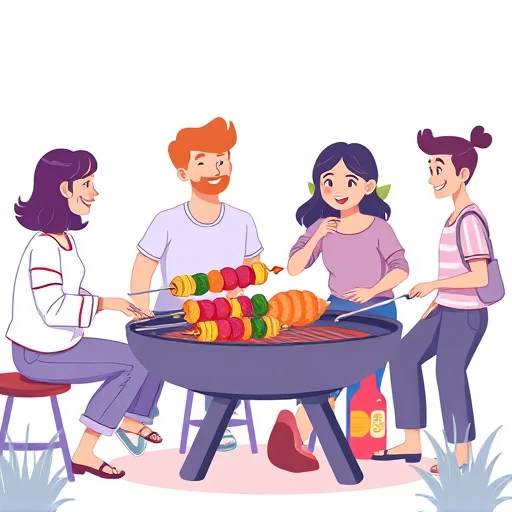
- A barbie is typically an informal gathering held in backyards, public parks, or at the beach. It is the default setting for birthdays, public holidays like Australia Day, and casual weekend get-togethers.
"We're having a few mates over for a barbie this Sunday afternoon, so bring some drinks and your swimmers!"
The term is used across all demographics in Australia. Whether you are in a rural outback town or a high-rise apartment in Sydney with a balcony grill, the word remains the same. It carries a connotation of 'no worries' and 'come as you are'. When someone says they are 'firing up the barbie', they are signaling a transition from the stresses of work or formal life into a space of leisure. It is important to note that the term is almost never used in formal writing or professional settings unless the intent is to sound intentionally colloquial or 'Aussie'. For a learner, using 'barbie' correctly signals a high level of cultural awareness and an attempt to integrate into the local vernacular. It is one of the first slang words a visitor to Australia will encounter and likely the one they will use most frequently during the summer months.
- The Physical Object
- The 'barbie' itself can range from a sophisticated six-burner gas range to a simple wood-fired plate in a public park. In many Australian parks, the government provides free electric or gas barbies for public use.
"Can you go outside and clean the barbie? It's still got some grease on it from last night."
Historically, the barbie became a staple of Australian life in the post-World War II era as suburban backyards grew and the climate encouraged outdoor dining. The word itself gained international fame through Paul Hogan's 'Come and Say G'day' tourism ads in the 1980s, where he famously promised to 'slip an extra shrimp on the barbie for you'. Interestingly, Australians actually call them 'prawns', not 'shrimp', making the famous phrase a bit of a linguistic compromise for the American market. Despite this, the word 'barbie' remains the undisputed king of Australian food terminology. It evokes the smell of eucalyptus smoke, the sound of sizzling meat, and the feeling of a cold drink in hand on a hot day. It is a word that bridges the gap between a simple meal and a national pastime.
- Linguistic Evolution
- The suffix '-ie' is a marker of endearment and informality. By turning 'barbecue' into 'barbie', the speaker reduces the formality of the event, making it more approachable and friendly.
"Don't bother dressing up for the barbie; it's just a casual thing in the backyard."
"We forgot the tongs for the barbie, so I had to use a fork to turn the snags."
Using the word barbie correctly requires an understanding of its informal register. While it is grammatically simple—acting as a standard countable noun—its placement in a sentence often reflects the relaxed Australian lifestyle. You will most frequently see it paired with verbs like 'have', 'host', 'fire up', or 'throw'. For example, 'throwing a barbie' is a common idiom meaning to organize a barbecue party. The word is versatile enough to describe the event, the equipment, and even the style of food. When using it, you should be mindful of your audience; while perfectly acceptable in a casual conversation with an Australian boss, it might feel out of place in a formal written report or a serious academic setting.
- Common Verb Pairings
- Australians 'fire up' the barbie when they start the heat, and they 'throw' a barbie when they invite people over. You can also 'clean' the barbie or 'stand around' the barbie.
"I'll fire up the barbie as soon as the cricket finishes on TV."
In terms of sentence structure, 'barbie' often appears in the object position. Because it is a noun, it can be modified by adjectives to give more detail about the event. You might hear about a 'massive barbie', a 'quiet barbie', or a 'Christmas barbie'. It is also frequently used in prepositional phrases, such as 'on the barbie' or 'at the barbie'. These phrases help specify whether you are talking about the food being cooked or the location of the social interaction. For instance, 'the snags are on the barbie' refers to the cooking process, whereas 'I saw him at the barbie' refers to the event. This distinction is usually clear from the context of the conversation.
- Prepositional Usage
- 'On the barbie' is the most common phrase for cooking. 'At the barbie' refers to the social gathering. 'Around the barbie' describes the typical Australian social grouping.
"We spent the whole afternoon just standing around the barbie and chatting about the footy."
Another interesting way 'barbie' is used is in compound structures or as a modifier. While not a formal adjective, it can describe things associated with the event. You might hear about 'barbie weather' (sunny and warm) or 'barbie tongs'. In Australian slang, it is also part of the phrase 'sausage sizzle', which is a specific type of barbie often held for charity or at hardware stores. While 'barbie' is the general term, 'sausage sizzle' is the specific event. Understanding these nuances helps a learner sound more like a native speaker. Remember, the word is almost always singular when referring to the event ('we're having a barbie'), even if multiple grills are being used.
- Compound and Modified Uses
- 'Barbie tools', 'barbie meat', and 'barbie season' are common ways to extend the word's utility in everyday speech.
"It's perfect barbie weather today, not a cloud in the sky and a nice breeze."
"I need to buy some new barbie cleaners because the plate is getting really crusty."
The word barbie is ubiquitous across the Australian continent. You will hear it in the bustling suburbs of Melbourne, the tropical reaches of Queensland, and the remote stations of the Northern Territory. It is perhaps the most 'geographic' word in the Australian lexicon because it is so tied to the physical environment. In coastal areas, the 'beach barbie' is a standard weekend activity. In the city, the 'balcony barbie' is the urban equivalent. Because Australia has a culture that revolves around the outdoors, the word is heard in almost every social context that involves food and friends. It is a word that transcends class; from the Prime Minister to a construction worker, everyone 'has a barbie'.
- Public Spaces
- Public parks in Australia are famous for their coin-operated or free electric barbies. You will hear families discussing who is going to 'claim the barbie' at the park on a busy Saturday morning.
"If we want to get the barbie by the lake, we'd better get to the park by 10 AM."
Beyond the physical location, you will hear 'barbie' in Australian media and advertising constantly. It is used to sell everything from outdoor furniture to insect repellent. In television shows like 'Home and Away' or 'Neighbours', the 'barbie' is a frequent plot device where characters gather to resolve conflicts or celebrate milestones. It is also a staple of Australian comedy, often used to poke fun at national stereotypes. However, the most common place to hear it is in the simple, everyday planning of social life. A text message saying 'Barbie at mine, 5pm' is a standard invitation that requires no further explanation. It is the shorthand for Australian hospitality.
- Retail and Commerce
- Hardware stores like Bunnings are famous for their 'Sausage Sizzles', which are essentially community barbies. You'll hear people asking, 'Are they doing a barbie today?' as they walk into the store.
"I'm just heading to Bunnings for some lightbulbs and a snag from the barbie out front."
In addition to social and commercial settings, 'barbie' is heard in the context of sports. It is very common for local sports clubs—whether it's cricket, footy, or netball—to host a barbie after a match or training session. This 'post-match barbie' is where the community bonds. You'll hear coaches and parents coordinating who is bringing the bread rolls and who is 'manning the barbie'. This reinforces the word's connection to community and teamwork. Even in high-end real estate, a 'built-in barbie' is a major selling point for Australian homes, showing that the word has a place in the luxury market as well as the casual one. It is truly a word that lives in the air of the Australian environment.
- Sports and Clubs
- Local clubs use the barbie as a primary fundraising tool. 'The club barbie' is a fixture of Saturday morning junior sports across the country.
"After the grand final, the whole team is going back to the clubhouse for a victory barbie."
"The real estate agent said the house has a great outdoor entertaining area with a plumbed-in barbie."
The most frequent mistake learners make with the word barbie is a lack of awareness regarding its regional specificity. While it is a perfectly standard word in Australia and New Zealand, using it in the United States, United Kingdom, or Canada might lead to confusion. In those regions, 'Barbie' almost exclusively refers to the famous fashion doll made by Mattel. If you tell an American, 'I'm going to put some meat on the Barbie,' they might look at you with horror, imagining you are destroying a child's toy. Therefore, the first rule of using 'barbie' is knowing your location. If you are not in Australia or talking to an Australian, it is safer to use 'barbecue' or 'BBQ'.
- The 'Doll' Confusion
- Always capitalize 'Barbie' when referring to the doll, and use lowercase 'barbie' for the grill. However, in spoken English, context is the only way to distinguish them.
"I bought my niece a Barbie (doll) for her birthday, but we're having a barbie (food) for the party."
Another common error is misusing the word as a verb. In standard English, 'barbecue' can be both a noun ('We had a barbecue') and a verb ('We barbecued some chicken'). However, 'barbie' is almost strictly a noun. You would rarely hear an Australian say, 'I'm going to barbie some steaks.' Instead, they would say, 'I'm going to cook some steaks on the barbie' or 'We're having a barbie.' Using it as a verb sounds unnatural and is a clear sign of a non-native speaker trying too hard to use slang. Stick to using it as a noun for the event or the equipment to maintain a natural flow.
- Verb vs. Noun
- Incorrect: "Let's barbie tonight!" Correct: "Let's have a barbie tonight!" or "Let's fire up the barbie!"
"We had a barbie (noun) last night, and the steaks were perfect."
Finally, there is the 'shrimp' mistake. As mentioned before, Australians do not call them 'shrimp'; they call them 'prawns'. If you use the word 'barbie' and then talk about 'shrimp', you are mixing a genuine Australian term with an Americanized stereotype. To sound authentic, pair 'barbie' with other Australian food terms like 'snags' (sausages), 'chops' (lamb chops), or 'prawns'. Also, be careful with the plural. While 'barbies' is the correct plural, it is much more common to talk about the event in the singular. Saying 'We went to many barbies this summer' is fine, but 'We are having barbies' sounds like you are hosting multiple separate barbecue events at the same time.
- Vocabulary Pairing
- Pair 'barbie' with 'snags', 'prawns', and 'coldies' (cold drinks) for maximum authenticity. Avoid 'shrimp' unless you want to sound like a tourist.
"Throw some prawns on the barbie—not shrimp!"
"I'm bringing a pack of snags for the barbie, so we'll have plenty of food."
While barbie is the dominant informal term in Australia, there are several alternatives depending on the level of formality and the specific region you are in. The most obvious alternative is the full word, 'barbecue'. This is used in more formal contexts or when the speaker wants to be very clear. 'BBQ' is the standard written abbreviation, commonly seen on signs, menus, and in text messages. While 'barbie' is the spoken preference, 'BBQ' is the visual preference. Understanding when to use each helps in navigating the balance between casual speech and clear communication.
- Barbecue vs. Barbie
- 'Barbecue' is the formal noun/verb. 'Barbie' is the informal Australian noun. Use 'barbecue' in a business invitation; use 'barbie' with friends.
"The company is hosting an annual barbecue for all staff and their families."
Another related term is 'sausage sizzle'. While a barbie can involve steaks, chops, prawns, and vegetables, a 'sausage sizzle' is a very specific, simplified version of a barbie. It usually consists only of sausages (snags) served on a single slice of white bread with grilled onions and tomato sauce. These are often held for charity (like the famous 'Bunnings Snag'). If someone invites you to a 'sausage sizzle', do not expect a full gourmet meal; expect a quick, delicious snack. In American English, the equivalent of a barbie might be a 'cookout' or a 'grill-out', though these terms lack the specific cultural weight that 'barbie' carries in Australia.
- Sausage Sizzle
- A specific type of barbie focused on fundraising or quick community meals. It is a subset of the broader 'barbie' category.
"We're running a sausage sizzle at the school fete to raise money for new books."
For those looking for more descriptive terms, you might hear 'grill' used as a noun, especially in American English ('Put it on the grill'). In Australia, 'the grill' usually refers to the part of the oven inside the house, whereas 'the barbie' is the outdoor unit. This is a crucial distinction to avoid confusion when someone asks you to 'put the toast under the grill'. Other alternatives include 'roast' (if the meat is cooked whole) or 'spit-roast' (if the meat is turned on a rod). However, none of these terms capture the social essence of the 'barbie'. It remains the most evocative and commonly used term for outdoor dining in the Southern Hemisphere.
- Regional Alternatives
- US: Cookout, BBQ, Grill-out. South Africa: Braai. UK: Barbecue. Australia: Barbie, Sausage Sizzle.
"When I lived in Texas, we called it a cookout, but here in Brisbane, it's definitely a barbie."
"My South African neighbors invited us over for a braai, which is very similar to our barbies."
How Formal Is It?
حقيقة ممتعة
The Australian version 'barbie' became a global cultural icon in the 1980s due to a tourism advertisement featuring actor Paul Hogan, though he used the word 'shrimp' instead of the local 'prawn' to avoid confusing Americans.
دليل النطق
- Pronouncing the 'r' too strongly in an Australian context.
- Confusing the vowel sound with 'baby'.
- Making the 'ie' sound too long.
- Putting the stress on the second syllable.
- Spelling it 'Barby'.
مستوى الصعوبة
Easy to recognize in context, though spelling might be confused with the doll.
Requires knowledge of informal register and regional appropriateness.
Simple to pronounce, but requires an understanding of Australian tone.
Can be missed if the listener is expecting the full word 'barbecue'.
ماذا تتعلّم بعد ذلك
المتطلبات الأساسية
تعلّم لاحقاً
متقدم
قواعد يجب معرفتها
Australian Hypocorisms
Barbecue -> Barbie, Breakfast -> Brekkie, Mosquito -> Mozzie.
Countable Nouns
We had two barbies last week.
Zero Article in Phrases
We're having barbie tonight (informal/rare) vs We're having a barbie.
Compound Noun Formation
Barbie + weather = barbie weather.
Prepositional Phrases of Location
The meat is *on* the barbie.
أمثلة حسب المستوى
We have a barbie in the garden.
Nous avons un barbecue dans le jardin.
Simple present tense with 'have'.
I like the barbie.
J'aime le barbecue.
Subject + verb + object.
The barbie is hot.
Le barbecue est chaud.
Adjective 'hot' describing the noun.
Can we have a barbie?
Pouvons-nous faire un barbecue ?
Question form with 'can'.
My dad is at the barbie.
Mon père est au barbecue.
Preposition 'at' for location.
We eat sausages at the barbie.
Nous mangeons des saucisses au barbecue.
Present simple for a regular action.
It is a sunny day for a barbie.
C'est une journée ensoleillée pour un barbecue.
Noun used in a prepositional phrase.
The barbie is big.
Le barbecue est grand.
Simple descriptive sentence.
Let's have a barbie this weekend.
Faisons un barbecue ce week-end.
'Let's' for a suggestion.
I'm bringing some meat for the barbie.
J'apporte de la viande pour le barbecue.
Present continuous for a planned action.
The park has a free barbie for everyone.
Le parc a un barbecue gratuit pour tout le monde.
Third person singular 'has'.
Do you know how to use this barbie?
Sais-tu comment utiliser ce barbecue ?
Infinitive phrase 'how to use'.
We had a great barbie last night.
Nous avons fait un super barbecue hier soir.
Past simple of 'have'.
Don't touch the barbie, it's very hot!
Ne touche pas au barbecue, il est très chaud !
Imperative 'don't touch'.
Is the barbie ready yet?
Le barbecue est-il déjà prêt ?
Question with 'yet'.
They are having a barbie for his birthday.
Ils font un barbecue pour son anniversaire.
Present continuous for an event.
We're throwing a barbie to celebrate the end of exams.
On organise un barbecue pour fêter la fin des examens.
Idiomatic use of 'throwing' with 'barbie'.
Could you please fire up the barbie while I chop the salad?
Pourrais-tu allumer le barbecue pendant que je coupe la salade ?
Phrasal verb 'fire up'.
A backyard barbie is the best way to spend a Sunday afternoon.
Un barbecue dans le jardin est la meilleure façon de passer un dimanche après-midi.
Gerund phrase as a complement.
I'll put the snags on the barbie as soon as the guests arrive.
Je mettrai les saucisses sur le barbecue dès que les invités arriveront.
Future with 'will' and time clause 'as soon as'.
We usually have a barbie on Australia Day.
Nous faisons habituellement un barbecue le jour de l'Australie.
Adverb of frequency 'usually'.
The barbie needs a good clean before we use it again.
Le barbecue a besoin d'un bon nettoyage avant qu'on ne l'utilise à nouveau.
Noun 'clean' used after 'needs'.
Everyone stood around the barbie, waiting for the food.
Tout le monde se tenait autour du barbecue, attendant la nourriture.
Past simple with a participle phrase.
Is there enough gas for the barbie?
Y a-t-il assez de gaz pour le barbecue ?
Quantifier 'enough'.
Hosting a barbie is a great way to meet your new neighbors.
Organiser un barbecue est un excellent moyen de rencontrer vos nouveaux voisins.
Gerund 'hosting' as the subject.
The smell of a barbie always reminds me of my childhood summers.
L'odeur d'un barbecue me rappelle toujours les étés de mon enfance.
Present simple expressing a permanent state.
If the weather holds up, we'll have the barbie down by the beach.
Si le temps se maintient, nous ferons le barbecue à la plage.
First conditional structure.
He's quite the expert at manning the barbie.
C'est un véritable expert pour s'occuper du barbecue.
Idiomatic 'quite the expert' and 'manning'.
We had to cancel the barbie due to the unexpected downpour.
Nous avons dû annuler le barbecue à cause de l'averse inattendue.
Prepositional phrase 'due to'.
The barbie was the centerpiece of the community festival.
Le barbecue était la pièce maîtresse du festival communautaire.
Noun as a subject complement.
Make sure you don't overcook the prawns on the barbie.
Assure-toi de ne pas trop cuire les crevettes au barbecue.
Negative imperative in a 'make sure' clause.
The tradition of the Sunday barbie is still going strong.
La tradition du barbecue du dimanche est toujours bien vivante.
Present continuous 'going strong'.
The informal nature of the barbie facilitates a unique kind of social bonding.
La nature informelle du barbecue facilite un type unique de lien social.
Formal verb 'facilitates' with informal noun.
Critics argue that the barbie is a symbol of a bygone era of Australian domesticity.
Les critiques soutiennent que le barbecue est le symbole d'une époque révolue de la vie domestique australienne.
Reporting verb 'argue' with a 'that' clause.
Despite its simplicity, the barbie requires a certain level of culinary intuition.
Malgré sa simplicité, le barbecue requiert un certain niveau d'intuition culinaire.
Concessive clause starting with 'Despite'.
The ubiquity of the barbie in Australian parks reflects a commitment to public leisure.
L'ubiquité du barbecue dans les parcs australiens reflète un engagement envers les loisirs publics.
Abstract noun 'ubiquity' as subject.
He spent the afternoon holding court by the barbie, regaling us with stories.
Il a passé l'après-midi à tenir salon près du barbecue, nous régalant de ses histoires.
Participial phrase 'regaling us'.
The transition from wood-fired to gas barbies marked a shift in suburban convenience.
La transition des barbecues au bois vers ceux au gaz a marqué un changement dans le confort des banlieues.
Noun phrase as subject.
Nothing beats the charred flavor of meat cooked over an open barbie.
Rien ne bat la saveur carbonisée de la viande cuite sur un barbecue ouvert.
Negative subject 'Nothing'.
The barbie serves as a democratic space where social hierarchies are momentarily suspended.
Le barbecue sert d'espace démocratique où les hiérarchies sociales sont momentanément suspendues.
Passive voice 'are suspended'.
The barbie is inextricably linked to the Australian psyche, embodying the myth of the 'fair go'.
Le barbecue est inextricablement lié à la psyché australienne, incarnant le mythe du 'fair go'.
Adverb 'inextricably' modifying a participle.
To dismiss the barbie as a mere cooking method is to overlook its profound sociological implications.
Rejeter le barbecue comme une simple méthode de cuisson, c'est négliger ses profondes implications sociologiques.
Infinitive phrase as subject and complement.
The semiotics of the backyard barbie suggest a deliberate rejection of European formality.
La sémiotique du barbecue de jardin suggère un rejet délibéré du formalisme européen.
Subject-verb agreement with 'semiotics'.
In the tapestry of Australian cultural life, the barbie is a thread that binds disparate communities.
Dans la mosaïque de la vie culturelle australienne, le barbecue est un fil qui lie des communautés disparates.
Metaphorical language.
The ritualistic 'firing up of the barbie' serves as a secular liturgy for the Australian weekend.
Le rituel de 'l'allumage du barbecue' sert de liturgie laïque pour le week-end australien.
Appositive phrase 'firing up of the barbie'.
Environmental concerns have prompted a re-evaluation of the traditional charcoal barbie.
Les préoccupations environnementales ont suscité une réévaluation du barbecue au charbon traditionnel.
Present perfect 'have prompted'.
The barbie acts as a catalyst for the oral tradition of 'yarn-spinning' in rural Australia.
Le barbecue agit comme un catalyseur pour la tradition orale du 'racontage d'histoires' dans l'Australie rurale.
Noun as a catalyst.
The enduring popularity of the barbie defies the encroachment of global fast-food culture.
La popularité durable du barbecue défie l'empiètement de la culture mondiale de la restauration rapide.
Transitive verb 'defies'.
تلازمات شائعة
العبارات الشائعة
— An invitation to cook more food for an unexpected or extra guest. 'Snag' is slang for sausage.
If your brother is coming, I'll slip an extra snag on the barbie.
— A very short way to invite someone to your house for a barbecue. 'Mine' refers to my place.
Barbie at mine this Saturday, see you there!
— A signal that the grill is ready for cooking to begin. Often used to tell people to bring their meat over.
The barbie's hot, so bring out the steaks!
— The act of scraping the grill plate, usually done before or after cooking. A common chore.
It's your turn to clean the barbie after we finish.
— Describes the social gathering of people standing near the grill. The heart of the party.
We spent the whole night just chatting around the barbie.
— Refers to the summer months in Australia when barbecues are most frequent. Usually December to February.
I love it when barbie season finally arrives.
— Refers to the LPG cylinder needed to fuel most modern Australian grills.
We need to go to the petrol station to get more gas for the barbie.
— A small grill that can be carried to the beach or a park. Very popular for camping.
Don't forget to pack the portable barbie for the camping trip.
— The specific utensils used for grilling, like long tongs, spatulas, and brushes.
He got a fancy set of barbie tools for Father's Day.
— An event organized by a local group or club to bring people together.
The local council is hosting a community barbie to discuss the new park.
يُخلط عادةً مع
The most common confusion. The doll is a proper noun (capital B), the grill is a common noun (lowercase b).
The South African version. Similar concept, different word and specific cultural rules.
In Australia, 'the grill' often refers to the indoor oven part, while 'barbie' is outdoor.
تعبيرات اصطلاحية
— A famous phrase from an 80s tourism ad. Australians actually say 'prawns', so this is mostly used ironically now.
He's such a tourist, he actually said 'shrimp on the barbie'!
informal/ironic— A more authentic version of the 'shrimp' phrase, meaning to cook more food for someone.
Don't worry, we'll throw another snag on the barbie for you.
informal— Taking responsibility for the cooking during the event. Usually a social role.
Uncle Dave is manning the barbie, so the meat will be perfectly cooked.
informal— A humorous title for someone who considers themselves an expert at grilling.
He even has an apron that says 'Barbie King'.
informal/humorous— Used to imply that there are other things to consider or other people involved. Rare but colorful.
He's not the only snag on the barbie; we have to think about the rest of the team too.
slang— To start a project or event with enthusiasm, not just a literal grill.
Let's fire up the barbie and get this meeting started!
informal/metaphorical— Having a cold beer or drink while standing next to the grill. The peak of Australian relaxation.
There's nothing better than a coldie by the barbie on a Friday night.
informal— Perfect conditions for an outdoor gathering—sunny, warm, and not too windy.
We've had a run of great barbie weather lately.
informal— A very basic barbecue focused on fundraising or simple community feeding.
The local fire brigade is having a sausage sizzle barbie today.
informal— Something that is exceptionally clean or brand new. A local variation of 'clean as a whistle'.
His new car is as clean as a new barbie.
informal/rareسهل الخلط
Identical spelling and pronunciation.
One is a fashion doll (proper noun), the other is a barbecue (common noun).
She plays with her Barbie while her dad cooks on the barbie.
Phonetic spelling.
Barby is a rare name or misspelling; barbie is the standard spelling for the grill.
He spelled it 'barby' on the sign, but it should be 'barbie'.
Same meaning.
BBQ is an abbreviation used globally; barbie is specifically Australian slang.
The sign says BBQ, but we call it a barbie.
Both involve cooking meat.
A grill is the part of the stove; a barbie is the whole outdoor unit and event.
I used the grill for toast, but the barbie for steaks.
Both are outdoor meals.
Cookout is American; barbie is Australian. A cookout might not use a grill (could be a fire).
In New York we had a cookout, but in Sydney we had a barbie.
أنماط الجُمل
I have a [noun].
I have a barbie.
Let's have a [noun].
Let's have a barbie.
We are [verb-ing] a [noun].
We are throwing a barbie.
It is [adjective] [noun] weather.
It is perfect barbie weather.
The [noun] serves as a [noun phrase].
The barbie serves as a social hub.
The [noun] is inextricably linked to [concept].
The barbie is inextricably linked to the national identity.
Put the [food] on the [noun].
Put the snags on the barbie.
Who is [verb-ing] the [noun]?
Who is manning the barbie?
عائلة الكلمة
الأسماء
الأفعال
الصفات
مرتبط
كيفية الاستخدام
Extremely high in Australia/NZ; low elsewhere.
-
Using 'shrimp' instead of 'prawns'.
→
Throw some prawns on the barbie.
Australians call them prawns. 'Shrimp' is an American term used in a famous but inaccurate ad.
-
Using 'barbie' as a verb.
→
Let's have a barbie.
'Barbie' is a noun. Using it as a verb ('Let's barbie tonight') sounds unnatural.
-
Capitalizing 'barbie' when referring to food.
→
We're having a barbie.
Capital 'Barbie' is the doll. Lowercase 'barbie' is the grill/event.
-
Using 'barbie' in a formal business meeting.
→
We are hosting a corporate barbecue.
'Barbie' is too informal for professional settings. Stick to 'barbecue'.
-
Pronouncing the 'r' too heavily.
→
Say 'bah-bee'.
Australian English is non-rhotic. A heavy 'r' sounds American or like you're talking about the doll.
نصائح
The 'BYO' Rule
When invited to a barbie, always assume it's 'Bring Your Own' drinks unless told otherwise. It's a standard part of the casual culture.
Mind the 'R'
In Australia, the 'r' in barbie is silent. Practice saying 'bah-bee' to sound more like a local.
The Social Hub
The barbie is the center of the party. If you want to meet people, stand near the grill—that's where the best conversations happen.
Public Barbie Etiquette
If you use a public barbie in a park, always clean it with a scraper and water when you're finished. It's a major social rule.
Know Your Snags
Pair 'barbie' with 'snags' (sausages) to sound authentic. It's the most common food found on any Australian grill.
Seasonal Usage
You'll hear the word 'barbie' ten times more often in summer than in winter. It's a seasonal word for a seasonal lifestyle.
Noun Only
Remember to use 'barbie' as a noun. If you need a verb, use 'barbecue' or 'cook'. 'Let's barbie' sounds wrong to native ears.
Travel Tip
If you're in the US, use 'BBQ'. If you're in South Africa, use 'Braai'. Only use 'barbie' in Australia and New Zealand.
The 'Barbie King' Apron
If you see someone wearing a 'Barbie King' apron, they are likely the host and take great pride in their grilling skills!
Spelling Matters
Always spell it 'barbie' with an 'ie'. Spelling it 'barby' or 'barbe' is considered a mistake in Australian English.
احفظها
وسيلة تذكّر
Think of a 'Barbie' doll holding a 'Barbecue' grill. Barbie + Barbecue = Barbie!
ربط بصري
Imagine a sunny Australian backyard with a sizzling grill and a cold drink. The 'B' in Barbie stands for Backyard and Barbecue.
Word Web
تحدٍّ
Try to use 'barbie' in three different sentences today: one about the weather, one about an invitation, and one about cleaning.
أصل الكلمة
The word 'barbie' is an Australian diminutive of 'barbecue'. The root word 'barbecue' comes from the Spanish 'barbacoa', which was derived from a Taino word for a wooden framework used for cooking meat over a fire.
المعنى الأصلي: A wooden structure for roasting meat.
Indo-European (via Spanish and Taino).السياق الثقافي
Be aware that 'Barbie' is a trademarked name for the doll. In writing, use lowercase for the grill to avoid confusion.
While 'barbie' is common in Australia and New Zealand, it is almost never used in the UK or US except to refer to the doll.
تدرّب في الحياة الواقعية
سياقات واقعية
Social Gatherings
- Throwing a barbie
- Come over for a barbie
- Weekend barbie
- Barbie at mine
Cooking/Food
- On the barbie
- Fire up the barbie
- Barbie tongs
- Clean the barbie
Public Parks
- Public barbie
- Electric barbie
- Claim the barbie
- Park barbie
Weather
- Barbie weather
- Perfect for a barbie
- Summer barbie
- Sunny day barbie
Fundraising
- Sausage sizzle barbie
- Charity barbie
- School barbie
- Club barbie
بدايات محادثة
"Are you guys having a barbie for Australia Day this year?"
"Do you prefer a gas barbie or the traditional charcoal ones?"
"What's your go-to food to cook when you're manning the barbie?"
"Have you ever used the public barbies down at the beach?"
"Is it barbie weather today, or do you think it might rain?"
مواضيع للكتابة اليومية
Describe your ideal afternoon spent at a backyard barbie with friends.
Compare the Australian 'barbie' culture with outdoor dining traditions in your own country.
Write about a time a barbie was ruined by bad weather or a cooking disaster.
Why do you think the 'barbie' is such an important symbol of Australian identity?
If you were hosting a barbie, what three things would be most important to you?
الأسئلة الشائعة
10 أسئلةYes, it is primarily used in Australia and New Zealand. While people in other countries might understand it due to cultural exports, they don't use it in their daily lives. In the US or UK, 'barbecue' or 'BBQ' are the standard terms. Using 'barbie' outside of an Australian context might lead people to think you are talking about the doll.
It is very uncommon to use 'barbie' as a verb. You wouldn't say 'I'm barbieing the meat.' Instead, you should use 'barbecue' as the verb or say 'cooking on the barbie.' For example, 'I'm going to barbecue some chicken' or 'I'm cooking some chicken on the barbie.' Stick to using it as a noun to sound natural.
A 'barbie' is a general term for any barbecue event or the grill itself. It can involve many types of food. A 'sausage sizzle' is a specific, very simple type of barbie where only sausages are served on white bread. Sausage sizzles are common for fundraising at schools or stores like Bunnings. All sausage sizzles are barbies, but not all barbies are sausage sizzles.
No, this is a common myth! Australians almost always use the word 'prawns' instead of 'shrimp.' The famous phrase was created for an American advertising campaign because the advertisers thought Americans wouldn't know what a 'prawn' was. If you say 'shrimp on the barbie' in Australia, people will know you are a tourist or making a joke.
No, 'barbie' is very informal. It is a 'hypocorism,' which is a pet name or a shortened version of a word. You should use it with friends, family, and in casual social settings. In a formal business email or a professional invitation, it is better to use the full word 'barbecue' to maintain a professional tone.
The plural is 'barbies.' For example, 'We went to three different barbies over the Christmas break.' It follows the standard rule of adding an 's' to the end of the word. Make sure not to use an apostrophe (barbie's) unless you are talking about something belonging to the barbie.
This phrase refers to the person who is taking charge of the cooking. Usually, one or two people will stand by the grill to turn the meat and make sure nothing burns. 'Manning the barbie' is often a social role where the cook chats with guests while working. It doesn't have to be a man; anyone can man the barbie!
Yes, by definition, a barbie is an outdoor activity. If you cook meat on a grill inside the house, it is usually just called 'grilling' or 'using the grill.' The word 'barbie' carries the connotation of being in a backyard, a park, or at the beach. The outdoor setting is a crucial part of the 'barbie' experience.
If you are invited to a barbie in Australia, it is polite to ask 'What can I bring?' Often, the host will suggest you bring your own drinks (BYO) or perhaps a salad or dessert. Sometimes people even bring their own meat to put on the grill. This communal approach is very common and helps keep the event casual and easy for the host.
This is a very common feature of Australian English. Adding '-ie' or '-o' to shortened words makes the language feel more friendly, casual, and less formal. It reflects the Australian cultural value of 'mateship' and a relaxed attitude toward life. Other examples include 'brekkie' (breakfast), 'sunnies' (sunglasses), and 'postie' (postman).
اختبر نفسك 200 أسئلة
Write a short invitation to a friend for a barbie this weekend.
Well written! Good try! Check the sample answer below.
Describe the steps to prepare a barbie for a party.
Well written! Good try! Check the sample answer below.
Compare an Australian barbie to a traditional meal in your country.
Well written! Good try! Check the sample answer below.
Write a dialogue between two people deciding what to cook on the barbie.
Well written! Good try! Check the sample answer below.
Explain why the 'barbie' is a symbol of Australian culture.
Well written! Good try! Check the sample answer below.
Write a humorous story about a 'Barbie King' whose grill caught fire.
Well written! Good try! Check the sample answer below.
Describe the atmosphere of a beach barbie at sunset.
Well written! Good try! Check the sample answer below.
Write a formal email (using 'barbecue') and an informal text (using 'barbie') for the same event.
Well written! Good try! Check the sample answer below.
What are the essential items you need for a successful barbie?
Well written! Good try! Check the sample answer below.
Discuss the pros and cons of gas vs. charcoal barbies.
Well written! Good try! Check the sample answer below.
Write a review of a public barbie facility in a local park.
Well written! Good try! Check the sample answer below.
How has the 'barbie' changed in Australia over the last 50 years?
Well written! Good try! Check the sample answer below.
Write a poem about the sound and smell of a barbie.
Well written! Good try! Check the sample answer below.
Describe a 'sausage sizzle' to someone who has never heard of it.
Well written! Good try! Check the sample answer below.
Write a set of rules for 'barbie etiquette'.
Well written! Good try! Check the sample answer below.
What does 'mateship' have to do with the barbie?
Well written! Good try! Check the sample answer below.
Write a short paragraph using the words: barbie, snags, esky, and sunnies.
Well written! Good try! Check the sample answer below.
Describe your favorite memory of an outdoor meal.
Well written! Good try! Check the sample answer below.
Explain the difference between a barbie and a braai.
Well written! Good try! Check the sample answer below.
Write a slogan for a new brand of Australian barbies.
Well written! Good try! Check the sample answer below.
Pronounce the word 'barbie' with an Australian accent.
Read this aloud:
قلت:
Speech recognition is not supported in your browser. Try Chrome or Edge.
Invite a friend to a barbie at your house.
Read this aloud:
قلت:
Speech recognition is not supported in your browser. Try Chrome or Edge.
Explain how to cook a sausage on a barbie.
Read this aloud:
قلت:
Speech recognition is not supported in your browser. Try Chrome or Edge.
Describe your favorite barbie experience.
Read this aloud:
قلت:
Speech recognition is not supported in your browser. Try Chrome or Edge.
Discuss the cultural importance of the barbie in Australia.
Read this aloud:
قلت:
Speech recognition is not supported in your browser. Try Chrome or Edge.
Roleplay: You are 'manning the barbie' and talking to a guest.
Read this aloud:
قلت:
Speech recognition is not supported in your browser. Try Chrome or Edge.
Explain the difference between 'shrimp' and 'prawns' to a tourist.
Read this aloud:
قلت:
Speech recognition is not supported in your browser. Try Chrome or Edge.
What would you say if someone asked 'What can I bring?'
Read this aloud:
قلت:
Speech recognition is not supported in your browser. Try Chrome or Edge.
Give a short speech at a community barbie.
Read this aloud:
قلت:
Speech recognition is not supported in your browser. Try Chrome or Edge.
Describe the sound of a barbie to someone who can't hear it.
Read this aloud:
قلت:
Speech recognition is not supported in your browser. Try Chrome or Edge.
Argue for why gas barbies are better than charcoal ones.
Read this aloud:
قلت:
Speech recognition is not supported in your browser. Try Chrome or Edge.
Tell a joke about a barbie.
Read this aloud:
قلت:
Speech recognition is not supported in your browser. Try Chrome or Edge.
Explain the 'BYO' rule to a newcomer.
Read this aloud:
قلت:
Speech recognition is not supported in your browser. Try Chrome or Edge.
Describe the physical appearance of a typical Australian barbie.
Read this aloud:
قلت:
Speech recognition is not supported in your browser. Try Chrome or Edge.
What is the best time of day for a barbie?
Read this aloud:
قلت:
Speech recognition is not supported in your browser. Try Chrome or Edge.
How do you feel when you smell a barbie starting up?
Read this aloud:
قلت:
Speech recognition is not supported in your browser. Try Chrome or Edge.
Describe a 'sausage sizzle' at a hardware store.
Read this aloud:
قلت:
Speech recognition is not supported in your browser. Try Chrome or Edge.
What are the social rules of standing around a barbie?
Read this aloud:
قلت:
Speech recognition is not supported in your browser. Try Chrome or Edge.
Talk about the environmental impact of barbies.
Read this aloud:
قلت:
Speech recognition is not supported in your browser. Try Chrome or Edge.
If you could have a barbie anywhere in the world, where would it be?
Read this aloud:
قلت:
Speech recognition is not supported in your browser. Try Chrome or Edge.
Listen to the sentence: 'We're having a barbie.' What event is happening?
Listen for the word 'snags'. What food is being discussed?
Listen to the tone: 'The barbie's hot!' Is the speaker excited or bored?
Listen for the phrase 'manning the barbie'. Who is being talked about?
Listen to the accent: 'Bah-bie'. Is this likely UK, US, or Australian?
Listen for the word 'BYO'. What should the guest bring?
Listen to the sentence: 'Throw another snag on the barbie.' How many more sausages are needed?
Listen for the word 'portable'. Can the barbie be moved?
Listen to the sound of sizzling. What is happening?
Listen for 'barbie weather'. Is it a good day for a party?
Listen for 'clean the barbie'. Is this a fun job or a chore?
Listen for 'shrimp on the barbie'. Is the speaker likely a local or a tourist?
Listen for 'Bunnings'. Where is the barbie located?
Listen for 'gas bottle'. What is the barbie running out of?
Listen for 'backyard'. Where is the party?
/ 200 correct
Perfect score!
Summary
The word 'barbie' is the heart of Australian social life, representing a relaxed, outdoor-focused culture where food and friends meet. Example: 'We're having a barbie this weekend, so come over for some snags!'
- An informal Australian noun meaning 'barbecue', used for the grill and the party.
- A central part of Australian culture, emphasizing casual outdoor social gatherings.
- Commonly paired with verbs like 'throw', 'host', or 'fire up' in everyday speech.
- Distinct from the 'Barbie' doll; it is a key example of Australian hypocorism.
The 'BYO' Rule
When invited to a barbie, always assume it's 'Bring Your Own' drinks unless told otherwise. It's a standard part of the casual culture.
Mind the 'R'
In Australia, the 'r' in barbie is silent. Practice saying 'bah-bee' to sound more like a local.
The Social Hub
The barbie is the center of the party. If you want to meet people, stand near the grill—that's where the best conversations happen.
Public Barbie Etiquette
If you use a public barbie in a park, always clean it with a scraper and water when you're finished. It's a major social rule.